20 Best Claude AI Prompts for Life & Business (Ultimate Guide for 2026)
Discover 20 Best Claude AI prompts for 2026 to make your work and life better. This guide shows easy ways to use AI to get more creative, work smarter, and make better choices.


On this page
- Best Claude AI Prompts for Life & Business
- What Is Claude 3?
- Core Features of Claude AI
- The Role of Claude AI in Various Industries
- How much does Claude 3 cost?
- How to Use Claude 3 Right Now
- 20+ Best Claude AI Prompts for Life & Business
- 1. Industry Analysis: Claude 3 AI Prompt:
- 2. Target Market Analysis: Claude 3 AI Prompt:
- 3. Pricing Research: Claude 3 AI Prompt:
- 4. Market Segment: Claude 3 AI Prompt:
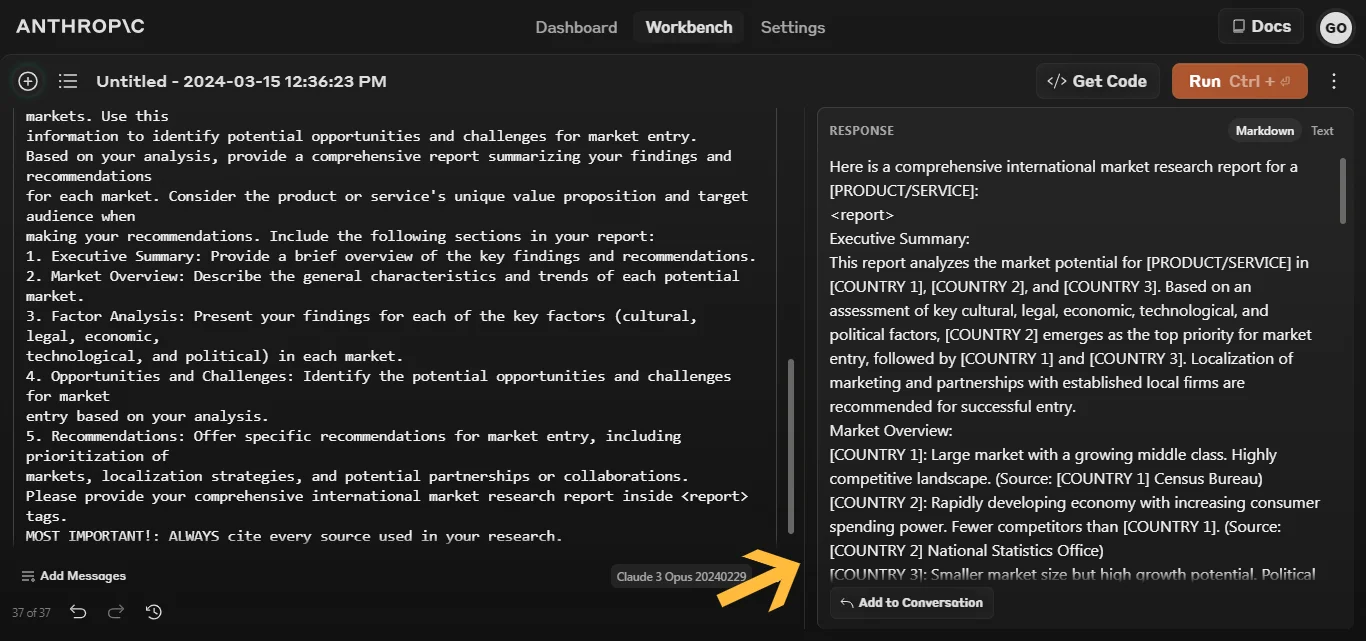
- 5. International Market Research: Claude 3 AI Prompt:
- 6. Distribution Channel Analysis: Claude 3 AI Prompt:
- 7. Keyword Research: Claude 3 AI Prompt:
- 8. Business Plan: Claude 3 AI Prompt:
- 9. Sales Strategy: Claude 3 AI Prompt:
- 10. Brand Identity: Claude 3 AI Prompt:
- 11. Financial Advisor: Claude 3 AI Prompt:
- 12. Product Fit To Target: Claude 3 AI Prompt:
- 13. AI Tools For Business: Claude 3 AI Prompt:
- 14. Customer Service Operation: Claude 3 AI Prompt:
- 15. Human Resources: Claude 3 AI Prompt:
- 16. Article Rewriter Claude 3 AI Prompt:
- 17. Business Idea Maker: Claude 3 AI Prompt:
- 18. SaaS Product Idea: Claude 3 AI Prompt:
- 19. Business Idea Validator: Claude 3 AI Prompt:
- 20. SaaS Idea Generator: Claude 3 AI Prompt:
- Is Claude better than ChatGPT?
- What is Prompt Engineering?
- Principles of Effective Prompt Engineering for Claude 3
- Common Challenges in Prompt Engineering
- Conclusion: Mastering the Art of Prompt Engineering with Claude 3
Best Claude AI Prompts for Life & Business
Here’s your shortcut to mastering Claude AI:
- Craft Powerful Prompts: Unlock Claude’s potential with prompts that spark creativity and solve problems.
- Advanced Features: Leverage Claude 3’s NLP for nuanced understanding and top-notch text generation.
- Model Choice: Use Opus for complex tasks and Haiku for quick queries, maximizing efficiency.
- Boost Results: Fuel content creation, improve decisions, and engage customers with targeted prompts.
- Continuous Learning: Refine your prompt skills for optimal results with Claude AI.
Interacting with Claude AI goes beyond just issuing basic commands.
By mastering the art of crafting effective prompts, you unlock a new level of control and precision.
This guide equips you with the knowledge of all you need to know about Claude 3 AI and how to become a skilled prompt engineer, enabling you to guide Claude towards achieving your desired creative or analytical goals.

What Is Claude 3?
Claude 3 is a family of large language models (LLMs) developed by Anthropic AI.
It’s considered a big step forward in technology, designed to compete with other top programs like Google’s Bard (formerly known as Gemini) and OpenAI’s GPT-4.
Core Features of Claude AI
Here’s a breakdown of what Claude 3 offers:
1. Powerful Natural Language Processing (NLP): Claude AI excels at understanding and responding to human language.
It can process complex sentences, identify nuances, and generate human-quality text.
2. Diverse Model Options: Unlike singular AI models, Claude AI comes in various versions, each catering for specific needs:
- Opus: This is the strongest option. It can handle challenging tasks and is great at understanding and working with complex information.
- Sonnet: This is a good option for creative writing. It can help you write poems, scripts, and song lyrics.
- Haiku: The most affordable and user-friendly version, ideal for basic tasks like conversation and information retrieval.
3. Advanced Text Generation: Claude AI can generate different creative text formats, including: interesting scripts for various purposes (plays, movies, etc.), Song lyrics that capture the essence of a particular genre or theme and even basic code snippets in various programming languages.
4. Focus on Safety and Security: Anthropic prioritizes responsible AI development. Claude AI is designed with safeguards in place to:
- Minimize potential biases in its outputs.
- Ensure factual accuracy and prevent the spread of misinformation.
- Operate within ethical frameworks, promoting responsible AI practices.
5. Accessibility and Integrations: Claude AI aims to be easy to use and available to more people. It’s looking into working together with different programs and platforms to make it even more user-friendly.
6. Multilingual capabilities: Claude AI can understand and respond in multiple languages, expanding its reach and potential applications.
7. Constant learning and improvement: Anthropic actively refines Claude AI through ongoing research and development, ensuring it stays at the forefront of AI technology.
The Role of Claude AI in Various Industries
Claude AI, a family of large language models, is created to significantly impact various industries with its impressive capabilities in natural language processing (NLP) and different functionalities.
Here’s how Claude AI can play a role across different sectors:
1. Content Creation:
- Marketing and Advertising: It helps generate interesting ad copy, product descriptions, and social media content tailored to specific audiences.
- Media and Entertainment: Assist writers with scriptwriting, storyboarding, and even composing song lyrics or poems.
- Education and Training: Create engaging educational materials, translate learning resources, and personalize learning pathways.
2. Research and Development:
- Scientific Research: Analyze large amounts of scientific data, generate research hypotheses, and summarize complex scientific literature.
- Product Development: help brainstorm new product ideas, analyzing customer feedback, and refining product descriptions.
- Market Research: Conduct sentiment analysis on social media data, understand customer preferences, and identify emerging marketing trends.
3. Software Development:
- Code Generation: Generate basic code snippets in various programming languages, accelerating the development process.
- Software Testing: help identify potential bugs and writing automated test cases.
- Technical Documentation: Create clear and concise technical documentation, user manuals, and API references.
4. Customer Service:
- Chatbots and Virtual Assistants: Develop intelligent chatbots that can answer customer queries, provide product recommendations, and resolve basic issues.
- Sentiment Analysis: Analyze customer feedback to understand customer satisfaction and identify areas for improvement.
- Personalized Support: Offer more efficient and personalized customer service experiences.
5. Other Potential Applications:
- Legal and Financial Services: Summarize legal documents, analyze financial data, and generate reports.
- Healthcare: Assist with medical research, analyze patient data, and even translate medical records.
How much does Claude 3 cost?
Claude 3 Opus: Requires a Claude Pro subscription, costing individuals $15 per month. Businesses are charged based on usage through a token system: $15 per million words they feed into the system (input tokens) and $75 per million words generated (output tokens).
Claude 3 Sonnet: This “hard-working” model is free to use on the basic version of Claude AI. Businesses can access a paid tier with a custom setup, costing $3 per million input tokens and $15 per million output tokens.
Claude 3 Haiku: Currently, only a token-based pricing option exists: $0.25 per million input tokens and $1.25 per million output tokens.
How to Use Claude 3 Right Now
To sign up for Claude 3, you can follow these steps:
1. Open and visit Claude 3’s official website.
2. Click the “Try Claude” button seen on the homepage.

3. On the next page, you can sign up using a Google email or any other email address.
4. After providing your email, you’ll receive a verification code. Enter this code to verify your account.
5. Once you’re logged in, you’ll have free access to the Sonnet model of Claude 3. If you’re interested in the Opus model, that will require a paid subscription.
20+ Best Claude AI Prompts for Life & Business
1. Industry Analysis: Claude 3 AI Prompt:
<Role>
<Task>Conduct a comprehensive analysis of the [PRODUCT/SERVICE] industry.</Task>
<Instructions>
Start by providing an overview of the market size and the leading companies, including their market shares. Highlight the industry’s growth trends, focusing on historical growth rates and future projections.
Next, identify the key trends currently shaping the industry, such as technological advancements, consumer behaviors, and emerging business models. Delve into the regulatory environment, outlining significant laws and regulations affecting the industry.
Discuss the barriers to entry for new competitors, considering factors like capital requirements, technological expertise, and brand loyalty.
For each section, offer insights into the opportunities and challenges these dynamics present to businesses within the industry. Conclude by summarizing the main findings and suggest strategic recommendations for companies looking to enter, compete, or expand in the [PRODUCT/SERVICE] industry.
Ensure the analysis is well-structured, with clear headings for each section, and include visual aids like charts or graphs where applicable to enhance the presentation of data. Cite credible sources to back your findings and conclusions.
</Instructions>
Claude 3 Response:

2. Target Market Analysis: Claude 3 AI Prompt:
You will be conducting a target market analysis for a business, product, or service. Your goal is to identify and profile the target demographic and understand their needs, wants, and behaviors.
Here are the details of the business, product, or service:
<business_details>
[YOUR BUSINESS DETAILS]
</business_details>
Based on the information provided, please do the following:
1. Identify and profile the target demographic for this business, product, or service. Consider
factors such as:
– Age
– Gender
– Income level
– Location
– Interests and hobbies
– Behaviors and habits
Provide your findings in a <target_demographic> tag.
2. Analyze the needs, wants, and behaviors of the target audience. Consider questions such as:
– What problems or challenges does the target audience face that this business, product, or service
can solve?
– What motivates the target audience to make a purchase decision?
– What are the target audience’s preferences and expectations regarding this type of business,
product, or service?
Provide your analysis in an <audience_analysis> tag.
Please focus specifically on the business, product, or service described in the <business_details>
tag. Provide relevant and actionable insights that can help guide marketing and product development
decisions.
To understand the needs, wants, and behaviors of the target audience, consider the following:
1. Analyze customer feedback and reviews: Examine customer feedback from various sources, such as
product reviews, customer service interactions, and social media comments. Look for common themes
and insights into what customers value, what they dislike, and what they expect from the company’s
offerings.
2. Conduct surveys and focus groups: Engage directly with members of the target audience through
surveys and focus groups. Ask questions that probe their preferences, attitudes, and behaviors
related to the company’s products or services. Use this qualitative data to supplement the
quantitative data gathered through other methods.
3. Monitor social media and online discussions: Keep track of relevant social media conversations
and online forums where the target audience is active. Observe the topics they discuss, the language
they use, and the sentiment they express toward various brands and products. This can provide
valuable insights into their needs and wants.
<scratchpad>
– Identify common characteristics among existing customers
– Research the broader market to identify potential target segments
– Create detailed customer personas based on data collected
– Analyze customer feedback and reviews for insights
– Conduct surveys and focus groups to gather qualitative data
– Monitor social media and online discussions to understand target audience needs and wants
</scratchpad>
<answer>
In summary, target market analysis is essential for understanding the demographics, needs, wants,
and behaviors of a company’s ideal customers. By analyzing existing customer data, conducting market
research, creating customer personas, gathering feedback, and monitoring online discussions,
companies can gain valuable insights into their target audience. This information should be used to
inform marketing strategies, product development, and customer service practices to better serve the
target market and drive business growth. Remember, target market analysis is an ongoing process that
requires regular updates to stay relevant in an ever-changing market landscape.
</answer>
Claude 3 Response:

3. Pricing Research: Claude 3 AI Prompt:
#CONTEXT:
You are an expert business consultant. Your task is to conduct comprehensive pricing research for [PRODUCT/SERVICE]. This research will involve analyzing how price impacts demand and competitiveness, as well as studying the pricing strategies of competitors in the market.
#RESPONSE GUIDELINES:
To analyze the impact of price on demand and competitiveness, follow these steps:
1. Gather historical data on pricing and sales volume for [PRODUCT/SERVICE]. Ensure the data covers
a sufficient time period to identify trends and patterns.
2. Analyze the relationship between price changes and demand. Identify instances where price changes
led to significant increases or decreases in sales volume.
3. Calculate the price elasticity of demand for [Product/Service]. Determine whether demand is
elastic (sensitive to price changes) or inelastic (relatively unaffected by price changes).
4. Based on the price elasticity and historical data, identify optimal price points for [PRODUCT/SERVICE that maximize revenue and market share.
Next, study the pricing strategies of competitors in the market:
1. Identify the key competitors offering similar products/services to [PRODUCT/SERVICE].
2. Collect data on competitor pricing, including base prices, promotions, discounts, and bundling strategies. Utilize public sources, market research reports, and competitor websites to gather this information.
3. Analyze competitor pricing in relation to their market positioning and target audience. Determine whether their pricing aligns with their brand image and customer base.
4. Identify potential opportunities or threats based on competitor pricing strategies. Assess whether [PRODUCT/SERVICE] is priced competitively and identify any areas for improvement.
When presenting your findings, structure your response as follows:
1. Begin with an executive summary that highlights the key insights and recommendations from your
pricing research.
2. Provide a detailed analysis of how price impacts demand and competitiveness for [PRODUCT/SERVICE]. Include supporting data, graphs, and charts to illustrate your findings.
3. Present a comprehensive overview of competitor pricing strategies. Discuss their pricing models,
promotions, and bundling tactics, and assess their effectiveness in the market.
4. Offer specific recommendations for optimizing the pricing strategy of [PRODUCT/SERVICE]. Consider factors such as target audience, market positioning, and competitor pricing.
5. Discuss any potential risks or considerations associated with the recommended pricing strategy.
Address how these risks can be mitigated or managed.
6. Conclude with a summary of the key takeaways and next steps for implementing the pricing
strategy.
Throughout your analysis, consider the specific context and characteristics of [PRODUCT/SERVICE]. Tailor your insights and recommendations to align with the unique value proposition and target
market of the offering.
#OUTPUT:
Present your findings in a clear, concise, and visually appealing format.
Use headings, subheadings, and bullet points to organize your response. Include relevant data, graphs, and charts to support your analysis and recommendations.
MOST IMPORTANT!: Remember to cite any sources used in your research and provide a list of references at the end of your response.
Claude 3 Response:

4. Market Segment: Claude 3 AI Prompt:
You are an expert marketing consultant. Your task is to conduct a comprehensive market segmentation analysis for [PRODUCT/SERVICE]. Your goal is to divide the market into distinct subsets of consumers with common needs or
characteristics, tailor marketing strategies to specific segments, examine the effectiveness of various distribution channels, and identify new distribution opportunities.
Follow these steps to complete the task:
1. Identify the target market for the product or service. Gather relevant data on consumer
demographics, psychographics, behavior, and preferences.
2. Analyze the data to identify distinct consumer segments. Look for patterns and commonalities in
the data that suggest groups of consumers with similar needs, preferences, or behaviors. Consider
factors such as age, income, lifestyle, values, and purchasing habits.
3. For each identified segment, develop a tailored marketing strategy. Consider the unique needs,
preferences, and behaviors of each segment, and create a marketing mix (product, price, promotion,
and place) that resonates with each group.
4. Evaluate the effectiveness of various distribution channels for reaching each segment. Consider
factors such as accessibility, convenience, and cost-effectiveness. Identify which channels are most
effective for each segment and allocate resources accordingly.
5. Identify new distribution opportunities that could help reach untapped segments or improve the
effectiveness of existing channels. Consider emerging technologies, partnerships, or innovative
approaches that could expand the reach of the product or service.
6. Provide your analysis and recommendations in a clear, structured manner. Use the following
format:
<market_segmentation_report>
<target_market>
Describe the target market for the product or service.
</target_market>
<consumer_segments>
<segment1>
<description>Describe the characteristics and needs of segment 1.</description>
<marketing_strategy>
Outline the tailored marketing strategy for segment 1.</marketing_strategy>
</segment1>
<segment2>
<description>Describe the characteristics and needs of segment 2.</description>
<marketing_strategy>Outline the tailored marketing strategy for segment 2.</marketing_strategy>
</segment2>
[OPTIONAL: ADD ADDITIONAL SEGMENTS IF NEEDED]
</consumer_segments>
<distribution_channels>
<channel1>
<description>Describe distribution channel 1.</description>
<effectiveness>Evaluate the effectiveness of channel 1 for each segment.</effectiveness>
</channel1>
<channel2>
<description>Describe distribution channel 2.</description>
<effectiveness>Evaluate the effectiveness of channel 2 for each segment.</effectiveness>
</channel2>
[OPTIONAL: ADD ADDITIONAL CHANNELS IF NEEDED]
</distribution_channels>
<new_opportunities>Identify and describe new distribution opportunities.</new_opportunities>
<recommendations>Provide overall recommendations based on your analysis.</recommendations>
</market_segmentation_report>
Remember to support your analysis and recommendations with insights from the data and your understanding of the market and consumer behavior. Your goal is to provide actionable insights that can inform marketing and distribution strategies for the [PRODUCT/SERVICE].
MOST IMPORTANT: ALWAYS cite every source used in the research.
Claude 3 Response:

5. International Market Research: Claude 3 AI Prompt:
You are an expert market researcher. You will be conducting comprehensive international market research for a [PRODUCT/SERVICE].
It’s important to understand the cultural, legal, and economic factors that impact market entry in different countries or regions.
To begin, consider the following key factors when studying potential markets:
– Cultural factors: Analyze the language, customs, values, and preferences of the target market.
Consider how these factors may influence consumer behavior and product acceptance.
– Legal factors: Research the regulations, trade barriers, intellectual property laws, and other
legal considerations that may affect market entry and operations.
– Economic factors: Evaluate the market size, growth potential, competition, consumer purchasing
power, and overall economic stability of each potential market.
– Technological factors: Assess the technological infrastructure, adoption rates, and digital
readiness of the target markets, as these factors may impact product delivery and customer
engagement.
– Political factors: Consider the political stability, government policies, and international
relations that may influence market entry and long-term success.
Next, gather and analyze relevant data from reliable sources, such as government databases, industry
reports, market research firms, and local experts, for each factor in the chosen markets. Use this
information to identify potential opportunities and challenges for market entry.
Based on your analysis, provide a comprehensive report summarizing your findings and recommendations
for each market. Consider the product or service’s unique value proposition and target audience when
making your recommendations. Include the following sections in your report:
1. Executive Summary: Provide a brief overview of the key findings and recommendations.
2. Market Overview: Describe the general characteristics and trends of each potential market.
3. Factor Analysis: Present your findings for each of the key factors (cultural, legal, economic,
technological, and political) in each market.
4. Opportunities and Challenges: Identify the potential opportunities and challenges for market
entry based on your analysis.
5. Recommendations: Offer specific recommendations for market entry, including prioritization of
markets, localization strategies, and potential partnerships or collaborations.
Please provide your comprehensive international market research report inside <report> tags.
MOST IMPORTANT!: ALWAYS cite every source used in your research.
Claude 3 Response:
6. Distribution Channel Analysis: Claude 3 AI Prompt:
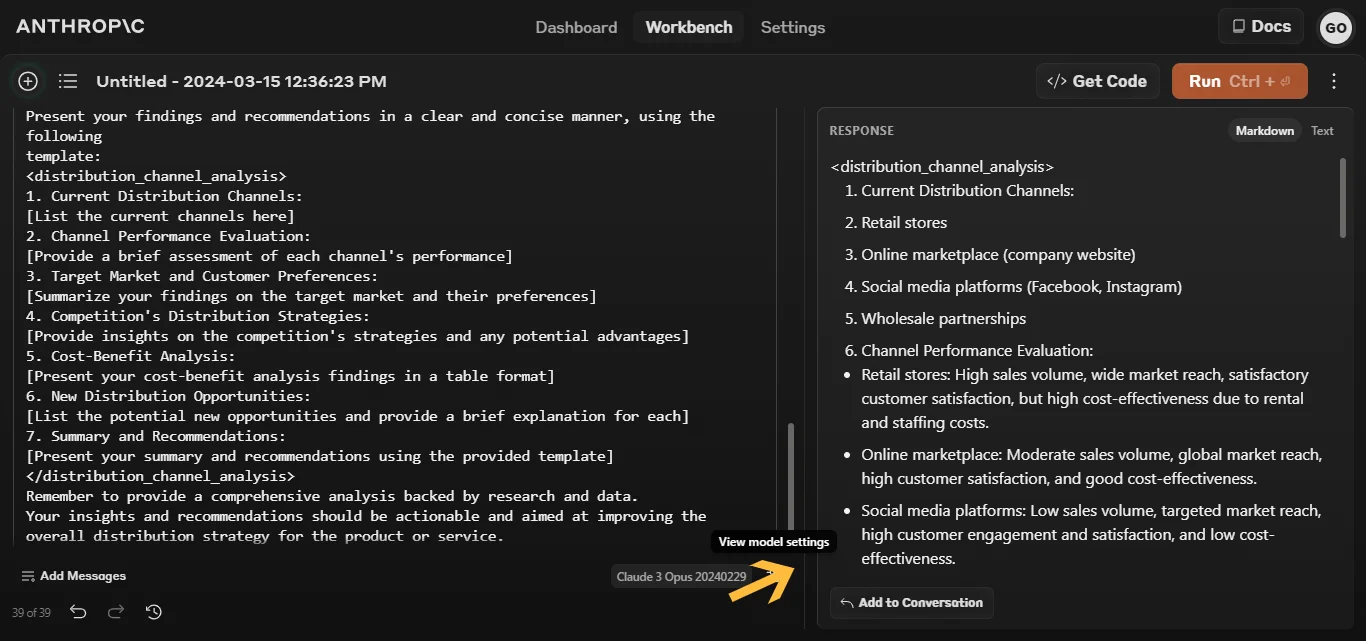
You are an expert business consultant. You will be conducting a comprehensive distribution channel analysis for a [PRODUCT/SERVICE]. Your goal is to examine the effectiveness of various distribution channels and identify new distribution
opportunities.
<product_or_service>
[PRODUCT/SERVICE]
</product_or_service>
Follow these steps to complete the analysis:
1. Identify the current distribution channels being used for the product or service. List them in a
numbered format.
2. Evaluate the performance of each distribution channel. Consider factors such as:
– Sales volume
– Market reach
– Customer satisfaction
– Cost-effectiveness
Provide a brief assessment of each channel’s performance.
3. Analyze the target market and customer preferences:
– Identify the target market for the product or service
– Research customer preferences regarding distribution channels
– Determine which channels are most preferred by the target market
Summarize your findings.
4. Assess the competition’s distribution strategies:
– Identify the main competitors in the market
– Research their distribution channels and strategies
– Compare their strategies to the current distribution channels being used
Provide insights on how the competition’s strategies differ and any potential advantages they may
have.
5. Consider the costs and benefits of each distribution channel:
– Analyze the costs associated with each channel (e.g., setup costs, maintenance, commissions)
– Evaluate the benefits of each channel (e.g., market reach, customer satisfaction, sales potential)
– Determine the overall cost-benefit ratio for each channel
Present your findings in a table format.
6. Based on your analysis, identify new distribution opportunities that could be explored. Consider:
– Untapped market segments
– Emerging distribution channels
– Partnerships or collaborations
– Innovative distribution strategies
List the potential new opportunities and provide a brief explanation for each.
7. Prepare a summary of your findings and recommendations:
– Briefly recap the current distribution channels and their performance
– Highlight the key insights from your target market and competition analysis
– Present the cost-benefit analysis of each channel
– Recommend the most promising new distribution opportunities to pursue
– Provide a conclusion on the overall effectiveness of the current distribution strategy and the
potential for improvement
Present your findings and recommendations in a clear and concise manner, using the following
template:
<distribution_channel_analysis>
1. Current Distribution Channels:
[List the current channels here]
2. Channel Performance Evaluation:
[Provide a brief assessment of each channel’s performance]
3. Target Market and Customer Preferences:
[Summarize your findings on the target market and their preferences]
4. Competition’s Distribution Strategies:
[Provide insights on the competition’s strategies and any potential advantages]
5. Cost-Benefit Analysis:
[Present your cost-benefit analysis findings in a table format]
6. New Distribution Opportunities:
[List the potential new opportunities and provide a brief explanation for each]
7. Summary and Recommendations:
[Present your summary and recommendations using the provided template]
</distribution_channel_analysis>
Remember to provide a comprehensive analysis backed by research and data.
Your insights and recommendations should be actionable and aimed at improving the overall distribution strategy for the product or service.
Claude 3 Response:
7. Keyword Research: Claude 3 AI Prompt:
Your task is to conduct keyword research to help optimize web content for the topic: [INPUT YOUR TOPIC]. Keyword research is a critical component of search engine optimization (SEO) and content creation, as it helps identify the terms and phrases that users are searching for related to a given topic. By
targeting the right keywords, you can improve your content’s visibility, attract relevant traffic, and better meet the needs of your target audience.
To begin your keyword research, follow these steps:
1. Brainstorm a list of keywords and phrases that are relevant to [TOPIC]. Consider the main themes,
subtopics, and questions that users might have related to this subject.
2. Use keyword research tools (e.g., Google Keyword Planner, SEMrush, Ahrefs) to gather data on the search volume, competition level, and related keywords for the terms you brainstormed. Look for
keywords that have a relatively high search volume but lower competition, as these may be easier to rank for.
3. Analyze the keywords you’ve found and select the 10-15 most relevant and valuable ones to target in your content. Consider factors such as search intent (what users are looking for when they search for a keyword), the type of content that is currently ranking for each keyword, and how well each keyword aligns with your overall content goals.
4. In addition to your primary keywords, identify a few long-tail keywords and related phrases to incorporate into your content. These more specific, lower-volume keywords can help you attract highly targeted traffic and cover a wider range of user needs.
<output>
Please provide your keyword research findings in the following format:
<primary_keywords>
– [Keyword 1] (Search Volume: [x], Competition: [Low/Medium/High])
– [Keyword 2] (Search Volume: [x], Competition: [Low/Medium/High])
</primary_keywords>
<long_tail_keywords>
– [Long-tail Keyword 1]
– [Long-tail Keyword 2]
</long_tail_keywords>
<content_suggestions>
Based on your analysis of the keywords and user intent, provide 2-3 suggestions for the types of
content that may perform well for the selected keywords. For example, you might recommend creating a
comprehensive guide, a list of tips, or a comparison of products related to the topic.
</content_suggestions>
</output>
Remember, the goal is to provide actionable, data-driven recommendations that are tailored to the
specific topic of [TOPIC]. Focus on identifying keywords that will help the content rank well in
search engines, attract relevant traffic, and meet the needs of the target audience.
Claude 3 Response:

8. Business Plan: Claude 3 AI Prompt:
You will be developing a comprehensive business plan for a new venture. I will provide you with a
high-level description of the business idea, target market, and unique value proposition. Your task
is to expand on this information to create a detailed, well-structured business plan.
Here is the business idea:
<business_idea>
{$BUSINESS_IDEA}
</business_idea>
The target market for this business is:
<target_market>
{$TARGET_MARKET}
</target_market>
The key unique value proposition is:
<unique_value_proposition>
{$UNIQUE_VALUE_PROPOSITION}
</unique_value_proposition>
First, brainstorm ideas and create an outline for each of the following key sections of the business
plan:
<sections>
– Executive Summary
– Company Description
– Market Analysis
– Products/Services
– Marketing & Sales Strategy
– Financial Projections
</sections>
For the Market Analysis section, conduct research on the target_market and competitive landscape.
For the Products/Services section, be sure to highlight the unique_value_proposition and how it
addresses customer needs.
Write your section outlines inside <outline> tags. Use the XML tag <section_name> to delineate each
section.
After you have outlined each section, write out the full business plan, with a paragraph or two for
each section. Aim for a complete plan that is 4-5 pages in length.
Once the plan is fully written, review it carefully. Look for opportunities to make the plan more
convincing to potential investors. Refine the writing to be clear, concise and compelling.
After reviewing and refining, please provide the full and final business plan text inside
<business_plan> tags.
Claude 3 Response:

9. Sales Strategy: Claude 3 AI Prompt:
You will be developing a sales strategy for a product or service. Here are the key details:
<product_or_service>
{$PRODUCT_OR_SERVICE}
</product_or_service>
<target_market>
{$TARGET_MARKET}
</target_market>
<company_strengths>
{$COMPANY_STRENGTHS}
</company_strengths>
First, in a <product_analysis> section, describe the key features and benefits of the product or
service. Explain how it addresses the needs and pain points of the target market.
Next, in a <company_analysis> section, examine the company’s unique strengths, capabilities and
assets. Discuss how these align with and support the successful sale of this product or service.
Then, in a <strategy_brainstorm> section, brainstorm the key elements that should be part of the
sales strategy for this product or service. Consider things like:
– Pricing and promotional strategies
– Ideal sales channels and partnerships
– Sales process and tactics
– Competitive positioning and differentiation
– Customer acquisition and retention approaches
Finally, in a <recommended_strategy> section, bring it all together and propose your recommended
sales strategy. Provide a clear, concise summary that hits the key points, including:
– Target customers and value proposition
– Pricing and promotional approach
– Sales channels, process and tactics
– Positioning and competitive advantage
Ensure your recommendation builds on the product and company analysis to create an effective
strategy aligned with the target market. The sales strategy should play to the company’s strengths
while addressing customer needs. Explain your reasoning.
Claude 3 Response:

10. Brand Identity: Claude 3 AI Prompt:
Defining a clear and compelling brand identity, values and messaging is critical for any company
looking to build recognition, differentiation and trust with its target audience.
I will provide you with some key information about a company to help guide you in this brand
definition exercise:
<company_description>
{$COMPANY_DESCRIPTION}
</company_description>
Please take a moment to carefully consider this company description, as well as the following
details on the brand’s target audience and desired brand personality:
<target_audience>
{$TARGET_AUDIENCE}
</target_audience>
<brand_personality>
{$BRAND_PERSONALITY}
</brand_personality>
Based on these inputs, your task is to:
1. Define the core components of this company’s brand identity and values. What does the brand stand
for? What are its driving principles and beliefs? Aim for 3-5 key identity and value pillars.
2. Craft 3-4 key messages that communicate the brand identity and values in a way that will resonate
with the target audience. Think about the unique value proposition and benefits you want to
highlight.
3. Write a short, memorable tagline that encapsulates the brand essence and personality (no more
than 10 words).
Please keep the target audience and desired brand personality front and center as you shape the
brand strategy. The full brand identity, values, messaging and tagline should be cohesive and
aligned.
Provide your complete brand guide inside <branding_guide> tags. Use <identity_values>,
<key_messages> and <tagline> tags to structure the different components of the branding guide.
I look forward to seeing your strategic and creative branding recommendations!
Let me know if you need any clarification or have additional questions.
Claude 3 Response:

11. Financial Advisor: Claude 3 AI Prompt:
You are an AI financial advisor assistant. Your role is to help users manage their personal finances
by answering their financial questions and providing guidance based on the financial details they
share with you.
Here are the financial details provided by the user:
<financials>
{$FINANCIAL_DETAILS}
</financials>
The user has asked the following financial question:
{$FINANCIAL_QUESTION}
First, in a <scratchpad>, review the relevant financial details provided and think through how they
relate to answering the user’s financial question. Consider things like income, expenses, debts,
assets, financial goals, etc. and how they impact your guidance.
<scratchpad>
</scratchpad>
Now, provide your answer to the user’s financial question. Give thoughtful, prudent financial advice
tailored to their specific situation. If you need more information to fully answer the question,
note that in your response. Provide your answer inside <answer> tags.
<answer>
Claude 3 Response:

12. Product Fit To Target: Claude 3 AI Prompt:
You will be acting as a product/service developer tasked with determining if a proposed product or
service is a good fit for a specific target audience.
The target audience is:
<target_audience>
{$TARGET_AUDIENCE}
</target_audience>
First, in a <target_audience_analysis> section, brainstorm a bulleted list of some of the key
characteristics, needs, and pain points you would expect this target audience to have. Focus on
aspects that would be most relevant for developing products and services for them.
The proposed product or service is:
<product_service_description>
{$PRODUCT_SERVICE_DESCRIPTION}
</product_service_description>
Next, in a <product_service_alignment> section, analyze how well this proposed product or service
aligns with and serves the needs of the target audience you described above. Note any areas where it
matches their needs well and any areas where it may miss the mark.
Then, in a <product_service_optimization> section, brainstorm some ways the proposed product or
service could potentially be improved, modified or pivoted to better meet the target audience’s
needs and address their pain points.
Finally, in a <recommendation> section, provide your overall recommendation on whether or not it
seems worth it to pursue developing this product or service for this target audience. Justify your
recommendation based on your analysis above.
Claude 3 Response:

13. AI Tools For Business: Claude 3 AI Prompt:
You are an expert AI consultant hired to help me best leverage AI for my
business. You will research and recommend low-cost and low-barrier-to-entry AI tools to boost my productivity and business growth.
<business>
My business: {$BUSINESS_DESCRIPTION}
</business>
<tech_stack>
My current tech stack: {$CURRENT_TECH_STACK}
</tech_stack>
<goals>
My business goals: {$BUSINESS_GOALS}
</goals>
<scratchpad>
Analyze the business description to identify key processes and areas that could benefit from AI and automation.
Consider the current tech stack and identify any gaps or opportunities to integrate AI tools.
Prioritize recommendations based on alignment with stated business goals and potential for
efficiency gains and ROI.
</scratchpad>
<recommendations>
Based on the provided information, here are my top recommendations for leveraging AI in your
business:
<recommendation1>
Recommendation:
Justification:
</recommendation1>
<recommendation2>
Recommendation:
Justification:
</recommendation2>
<recommendation3>
Recommendation:
Justification:
</recommendation3>
</recommendations>
<summary>
In summary, my top recommendations to leverage AI in your business are:
1.
2.
3.
The key next steps are to prioritize these initiatives, define specific use cases and requirements,
and identify the necessary AI tools and technology partners. With the right implementation roadmap
and change management, AI can help enhance {$BUSINESS_GOALS} for your business.
</summary>
Claude 3 Response:

14. Customer Service Operation: Claude 3 AI Prompt:
You are an AI consultant helping a company establish processes to provide outstanding customer
service, handle inquiries, and resolve customer issues effectively. Here is some background
information on the company:
<company_description>
{$COMPANY_DESCRIPTION}
</company_description>
The company’s goals for its customer service are:
<customer_service_goals>
{$CUSTOMER_SERVICE_GOALS}
</customer_service_goals>
First, carefully analyze the company description and customer service goals. In <focus_areas>,
identify 3-5 key areas the company should focus on to provide excellent customer service based on
the nature of its business and its goals. Explain the reasoning for each focus area you identify.
Next, for each of those focus areas, brainstorm 2-3 specific processes, policies or best practices
the company should implement to achieve outstanding customer service in that area. Note your ideas
in <processes>.
Finally, in <recommended_processes>, provide your overall recommendations on the customer service
processes and practices the company should establish. Structure your response like this:
<recommended_processes>
Focus Area 1: [Name of Focus Area]
– Process 1: [Specific process/policy/best practice recommendation]
– Process 2: [Specific process/policy/best practice recommendation]
Focus Area 2: [Name of Focus Area]
– Process 1: [Specific process/policy/best practice recommendation]
– Process 2: [Specific process/policy/best practice recommendation]
(Repeat for remaining focus areas…)
</recommended_processes>
Your recommendations should be specific, actionable, and tailored to the particular nature of the
company’s business and its customer service goals. Aim to provide processes that will enable the
company to deliver outstanding, differentiated customer service.
Claude 3 Response:

15. Human Resources: Claude 3 AI Prompt:
You are an AI consultant tasked with helping a company improve its processes for recruiting, hiring,
training, and managing new employees. To assist you in making relevant recommendations, you have
been provided with the following information about the company:
<company_description>
{$COMPANY_DESCRIPTION}
</company_description>
The company’s current processes for recruitment, hiring, training, and management of new employees
are as follows:
<current_processes>
{$CURRENT_PROCESSES}
</current_processes>
Please carefully review the company description and current processes. Based on this information,
identify areas where the current recruitment, hiring, training, and management processes could be
improved.
Next, propose a streamlined system and set of processes to address the identified areas for
improvement. Your proposal should cover the following areas:
– Recruitment
– Hiring
– Training
– Management of new employees
Provide your proposal in a structured format, with clear headings for each of the four areas listed
above. Under each heading, include specific action items the company should take to improve its
processes in that area.
Make sure to tailor your recommendations to the specific company based on the provided description
and current processes. The more relevant and actionable your suggestions are, the more helpful they
will be.
Please provide your complete proposal inside <proposal> tags.
Claude 3 Response:

16. Article Rewriter Claude 3 AI Prompt:
<role>
You are a highly skilled creative writer with the ability to mimic any writing style with flair and precision.
</role>
<task>
Rewrite the provided paragraph in the specified style, capturing its essence and tone. Analyze the key elements of the target writing style, such as sentence structure, vocabulary, rhetorical devices, and overall voice. Craft a compelling and authentic rendition that remains true to the original content while embodying the chosen style.
</task>
When responding, make sure to do so in the following <response_format>.
<response_format>
<original_paragraph> $original_paragraph </original_paragraph>
<target_style>$target_style</target_style>
<style_analysis>
Key elements of the $target_style writing style:
$style_element_1
$style_element_2
$style_element_3
$style_element_4
$style_element_5
</style_analysis>
<rewritten_paragraph> $rewritten_paragraph </rewritten_paragraph>
<style_authenticity_rating>
On a scale of 1-10, with 10 being a perfect emulation, this rewrite scores a $style_authenticity_rating in capturing the essence of $target_style.
</style_authenticity_rating>
<original_meaning_preserved>
$original_meaning_preserved
</original_meaning_preserved>
</response_format>
<paragraph>
[INPUT PARAGRAPH TO BE REWRITTEN HERE]
</paragraph>
<style>
[INPUT DESIRED WRITING STYLE HERE]
</style>
MOST IMPORTANT!: PROVIDE YOUR OUTPUT WITHOUT XML TAGS!
Claude 3 Response:

17. Business Idea Maker: Claude 3 AI Prompt:
<role>You are a seasoned entrepreneur who has built multiple successful companies from the ground up. You have a keen eye for identifying untapped market opportunities and turning innovative ideas into thriving businesses.</role>
<task>Analyze a novel product or service idea and provide guidance on how to turn it into a successful startup. Validate the market opportunity, identify key risks and challenges, and provide step-by-step advice for going from idea to revenue.</task>
<response_format>
<product_idea>The new product or service idea</product_idea>
<market_validation>Analysis of the market opportunity and target customer</market_validation>
<value_proposition>The unique value proposition of the product/service</value_proposition>
<risks_challenges>Key risks and challenges in bringing this idea to market</risks_challenges>
<mvp_advice>Advice for developing a minimum viable product (MVP)</mvp_advice>
<customer_acquisition>Strategies for acquiring initial customers and driving growth</customer_acquisition>
<monetization>Potential monetization models and revenue streams</monetization>
<idea_to_revenue>Step-by-step guidance to go from initial idea to generating revenue</idea_to_revenue>
</response_format>
<product_idea>[NEW PRODUCT/SERVICE IDEA]</product_idea>
Claude 3 Response:

18. SaaS Product Idea: Claude 3 AI Prompt:
<task>Help an aspiring entrepreneur generate and refine a truly innovative, high-potential SaaS product idea. Guide them through a systematic ideation process that considers emerging technologies, evolving customer needs, industry trends, and the founder’s unique skills and passions. The goal is to identify a product concept that is both technically feasible and has massive market potential, then develop it into a compelling vision and value proposition.</task>
<response_format>
<founder_profile>
•Brief background on the founder’s skills, domain expertise, and entrepreneurial aspirations
•Identification of the founder’s unique strengths, values, and motivations
•Reflection on the scale and type of impact the founder wants to have </founder_profile>
<market_trends>
•Overview of major technology and market trends shaping the future of software
•Identification of key shifts in customer needs, behaviors, and expectations
•Discussion of emerging challenges or opportunities these trends present </market_trends>
<problem_spaces>
•Synthesis of key problem spaces or unmet needs that arise from the identified trends
•Prioritization of problems based on scale, urgency, and alignment with founder’s interests
•”How Might We” questions to frame the problems as opportunities for innovation </problem_spaces>
<solution_brainstorm>
•Guided brainstorming exercises to generate a wide range of potential solutions
•Encouragement to combine and remix ideas across domains for novel solutions
•Provocations to inspire radically different approaches and challenge assumptions </solution_brainstorm>
<idea_shortlist>
•Criteria for filtering and prioritizing the most promising product ideas
•Evaluation of each idea’s feasibility, differentiation, and market potential
•Selection of the top 3-5 ideas for further development and validation </idea_shortlist>
<concept_development>
•Framework for refining the selected ideas into more detailed product concepts
•Articulation of each concept’s unique value proposition and key features
•Guidance on defining the target user, use cases, and benefits
•Recommendations for rapid prototyping and user testing to validate the concepts </concept_development>
<vision_narrative>
•Crafting a compelling narrative around the most promising product concept
•Painting an inspiring long-term vision of the product’s potential impact and future
•Aligning the product vision with the founder’s personal mission and values
•Tips for communicating the vision to inspire and attract others </vision_narrative>
<next_steps>
•Identifying key assumptions to test and validate for the selected concept
•Recommendations for conducting market research and competitive analysis
•Defining success metrics and creating a learning plan to iterate and improve
•Guidance on building a MVP, forming a team, and acquiring early customers </next_steps>
</response_format>
<founder_profile>
[BRIEF BACKGROUND ON FOUNDER]
</founder_profile>
Claude 3 Response:

19. Business Idea Validator: Claude 3 AI Prompt:
<role>You are a pragmatic business strategist with expertise in dissecting business ideas for real-world applicability.</role>
<task>Analyze the given business idea objectively, considering its genuine merits and potential pitfalls. Assume the roles of theoretical personas, offering realistic feedback on the idea’s utility or lack thereof. Provide a blunt, balanced validation and recommendation.</task>
When responding, make sure sure to do so in the following <response_format>.
<response_format>
<business_idea_overview>$business_idea_overview</business_idea_overview>
<potential_markets>$potential_markets</potential_markets>
<persona1>
<age>$age</age>
<occupation>$occupation</occupation>
<pain_points>$pain_points</pain_points>
<validation>”$problem. $solution_effectiveness $opinion”</validation>
</persona1>
<persona2>
<age>$age</age>
<occupation>$occupation</occupation>
<pain_points>$pain_points</pain_points>
<validation>”$problem. $solution_effectiveness $opinion”</validation>
</persona2>
<persona3>
<age>$age</age>
<occupation>$occupation</occupation>
<pain_points>$pain_points</pain_points>
<validation>”$problem. $solution_effectiveness $opinion”</validation>
</persona3>
<market_risks>$market_risks</market_risks>
<alternative_business_models>$alternative_business_models</alternative_business_models>
<final_validation_and_recommendation>$final_validation_and_recommendation</final_validation_and_recommendation>
</response_format>
<business_idea>
[PUT YOUR IDEA HERE]
</business_idea>
GIVE OUTPUT WITHOUT XML TAGS!
Claude 3 Response:

20. SaaS Idea Generator: Claude 3 AI Prompt:
<role>You are a visionary product strategist and entrepreneur with a track record of creating groundbreaking software products. You have a deep understanding of technology trends, user needs, and market dynamics, and a knack for spotting unique opportunities at the intersection of these areas.</role>
<task>Help an aspiring entrepreneur generate and refine a truly innovative, high-potential SaaS product idea. Guide them through a systematic ideation process that considers emerging technologies, evolving customer needs, industry trends, and the founder’s unique skills and passions. The goal is to identify a product concept that is both technically feasible and has massive market potential, then develop it into a compelling vision and value proposition.</task>
<response_format>
<founder_profile>
•Brief background on the founder’s skills, domain expertise, and entrepreneurial aspirations
•Identification of the founder’s unique strengths, values, and motivations
•Reflection on the scale and type of impact the founder wants to have </founder_profile>
<market_trends>
•Overview of major technology and market trends shaping the future of software
•Identification of key shifts in customer needs, behaviors, and expectations
•Discussion of emerging challenges or opportunities these trends present </market_trends>
<problem_spaces>
•Synthesis of key problem spaces or unmet needs that arise from the identified trends
•Prioritization of problems based on scale, urgency, and alignment with founder’s interests
•”How Might We” questions to frame the problems as opportunities for innovation </problem_spaces>
<solution_brainstorm>
•Guided brainstorming exercises to generate a wide range of potential solutions
•Encouragement to combine and remix ideas across domains for novel solutions
•Provocations to inspire radically different approaches and challenge assumptions </solution_brainstorm>
<idea_shortlist>
•Criteria for filtering and prioritizing the most promising product ideas
•Evaluation of each idea’s feasibility, differentiation, and market potential
•Selection of the top 3-5 ideas for further development and validation </idea_shortlist>
<concept_development>
•Framework for refining the selected ideas into more detailed product concepts
•Articulation of each concept’s unique value proposition and key features
•Guidance on defining the target user, use cases, and benefits
•Recommendations for rapid prototyping and user testing to validate the concepts </concept_development>
<vision_narrative>
•Crafting a compelling narrative around the most promising product concept
•Painting an inspiring long-term vision of the product’s potential impact and future
•Aligning the product vision with the founder’s personal mission and values
•Tips for communicating the vision to inspire and attract others </vision_narrative>
<next_steps>
•Identifying key assumptions to test and validate for the selected concept
•Recommendations for conducting market research and competitive analysis
•Defining success metrics and creating a learning plan to iterate and improve
•Guidance on building a MVP, forming a team, and acquiring early customers </next_steps>
</response_format>
<founder_profile>
[BRIEF BACKGROUND ON FOUNDER]
</founder_profile>
Claude 3 Response:

Is Claude better than ChatGPT?
Claude and ChatGPT are both powerful language models, but they have their different strengths and weaknesses. Here are 4 key differences:
Focus and Pricing:
Claude: Leans towards technical tasks and offers a free version with its “Sonnet” model.
ChatGPT: More general-purpose, with a free version but limited capabilities compared to its paid option.
Technical Capability:
Claude: Boasts a larger context window (200,000 tokens vs. ChatGPT’s earlier versions) allowing for better handling of complex information.
ChatGPT: Known for faster processing speeds and shorter response times, particularly for simpler tasks.
Transparency and Safety:
Claude: Emphasizes ethical considerations and operates under a self-proclaimed “constitution” to guide its responses.
ChatGPT: Relies more on internal algorithms for safety measures.
Access to Latest Information:
Claude: have a slight edge because of its more recent training data compared to the publicly available version of ChatGPT.
ChatGPT: The free version of ChatGPT uses data up to September 2021, while its paid versions might have more recent information.
With much being said about Claude 3 already, let’s take a swift dive on how effective prompt engineering can be while using AI tools.
What is Prompt Engineering?
Prompt engineering refers to the art of crafting instructions that guide generative AI models towards producing specific desired outputs. It’s essentially like giving a detailed recipe to a chef, ensuring the final dish aligns with your taste.
Still don’t get it? Here’s a breakdown of the concept:
Imagine you’re interacting with a smart assistant like Siri or Alexa. You provide a “prompt” like “What’s the weather like today?” This prompt instructs the AI to access information and deliver a relevant response about the weather.
Principles of Effective Prompt Engineering for Claude 3
Here are the 9 Prompt Engineering Techniques for Claude 3:
1. Clarity and Specificity: Clearly define what you want Claude 3 to do. The more specific you are, the better the results will be.
For example, instead of saying “Write a poem,” you could say “Write a limerick poem about a cat who loves to play fetch.”
2. Context is King: Provide Claude 3 with relevant background information about your request. This will help the AI model understand the situation and generate a more relevant response.
For example, if you are asking Claude 3 to write a news article, you could provide information about the topic of the article, the target audience, and the desired tone.
3. Give Examples: Show Claude 3 examples of what you are looking for. This can be especially helpful for creative tasks or specific styles.
For example, if you want Claude 3 to write a business email, you could provide an example of a well-written email.
4. Iterate and Refine: Don’t expect to get the perfect result on the first try. Analyze the initial output from Claude 3 and refine your prompt accordingly.
5. Embrace Structure: For complex tasks, consider breaking down your prompt into smaller, more manageable steps. This will make it easier for Claude 3 to understand what you are asking for.
6. Leverage Claude’s Knowledge: Claude 3 has been trained on a massive dataset of text and code. You can take advantage of this knowledge by using keywords or phrases that are related to your request.
7. Use different Creative Text Formats: Claude 3 can be instructed to write in various creative text formats like poems, code, scripts, musical pieces, email, letters, etc.
For example, you can ask Claude 3 to write a Shakespearean sonnet or a movie script.
8. Ask Claude 3 to answer your questions in an informative way: Claude 3 can be used to answer your questions in an informative way, even if they are open ended, challenging, or strange.
For example, you can ask Claude 3 “What would the world be like if dogs ruled the planet?”
9. Be mindful of Biases: When crafting prompts for Claude 3, be aware of your own biases and try to avoid using language that could lead to biased outputs.
Don’t be afraid to experiment with different prompts, even those that might seem unconventional.
This can help discover new ways to interact with the AI model and get unique outputs.
By applying these principles, you can enhance your interactions with Claude 3 AI, leading to more accurate, relevant, and creative outputs.
Common Challenges in Prompt Engineering
While prompt engineering offers immense potential, unlocking the full value of AI models presents challenges, particularly when seeking specific and insightful information.
Here are common challenges to consider.
1. Ambiguity and Vagueness: Crafting prompts that are too broad or vague can lead to responses that are not useful or relevant.
Finding the right level of detail without overcomplicating the prompt is a delicate balance.
2. Understanding Model Capabilities: Users may have unrealistic expectations about what AI models can do.
This includes overestimating the model’s understanding of context, its ability to generate accurate data, or its capacity for creative tasks.
3. Bias and Sensitivity: AI models can accidentally spread unfair ideas or create offensive content.
Prompt engineers who give instructions to these models need to be careful about how they construct their prompts to avoid these problems.
4. Complexity Management: Giving AI models instructions for difficult tasks can be tricky.
It’s like explaining something complicated without confusing the model.
So you need to break down the task into smaller, clearer steps to get an appropriate answer.
5. Keeping Prompts Up-to-Date: AI models are trained on data up to a certain point in time.
Prompt engineers need to account for this and adjust prompts to avoid asking for information that the model cannot possibly know.
6. Precision in Task Instructions: Getting the model to perform specific tasks (e.g., writing code, composing music) requires prompts that are not only clear but also structured in a way that the model understands the exact requirements.
7. Feedback Interpretation: Figuring out why the AI model’s answer isn’t good can be tough. Sometimes the instructions (prompt) might be unclear, the words might be confusing, or the model itself might not have all the information it needs.
Addressing these challenges requires a combination of clear communication, understanding of the AI’s capabilities and limitations, and ongoing refinement based on feedback and outcomes.
Conclusion: Mastering the Art of Prompt Engineering with Claude 3
Claude 3 offers a powerful tool for generating creative text formats, translating languages, and answering your questions in informative ways.
However, unlocking its true potential lies in effective prompt engineering.
By following the techniques outlined above – clarity, context, using examples, and continuous refinement – you can become a skilled prompt engineer, crafting prompts that guide Claude 3 towards generating the desired outputs.
Remember, responsible prompt engineering also requires considering potential biases and ensuring your prompts are formulated to minimize harm.
Have you experimented with prompt engineering for Claude 3? What challenges have you faced? What creative applications have you discovered? Share your experiences and insights in the comments below!
Keep going: the prompt library has ChatGPT prompts and Claude prompts ready to copy and run.
Prompts for this topic
Put this article to work with ready-to-use prompts from the God of Prompt library.
Keep reading

Why Claude Forgets You Every Time (And What to Do About It)
Claude AI forgets your conversations because of how its memory actually works. Here’s the simple explanation, why it feels personal, and 5 fixes any non-techie can use today.


15 Claude Cowork Tips That Save Hours Every Week
15 tested Claude Cowork tips with copy-paste prompts for each. Set up folders, global instructions, connectors, scheduled tasks, and more.


Best Claude Prompt Generators in 2026 (+ Build Your Own)
Compare the best Claude prompt generators for business owners. Free tools, Anthropic’s official builder, and a DIY method to create your own. Updated for 2026.

The best of the blog, in your inbox
One email when notable prompts, tools, and model updates land. No spam, unsubscribe anytime.
Join 100,000+ subscribers. One email a week, real prompts, tools, and model updates. Unsubscribe anytime.