Simple Professional Prompt Collections for AI Beginners
Use curated AI prompt collections to save time and produce consistent, professional outputs for writing, marketing, teaching, and daily business tasks.


On this page
- ChatGPT Prompt Engineering for Beginners | AI Step-by-Step Tutorial | No Experience Required
- Beginner-Friendly Prompt Collections
- Practical Benefits of Using Prompt Collections
- 1. Business Productivity
- Simplifying Daily Operations with Ready-to-Use Prompts
- 2. Marketing Strategies
- Crafting High-Impact Marketing Copy with AI Prompts
- 3. Educational Tools
- Streamlining Lesson Planning and Assessment Creation
- 4. Creative Content Generation
- Bringing Personal Style to AI-Generated Stories and Visual Content
- Prompt Implementation Tips
- Conclusion
- FAQs
- What’s the best way for beginners to use AI prompt collections to be more productive?
- What are the advantages of using pre-designed AI prompts for creative tasks?
- How can prompt collections make lesson planning easier for educators?
- Related Blog Posts
AI prompts simplify tasks for beginners by providing ready-to-use templates for tools like ChatGPT, Claude, and MidJourney. These collections help with writing, productivity, and even education. For example:
- Amelia Roberts introduced a "Prompt Generator" in August 2025, creating tailored prompts for tasks like budgeting or meal planning.
- Mukundan Sankar launched "Tiny AI Prompts", offering 20+ reusable templates for productivity and focus.
- God of Prompt provides over 1,000 free prompts and premium bundles with 30,000+ prompts for business, marketing, and creative tasks.
Using pre-tested prompts saves time, improves output quality, and removes the guesswork. Whether drafting emails, planning lessons, or creating marketing content, these tools streamline workflows and inspire new ideas. For the best results, structure prompts with a clear persona, task, context, and output format.
Key Benefits:
- Faster task completion (e.g., drafting emails, summarizing reports)
- Consistent, professional results
- Boosted creativity with starting points for new ideas
- Simplified workflows for business, education, and more
Start with free resources or explore premium options for advanced needs. Refine prompts through testing and build a personal library for ongoing efficiency.
AI Prompt Collections: Key Benefits and Statistics for Beginners
ChatGPT Prompt Engineering for Beginners | AI Step-by-Step Tutorial | No Experience Required
Beginner-Friendly Prompt Collections
Finding great prompts to get started is easier than you might think. Free collections offer templates designed to boost productivity, improve writing, and enhance team collaboration. These resources are perfect for beginners dealing with writer’s block or aiming for professional-quality results – all without spending a dime.
If you’re ready to take things a step further, premium options provide more advanced tools. These include features that let you fine-tune AI outputs to match your specific needs, whether it’s for your brand’s voice or unique content requirements. Plus, they often come with added perks like better security and smooth integration into your existing workflows, helping you save time and work more efficiently.
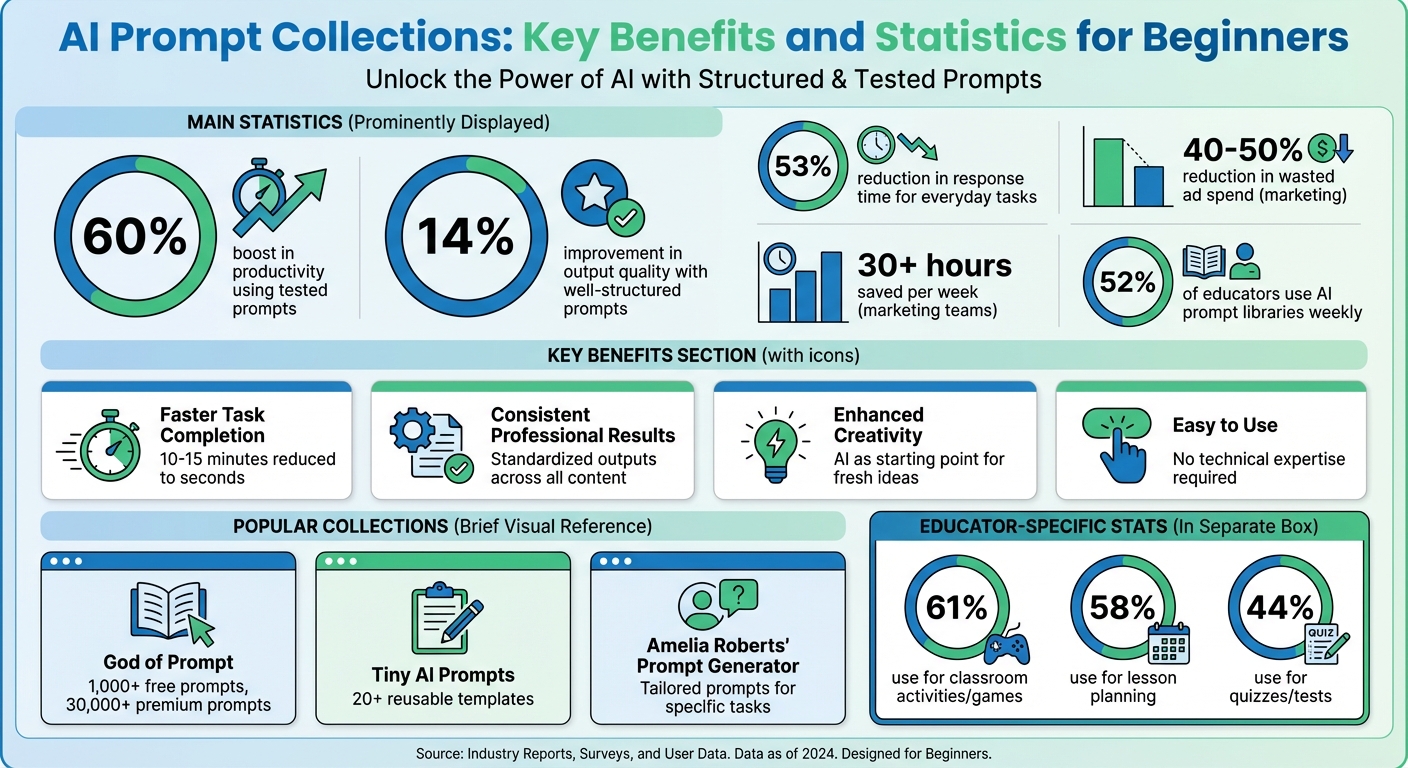
Why do prompts matter so much? They’ve been tested and refined through user feedback, ensuring reliable performance. In fact, studies reveal that using well-structured prompts can lead to 14% better quality outputs and a 60% boost in productivity. These results make them invaluable in fields like business, marketing, and education.
One standout resource is God of Prompt, which caters to users at every skill level. Beginners can dive in with over 1,000 free ChatGPT prompts and 100 Midjourney prompts to kickstart their journey. For those looking to expand their toolkit, specialized bundles like the Writing Pack ($37) or the Complete AI Bundle ($150) unlock access to more than 30,000 prompts. These bundles cover everything from business and marketing to SEO and creative tasks, and they include lifetime updates along with a 7-day money-back guarantee. It’s a hassle-free way to scale up your AI capabilities quickly.
The best part? These collections are flexible. You can use them as-is or tweak them with power phrases like "Be surprising", "Be concise", or "Adopt my style" to get responses that hit the mark. Whether you’re a beginner or a seasoned pro, these tools make achieving polished, professional results accessible to everyone.
Practical Benefits of Using Prompt Collections
Prompt collections play a key role in achieving professional results with AI tools, offering clear advantages in terms of efficiency, quality, and creative output.
For those new to AI, curated prompt collections remove the guesswork. Instead of spending 10–15 minutes crafting a prompt from scratch, you can use a pre-tested template and see results in seconds. These prompts have already been refined through trial and error, saving you the hassle of experimenting.
The time savings are significant. Tasks that might take hours – like drafting client emails, summarizing reports, creating ad copy, or handling routine administrative work such as data entry and scheduling – can be completed much faster using pre-tested prompts. Beyond speed, these prompts deliver consistent, professional-quality results.
Consistency is another major benefit. With standardized prompts, your marketing materials maintain the same brand voice across product descriptions, social media posts, and email campaigns, eliminating the need for constant rewrites. They also enable quicker, more informed decision-making.
Surprisingly, curated prompts don’t stifle creativity – they enhance it. Acting as a starting point, these prompts inspire fresh ideas by presenting questions and scenarios you might not have considered. AI processes vast amounts of data to suggest unique concepts and new perspectives, helping you overcome creative blocks without staring at an empty page. With multiple avenues to explore, you can focus more on refining ideas and less on struggling to get started.
Ease of use is unmatched. You don’t need to be a technical expert to produce polished, professional-grade work. Whether you’re drafting business proposals, designing educational materials, or crafting marketing strategies, these prompts guide you to high-quality results without requiring in-depth knowledge of prompt engineering. It’s a straightforward way to achieve professional outcomes with minimal effort.
1. Business Productivity
Simplifying Daily Operations with Ready-to-Use Prompts
AI-powered prompts are transforming how businesses handle everyday tasks, making professional-level results accessible to everyone – even those without specialized expertise. These ready-to-use prompts take the hassle out of routine activities like drafting emails or summarizing reports, delivering polished results in a fraction of the time. The real advantage? They allow businesses to focus on what truly matters while leaving repetitive tasks to AI.
These prompts integrate seamlessly with tools like ChatGPT, Copilot, Gemini, and Claude, tailoring outputs to your specific needs. For instance:
- Email drafting prompts: Help you create clear, professional messages effortlessly.
- Report summarization prompts: Turn lengthy documents into concise, actionable insights.
- Scheduling prompts: Organize calendars and coordinate meetings across time zones [5, 7, 9, 16].
For small businesses, these tools are game-changers. They automate tasks that would otherwise require additional staff or significant time investment [27, 28]. They also bring in structured methods like RTFD (Read the Full Document) to improve communication efficiency [4, 27].
The result? Faster task completion, fewer mistakes, and more time for your team to focus on strategic initiatives [27, 28]. By streamlining operations, these prompts not only enhance productivity but also lay the groundwork for more advanced applications in areas like marketing and education.
2. Marketing Strategies
Crafting High-Impact Marketing Copy with AI Prompts
Marketing teams are finding that AI prompts can save them over 30 hours a week while improving both content quality and campaign results. These prompts are versatile, handling everything from email campaigns and social media posts to landing pages and ad copy – all without needing advanced technical expertise. The goal is to transform AI prompts into practical, user-friendly tools for professionals.
The secret to creating effective marketing prompts is all about clarity, specificity, and context. Instead of vaguely asking AI to "write an email", a well-crafted prompt includes the target audience, an appropriate tone (like casual but professional), and key details about product benefits or customer challenges. This level of precision ensures that the AI generates content that’s not only relevant but also actionable, especially for emails and social media posts.
AI prompts shine when it comes to producing customer-focused email sequences. These include trial drip campaigns, re-engagement emails, persona-specific nurture series (like those targeting CFOs), and urgency-driven offers. For social media, AI can suggest trending ideas and create content tailored for specific platforms. Plus, you can tweak prompts to match your brand’s voice or a campaign’s theme, keeping your messaging authentic and consistent.
Another advantage? AI-powered content creation can cut wasted ad spend by 40–50% by improving targeting and messaging. If you’re new to this, prompt libraries offer a great starting point. They provide structured templates that guide you through the entire process – from brainstorming ideas to producing polished content [8, 18].
sbb-itb-58f115e
3. Educational Tools
Streamlining Lesson Planning and Assessment Creation
More than half of educators – 52%, to be exact – now rely on AI prompt libraries at least once a week to streamline their teaching workflows. These tools are most commonly used for creating classroom activities and games (61%), developing lesson plans (58%), and designing quizzes or tests (44%). This growing trend highlights the importance of crafting detailed and context-rich prompts for effective educational use.
The key to success lies in specificity and context. Rather than simply asking AI to "create a lesson plan", educators achieve better results by including details like grade level, learning standards, lesson duration, and real-world applications. For instance, a strong prompt might look like this: "Draft a scope and sequence for a social studies unit on [Topic], aligned with [Grade] standards. The unit will span 4 weeks, meeting 3 times per week for 45 minutes per session". Such precision ensures the generated content aligns with classroom needs and teaching goals.
AI’s usefulness extends beyond lesson plans to assessments. Teachers can quickly create formative tools with prompts like: "Create an exit ticket with 5 multiple-choice questions for [Subject] in [Grade] to assess student understanding after each lesson". For more comprehensive evaluations, prompts can guide the creation of detailed rubrics, such as: "Design a rubric for an [Assignment] on [Topic] for [Grade], including clear criteria, detailed descriptions, and measurable objectives".
To get the most out of these tools, it’s helpful to break larger tasks into smaller, manageable steps and provide reference materials whenever possible. For example, offering existing lesson plans or handouts as context can improve the quality of AI-generated content. Testing prompts across various classroom scenarios ensures relevance and age-appropriateness. This approach not only saves valuable preparation time but also helps maintain academic rigor.
4. Creative Content Generation
Bringing Personal Style to AI-Generated Stories and Visual Content
Creative fields like storytelling, marketing, and design can thrive with the help of well-crafted AI prompts. To make AI-generated content reflect your unique voice, one effective strategy is to feed the AI samples of your own writing. This helps the system learn your style, making it easier to produce tailored stories, marketing copy, or even social media posts that feel authentically yours.
Instead of a vague request like "write a story", give the AI specific details about the genre, tone, audience, and purpose. For example, you could say: "Write a 500-word mystery story in a noir style for adult readers, featuring a detective investigating a missing painting in 1940s Chicago." This kind of clarity gives the AI a strong foundation to work from, making the results more aligned with your vision.
If the initial output doesn’t hit the mark, don’t give up – refine your prompts. Add more specific keywords or adjust the framing of your request. Think of it like working with a creative partner: if they don’t understand your direction, you’d clarify rather than abandon the project. You can even layer prompts to guide the AI on tone, structure, and content, creating more nuanced and polished results.
For those moments when writer’s block strikes, try the AI Interviewer technique. Ask the AI to "act as an experienced interviewer" and have it pose thoughtful questions about your topic. This interactive back-and-forth can spark fresh ideas and help you develop content through a collaborative dialogue. By treating the AI as a creative partner and providing iterative feedback, you can unlock a wealth of possibilities.
Prompt Implementation Tips
To make the most of the professional prompt collections mentioned earlier, try structuring your prompts using a simple four-part approach:
- Define the persona: Specify who or what the AI should emulate (e.g., market research analyst).
- State the task: Clearly outline what needs to be done (e.g., analyze competitor websites).
- Provide context: Include relevant details to guide the AI (e.g., focus on pricing models and features of Competitor A/B).
- Specify the output format: Indicate how the results should be presented (e.g., a table, under 200 words, in a professional tone).
Once you’ve drafted your prompt, refine it through iteration to achieve better results.
Iterate and refine. Testing and adjusting your prompts can significantly improve outcomes. For instance, self-correcting prompts using GPT-4 has been shown to increase accuracy by 8.7% and enhance code readability by 13.9 units. If the results aren’t quite right, tweak one element at a time – add specific numerical constraints, clarify vague terms, or break down complex tasks into smaller, sequential steps.
Create a reusable prompt library. Organize your most effective prompts into categories like sales, content creation, or data analysis. Use clear naming conventions, such as "writing_fiction_character_backstory.md", to make them easy to find. Templates with placeholders like [TOPIC], [AUDIENCE], or [STYLE] can save time and make customization seamless. Regularly document and refine each version based on its performance.
Jeremy Caplan from Wonder Tools emphasizes the importance of flexibility:
"Adapt these prompts as foundational formulas for your AI assistant. They’re customizable recipes rather than rigid scripts. Experiment, improve, and make them your own."
Conclusion
Professional prompt collections can be a game-changer for AI beginners, offering structured and specific instructions that lead to clearer, more effective results. Instead of relying on vague or generic inputs, these collections allow you to leverage expert-level techniques without needing to master prompt engineering.
But there’s more to these prompts than just improving AI outputs – they also encourage sharper, more strategic thinking. As Nate puts it:
"Each of these 16 prompts is designed not just to elicit better output – but to shape better thinking".
By mastering these techniques, you’re not just enhancing AI interactions – you’re also developing skills that make you a better researcher, writer, and decision-maker. For instance, companies using AI tools have reported a 53% reduction in response time for everyday tasks.
Dive into the prompt collections highlighted in this article, whether your focus is on boosting productivity, crafting marketing strategies, enhancing education, or generating creative content. Start building your own "Prompt Wallet" – a personal library of reusable scripts that can handle the majority of your routine tasks. Use the four-part framework (persona, task, context, output format) and refine your prompts through iteration to achieve even better results. This method mirrors the strategies discussed earlier and sets you up for long-term success.
As Priyanka Sen from Netwoven wisely states:
"Great AI results don’t happen by accident – they’re the result of clear, thoughtful prompts".
The tools and techniques shared here provide a strong starting point, but your success will depend on how willing you are to experiment, adapt, and perfect them. With access to over 30,000 prompts from God of Prompt, you have everything you need to save time and achieve professional-quality outcomes with ease.
FAQs
What’s the best way for beginners to use AI prompt collections to be more productive?
Beginners can boost their efficiency with AI prompt collections by tapping into ready-made templates for everyday tasks. Whether it’s drafting emails, outlining content, summarizing reports, or organizing project plans, these prompts are designed to save time and deliver polished results – no advanced expertise required.
To make the most of these tools, tweak the prompts to suit your unique needs. Customizing them ensures more precise and relevant outputs, allowing you to simplify workflows and concentrate on what truly matters instead of getting bogged down by repetitive tasks. With just a little effort, you can harness the power of AI for business, marketing, or educational projects.
What are the advantages of using pre-designed AI prompts for creative tasks?
Using pre-designed AI prompts is a great way to spark creativity while cutting down on brainstorming time. These prompts are carefully crafted to steer AI tools toward generating focused and effective results, making them an excellent resource, especially for those just starting out.
They also simplify the process by offering organized ideas tailored to specific objectives – whether you’re tackling business strategies, creating marketing material, or working on educational content. With these ready-to-use prompts, you can spend less time figuring out where to begin and more time fine-tuning the final product, making it easier to achieve polished, professional outcomes.
How can prompt collections make lesson planning easier for educators?
Prompt collections make lesson planning easier by offering ready-made, customizable prompts that can save valuable time and minimize stress. These collections include clear and flexible ideas designed to suit various subjects, grade levels, and student needs, helping teachers craft engaging lessons with less effort.
With these prompts, educators can ensure consistency, address diverse learning styles, and dedicate more energy to teaching effectively instead of building plans from the ground up. Whether you’re preparing activities, assessments, or class discussions, prompt collections streamline the process and keep everything organized.
Related Blog Posts
- Best Prompt Collections for ChatGPT and Claude Users
- Best Prompt Collections for B2B Marketing Teams
- Complete Prompt Collections for ChatGPT, Claude and Gemini
- Simple AI Prompt Collections Anyone Can Use
Put this into practice: browse the 30,000+ prompt library and ChatGPT prompts in the God of Prompt library — copy, paste, and run.
Keep reading
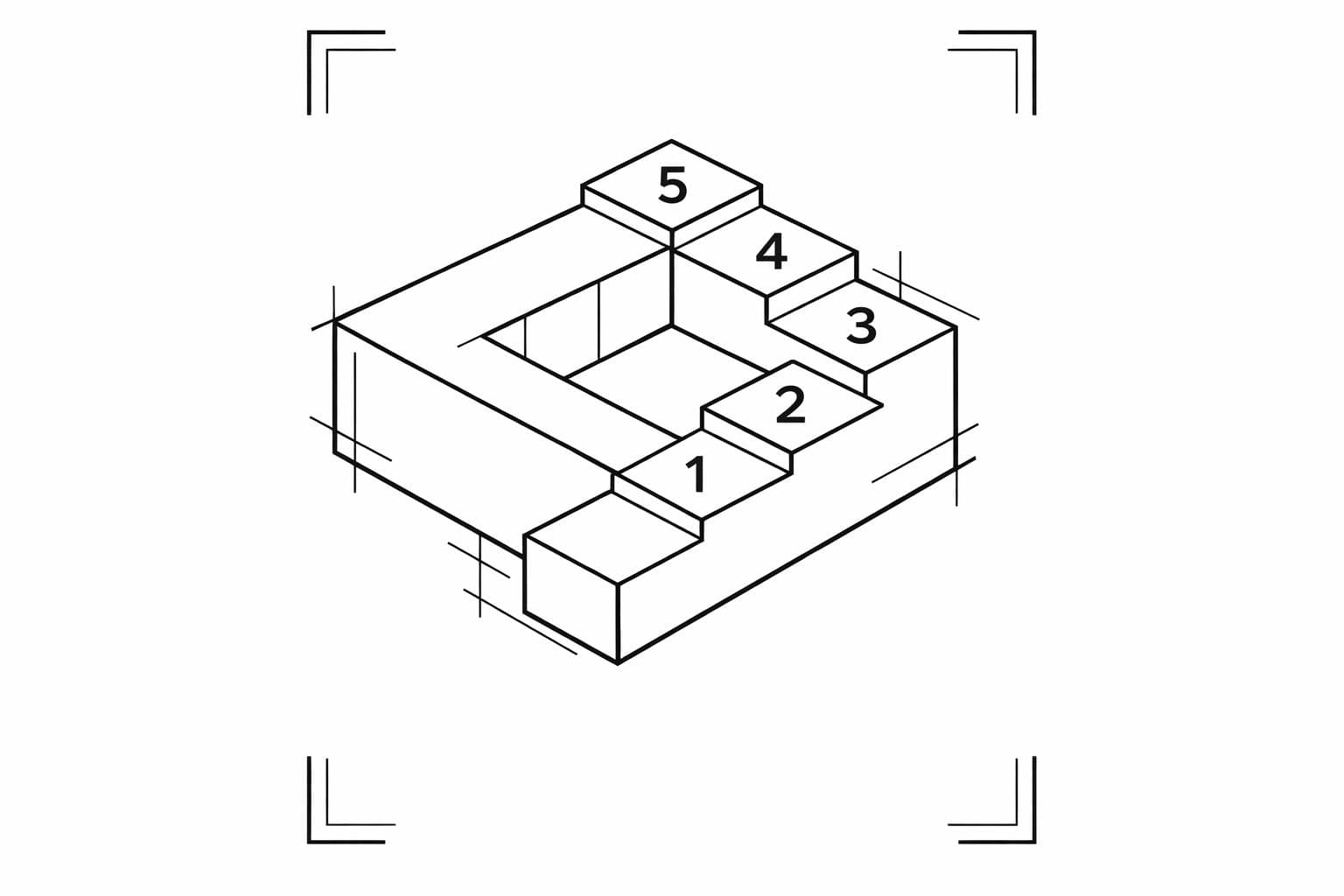
5 Steps to Build Reusable Prompt Templates
Build flexible, consistent prompt templates in five steps: choose variables, set role and context, structure requests, define output format, then test and refine.

Top Revenue-Generating AI Prompt Collections
Curated AI prompt collections that boost sales, speed content creation, automate workflows, and save time—pricing, features, and real-world impact explained.

AI Prompt Libraries That Increase Revenue and Conversions
Compare top AI prompt libraries that drive revenue and conversions, save time, and provide ready-made prompts for marketing, sales, SEO, and automation.

The best of the blog, in your inbox
One email when notable prompts, tools, and model updates land. No spam, unsubscribe anytime.
Join 160,000+ subscribers — one email a week, real prompts, tools, and model updates. Unsubscribe anytime.