

Easy AI Resources: Beginner Prompt Collections That Work




Getting started with AI tools like ChatGPT, Claude, or Midjourney can feel overwhelming. Crafting effective prompts is key to getting great results, but it takes time to learn. That’s where beginner-friendly prompt collections come in. These resources provide pre-tested templates for tasks like creating emails, marketing campaigns, or visuals - saving you time and effort.
Here’s why they’re helpful:
- Time-Saving: Skip trial and error with ready-to-use prompts.
- Organized by Use Case: Find prompts tailored for business, marketing, productivity, or visual content.
- Proven Results: Over 80% of AI users report increased productivity using curated prompts.
For example, platforms like God of Prompt offer thousands of categorized prompts for tools like ChatGPT and Midjourney, including free options. Whether you’re drafting emails, planning campaigns, or generating visuals, these collections simplify the process and help you get started fast.
Let’s explore how these prompts can streamline your workflows.
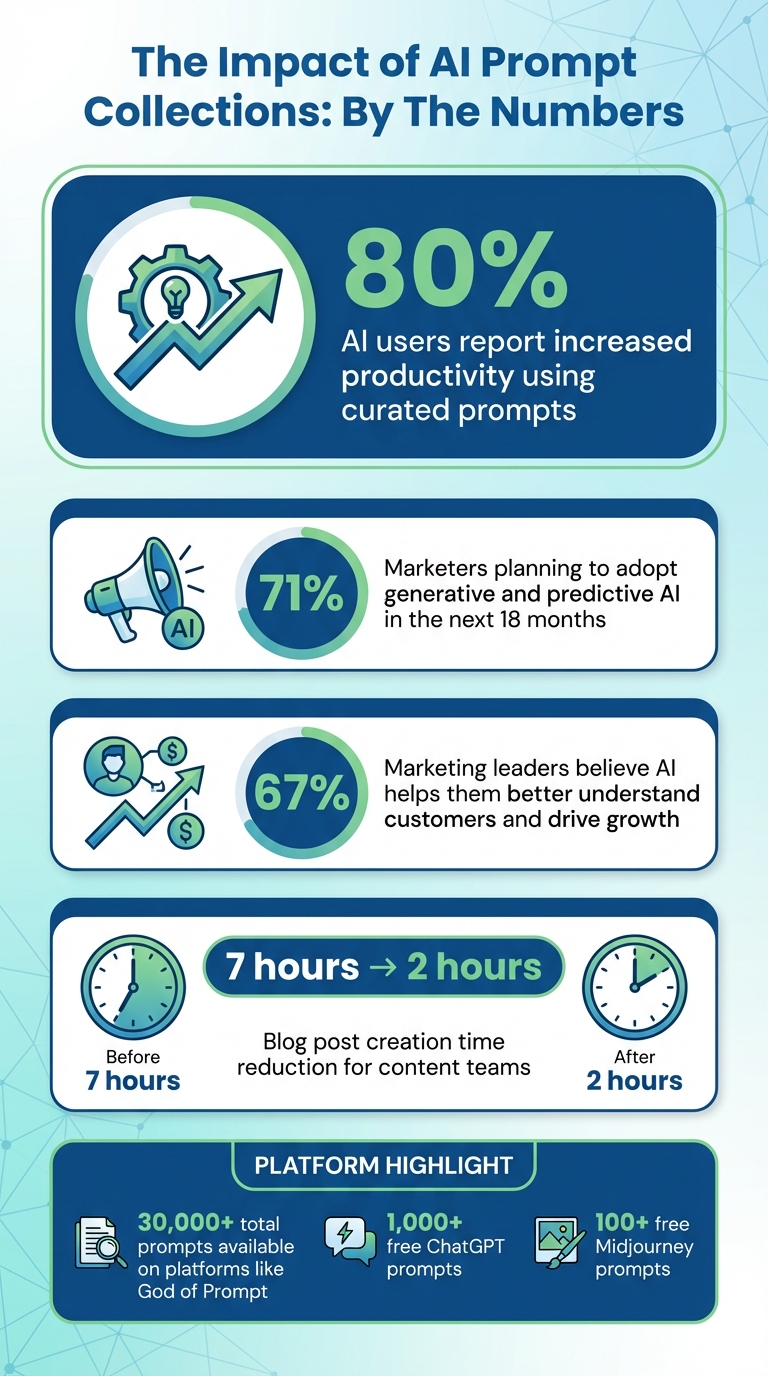
AI Prompt Collections Impact: Key Statistics on Productivity and Adoption
The EASIER WAY To Create AI Prompts (Without Writing Them Yourself)
Beginner-Friendly Prompt Collections for AI Tools
When starting with AI tools, simplicity is key. That’s where curated prompt collections come in, offering a straightforward way to get the most out of these tools without the trial-and-error guesswork.
These collections are thoughtfully organized by business functions - like marketing, finance, sales, and operations - so you can dive right into meaningful tasks. This structured approach not only saves time but also drives noticeable productivity improvements. For instance, according to research by Slack, over 80% of AI users report increased productivity and job satisfaction. Content teams, specifically, have seen blog post creation times drop from an average of seven hours to just two.
Take God of Prompt, for example. This platform offers over 30,000 prompts tailored for tools like ChatGPT, Claude, Midjourney, and Gemini AI. These prompts are bundled into categories ranging from business strategy to visual content creation. The best part? You can access over 1,000 free ChatGPT prompts and more than 100 free Midjourney prompts, with premium bundles available for those looking to expand further.
What sets these collections apart is their precise categorization and consistent quality. As Stephanie Baladi from Glean puts it:
"AI marketing prompts are more than a trend - they are a tool for driving real results".
With 71% of marketers planning to adopt generative and predictive AI in the next 18 months, having access to well-organized, ready-to-use prompts is becoming a must-have resource rather than just a helpful convenience.
These tools cater to everyone, from beginners to seasoned professionals across various industries. Small business owners, for instance, use them to simplify email management and craft marketing strategies without hiring costly consultants. Meanwhile, marketing teams leverage curated prompts to deliver personalized customer experiences. In fact, 67% of marketing leaders believe AI helps them better understand their customers and drive growth.
1. Business Prompts
Strategic Planning and Communication Templates
Business prompts are like having a consultant available 24/7 - they tackle strategic planning and communication tasks quickly, delivering actionable insights when you need them most. The trick? Craft prompts that ask the right questions and guide the AI toward structured, practical solutions.
Let’s break it down with an example. For tasks like drafting emails or creating meeting agendas, your prompt should include details about the audience, tone, and context. For instance: "Write a professional follow-up email to a potential client I met at last week's conference. Include a brief recap of our conversation, highlight three benefits of our service, and suggest two meeting times." This level of detail ensures the output is polished and aligned with your needs, cutting down on the back-and-forth of revisions.
To take things further, you can use the RIGS framework - Role, Instruction, Guardrails, Specifics - to fine-tune prompts for complex tasks. For example: "Act as a financial planning expert and create a detailed budget for a small retail business. Include monthly cash flow projections, categorized expenses, and three strategies to reduce costs." The more precise your input, the more useful and tailored the AI's response will be. This kind of precision turns what could be a time-consuming process into immediate, actionable steps.
Keeping related prompts in the same conversation also helps maintain context, transforming AI into a true collaborative partner in your planning process.
2. Marketing Prompts
Social Media and Campaign Templates That Drive Engagement
Marketing prompts are a powerful tool for quickly crafting campaigns, analyzing competitors, and delivering high-quality content. The key to success? Treat your prompt like a well-thought-out creative brief. Be clear about the platform, audience, tone, and goal right from the start. This way, you'll get outputs that are ready to use without much tweaking.
For social media content, specificity is everything. Generic prompts won't cut it. Instead, include details like the platform, audience, tone, and even word count. For example: "Write a 120-word LinkedIn post highlighting the top three benefits of AI for marketing teams" or "Write a playful, 50-character Instagram caption for a new product launch aimed at Gen Z". These kinds of prompts help ensure the content matches your brand's voice and campaign goals.
The same approach works for email marketing. You can create entire email sequences by being clear about the purpose and audience. For instance: "Develop a three-email re-engagement campaign for leads who haven't opened our last five newsletters. Use a friendly, conversational tone, and include a special offer in the final email". Clear, detailed instructions like this lead to well-structured email campaigns that hit the mark.
When it comes to planning larger campaigns, prompts can help you build content calendars effortlessly. For example: "Create a 7-day Instagram posting schedule for a fashion e-commerce brand" or "Generate a 4-week LinkedIn content plan for a B2B SaaS product launch". Specify things like posting frequency, themes, and calls-to-action to make sure the content stays cohesive and aligned with your strategy.
Now, let’s look at how productivity prompts can bring the same level of clarity and effectiveness to streamlining operations.
sbb-itb-58f115e
3. Productivity Prompts
Task Management and Workflow Automation That Saves Hours
Think of productivity prompts as your way to turn AI into a highly capable assistant. The trick? Be as clear and specific as possible. Using structured frameworks like RTFD or CAP can help you craft instructions that the AI can easily follow, ensuring it delivers exactly what you need. The more precise you are, the more actionable the results. This approach can save time across a variety of workflow tasks.
AI is particularly good at handling repetitive chores like scheduling, prioritizing tasks, and managing email. For instance, instead of vaguely saying, "Help me organize my day," you could try something like:
"Act as a productivity coach. Review 12 tasks and create a prioritized 8-hour schedule. Group similar tasks together and block 90 minutes for deep work. Format this as a time-blocked calendar."
With this level of detail, the AI can produce a structured plan that's easy to follow. Just like in strategic or marketing workflows, this method can make your daily routines far more efficient.
When it comes to to-do lists, AI can break down big, daunting projects into smaller, more manageable steps. A prompt like:
"Take this project goal and create a step-by-step action plan with time estimates for each task. Identify dependencies and suggest which tasks can be done simultaneously."
can transform your vague objectives into a clear, actionable roadmap. Want even more options? Add a follow-up request like, "Now create three alternative approaches, ranked by time efficiency."
Here's another example:
"Draft three professional email responses to this client inquiry. Keep each under 150 words, maintain a friendly but professional tone, and include a clear call-to-action. Avoid jargon."
4. Visual Content Prompts
Creating Images That Actually Look Professional
Crafting professional-looking visuals with AI tools like Midjourney, Gemini Image, or ChatGPT Image requires more than just basic instructions. The secret lies in being precise and detailed about the style, subject, and overall aesthetic. For instance, instead of a vague request like "make me a logo", you could use a more specific prompt such as:
"Create a photorealistic sunset over an ocean with silhouetted palm trees".
Including details about lighting, color, and composition can make a significant difference in the quality of the output.
To take it a step further, structure your prompts with clarity and purpose. Start with a strong action verb and include specifics about the style, subject, and mood. For example, if you're creating visuals for marketing, you might say:
"Create inspirational images for a marketing campaign for eco-friendly water bottles. Images should use earth tones and natural elements like mountains and rivers. Use a photorealistic style".
This level of detail ensures that the final images align with your vision and purpose. It’s an effective way for beginners to gain confidence in creating polished visual content.
If you're looking to simplify the process, pre-tested prompt collections can be a game-changer. These curated prompts are designed for specific artistic styles and themes, saving you the hassle of trial and error. With these tools, you can generate striking visuals without needing advanced skills in prompt crafting.
Conclusion
For those just starting out, beginner-friendly prompt collections take the uncertainty out of the equation. Whether you're drafting emails, creating marketing campaigns, analyzing data, or generating visuals, these resources provide a straightforward way to dive into AI tools. By centralizing prompts, they not only streamline productivity but also make adopting AI much more approachable.
In October 2025, sales teams using prompt libraries reported faster response times and better communication, all thanks to eliminating the trial-and-error process of crafting prompts. These libraries also gave structure to teams new to AI by organizing knowledge and teaching users how to think in terms of prompts for consistent communication. As Skaled, an industry expert, noted:
"Prompt libraries aren't useless. They're a helpful entry point. They centralize knowledge, teach reps how to think in prompts, and create consistency in language".
The results speak for themselves. These curated collections make it easier to go from planning to execution without the need for weeks of mastering complex prompt engineering. With tested and refined prompts, tools like ChatGPT, Claude, Midjourney, and Gemini become less intimidating and more like everyday allies.
So, why wait? You can start using these prompts right now - whether you're a small business owner crafting marketing content, a professional automating repetitive tasks, or someone curious about AI's possibilities. Beginner-friendly prompt collections are tailored to fit your goals, whether for business operations, marketing, productivity, or creative projects. With ready-to-use prompts at your disposal, you’ll quickly discover how AI can simplify decisions, save time, and help you work smarter every day.
FAQs
How can beginner-friendly prompt collections help boost productivity with AI tools?
Beginner-friendly prompt collections simplify the process of getting accurate and helpful results from AI tools by providing clear, pre-made instructions. These prompts cut down on trial and error, saving both time and effort in building effective workflows.
With ready-to-use examples designed for areas like business, marketing, or productivity, users can concentrate on achieving their objectives without the hassle of perfecting their inputs. This method helps make workflows smoother, reduces confusion, and ensures users get the most out of AI tools for their daily tasks.
How can categorized prompt collections improve business workflows?
Using categorized prompt collections can make business workflows run much smoother by offering precise and task-specific guidance. These collections help save time, cut down on mistakes, and support quicker, smarter decision-making by providing solutions tailored to your organization’s specific needs.
Whether you're focusing on marketing, boosting productivity, or improving customer engagement, having a library of ready-to-use prompts can be a game-changer. They allow you to quickly align AI tools like ChatGPT or Midjourney with your objectives, simplifying processes and delivering better outcomes with less hassle.
What’s the best way to start using AI prompts to create professional visuals?
To produce high-quality visuals, begin with well-crafted and detailed prompts. Clearly outline the subject, desired style, mood, and context. Including specific adjectives, artistic influences, or references can guide the AI tool effectively. For instance, platforms like Midjourney or DALL·E excel when you include details such as resolution, color palette, or aspect ratio.
Don’t hesitate to experiment with different prompts to fine-tune your results. Adjust settings like image quality or composition to achieve your vision. Looking through curated examples designed for beginners can also provide valuable insights and help you quickly grasp what works best.
Related Blog Posts

Loved by Business Owners


Based on 1K reviews
Get smarter on AI every week.
Ready to transform your business?