

AI automation in 2026 – what works for startups vs. enterprises



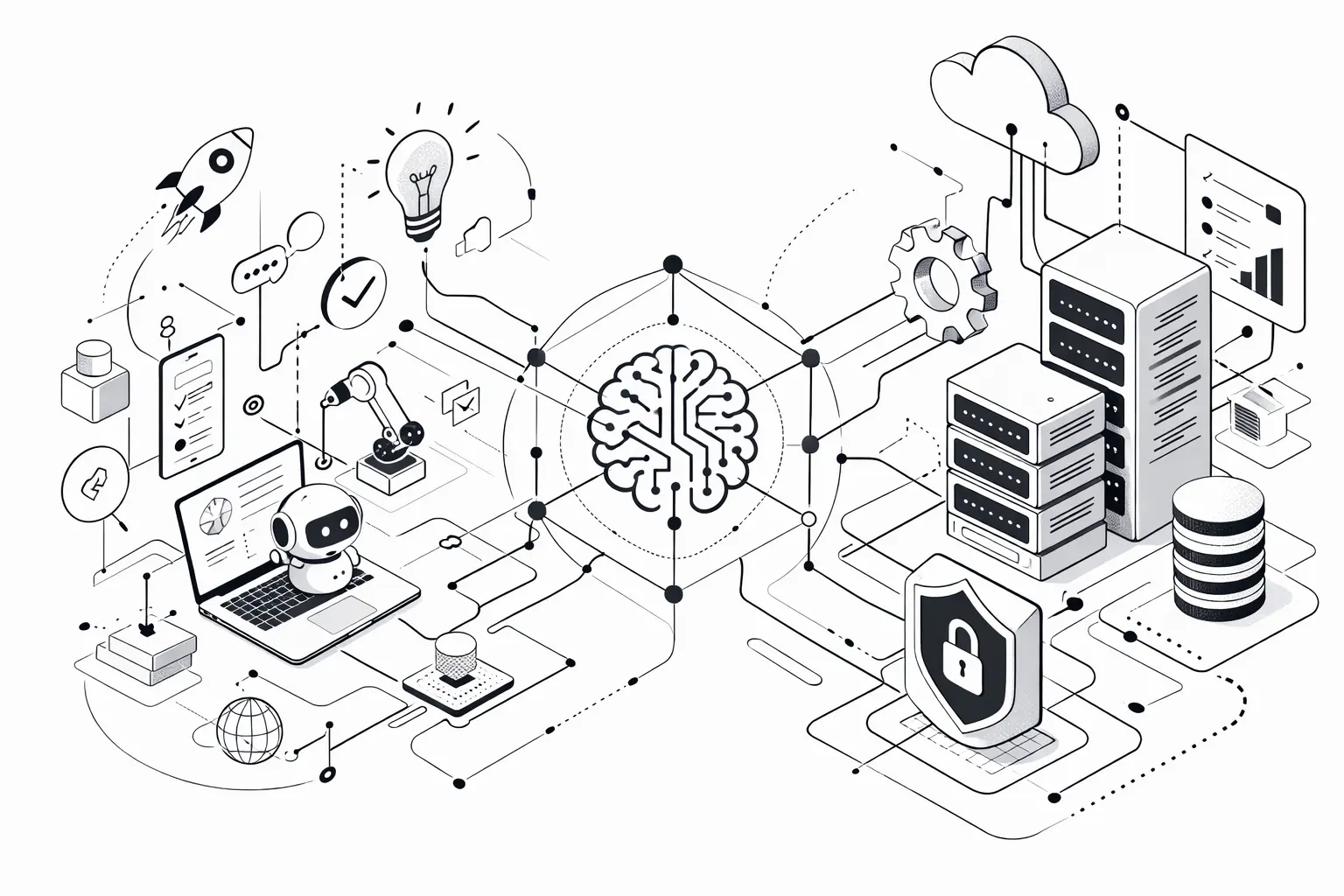
AI automation looks wildly different depending on who's doing it – and in 2026, that gap has never been more obvious. Startups are moving at a pace that would've seemed reckless three years ago. Enterprises are finally graduating from endless pilots into something that actually ships. And the strategies driving results for each? Almost nothing in common.
According to Deloitte's State of AI in the Enterprise report, 66% of organizations now report measurable productivity gains from AI adoption. Sounds promising – until you realize that still leaves a third of companies either treading water or actively spinning their wheels. The difference, more often than not, comes down to one deceptively simple variable: knowing which kind of organization you actually are.
ALSO READ: 15 NotebookLM Prompts That Actually Work (Copy, Paste, Done)

Why the same tool produces opposite results across company types
Here's something that doesn't get said enough. AI automation isn't a product. It's a posture – and that posture shifts dramatically based on context.
Ask a startup founder what AI has done for their business and they'll describe it like a cheat code. Three people doing the work of twelve. Features shipping in days instead of months. Customer support handled overnight without adding a single hire. Speed is their oxygen, and AI is basically a turbocharger bolted onto everything.
Ask a Fortune 500 CTO the same question and the conversation gets... slower. Governance frameworks. Compliance review cycles. Model drift. Integration timelines measured in fiscal quarters, not sprints. Not because enterprises are slow by nature – but because they're solving a fundamentally different problem. Their friction isn't about output. It's about connecting AI to the way work actually flows inside a system built over decades, held together by undocumented tribal knowledge and legacy infrastructure nobody wants to touch.
Neither camp is wrong. They're operating in different realities.
According to Goldman Sachs, management teams that tracked AI-driven productivity on specific tasks saw a median gain of around 30% – and 2026 is widely expected to be the year those gains spread from isolated wins to organization-wide impact. For a five-person company, AI automation tools don't augment existing workflows. They replace entire departments that never existed in the first place.
What's actually moving the needle for startups
Three areas stand out – and they're not the ones that get the most press.
Speed-to-ship. AI-assisted development has collapsed the timeline between idea and live product. Teams that once spent six weeks scoping, building, and testing a feature are doing it in under two. That compression compounds: faster cycles mean more experiments, more learning, and a much shorter runway to product-market fit. One well-known no-code platform reported that their early-adopter cohort – teams integrating AI into their dev workflow – shipped 3x more features in Q1 2026 than matched peers who hadn't.
Content operations at scale. A two-person growth team running AI-powered content pipelines can now out-publish a legacy marketing department of ten – with better SEO coverage and tighter messaging consistency. Outreach sequences, ad variations, long-form drafts, social calendars. One B2B SaaS startup tracked a 40% jump in monthly prospect touchpoints after plugging AI into their content workflow. That's not a productivity footnote. That's a growth lever.
Support without the headcount. AI agents are handling a meaningful chunk of tier-1 customer queries without escalation. For a startup watching burn rate obsessively, that's not a convenience feature – it's a survival mechanism.
The stack making this happen? Mostly off-the-shelf, lightly tweaked: LLM-powered platforms, no-code automation builders, a few well-placed API integrations. Cheap to spin up, easy to replace when something better rolls out next month (and something always does).
The catch – and there is one – is that this lightweight approach has a ceiling. Scale the team, take on an enterprise client with compliance requirements, or start pulling from messy internal datasets, and the cracks show fast. That inflection point isn't a failure. It's a signal that the next chapter requires a different playbook.
The enterprise shift: from endless pilots to actual production
For large organizations, 2026 feels different. As Foundation Capital put it in their January outlook, this is the year enterprises stop running AI experiments and start running AI operations. Gartner backs that up with a projection that caught a lot of people off guard: the share of enterprise applications with embedded agentic AI capabilities is expected to jump from under 5% in 2025 to 40% in 2026. Not a gradual drift – a structural reset.
What's finally pushing things over the line?
- Agentic AI grew up. These systems can now coordinate across tools, apply business logic, pull from multiple data sources, and execute multi-step workflows without a human rubber-stamping every decision. That's not automation in the old sense. It's closer to having a tireless junior analyst embedded in every process simultaneously.
- The ROI evidence got hard to ignore. Early enterprise adopters have been tracking numbers carefully, and the payback periods are shrinking. Internal momentum follows. When the CFO sees concrete productivity data from one department, funding the next rollout gets dramatically easier.
- Governance frameworks caught up. UiPath's 2026 Trends Report found that 78% of executives believe they need to reinvent their operating models to capture full value from agentic automation – and unlike two years ago, that reinvention is now happening, not just being discussed on slides.
Real-world traction is showing up in intelligent document processing, automated compliance monitoring, agentic customer service routing, and AI-assisted product development. A global manufacturer quietly made headlines earlier this year for deploying AI agents to handle cost-versus-time trade-off analysis in new product planning – work that previously consumed weeks of analyst bandwidth per initiative.
Enterprises aren't just using more AI than startups. They're using it differently – custom-built solutions, proprietary data fine-tuning, dedicated model management teams. That's where specialized implementation partners become genuinely valuable rather than a nice-to-have. Svitla's breakdown of AI approaches for Enterprises and Startups gets into the strategic layer of this well – specifically the decisions that determine whether a deployment actually delivers or quietly fades into the pilot graveyard.
Where the two worlds genuinely diverge
Strip away the buzzwords and the differences are pretty concrete:
- Deployment speed. A startup can go from whiteboard to live automation in a week. An enterprise deployment – done properly – takes quarters. That's not bureaucratic dysfunction; it's security reviews, system integration, and stakeholder alignment that simply require time at scale.
- Customization depth. Startups use pre-built tools and smart prompting. Enterprises are increasingly commissioning or building custom models fine-tuned on proprietary data. Different cost structures, different payoff timelines.
- Risk appetite. A startup can test a new AI workflow on 20% of traffic and roll it back if it behaves strangely. An enterprise running AI in a regulated environment – healthcare claims, financial reporting, legal document review – does not have that luxury without serious guardrails already in place.
- Data quality (the one nobody talks about enough). Startups often have smaller, cleaner datasets. Enterprises are sitting on fragmented legacy data spread across dozens of systems, some of which haven't been touched since 2009. Poor data quality remains the quiet killer of enterprise AI projects – models are only as useful as what you feed them.
- Governance as prerequisite. For enterprises, this isn't optional anymore. Who audits the model's decisions? What's the escalation path when the agent gets it wrong? How does bias get monitored over a 24-month deployment? These questions need answers before go-live, not six months after something breaks.
As Dr. Nicola Morini Bianzino, Global Chief AI Officer at EY, has put it: organizations capturing real value from AI treat it as an operational discipline – not a technology investment. That distinction matters more than any specific tool choice.
Practical direction, by company type
The temptation is to assume enterprise AI is just startup AI with more budget. It isn't – the logic is genuinely different.
For startups, the smarter path looks like this:
- Start with workflows that are high-frequency and low-stakes: content generation, internal reporting, FAQ handling. Build confidence before touching anything customer-critical.
- Pick tools with fast feedback loops. Learning speed matters more than feature count at this stage.
- Resist the urge to over-engineer. A well-crafted prompt integration routinely outperforms a custom-built model that took six months of engineering time.
- Invest in data infrastructure earlier than feels necessary. It's far cheaper to build clean pipelines at 15 people than to untangle them at 150.
For enterprises, the priority order shifts:
- Focus on orchestration, not individual tools. One AI tool adding 15% efficiency in one department is a footnote. A network of coordinated agents improving decision speed across the organization is a competitive moat.
- Invest in integration before intelligence. The single biggest reason enterprise AI underdelivers isn't model quality – it's the inability to connect outputs to where decisions actually get made.
- Treat governance as an accelerant, not a speed bump. Well-governed AI systems earn trust faster internally, which means broader rollouts with less resistance.
- Get technical partnership right from the start. Generic vendors don't have the domain depth that complex enterprise environments require, and discovering that twelve months into a deployment is painful.
Final thoughts
The AI automation story in 2026 isn't really about one approach winning over another. Startups and enterprises are running different races – different timelines, different risk profiles, different definitions of what "working" even means.
What's becoming clear, watching both ends of the spectrum, is that the organizations pulling ahead share one quiet habit: they stopped treating AI as a project with a launch date and started treating it as infrastructure with a maintenance schedule. The tools differ. The governance models differ. The timelines differ wildly. But the discipline underneath – build with intention, measure honestly, integrate where work actually happens – that part is identical.
Standing still while waiting for the "right moment" is, well – the right moment was probably eighteen months ago. The second-best time is now.

Loved by Business Owners


Based on 1K reviews
Get smarter on AI every week.
Ready to transform your business?