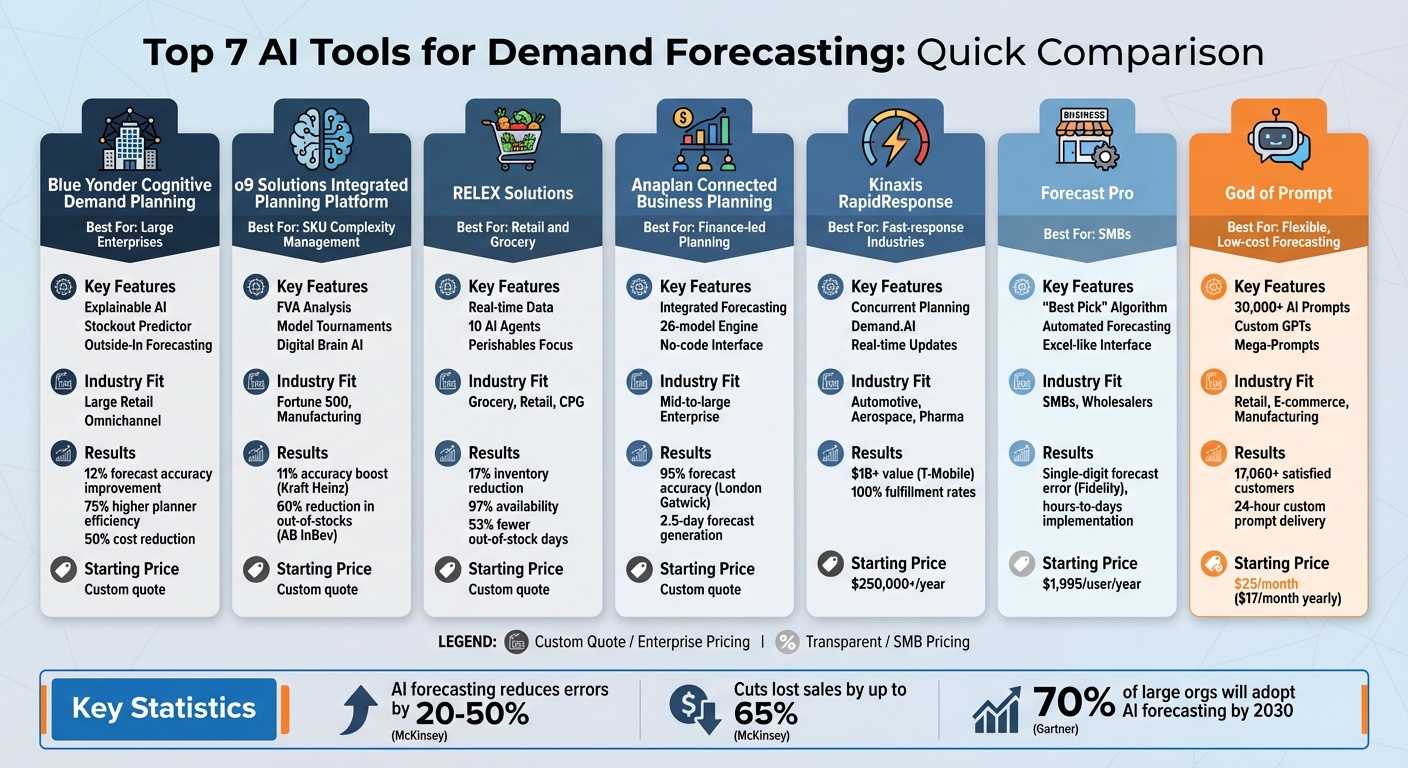
AI demand forecasting tools are transforming inventory and supply chain management by improving accuracy, reducing errors, and saving costs. Businesses can now predict demand more efficiently, leveraging vast data sets and advanced algorithms. Here’s a quick look at the top tools:
- Blue Yonder Cognitive Demand Planning: Best for large enterprises with complex supply chains. Offers explainable AI and specialized tools like Stockout Predictor.
- o9 Solutions Integrated Planning Platform: Excels in managing SKU complexity with features like Forecast Value Add (FVA) analysis.
- RELEX Solutions: Ideal for retail and grocery, focusing on perishables and promotions using real-time data.
- Anaplan Connected Business Planning: Combines forecasting with operational planning for finance-heavy and multi-department enterprises.
- Kinaxis RapidResponse: Designed for industries requiring fast responses to disruptions, like automotive and aerospace.
- Forecast Pro: A user-friendly, cost-effective option for small to mid-sized businesses.
- God of Prompt: Offers AI-driven forecasting via customizable prompts for businesses seeking flexibility and affordability.
Quick Comparison:
| Tool | Best For | Key Features | Starting Price |
|---|---|---|---|
| Blue Yonder | Large enterprises | Explainable AI, Stockout Predictor | Custom quote |
| o9 Solutions | SKU complexity | FVA analysis, Model Tournaments | Custom quote |
| RELEX Solutions | Retail and grocery | Real-time data, perishables focus | Custom quote |
| Anaplan | Finance-led planning | Integrated forecasting and planning | Custom quote |
| Kinaxis | Fast-response industries | Concurrent planning, Demand.AI | $250,000+/year |
| Forecast Pro | SMBs | Automated statistical forecasting | $1,995/user/year |
| God of Prompt | Flexible, low-cost forecasting | AI-driven prompts, custom workflows | $25/month ($17/yearly) |
These tools cater to different needs, from small businesses seeking simplicity to large enterprises managing intricate supply chains. Select one based on your industry, scale, and budget to improve your forecasting accuracy and efficiency.
AI Demand Forecasting Tools Comparison: Features, Pricing & Best Use Cases
AI for Demand Forecasting in Supply Chains | Complete Guide to Smarter Logistics & Predictions
sbb-itb-58f115e
1. Blue Yonder Cognitive Demand Planning
Blue Yonder stands out with its "glass box" explainability, providing clear visibility into why forecasts change. Whether it’s due to shifts in weather, social media trends, or economic factors, this transparency helps teams explain adjustments to executives and align on planning decisions effectively.
With its Outside-In Forecasting, the platform processes hundreds of internal and external signals – like weather patterns, social sentiment, promotions, and market trends – to generate unbiased predictions. This approach has delivered real-world results: Heineken has advanced its goal of becoming the best-connected brewer, and UK retailer Morrisons has maintained shelf availability for 29,000 SKUs across 500 stores. To further enhance planning precision, Blue Yonder also offers specialized microservices.
Its Pulse AI Microservices include tools like the Stockout Predictor, which forecasts risks of running out of stock, and the Markdown Predictor, designed to optimize pricing strategies. For New Product Introductions, the platform uses attribute-based modeling to predict demand by analyzing the characteristics of similar past launches, even when historical sales data is unavailable.
The results speak for themselves: users report a 12% improvement in forecast accuracy, 75% higher planner efficiency, and a 50% reduction in planning costs. Blue Yonder is particularly well-suited for large enterprises in industries such as retail, grocery, automotive, and consumer packaged goods – sectors that juggle thousands of SKUs, frequent promotions, and unpredictable demand patterns.
However, the platform comes with a hefty price tag. Enterprise implementations often involve licensing fees in the millions, with pricing available only through custom quotes. Additionally, while the interface is user-friendly, implementation can take several months and typically requires expert consulting.
For small businesses with stable and predictable sales, Blue Yonder may be more than they need. But for companies managing complex, multi-tier supply chains and aiming for high service levels, the platform is tailored to meet those challenges head-on.
2. o9 Solutions Integrated Planning Platform
o9 Solutions has developed a platform powered by its Digital Brain, which leverages Neuro-Symbolic AI and an Enterprise Knowledge Graph to simplify the management of complex SKU-location relationships.
One standout feature is its Forecast Value Add (FVA) Analysis, which evaluates each step in the forecasting process. It identifies where human input adds value and where it doesn’t, while also automating model selection through Model Tournaments. These tools help businesses achieve measurable improvements in their operations.
The platform’s impact is evident in its real-world applications. For example:
- Kraft Heinz adopted o9’s machine learning forecasting across North America and Europe, managing 7,000 SKUs. This resulted in an 11% boost in monthly forecast accuracy, a 25% cut in excess inventory, and a 32% reduction in time spent on forecasting.
- AB InBev transitioned from legacy SAP APO systems to o9’s cloud-native platform. The switch led to a 60% drop in out-of-stocks, a 53% reduction in inventory losses, and touchless planning adoption rates of 70–90% in key markets.
- T-Mobile relied on o9 during its 5G expansion and Sprint merger, achieving over $1 billion in value over three years while maintaining 100% fulfillment rates and 99%+ service levels.
"With o9’s AI/ML forecasting, our forecast accuracy improves, cross-functional collaboration strengthens, and decision-making accelerates within a centralized platform." – Gaby Gutierrez, VP of Global Supply Chain Planning
The platform supports more than 30 industries and integrates seamlessly with ERP systems, thanks to its foundation on open standards like Apache Hadoop and Spark. It has also earned recognition in the 2026 Gartner® Magic Quadrant™ for Supply Chain Planning. Designed for businesses dealing with high complexity and volatility – such as retail, consumer products, high tech, automotive, and telecom – o9 offers solutions tailored to meet these unique challenges. Pricing is determined through custom quotes based on specific enterprise needs.
3. RELEX Solutions for Retail and Grocery
RELEX Solutions leverages machine learning-based forecasting to analyze hundreds of variables at once, including weather changes, local events, price elasticity, and promotional effects. This approach excels in demand sensing by using real-time point-of-sale data to detect shifts in demand, rather than relying solely on historical patterns.
What sets RELEX apart is its Agentic AI ecosystem, which includes 10 specialized AI agents. These agents handle tasks like diagnosing root causes, managing inventory, and troubleshooting order proposals. The system also accounts for critical factors like cannibalization (when sales of similar products dip) and halo effects (when related items see a sales boost). Additionally, its level shift detection identifies demand changes caused by events such as new in-store displays or nearby construction projects.
The results speak volumes. For example, Europris, a Norwegian discount retailer with over 230 stores, reduced its distribution center inventory by 17% in just 18 weeks, improved in-store product availability from 91% to over 97%, and cut out-of-stock days by 53%. Similarly, Stockmann, a Finnish department store chain, implemented RELEX in 2011, reducing waste by 40% on average while maintaining over 99% product availability and automating 80–90% of its purchase orders.
"RELEX machine learning-based forecasting is critical to our ability to accurately forecast our most challenging categories, whether short-shelf life items or those with weather-driven demand." – Richard Turton, Head of Supply Chain, One Stop
RELEX serves a wide range of retail sectors, including fresh food, beauty products, and high-volatility environments like airports, where precise, day-level forecasts are crucial for balancing spoilage and profitability. With over 2,000 planning specialists and two decades of development, the company has consistently worked to improve forecast accuracy. Notably, all of its customers integrate AI into their planning processes. Pricing is customized to each business, with quotes tailored to enterprise size and specific module needs.
4. Anaplan Connected Business Planning
Anaplan brings AI forecasting into a single planning environment, connecting teams across finance, sales, supply chain, and workforce management. At the core of this capability is Anaplan Intelligence, which leverages machine learning models like Prophet, TimesFM, DeepAR, and XGBoost. These models generate predictions that seamlessly integrate into budget planning, capacity management, and operational schedules.
The platform automatically identifies the best forecasting model based on historical data. Its explainable AI feature goes a step further, highlighting the factors driving forecasts and providing confidence ranges. This level of transparency helps businesses understand the reasoning behind predictions, whether they’re shaped by internal sales patterns or external factors like weather or inflation. By combining forecasting with operational planning, Anaplan ensures departments work more efficiently together.
The practical impact of this approach is evident in real-world applications. For example, London Gatwick Airport uses Anaplan to forecast passenger volumes and optimize security staffing. According to Chris Fields, Head of Sales & Operations Planning, the airport now generates operational forecasts in just 2.5 days with a 95% accuracy rate three weeks before finalizing security rosters.
"With Anaplan we can create operational forecasts in just two and a half days, while also achieving a forecast accuracy rate of at least 95 percent three weeks in advance of when the security rosters are set." – Chris Fields, Head of Sales & Operations Planning, London Gatwick Airport
Similarly, South Central Ambulance Service adopted Anaplan’s PlanIQ within 2.5 weeks to improve workforce planning.
Anaplan is particularly suited for large enterprises with complex, multi-department planning needs. Its no-code interface caters to business planners instead of requiring data science expertise. Additionally, its patented Hyperblock® Technology supports real-time calculations across massive datasets – Unilever, for example, runs statistical models on 300 million rows of data. Pricing is customized based on the specific modules and scale required for each organization.
5. Kinaxis RapidResponse Multi-Tier Supply Chain
Kinaxis RapidResponse, now part of the Kinaxis Maestro platform, integrates demand forecasting with supply chain planning, creating a seamless connection between forecasts, supply, capacity, and inventory planning across every layer of the supply chain. When demand shifts, all related functions update in real time, removing delays caused by traditional sequential processes. This approach builds on earlier AI strategies by ensuring instant alignment across various operations.
The platform’s AI capabilities, powered by Demand.AI and Maestro Agents, combine historical data with real-time signals like weather patterns, point-of-sale data, promotional efforts, and even social media trends. A standout feature is its focus on explainable AI, which highlights the specific data points influencing forecast adjustments. This transparency fosters trust among different teams. Additionally, the platform offers robust what-if scenario analysis, allowing users to predict the effects of market disruptions, tariff shifts, or promotional campaigns across their supply chain.
Kinaxis supports major global players in industries such as Aerospace & Defense, Automotive, Consumer Products, High-tech & Electronics, Industrial Manufacturing, and Life Sciences. Its client list includes notable names like Lockheed Martin, Unilever, ExxonMobil, and Volvo Cars. The platform has been recognized as an 11-time Gartner Magic Quadrant Leader and holds an average user rating of 4.2/5 across review platforms. While users praise its scenario planning and analytics, some have pointed out challenges like high costs, a complex implementation process, and a steep learning curve.
Pricing is tailored for enterprises, ranging from $250,000 to $1,000,000 annually, plus implementation fees. There are two main tiers: Planning One, which focuses on core supply chain planning, and Maestro, which offers full AI-driven orchestration with advanced agents. Kinaxis is particularly suited for organizations with existing data infrastructure, as its models are designed to work with imperfect data.
6. Forecast Pro Automated Statistical Forecasting
Forecast Pro prioritizes ease of use and speed, making it a go-to choice for businesses looking for efficient forecasting tools. At its core is the "Best Pick" algorithm, which automatically selects the most accurate forecasting method from various statistical models. These include exponential smoothing, Box-Jenkins, and machine learning techniques. This allows the platform to handle seasonal trends, business cycles, and promotional impacts without requiring users to have an advanced understanding of statistics.
One standout feature is its Product Mapping tool, which is especially useful for new product launches. By leveraging AI, it maps historical data from similar or discontinued products to predict demand for new items. Additionally, the software supports hierarchical forecasting with automatic reconciliation. This means users can generate forecasts at different levels – whether by SKU, category, or region – and view data in multiple units of measure at the same time. For added precision, the Forecast Value Add (FVA) reporting feature tracks accuracy throughout the process, helping teams identify areas for improvement.
This focus on speed aligns with the growing demand for agile forecasting solutions. With over 40,000 users worldwide across approximately 12,000 organizations, Forecast Pro is trusted across industries. Companies like Fidelity Investments, Frito-Lay, and Oberto Sausage Company use it for tasks ranging from inventory management to revenue projections.
"Forecast Pro is so easy to use that we were able to create forecasts on the first day that it was installed. Within the first year, Forecast Pro helped us to reduce our forecast error to single digits." – Wendell Hull, Fidelity Investments
Another advantage is its rapid deployment. The software can be set up in hours or days, much faster than many enterprise solutions. Users also appreciate the Excel-like grid for manual adjustments and team collaboration. However, some note that its multivariate analysis capabilities are limited, as the platform primarily focuses on time-series forecasting rather than complex regression models.
Forecast Pro’s pricing is flexible, scaling with team size. Forecast Pro 100 starts at $1,995 per user annually, while Forecast Pro Extended ranges from $5,200 for a single user to $3,200 per user for teams of six or more. With a 4.2/5 rating on G2, it’s an excellent option for organizations needing a quick-to-implement, user-friendly solution that integrates seamlessly with existing ERP or planning systems.
7. God of Prompt
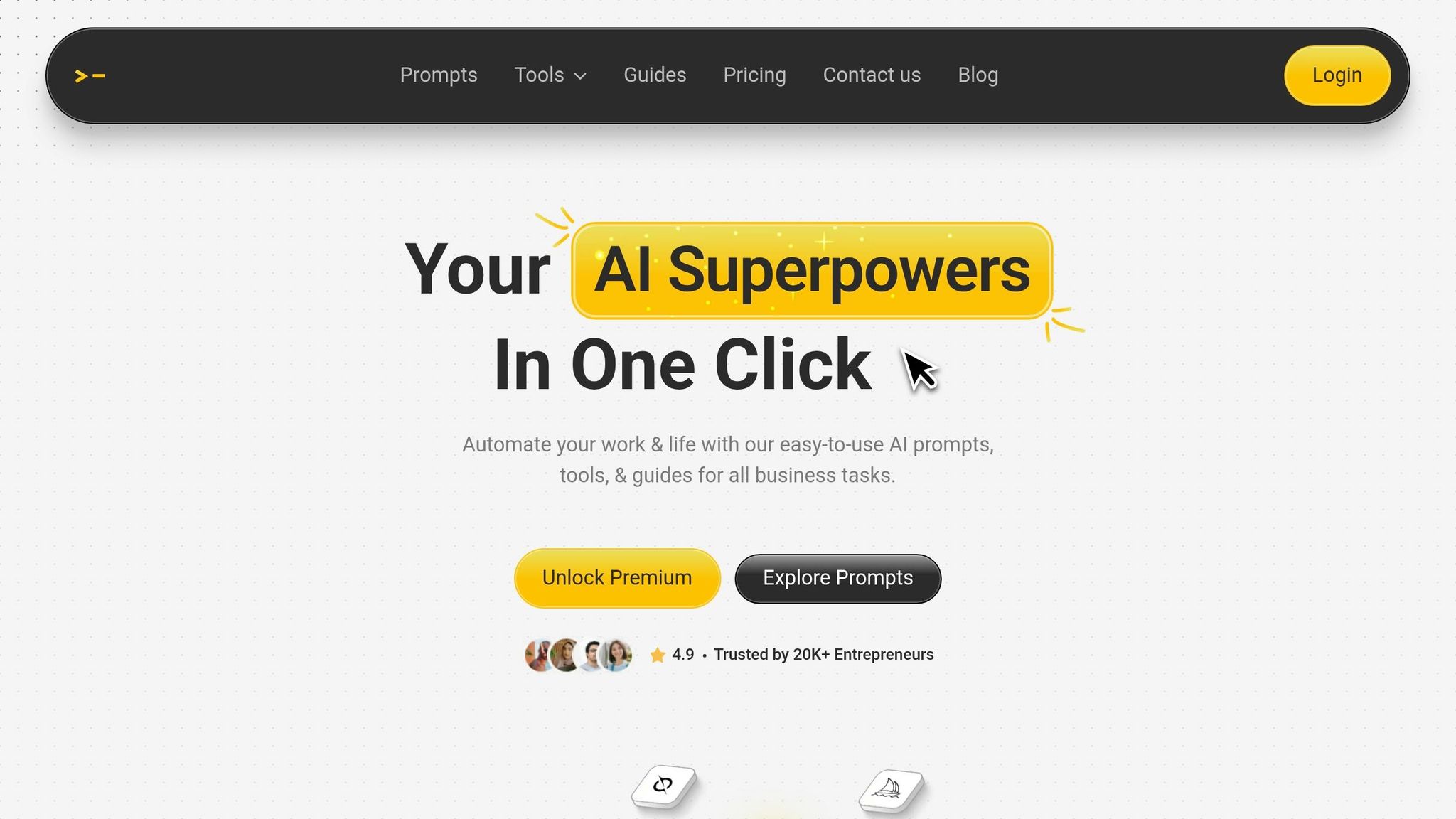
God of Prompt takes a different route in the world of AI-powered forecasting tools. Instead of offering a conventional forecasting engine, it provides a massive library of over 30,000 AI prompts and tools. These resources let businesses harness the power of large language models like ChatGPT, Claude, and Gemini for tasks ranging from demand forecasting to broader business operations – moving beyond the limitations of spreadsheets.
One of the platform’s standout features is its Mega-Prompts. These are highly detailed prompts – sometimes up to 100 pages long – designed for in-depth analysis. For demand forecasting, these prompts allow users to dig into nuanced demand signals, uncovering insights that traditional metrics might miss. Additionally, the Custom GPT Development option enables businesses to create specialized forecasting assistants tailored to their industry, whether it’s retail, manufacturing, or e-commerce.
Users have shared positive experiences with this approach:
"A 100 page prompt is an example of attention to detail and deep analysis. I have improved significantly using the product." – ABIOLA ALOBA
The platform’s impact is evident in its growing user base. With over 17,060 satisfied customers, God of Prompt supports industries ranging from retail and e-commerce to finance and manufacturing. Its business management prompts, in particular, are helping more than 5,915 business owners turn AI tools into operational success stories.
When it comes to pricing, God of Prompt keeps it simple. The Premium plan is $25/month or $17/month when billed annually, and it includes a 7-day free trial. This plan offers the complete AI bundle, no-code automations, unlimited prompt generation, and all available add-ons. Many users see it as a great investment, with one reviewer noting the bundle is "worth ten times the cost." The platform also enjoys a solid 4.2/5 rating on G2, with customers praising its responsive support team, which can deliver custom prompts within 24 hours.
Comparison Table
The table below provides a quick overview of the key features, pricing, and industries each tool is best suited for.
| Tool | Best For | Key AI Methods | Industry Fit | Starting Price |
|---|---|---|---|---|
| Blue Yonder Cognitive Demand Planning | High SKU complexity | Probabilistic ML, Agentic AI | Large Retail, Omnichannel | Custom quote |
| o9 Solutions Integrated Planning Platform | Integrated planning | Deep learning, Model ensembles | Fortune 500, Manufacturing | Custom quote |
| RELEX Solutions for Retail and Grocery | Perishables/Promotions | Probabilistic AI, Weather modeling | Grocery, Retail, CPG | Custom quote |
| Anaplan Connected Business Planning | Finance-led planning | 26-model statistical engine | Mid-to-large Enterprise | Custom quote |
| Kinaxis RapidResponse Multi-Tier Supply Chain | Rapid response | Concurrent planning AI, Demand.AI | Automotive, Aerospace, Pharma | Custom quote |
| Forecast Pro Automated Statistical Forecasting | Automated forecasting | "Best pick" (ML, Box-Jenkins) | SMBs, Wholesalers | $1,995/user/year |
| God of Prompt | AI prompt-driven forecasting | LLM-powered Mega-Prompts, Custom GPTs | Retail, E-commerce, Manufacturing | $25/month ($17/month yearly) |
Key Insights
- Blue Yonder and o9 Solutions are designed for large-scale enterprises with intricate supply chains, leveraging advanced techniques like probabilistic modeling and deep learning.
- RELEX Solutions caters to retailers managing perishables, adding features like weather and promotion modeling to optimize inventory and sales strategies.
- Anaplan is a strong choice for finance-driven planning, offering a robust 26-model statistical engine for mid-to-large enterprises.
- Kinaxis is tailored for industries like automotive or aerospace, where quick responses to disruptions are critical. Its Demand.AI engine incorporates external signals, such as social media trends and weather data, to improve accuracy.
- Forecast Pro simplifies forecasting for small to mid-sized businesses by automating statistical method selection, making it ideal for teams without advanced data science skills.
- God of Prompt offers a flexible, low-cost entry point for businesses seeking custom forecasting workflows powered by AI prompts and tools.
Pricing and Accessibility
Enterprise solutions such as Blue Yonder, o9 Solutions, RELEX, Anaplan, and Kinaxis require custom pricing, reflecting their tailored offerings. On the other hand, Forecast Pro provides transparent pricing at $1,995 per user annually, while God of Prompt offers the most affordable option at $25 per month (or $17 per month with an annual plan).
As Gartner predicts that 70% of large organizations will adopt AI-based supply chain forecasting by 2030, selecting the right tool now ensures your business stays ahead of the curve. The choice ultimately depends on your specific needs, whether it’s handling complex supply chains, managing perishables, or creating custom forecasting workflows.
Conclusion
AI-powered forecasting is shaking up inventory management, helping businesses cut costs and respond faster to demand changes. According to McKinsey, AI-driven forecasting can slash forecast errors by 20% to 50%, while reducing lost sales by up to 65%. And with Gartner projecting that 70% of large organizations will integrate AI-based supply chain forecasting by 2030, the real question isn’t whether to adopt these tools – it’s figuring out which one aligns best with your needs.
The key is to select a tool that matches your operational scale and industry focus. For example:
- RELEX is ideal for retailers managing perishables.
- Kinaxis or o9 Solutions cater to multi-tier manufacturers.
- Anaplan works well for finance-heavy planning.
- Forecast Pro is a great fit for small to mid-sized businesses.
- For those seeking flexibility and prompt-driven workflows, God of Prompt offers an affordable entry point at $25/month (or $17/month with an annual plan).
Before committing, test the tool using your own SKU data to confirm its impact on forecast accuracy. Also, consider your team’s technical expertise. Tools with no-code interfaces suit teams without data science skills, while enterprise-grade platforms may require advanced modeling capabilities. This thoughtful approach ensures your chosen solution enhances your supply chain performance.
AI forecasting doesn’t just speed up decision-making – it refines it. As Bani Kaur from Prediko puts it, "AI demand forecasting isn’t about replacing your planning process, it’s about making it sharper". Whether you’re managing a few dozen SKUs or thousands, the right tool can turn forecasting into a powerful strategic edge.
FAQs
Which AI demand forecasting tool fits my business size?
When choosing an AI demand forecasting tool, your business size plays a big role. For small to mid-sized businesses (SMBs), tools like Flowlity are a great option. They offer budget-friendly features like demand forecasting, inventory optimization, and automated reorder suggestions.
For larger enterprises, platforms such as Dataup AI or Prediko might be a better fit. These tools come with advanced features like multi-location inventory management and broad integration options, making them ideal for handling more complex supply chains.
What data do I need to get accurate forecasts?
To create precise demand forecasts, you’ll need a mix of historical sales data, market trends, economic indicators, and real-time, industry-specific details. Incorporating detailed product-level information, like SKUs, can refine accuracy even further. This combination ensures your forecasts reflect current market conditions and how your products are performing.
How do I test a tool before buying?
Many demand forecasting tools come with free trials, demos, or demo versions, giving you a chance to explore their features and determine if they suit your needs. Some even offer customized demos upon request, letting you test the software using your own data. Be sure to look for these trial or demo options to confirm the tool aligns with your business needs before making a purchase.