
Ultimate Guide to AI Supply Chain Monitoring



AI is transforming supply chain management in 2026 by shifting from manual systems to automated, predictive networks. Here's what you need to know:
- AI's Role: AI analyzes structured and unstructured data (e.g., shipping records, contracts) to predict disruptions, automate tasks, and optimize operations.
- Core Tools: Predictive analytics, IoT sensors, anomaly detection, and digital twins enable real-time monitoring and decision-making.
- Business Impact: Companies using AI report up to 72% higher profits, faster decision-making, and reduced operational costs.
- Applications: AI improves demand forecasting, inventory management, supplier monitoring, and logistics optimization.
- Implementation: Success requires clean data, integration with existing systems, and workforce training.
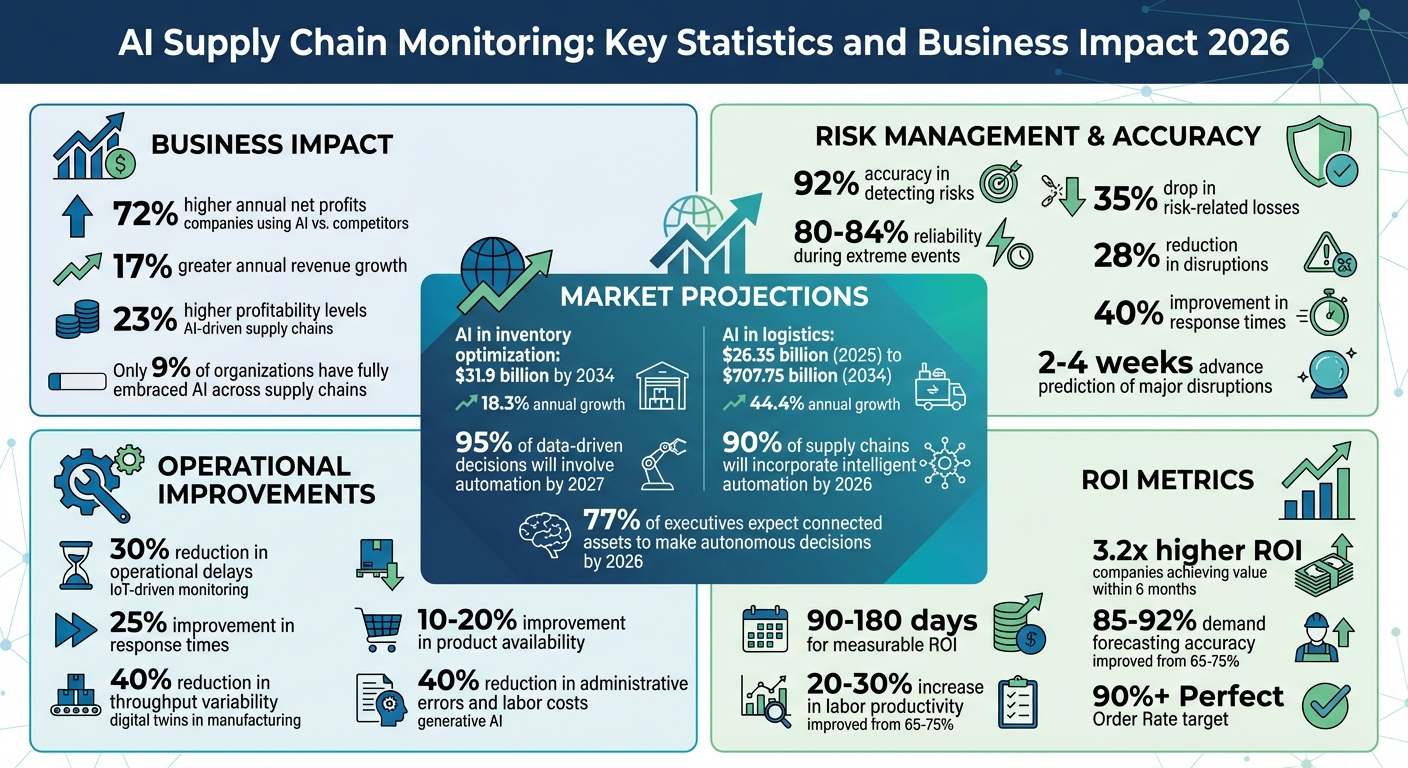
AI Supply Chain Monitoring: Key Statistics and Business Impact 2026
How AI Transforms SCM (Supply Chain Management): Real-Time Inventory & Route Optimization #ai
sbb-itb-58f115e
Core Capabilities of AI in Supply Chain Monitoring
AI monitoring takes raw data and transforms it into actionable insights, pushing businesses from reactive problem-solving to strategic management. By utilizing these advancements, modern AI monitoring revolves around three key capabilities, turning massive data flows into meaningful intelligence.
Predictive Analytics for Risk Management
AI-powered predictive analytics pulls data from diverse sources - internal metrics, weather forecasts, port activity, geopolitical events, even social media chatter - to spot potential risks before they materialize. Tools like XGBoost and LSTM models can predict major disruptions 2–4 weeks in advance, giving businesses the lead time needed to act.
These AI models achieve up to 92% accuracy in detecting risks, maintaining 80–84% reliability even during extreme events like natural disasters or political upheaval. Companies using such systems have reported a 35% drop in risk-related losses, a 28% reduction in disruptions, and a 40% improvement in response times.
Take DHL’s Resilience360 platform as an example. It processes live data from weather updates, political events, and traffic reports to alert logistics managers in real time, while also optimizing delivery routes. Similarly, Maersk’s TradeLens platform, developed with IBM, uses AI to analyze customs documents and port activity, streamlining vessel schedules and ensuring transparency across global trade routes.
"The boost provided by AI is only as strong as the data feeding it... garbage in, garbage out." - Kishan Kumar, MBA Specialist in Management & Leadership, Southern Connecticut State University
Once risks are flagged, IoT-enabled sensors step in to confirm and address these issues with real-time data.
IoT Integration and Real-Time Visibility
IoT sensors embedded in vehicles, containers, and warehouses provide the constant data flow that AI systems rely on. These sensors track everything - GPS location, temperature, humidity, vibration, and motion - offering real-time insights into asset conditions. With Edge AI, this data is processed at the source, enabling near-instant reactions to changes in conditions. For instance, if the temperature in a refrigerated container exceeds safe limits, the system sends immediate alerts. Companies using IoT-driven monitoring have seen operational delays drop by 30% and response times improve by 25%.
Amazon’s warehouse operations are a prime example of this in action. The company uses AI-integrated Kiva Robotics and real-time sensor data to optimize fulfillment center workflows. Robots adjust their routes on the fly to avoid collisions and retrieve items more efficiently, cutting fulfillment times significantly. Walmart, on the other hand, employs IoT sensors and RFID tags to maintain near-perfect inventory visibility, feeding this data into AI systems that predict shortages and automate restocking.
By 2026, 77% of executives expect generative AI to enable connected assets to make autonomous decisions, and 90% anticipate their supply chains will incorporate intelligent automation and AI assistants.
Beyond predictive analytics and IoT, AI also excels at spotting and resolving anomalies as they arise.
Anomaly Detection and Issue Resolution
AI’s anomaly detection capabilities continuously analyze operational patterns to spot irregularities that might go unnoticed - like subtle shifts in equipment vibration, unexpected route changes, temperature spikes, or unusual order activity. AI-powered cameras equipped with computer vision monitor warehouses and loading docks, identifying product defects, tracking inventory movement, and verifying packaging conditions without the need for manual checks.
When anomalies occur, the system doesn’t just alert managers - it can also take corrective action autonomously in advanced setups. This is the backbone of self-healing supply chains, where shipments are rerouted, suppliers switched, or inventory adjusted automatically. These proactive measures reduce operational friction, allowing supply chain professionals to focus on the 10% of complex cases flagged for human intervention rather than routine monitoring.
| Technology Component | Monitoring Role | AI Benefit |
|---|---|---|
| GPS Sensors | Real-time location tracking | Optimized routes and delay forecasting |
| Environmental Sensors | Monitoring temperature, humidity, and vibration | Ensures quality and prevents spoilage |
| RFID Tags | Tracking individual items or pallets | Accurate inventory and automated restocking |
| Edge AI | Local data processing | Instant anomaly detection and response |
| Computer Vision | Visual monitoring of warehouses | Automated quality checks and inventory tracking |
Digital twins take these capabilities further by creating virtual models of supply chains. Using real-time IoT data, they simulate thousands of "what-if" scenarios, helping managers visualize disruptions and test contingency plans before making real-world changes. In manufacturing, digital twins have already reduced throughput variability by 40%.
Applications of AI in Supply Chain Operations
AI is reshaping supply chain operations by integrating real-time monitoring, predictive analytics, and intelligent automation. These tools address everyday challenges like forecasting, inventory management, and logistics, creating more efficient and responsive systems.
Demand Forecasting and Inventory Management
AI takes demand forecasting to a new level, shifting from educated guesses to precise, data-driven predictions. Using machine learning models like Long Short-Term Memory (LSTM) and Recurrent Neural Networks (RNNs), AI analyzes a range of factors - historical sales, weather patterns, social sentiment, and economic data - to predict both long-term trends and short-term fluctuations. This approach allows businesses to adjust safety stock dynamically, considering real-time demand changes and supplier lead times. The result? Inventory costs drop by 15–25%, and product availability improves by 10–20%.
For example, Zara leverages AI to monitor sales data in real time, enabling it to predict demand and cut its concept-to-store cycle down to just 1 week - a stark contrast to the industry norm of 3–6 months. This agility helps the retailer avoid overstock issues. Similarly, Starbucks has implemented AI-driven inventory systems in North America, combining 3D spatial intelligence with automated counting to improve inventory accuracy. As of September 2025, this system ensures popular items like oat milk remain in stock.
The market for AI in inventory optimization is expected to hit $31.9 billion by 2034, with an annual growth rate of 18.3%. By 2025, 95% of data-driven decisions are predicted to involve at least some level of automation. However, getting started requires clean, consistent historical data - ideally 12–24 months’ worth - for accurate forecasting.
Supplier Network Monitoring
AI is invaluable for monitoring supplier networks, using real-time data like delivery performance, quality ratings, and financial health to identify risks before they escalate. It also tracks regulatory compliance, geopolitical events, and natural disasters, offering multi-tier visibility that helps uncover bottlenecks and maintain smooth operations. Companies using AI in their supply chains have reported risk reductions and cost optimizations exceeding 67%.
For instance, Amazon's Global Trade and Product Compliance (GTPC) Team uses AWS Supply Chain tools to automate regulatory compliance checks, saving roughly 3,000 operational hours annually. Meanwhile, the National Association of Boards of Pharmacy (NABP) partnered with IBM and AWS to launch "Pulse", a platform that provides end-to-end visibility for tracking prescription drug ownership. This ensures compliance with the Drug Supply Chain Security Act and prevents counterfeit medications.
Generative AI is also simplifying procurement by automating tasks like drafting RFx documents, generating purchase orders, and deploying chatbots for routine transactions. By 2025, 60% of executives anticipate that AI assistants will manage most traditional supply chain processes , often utilizing custom GPTs to streamline complex workflows. To maximize these benefits, businesses should map out workflows that are prone to manual errors or inefficiencies and prioritize them for AI integration.
Logistics and Transportation Optimization
AI optimizes logistics by analyzing real-time variables such as traffic, weather, port congestion, and carrier performance. This enables faster delivery routes and highly accurate arrival times. Machine learning also identifies the best routes and maximizes cargo space, reducing the percentage of empty miles. In the U.S., where trucks are empty about 30% of the time, AI-driven routing has cut this figure to 10–15%.
Uber Freight is a great example. By using machine learning for pricing and routing, it has reduced empty miles for its carriers to as low as 10–15%, compared to the national average of 30%. This initiative, led by CEO Lior Ron, relied on hundreds of data points to streamline the trucking process. Additionally, AI sensors monitor vehicle health - tracking factors like vibration, temperature, and power - to predict breakdowns before they happen, minimizing downtime.
Generative AI further enhances logistics by automating shipping documentation, including customs declarations and bills of lading. This reduces administrative errors and labor costs by 40%.
"AI is a moving target... It's not sitting still; it's aspirational because what was considered AI 30 years ago - even 20 years ago - is not considered cutting-edge AI anymore." - Chris Caplice, Executive Director, MIT Center for Transportation and Logistics
The market for AI in logistics is projected to grow from $26.35 billion in 2025 to a staggering $707.75 billion by 2034, with a growth rate of 44.4% annually. To make the most of this technology, businesses should focus on improving data quality and implementing "sense-and-respond" systems, such as cognitive control towers, to enable real-time analysis and quicker decision-making.
How to Implement AI Supply Chain Monitoring
Bringing AI into your supply chain isn’t just about adding new tools - it’s about planning strategically, organizing your data, and preparing your team for change. Right now, only 9% of organizations have fully embraced AI across their supply chains, but those that have are already reaping the rewards. Companies with AI-driven supply chains report profitability levels 23% higher than their competitors.
Start with Clean, Unified Data
AI systems rely on accurate data to deliver reliable results. Before deploying any AI tools, consolidate data from ERP systems, TMS platforms, and IoT sensors into a standardized data lake. Without this foundation, even the most advanced AI solutions will struggle to provide meaningful insights.
When evaluating AI vendors, look beyond flashy features. Focus on their track record with real-world implementations, their data security protocols (like encryption for data in transit and at rest), and whether their AI outputs are transparent. Ask the tough questions: Do they use your data to train external models like OpenAI or Google’s? Are they compliant with GDPR and other regional regulations? These factors are critical when trusting AI to make supply chain decisions.
Cloud-based data lakes and APIs can help bridge the gap between older ERP systems and newer AI platforms. The goal is to create an orchestration engine - a kind of "process conductor" - that coordinates multiple AI agents using unified data.
Choosing the Right Tools and Platforms
The right AI platform depends on your specific challenges. Look for tools that align with your needs while offering scalability, easy integration, and a clear understanding of long-term costs, including maintenance, training, and upgrades.
Identify workflows that are prone to errors or inefficiencies and prioritize them for AI integration. For instance, if your procurement team spends hours drafting RFx documents, generative AI can automate that process. If monitoring supplier risk is a concern, opt for platforms that provide real-time updates on delivery performance and financial health.
By 2026, intelligent automation and AI assistants are expected to play a role in 90% of supply chain workflows. Choose a platform with a forward-looking roadmap to ensure it evolves alongside your needs.
Take inspiration from examples like the National Association of Boards of Pharmacy (NABP). They collaborated with IBM and AWS to create "Pulse", a platform that uses APIs to connect manufacturers, wholesalers, and dispensaries to track prescription drug ownership. This system eliminated administrative bottlenecks and protected the supply chain from counterfeit drugs by choosing partners who understood both technical and regulatory requirements.
Integration with Existing Systems
Integrating AI into legacy systems doesn’t mean starting from scratch. The focus should be on interoperability - making sure new AI tools can seamlessly interact with your existing ERP, warehouse management, and transportation systems through APIs.
Amazon’s Global Trade and Product Compliance (GTPC) Team offers a great example. They used AWS Supply Chain’s tools to centralize fragmented regulatory data from suppliers. This cloud-based system is projected to save around 3,000 operational hours annually. By pulling data from multiple sources into one unified platform, they streamlined operations without overhauling their entire system.
An orchestration engine acts as a command center, coordinating various AI tools based on synthesized data. Generative AI can also speed up integration by transforming raw data into standardized formats, reducing manual preparation work. Building systems that can communicate across different platforms ensures that your AI tools work together, not in isolation.
Once your systems are connected, the next step is preparing your workforce to fully leverage these advancements.
Change Management and Employee Training
After ensuring technical integration, the focus shifts to aligning your workforce with these new tools. Employees need to transition from routine problem-solving to managing a network of technology and data providers. This shift requires clear communication, structured training, and fostering trust in AI recommendations.
Start with phased training. Begin with basic AI literacy for all employees, teaching them how to interact with generative AI and understand its applications. Intermediate training should target software engineers and business users, focusing on automating repetitive tasks. Advanced training is for AI specialists managing complex models and governance.
Accenture’s approach is a strong example. They’ve rolled out ChatGPT Enterprise to thousands of employees and leveraged their 77,000 AI practitioners as mentors to guide colleagues in safe prompt engineering and agent testing. This mentorship ensures consistent skill development and faster adoption.
To avoid skill erosion, where employees lose the ability to perform tasks manually due to AI reliance, implement "human-in-the-loop" models. In these setups, AI provides recommendations while humans handle high-level strategic decisions. This balance maintains critical thinking skills while benefiting from AI’s efficiency.
"The death of supply chain management is inevitable. To hasten its demise, companies must think differently about how and where they apply AI." - Pepe Rodriguez, Stefan Gstettner, Ashish Pathak, Ram Krishnan, and Michael Spaeth, BCG
Pilot projects should focus on AI that drives decision-making rather than just displaying data. For example, instead of merely showing inventory levels, the AI could recommend reorder quantities based on demand forecasts and supplier lead times. This approach demonstrates value and builds trust in the system.
Formalize new skills with certifications to give employees clear career paths and reduce anxiety about automation replacing jobs. Define roles like "Ecosystem Orchestrator" for supply chain managers or "AI Sense-Maker" for demand planners. This shows employees how their responsibilities will evolve alongside AI rather than being eliminated. By 2028, smart robots are expected to outnumber frontline workers in manufacturing, retail, and logistics, but the goal remains augmentation, not replacement.
Measuring Success and ROI of AI Monitoring
Measuring success and ROI is the final step in determining if AI is truly delivering on its promise to transform supply chain monitoring. After all the effort of implementation, the ultimate question is whether AI provides measurable value. Interestingly, only 25% of supply chain leaders report seeing tangible returns. Mismanagement, on the other hand, can drain 6–10% of annual revenue, making precise metrics essential.
Key Performance Indicators for AI Monitoring
The metrics you track should align with the specific challenges you're addressing. For example, demand forecasting accuracy is a key area. AI should improve accuracy from 65–75% to 85–92% within just 90 days. If inventory management is your focus, aim for a 15–25% reduction in carrying costs and better inventory turnover rates. For logistics, you should see a 12–18% drop in total costs by monitoring metrics like cost per shipment and reducing expedited freight expenses.
Labor productivity is another critical measure. With AI-driven warehouse operations, you should expect a 20–30% increase in orders processed per employee. The Perfect Order Rate - measuring orders delivered on-time, in-full, and undamaged - is the gold standard for customer satisfaction. Aiming for 90% or higher here is ideal. Financial health is also reflected in the Cash-to-Cash Cycle Time, which tracks how long cash is tied up between paying suppliers and receiving payments from customers. The stakes are high - global retailers lose over $1.77 trillion annually due to empty shelves.
Don’t overlook AI-specific metrics. For instance, track the percentage of AI-generated recommendations your team accepts and how often decisions are made without human involvement. By 2027, 95% of data-driven decisions are expected to involve at least partial automation. Low acceptance rates for AI recommendations could indicate issues with trust or transparency.
Calculating ROI for AI Solutions
Modern AI solutions often deliver measurable ROI within 90–180 days. Companies that achieve value within six months enjoy 3.2 times higher ROI over five years compared to those with longer timelines.
Start by establishing baseline metrics for areas like forecast accuracy, inventory costs, and labor productivity before implementation. During the first 60–90 days, monitor leading indicators weekly, such as improvements in week-over-week forecasts, stockout frequency, and reductions in task completion times. Don’t wait for annual reviews - catch problems early.
It’s also crucial to calculate total costs accurately. For large enterprises, implementation costs typically range between $8–$15 million, with 25–30% of that budget allocated to training and change management. But the returns can be substantial. For instance, in May 2024, a European retail giant used ThroughPut AI’s demand sensing tools to optimize over 15,000 SKUs. By monitoring real-time demand and eliminating low-value products, they increased profit margins by €30 million while slashing logistics costs. Similarly, a US aerospace sensor manufacturer saw a 20% boost in productivity and a 10% cut in processing time, resulting in $10 million in annual savings.
"Companies achieving AI value within six months see 3.2 times higher ROI over five years than those with extended timelines." - JJ Koch, Deposco
Focus on outcomes, not just activities. Success shouldn’t be measured by project milestones or "go-live" dates. Instead, assess whether the AI is making better decisions than previous methods. Delays beyond 90 days, reliance on custom integrations instead of pre-built connectors, or extensive customization for basic functionality can all hurt your ROI. On the other hand, organizations leading in AI adoption report 72% higher annual net profits and 17% greater annual revenue growth compared to their competitors.
Conclusion: The Future of AI Supply Chain Monitoring
AI is reshaping supply chains, shifting them from reactive problem-solving to proactive, predictive management. Modern systems now bring together data from procurement, manufacturing, and logistics to predict and address potential issues before they arise. By 2027, it's estimated that 95% of data-driven decisions will involve some level of automation across various operational areas.
Beyond just predicting problems, AI is stepping into real-time action. Self-healing supply chains are becoming a reality, with systems rerouting shipments, tapping into backup suppliers, or adjusting prices dynamically to handle demand spikes. These advancements are delivering tangible results - companies embracing generative AI report 72% higher annual net profits and 17% greater revenue growth compared to their peers. On top of that, generative AI-powered digital twins allow businesses to run thousands of "what-if" scenarios, stress-testing their networks continuously instead of limiting such evaluations to annual reviews.
This shift also redefines human roles in the supply chain. Routine oversight is giving way to strategic exception management, as AI handles up to 90% of routine tasks. Professionals will focus more on managing complex exceptions, strategic oversight, and building supplier relationships. As Kishan Kumar puts it:
"The future model is human-in-the-loop, with professionals shifting from tactical execution to exception management, strategic oversight, and relationship leadership."
However, the success of these advancements hinges on maintaining robust data integrity across the system. Technologies like blockchain-based provenance play a critical role in ensuring unified and reliable data strategies. Companies that scale their AI initiatives quickly and invest in workforce upskilling will emerge as leaders in this evolving landscape.
The integration of AI with IoT sensors, computer vision, and autonomous logistics is driving the concept of the "physical internet." In this vision, AI functions like an air traffic controller, optimizing supply chain movements for maximum efficiency and minimal waste. With 77% of executives predicting that connected assets will make autonomous decisions by 2026, the race is on for businesses to embed AI as a core strategic element in their supply chains. Those who act swiftly and strategically will set the standard for the future.
FAQs
How does AI improve demand forecasting and inventory management in supply chains?
AI improves demand forecasting and inventory management by leveraging advanced predictive models and analyzing real-time data. Tools like machine learning algorithms - including Long Short-Term Memory (LSTM) networks and Gradient Boosting Machines (GBM) - process data from sources such as sales trends, promotions, and market conditions. This results in highly accurate demand predictions, enabling businesses to anticipate and adjust to shifting market dynamics.
In inventory management, AI tools fine-tune stock levels by forecasting future demand and aligning inventory accordingly. This approach helps cut down on excess stock, avoid stockouts, and lower costs - all while maintaining strong service levels. By integrating AI with optimization methods, supply chains can quickly adapt to real-time changes, boosting efficiency, responsiveness, and flexibility.
What challenges do businesses face when using AI for supply chain monitoring?
Bringing AI into supply chain monitoring isn’t without its obstacles. One major challenge is integrating AI across various company functions and data sources. Many organizations only tap into AI for analytics and forecasting, leaving its potential for automating complex decision-making largely underutilized.
Another hurdle is building trust in AI systems among stakeholders. Concerns about bias, lack of transparency, and resistance to shifting operational models can slow down adoption. On top of that, the growing complexity of global and interconnected supply chains makes achieving visibility and resilience with AI tools even tougher.
To address these issues, companies need to focus on strategic investments, work on fostering trust in AI, and create solutions tailored to the unique demands of their supply chains.
How does AI anomaly detection improve supply chain efficiency?
AI-driven anomaly detection transforms supply chain management by spotting irregularities like shipment delays, inventory discrepancies, or route changes in real time. Using advanced algorithms to sift through massive data sets, AI identifies unusual patterns quickly, allowing businesses to address potential problems before they grow into larger issues.
Often, these systems also automate corrective actions - adjusting inventory levels or rerouting shipments - minimizing the need for manual input and speeding up recovery processes. The result? Operations run more smoothly, costs are reduced, and the supply chain becomes more resilient to unexpected disruptions.
Related Blog Posts

Loved by Business Owners


Based on 1K reviews
Get smarter on AI every week.
Ready to transform your business?