

How AI Adjusts Goals in Real Time




AI is changing how goals are managed, making them more flexible and responsive. Instead of sticking to fixed objectives, AI uses real-time data like sales trends, customer feedback, and market shifts to recalibrate goals instantly. This process, called Dynamic Goal Adjustment (DGA), helps businesses stay relevant and productive.
Key Takeaways:
- Real-Time Updates: AI analyzes live data to adjust priorities and tasks.
- Improved Efficiency: Users report a 40% productivity boost and save up to 9 hours per week.
- Advanced Reasoning: AI doesn’t just react; it evaluates and refines its goals continuously.
- Practical Applications: From inventory management to fraud detection, dynamic AI systems are reshaping industries.
By leveraging tools like AI frameworks and automation platforms, businesses can ensure their objectives remain aligned with changing conditions. This shift from static to dynamic goal management empowers organizations to respond quickly and effectively to challenges.
The AI Goal-Setting Hack That Will Change Your Life: My 2025 Game Plan
How AI Adjusts Goals in Real Time
AI systems today are designed to keep up with ever-changing environments and demands. They achieve this by constantly analyzing data, reassessing priorities, and fine-tuning their tasks as situations evolve. This dynamic process unfolds through three core mechanisms: analyzing live data, reasoning about shifting priorities, and reorganizing tasks when unexpected challenges or opportunities arise through workflow optimization.
Real-Time Data Analysis
AI systems rely on closed-loop feedback systems to gather and process data continuously. These systems work like self-correcting loops, constantly checking if the AI’s actions align with its objectives. When deviations are detected, adjustments are made immediately to stay on track.
A key tool here is the goal-compliance function. This mathematical check ensures the system’s current path aligns with its goals. If a mismatch is identified, the system shifts into a replanning phase. To manage priorities effectively, a task utility threshold is used. Tasks that no longer add value are dropped, while new opportunities that meet a certain threshold are added to the queue.
To avoid being overwhelmed by too much data, frameworks like Yunque DeepResearch divide work into semantically cohesive sub-goals. Once a sub-goal is completed, its summary is stored, leaving active tasks with detailed execution traces. This prevents "context collapse", a situation where excessive information hinders the system’s ability to function.
A practical example of this is Tencent BAC’s Yunque DeepResearch framework. In January 2026, it showcased a Supervisor Module that monitored for anomalies in research trajectories. If semantic stagnation or repetitive loops were detected, the system switched from "Acting Mode" to "Reflective Mode." This allowed it to prune irrelevant context and create alternative strategies, achieving a 51.7 score on the Humanity’s Last Exam benchmark. Similarly, the AdaPlanner framework excelled in adaptive refinement, outperforming other models by 3.73% in ALFWorld and 4.11% in MiniWoB++ environments.
Building on this real-time data analysis, AI systems then engage in reasoning to redefine their goals and priorities.
Goal-Conditioned Reasoning in AI
AI doesn’t just react to situations - it reasons about its goals and how to achieve them. Tsehaye Haidemariam from BI Norwegian Business School explains this shift:
"The shift from 'responding' to 'reasoning' refers not to the presence or absence of inference, but to a transition from instrumental reasoning about actions to meta-reasoning about purposes, priorities, and commitments".
This concept, known as synthetic teleology, enables AI to generate, evaluate, and regulate its goals internally, without relying solely on external instructions. Through recursive loops - perception, evaluation, goal-updating, and action - the system continuously adapts its intentions to align with its environment. Haidemariam describes this as "goal realism", where intelligence becomes a constant negotiation between the system’s objectives and the world around it.
Unlike traditional reinforcement learning, which focuses on state-based policies, goal-conditioned reasoning requires AI to make decisions tailored to evolving goals.
| Feature | Classical AI Reasoning | Goal-Conditioned Reasoning |
|---|---|---|
| Goal Source | Fixed, externally defined | Self-updated in real time |
| Primary Function | Focused on actions | Focused on purposes and priorities |
This advanced reasoning sets the stage for AI to reorganize its tasks dynamically when conditions change.
Dynamic Task Reconfiguration
When new challenges or opportunities arise, AI systems adapt by reorganizing their tasks. This process, called dynamic orchestration, allows the system to determine the next best action based on real-time feedback and prior steps.
A great example comes from You.com’s updated MAI framework. By adjusting task orders in real time, it improved benchmark accuracy by up to 7.5%. As the You.com team put it:
"Moving from mechanical, pre-set workflows to truly adaptive, reflective processes results in agents that work more like humans: thinking, learning, and adjusting as they go".
This adaptability relies on reflection phases, where the AI evaluates its progress, revises its plan, and decides whether to drop unnecessary tasks or add new ones. Frameworks like AdaPlanner use feedback to refine tasks either within the current plan ("in-plan") or by creating new paths ("out-of-plan"). For instance, an autonomous driving system using an Active Thinking Model (ATM) shifted its focus from "efficiency" to "safety" after detecting hazardous road conditions. This adjustment happened autonomously, without external input.
Steps to Build an AI Goal System That Adjusts Automatically
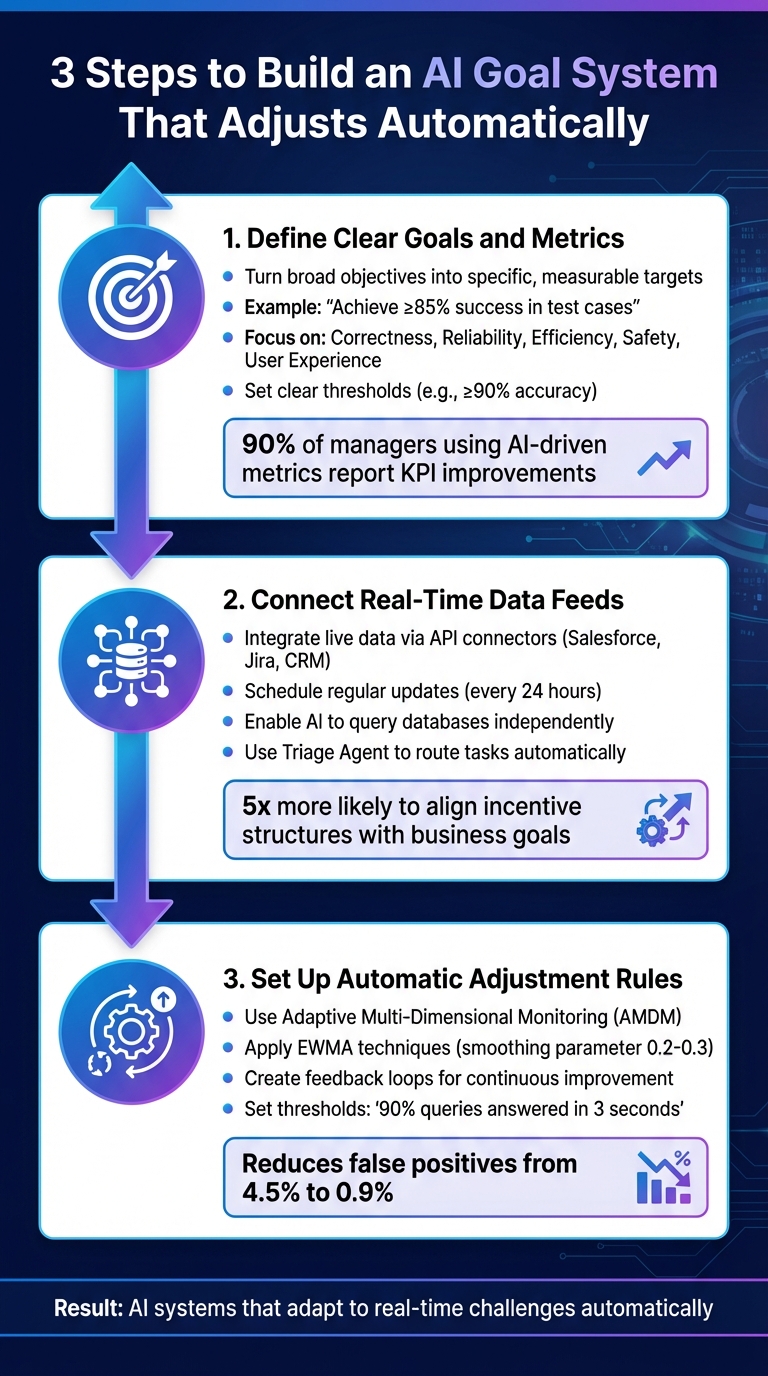
3 Steps to Build an AI Goal System That Adjusts Automatically
Creating an AI system that can modify its goals on its own involves three key steps: setting clear objectives, integrating live data, and establishing rules for dynamic adjustments. Each step builds on the last, ensuring the system remains aligned with ever-changing conditions.
Step 1: Define Clear Goals and Metrics
Start by turning broad objectives into specific, measurable targets. For example, instead of saying the AI should "perform well", define success as "achieving at least 85% success in test cases". Michael Brenndoerfer, Associate Director of Data Science at EQT Partners, underscores this:
"Without clear success criteria, you can't systematically improve your agent, catch regressions when you make changes, or confidently deploy it to users".
Focus on metrics like Correctness, Reliability, Efficiency, Safety, and User Experience, and assign clear thresholds for each (e.g., ≥90% accuracy for Correctness). Prioritize these metrics, often placing safety and correctness above efficiency.
A great example comes from Wayfair, which redefined its "lost-sales" KPI in February 2024. They discovered that 50% to 60% of "lost" sales were actually customers purchasing alternative items within the same category. By shifting to a "category-based retention" metric, they improved both recommendations and product placement. This shift demonstrates how AI can offer insights that traditional methods might miss. In fact, 90% of managers using AI-driven metrics report improvements in their KPIs.
Keep an evolving record of goals, including criteria, thresholds, and priorities. Regularly update this as the system encounters new challenges or edge cases.
Once goals are clearly defined, link them to real-time data sources to monitor performance continuously.
Step 2: Connect Real-Time Data Feeds
With clear metrics in place, the next step is to integrate live data streams to track performance in real time. Use API connectors to link your system to platforms like Salesforce, Jira, or your CRM, and schedule regular updates (e.g., every 24 hours) to ensure metrics stay current.
Allow your AI to independently query databases, read documents, or search the web for relevant information. This proactive approach eliminates the need for manual input. Companies using AI-enabled KPIs are five times more likely to align their incentive structures with business goals compared to those relying on outdated metrics.
For more complex setups, consider implementing a Triage Agent. This system assesses incoming data and routes tasks to the appropriate specialized agents. For instance, a customer inquiry could be automatically directed to Technical Support or Sales based on its content.
Additionally, use automation platforms like Power Automate or Zapier to trigger workflows when metrics change. For example, if sales velocity falls below a set threshold, the system could automatically shift focus from expansion to retention goals without requiring human input.
The final step involves setting up rules that allow the AI to adjust its goals based on continuous feedback.
Step 3: Set Up Automatic Adjustment Rules
Define rules that dictate when and how the AI system adjusts its goals. Use Adaptive Multi-Dimensional Monitoring (AMDM) to normalize metrics like capability, safety, efficiency, and user experience. This allows the system to identify trade-offs, such as an increase in efficiency coupled with a drop in safety, and flag these as anomalies requiring attention.
Incorporate Exponentially Weighted Moving Average (EWMA) techniques to dynamically adjust thresholds, accounting for natural data fluctuations. Set the EWMA smoothing parameter between 0.2 and 0.3 to balance responsiveness with stability. This method can significantly reduce false positives in anomaly detection, from 4.5% to just 0.9%.
Create a feedback loop where the AI's outputs are reviewed, either by a "large language model-as-judge" or by human evaluators. If performance falls short of expectations, this feedback triggers automatic adjustments, such as optimizing prompts or recalibrating goals. For critical actions - like sending emails, issuing refunds, or deleting data - set rules that require human approval before execution.
A practical example comes from Tokopedia, which introduced an AI scoring system in February 2024. This system analyzed millions of data points to create a "merchant quality" KPI, helping improve marketplace efficiency by identifying underperforming merchants and offering actionable insights.
Establish clear thresholds for success, such as "90% of queries must be answered within 3 seconds" or "100% of unsafe requests must be blocked". If the system detects underperformance, it should recalibrate automatically - whether by reallocating resources, trying new methods, or escalating issues to a human operator after repeated failures. These rules are the backbone of a system capable of adapting to real-time challenges.
sbb-itb-58f115e
Tools and Prompts for AI Goal Adjustment
Dynamic AI systems thrive when paired with the right tools. God of Prompt offers resources that simplify goal tracking and make adjustments seamless.
Using God of Prompt for Goal Systems
With over 30,000 categorized AI prompts, God of Prompt supports goal tracking, automation, and business optimization. Trusted by more than 17,060 customers, users report saving an average of 20 hours per week by incorporating these resources into their workflows.
Premium subscribers unlock additional tools, including the n8n No-Code Automations add-on (valued at $150). This add-on features 10+ pre-built workflows that integrate real-time marketing, sales, and operations data with AI systems. These workflows update goals automatically based on performance metrics, all without requiring technical know-how.
Subscribers also gain access to the AI Agents Mastery Guide and the Custom GPTs Toolkit, which includes over 100 "mega-instructions" for task automation. Rated 4.9/5 by more than 7,000 users, these resources enable the creation of autonomous agents capable of monitoring progress and dynamically reconfiguring tasks.
These tools provide a foundation for customizing systems with prompts tailored to individual needs.
Creating Custom Prompts for Goal Optimization
The platform's extensive library also supports the creation of custom prompts for precise goal optimization. Specialized prompts assist in developing performance metrics, setting SMART goals, and crafting effective goal strategies.
The Custom Prompt Generator transforms plain-language descriptions into structured prompts, complete with a PDF guide. This eliminates the hassle of manually creating complex prompts, offering a framework tailored to your specific business needs. Many prompts also incorporate [Variables], allowing you to integrate your own data, industry-specific constraints, or metrics for highly targeted AI outputs.
Additionally, the ChatGPT Custom Instructions Pack provides 12 commands, such as /save to store prompt logic or /SEO to set traffic goals, ensuring consistent goal-tracking workflows. As Lyndi Betony, a user since early 2024, shares:
"I used God Mode Chat GPT prompt library for a few months now and I can honestly say that it has made me more productive. It is so easy to use that it almost feels like a no brainer".
Benefits and Applications of AI Goal Adjustment
Advantages of AI Goal Adjustment
AI-driven goal adjustment systems bring a level of agility that reshapes how businesses and organizations operate. By leveraging real-time data, these systems allow objectives to shift instantly, ensuring companies can adapt to changing market conditions. Whether it's a competitor's new product launch, supply chain hiccups, or unexpected shifts in customer preferences, AI ensures businesses can respond immediately rather than waiting for traditional review cycles.
The efficiency gains are striking. For example, benchmark tests reveal that GPT-4o recovers 92.2% of goals after mid-conversation objective changes, far outperforming Gemini-2.5-Flash's 48.6% recovery rate. Similarly, the ACE (Agentic Context Engineering) framework has shown measurable improvements, enhancing overall agent performance by 10.6% and boosting financial reasoning capabilities by 8.6%.
Predictive analytics further amplify these benefits. AI systems analyze data like sales trends, customer feedback, and resource availability to preemptively address potential bottlenecks, such as inventory shortages or staff limitations. These systems can adjust timelines and reallocate resources automatically, ensuring operations continue smoothly without manual oversight, often supported by AI prompts for team management. As Midhat Tilawat, Principal Writer at AllAboutAI.com, puts it:
"Dynamic Goal Adjustment is a game-changer for businesses looking to stay flexible and competitive."
This approach not only streamlines processes but also delivers tangible improvements, as illustrated in the comparison below:
| Feature | Traditional Goal Setting | Dynamic Goal Adjustment |
|---|---|---|
| Frequency | Fixed (quarterly or yearly) | Real-time/Continuous |
| Relevance | Quickly outdated in fast-paced industries | Always current and context-aware |
| Effort | Requires manual oversight | Automated through AI and real-time data |
| Response Style | Reactive to past performance | Proactive and predictive |
Source:
Use Cases Across Different Fields
The versatility of AI goal adjustment is evident across various industries. In healthcare, AI systems streamline Revenue Cycle Management by adapting billing workflows in real-time as payor rules and medical codes evolve. This reduces claim denials and cuts processing times by 75% with the help of Robotic Process Automation. On another front, Google DeepMind's AI has achieved higher accuracy than radiologists in detecting breast cancer, shifting the focus from reactive treatments to proactive care strategies.
In education, the University of Miami introduced "Coach Vici", an AI chatbot that helps students set and refine SMART goals based on their academic performance and well-being data. Dr. Adrian Reynolds, Assistant Professor at the Miller School of Medicine, describes this innovation as:
"the next frontier of academic coaching in medical education."
This tool allows institutions to provide personalized coaching at scale without the need for additional staff.
Financial institutions are also tapping into these systems to create dynamic revenue strategies that balance short-term gains with long-term accuracy. Meanwhile, professional workflows are benefiting from AI assistants that analyze meeting transcripts and strategy documents to identify risks and highlight potential blind spots. For instance, tools like Windy integrate with platforms such as GitHub, Jira, and Slack to monitor project progress, flagging when 11% of organizational objectives risk falling behind schedule.
Conclusion
AI systems are redefining how organizations adapt to change by combining real-time data analysis, goal-oriented reasoning, and task reconfiguration. These systems no longer rely on rigid, periodic reviews. Instead, they continuously process live data - like sales metrics, customer feedback, and shifting market trends - to recalibrate objectives on the fly. For example, in tests with enterprise-grade conversational AI in airline booking scenarios, GPT-4o achieved an impressive 92.2% success rate in adapting to goal changes, compared to Gemini-2.5-Flash's 48.6%.
Across industries, the impact of these systems is undeniable. Walmart, for instance, reduced stockouts by 10% by using AI to predict demand and dynamically manage inventory. IBM teams saw a 30% boost in project delivery speed by leveraging Watson to monitor milestones and identify bottlenecks in real time. Similarly, HSBC slashed fraud detection times by over 40% by using machine learning to adjust compliance priorities as new patterns emerged.
Getting started with these systems doesn’t require advanced technical know-how. Platforms like God of Prompt offer over 30,000 AI prompts and step-by-step guides for creating dynamic goal systems using tools like ChatGPT, Claude, and Gemini AI. Their no-code automation bundles and custom prompt generators make it easy to connect real-time data feeds and set up automatic adjustment rules. Plans start at $10 per month (billed annually), with a 7-day free trial for the Premium tier, allowing businesses to experiment with these frameworks risk-free.
By embracing continuous data analysis and real-time task adjustments, companies can stay ahead in an ever-changing environment. Transitioning from reactive to proactive goal management is no longer optional - it’s a necessity. As Midhat Tilawat from AllAboutAI.com aptly puts it:
"Dynamic Goal Adjustment is a game-changer for businesses looking to stay flexible and competitive".
Now is the time to integrate these systems and ensure your business remains agile and ready for the challenges ahead.
FAQs
How does AI dynamically adjust goals to boost productivity?
AI systems have the ability to shift their goals in real time by evaluating changing priorities, performance indicators, and external conditions. This dynamic approach helps AI stay in sync with business needs, reducing the need for manual intervention and allowing for quicker, more efficient decision-making.
Take this for example: an AI system can adjust its objectives to enhance search results, fine-tune data analysis, or streamline workflows as circumstances evolve. By constantly reassessing goals based on live data, businesses can maintain smooth operations, address new challenges swiftly, and direct their energy toward achieving the most pressing objectives. This flexibility creates a more efficient and resilient workplace.
How does AI adjust goals automatically in real time?
AI systems are designed to adjust goals on the fly by analyzing real-time data, performance metrics, and external factors. They keep a constant eye on progress, assessing whether current strategies are working or need tweaking. If goals are found to be too easy or overly ambitious, the system recalibrates them to strike a balance - keeping them both achievable and challenging.
These systems use advanced tools like predictive analytics to set new milestones, optimize resource allocation, and fine-tune strategies as conditions change. By learning from both successes and missteps, AI continually refines its goal-setting process, staying in sync with evolving priorities and objectives.
How do AI systems adapt their goals based on real-time data?
AI systems adjust their goals on the fly by constantly analyzing data and tweaking their strategies to match shifting circumstances. They use feedback loops, performance metrics, and external signals to fine-tune their objectives as situations evolve. For example, an AI might take input from sensors or user interactions, assess its performance, and alter its methods to address new priorities or unexpected changes.
This real-time adaptability helps AI stay effective even in complex and unpredictable situations. With context-aware decision-making and built-in self-improvement capabilities, these systems can work more independently, tackling new challenges with greater accuracy and flexibility.
Related Blog Posts

Loved by Business Owners


Based on 1K reviews
Get smarter on AI every week.
Ready to transform your business?