
AI Prompt Libraries Compared: Features, Pricing and Quality




AI prompt libraries simplify your workflow by providing pre-written inputs for tools like ChatGPT, Midjourney, and Claude. They save time, improve consistency, and help refine AI outputs. Mastering prompt engineering is key to getting the most out of these libraries. But which one is right for you? Here's a quick breakdown of six popular platforms:
- God of Prompt: Lifetime access for $150 with 30,000+ prompts, including business-focused Mega-Prompts. Organized via Notion.
- AIPRM: Browser extension with 5,400+ prompts integrated into ChatGPT. Subscription plans from $20/month.
- PromptBase: Marketplace for buying/selling individual prompts ($1.99–$9.99). Quality-controlled but pay-per-prompt pricing can add up.
- PromptHero: Free visual prompt library for AI-generated images, ideal for designers. Limited to visual content.
- FlowGPT: Community-driven, mostly free, but quality varies. Offers gamified features and paid tiers starting at $14.99/month.
- PromptLayer: Built for teams managing prompts with Git-style versioning and API access. Developer-focused.
Quick Comparison:
| Platform | Key Features | Pricing | Best For |
|---|---|---|---|
| God of Prompt | 30,000+ prompts, lifetime access | $150 one-time | Professionals needing variety |
| AIPRM | 1-click prompts, SEO focus | $20–$79/month | Marketing and SEO teams |
| PromptBase | Pay-per-prompt marketplace | $1.99–$9.99/prompt | Specific, one-off tasks |
| PromptHero | Visual-focused, free | Free | Designers and AI artists |
| FlowGPT | Community-driven, gamified | Free–$24.99/month | Casual users, experimentation |
| PromptLayer | Prompt management for teams | Freemium | Developers, product teams |
Each platform caters to different needs. If you're a business professional, God of Prompt offers broad coverage without recurring fees. For SEO and marketing, AIPRM is a solid choice. Designers will find PromptHero helpful, while developers may prefer PromptLayer for its advanced tools. Casual users can explore FlowGPT for free, but quality may require extra effort. Choose based on your workflow and budget.

AI Prompt Library Comparison: Features, Pricing and Best Use Cases
1. God of Prompt
Features
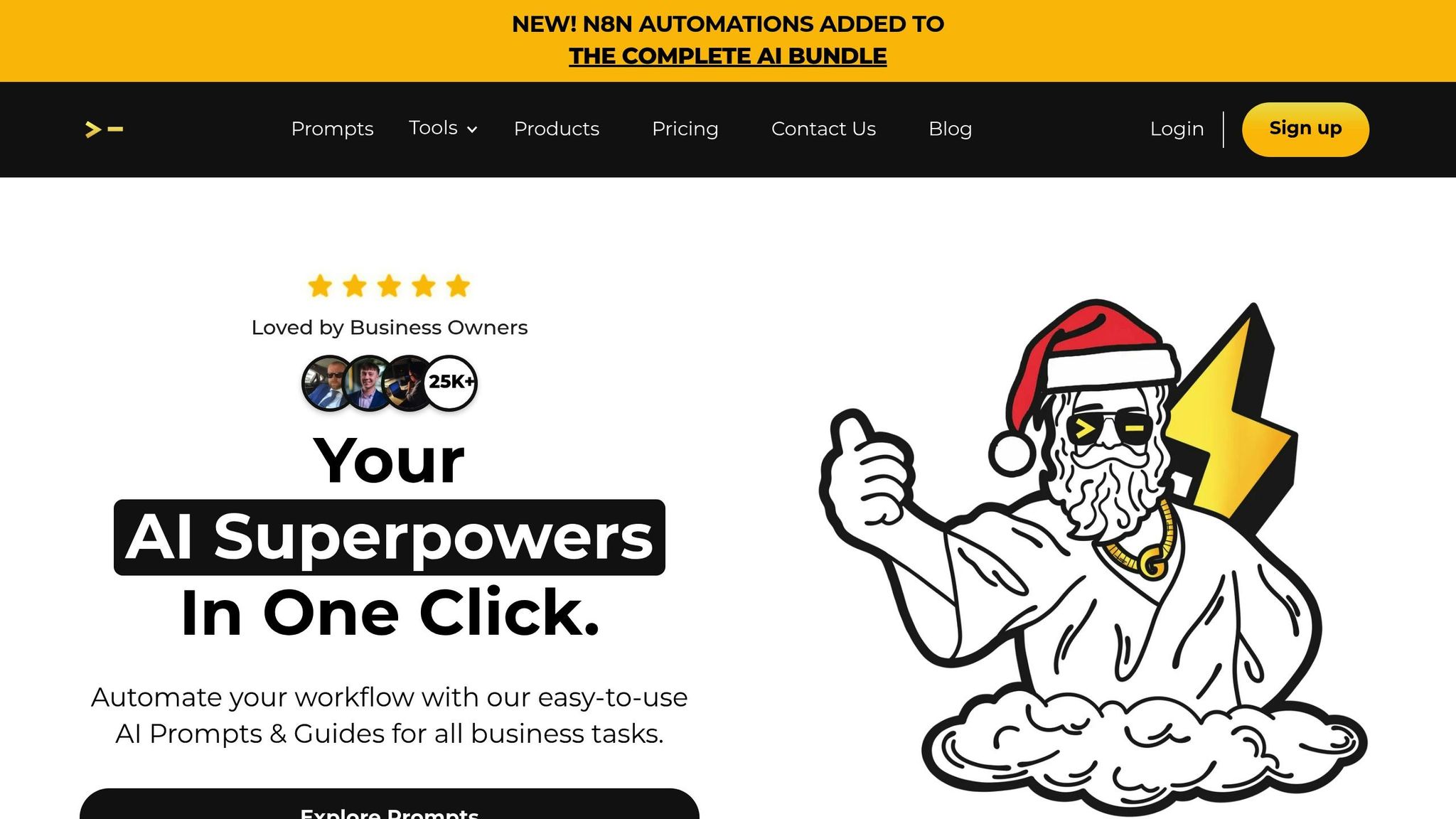
God of Prompt brings an impressive library of over 30,000 AI prompts, covering platforms like ChatGPT, Claude, Midjourney, Gemini AI, and newer tools such as Grok, Veo, and Sora. These prompts are neatly organized into categories like business, marketing, SEO, finance, e-commerce, education, sales, and productivity, making it easy to find what you need. A standout feature is its Mega-Prompts, which are detailed, structured instructions designed to produce professional-level results. You can even start with a free mega-prompt template to see the structure firsthand. Beyond the prompts, users gain access to an AI tools directory, a custom GPT toolkit, and guides on crafting effective prompts.
Prompt Quality
The prompts are meticulously crafted and structured to meet the needs of professionals and businesses. With over 2,000 Mega-Prompts for ChatGPT and more than 10,000 specialized prompts for Midjourney, the collection is built for delivering reliable, high-quality outputs. Each prompt is tested and fine-tuned to ensure consistency, making them suitable for tasks like marketing strategies, financial analyses, and more.
Pricing
God of Prompt uses a Lifetime Access model, offering all 30,000+ prompts, unlimited custom prompt creation, and updates for a one-time payment of $150.00. For those looking for smaller packages, there’s the ChatGPT Bundle at $97.00, the Midjourney Bundle at $67.00, and the Writing Pack at $37.00. A free tier is also available, including 1,000+ ChatGPT prompts, 100+ Midjourney prompts, and 10 Mega-Prompts. All paid plans come with a 7-day money-back guarantee.
Usability
The platform delivers everything through Notion, making it simple to search, filter, and organize prompts. Users can easily copy and paste prompts into their AI tools, and the categorized layout ensures quick access to relevant prompts. Updates are seamless - new prompts automatically appear in your Notion workspace.
Target Audience
God of Prompt is tailored for professionals and businesses that rely on AI for efficient, repeatable results. Solopreneurs, marketers, content creators, SEO experts, and finance professionals will find prompts specifically designed for their workflows. The focus on Mega-Prompts and business-oriented categories makes it especially useful for those who integrate AI deeply into their operations. Up next, we’ll explore AIPRM’s features.
2. AIPRM
Features
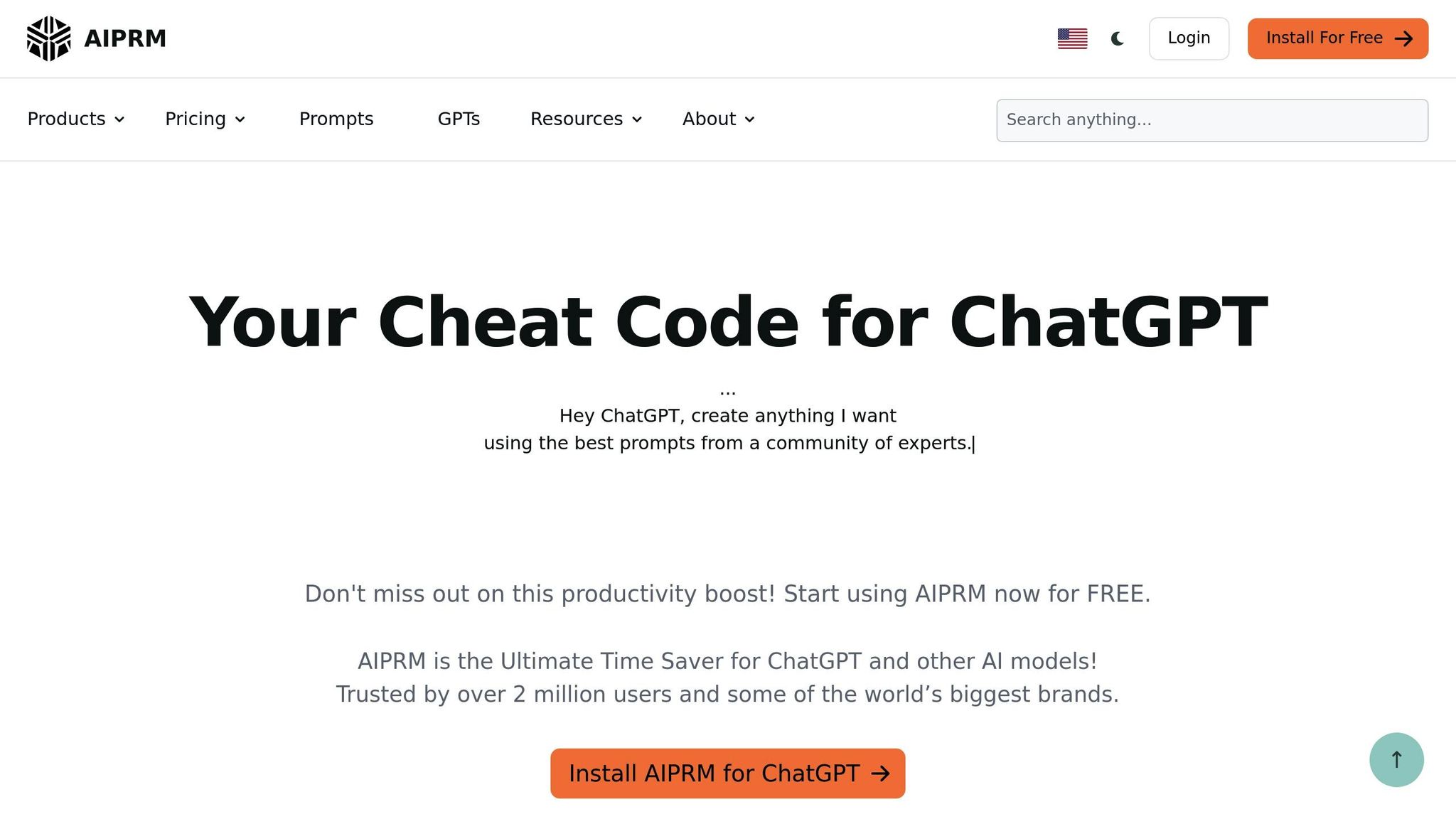
AIPRM is a browser extension that integrates seamlessly with ChatGPT and Claude, offering access to over 5,400 public prompts right within your AI interface. Its standout feature, "1-Click Prompts", allows users to instantly apply templates without any copying or pasting. Other key features include:
- Prompt Variables: Dropdowns and open fields within prompts for customization.
- Prompt Forking: Clone and modify existing prompts to suit specific needs.
- Live Crawling: Analyze URLs for up-to-date, real-time data.
- Omnibox Integration: Launch prompts directly from your browser's search bar.
With more than 2,000,000 users and over 1,000,000 Chrome extension installs, AIPRM is built to help teams streamline and standardize their AI outputs.
Prompt Quality
The platform ensures quality through community engagement and expert oversight. Each prompt features upvotes and usage stats, making it easy to identify effective options. Additionally, Verified Prompts - reviewed by expert Prompt Engineers - guarantee a higher standard of reliability. Alongside its public library, AIPRM hosts an impressive collection of 345,000 private prompts.
Pricing
AIPRM operates on a freemium model, offering free access to its extensive library of public prompts, basic team-sharing features, custom profiles, and advanced search tools. For those seeking more, paid tiers unlock premium features like Verified Prompts, Live Crawling, Prompt Forking, and Custom Tones for maintaining brand voice. Subscription options include:
- Plus: $20.00/month
- Pro: $39.00/month
- Elite: $79.00/month
"I have gone from basic subscriber to Elite and find this resource to be highly useful! ... The basic prompts are great and once results are returned, knowing how to refine the [output is key]" - Michael J. Sammut, Four Eyes Productions
Usability
AIPRM integrates directly into ChatGPT and Claude, providing an intuitive user experience. However, it doesn't support running alongside other ChatGPT extensions, so you'll need to disable any conflicting tools for the best results. The interface includes advanced search and filtering options, allowing users to sort prompts by topic, activity, and popularity. Whether you're working on SEO, sales, or marketing, finding the right prompt is straightforward, especially when using a comprehensive AI prompt bundle. The Chrome Web Store rates AIPRM 3.9 out of 5 stars, based on over 3,300 reviews.
Target Audience
This tool is designed for professionals like digital marketers, SEO specialists, sales teams, and customer support staff who want to standardize their AI-driven workflows. The Teams feature allows for easy sharing of curated prompt lists, ensuring consistent outputs across departments.
"I'm totally amazed with the 1 click prompts that saves me a lot of effort and valuable time" - Panagiotis Lymperopoulos, Fashion Photographer at KAVYAR
AIPRM is especially useful for businesses aiming to maintain high-quality, consistent prompt logic across their teams.
Up next, we’ll explore PromptBase's marketplace approach.
3. PromptBase
Features
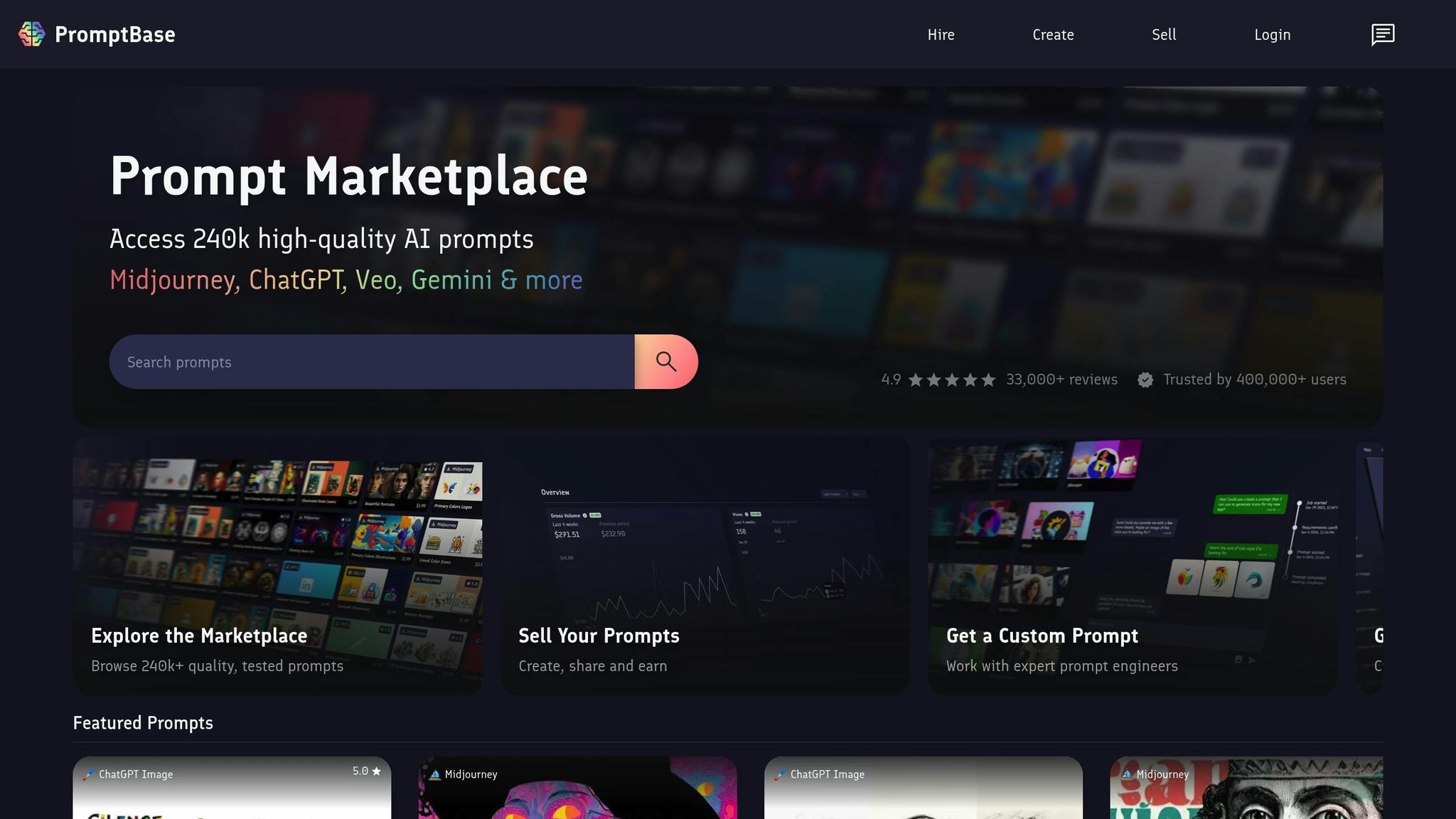
PromptBase stands out with its unique approach to prompt distribution. Instead of relying on a subscription model, it operates as a marketplace where users can buy and sell individual prompts. Supporting a variety of AI models - including DALL-E 3, Midjourney, Sora, Gemini, GPT-4, and Stable Diffusion - the platform provides detailed listings. Each listing includes technical specifications, example outputs, and style variations, giving buyers a clear understanding of what to expect.
The marketplace is equipped with powerful search and filtering tools, making it easy to browse by AI model or categories like "Logos", "Marketing", and "UX/UI." For creators, PromptBase offers tools for sales analytics and monetization, with an 80/20 revenue split - allowing sellers to keep 80% of their earnings.
Prompt Quality
PromptBase takes quality seriously. Unlike open community repositories, every prompt undergoes rigorous testing before being listed. This ensures that prompts perform as described, saving users time and reducing frustration. Additionally, the platform features a public ratings and reviews system, enabling buyers to assess seller profiles and the effectiveness of their prompts.
"Some of the prompts are well-crafted... Clear technical specifications, multiple style variations, produced consistently professional results." - Jess, Product Designer
With over 220,000 prompts available and more than 130,000 reviewed through its quality assurance process, PromptBase has established itself as a leader in the prompt marketplace [1,6].
Pricing
Prompts on PromptBase are priced between $1.99 and $9.99, with most falling in the $2.99 to $5.99 range. This pay-per-prompt model works well for those with occasional needs, though it may become costly for teams requiring a large volume of prompts.
Usability
Accessible via the web, PromptBase offers a user-friendly experience with tools to filter its extensive catalog by AI model, use case, or seller ratings. Each prompt listing provides detailed information - including example outputs and technical specifications - so buyers know exactly what they’re getting. However, the need to purchase prompts individually might feel less convenient compared to platforms offering unlimited-access subscriptions.
Target Audience
PromptBase is ideal for designers, developers, and product teams seeking high-quality, pre-tested prompts for specific tasks - whether it’s creating app icons or generating consistent marketing visuals. It’s also a valuable platform for prompt engineers, who can also turn ChatGPT into an expert prompt engineer to refine their submissions, offering a structured marketplace to monetize their skills with built-in payment processing and analytics tools.
Next, let’s look into how PromptHero approaches the marketplace.
4. PromptHero
Features
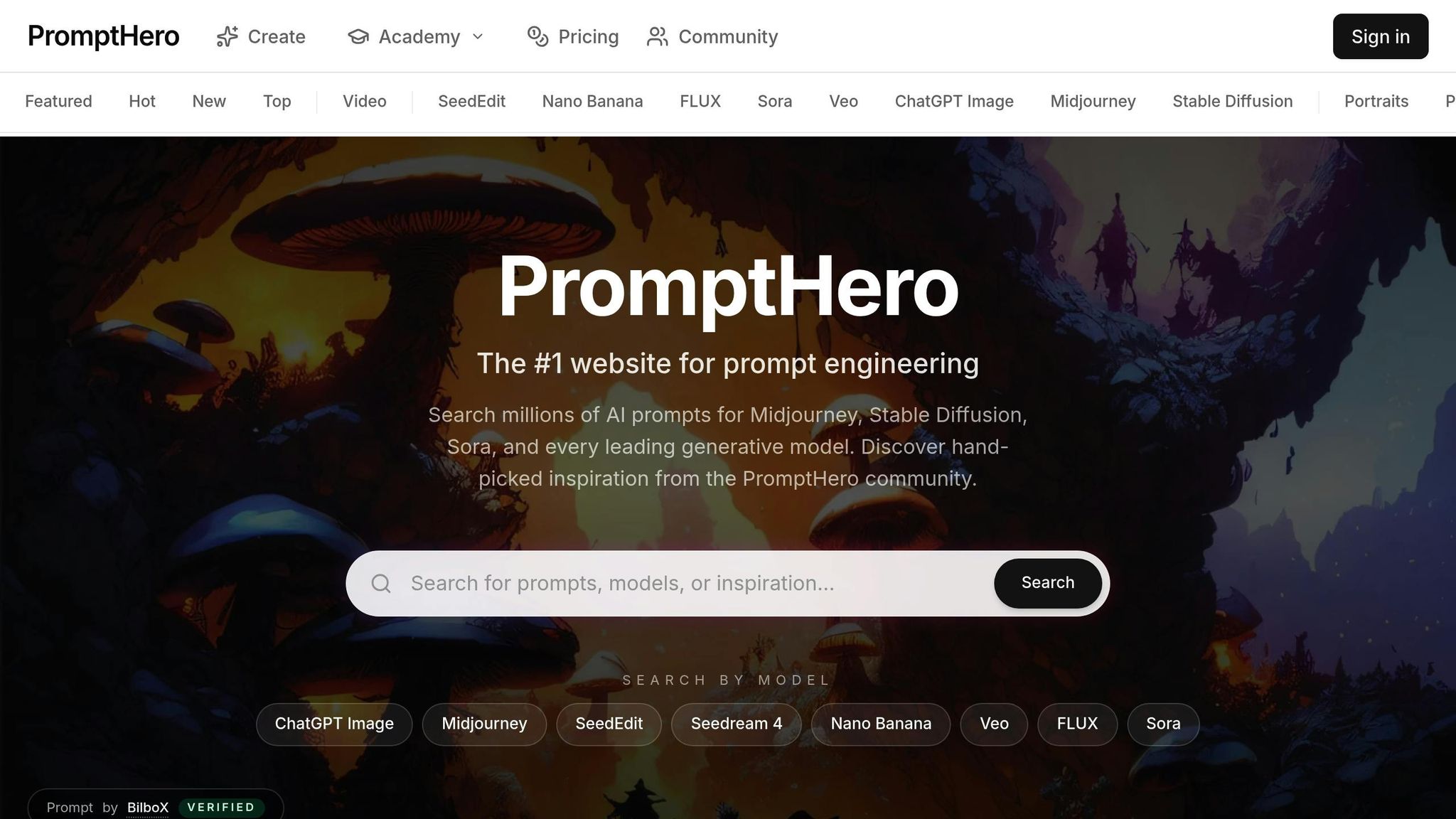
PromptHero brands itself as the "#1 website for prompt engineering", offering a searchable database packed with millions of AI prompts. What sets it apart? A visual-first approach that pairs each prompt with its actual AI-generated output, making it easier to see what works and why. Each prompt includes detailed technical parameters like aspect ratios, stylize values, and specific model versions to help users fine-tune their results. The platform also caters to niche creative needs, offering prompts tailored for projects such as T-shirt designs, website mockups, architectural concepts, and logo creation. On top of that, its "hand-picked" community inspiration section features verified, high-quality prompts curated for standout results. This focus on visuals and technical details underscores PromptHero's commitment to delivering effective and creative solutions.
Prompt Quality
One of PromptHero's standout features is its verification system, which flags effective prompts with a "Verified" badge. These verified prompts are backed by strong engagement metrics, helping users quickly spot reliable options. By displaying the actual output generated alongside each prompt, the platform eliminates guesswork. Plus, prompts are organized by specific generative models, ensuring compatibility across a wide range of AI tools.
Pricing
PromptHero is entirely free to use. Users can browse through millions of prompts, view their outputs, and copy the full prompt text without spending a dime. This makes it an accessible resource for anyone dabbling in AI art or searching for fresh ideas.
Usability
The platform's interface feels like an image gallery, putting visuals front and center. Each prompt is tagged with its corresponding generative model, making it easy to filter through options. With features like "Search by model" and a simple copy-paste function for full prompts, the platform is designed to be intuitive and user-friendly.
Target Audience
PromptHero is a go-to resource for AI artists, digital designers, and prompt engineers looking for creative inspiration or a chance to analyze complex prompt structures. It's especially useful for professionals working with image and video generation models who aim to achieve specific aesthetic styles, whether that's photorealism, cyberpunk, or traditional art styles like Ukiyo-e or Haida art. Additionally, the platform includes a job board that connects AI talent with employers, offering support for those pursuing careers in prompt engineering.
sbb-itb-58f115e
5. FlowGPT
Features
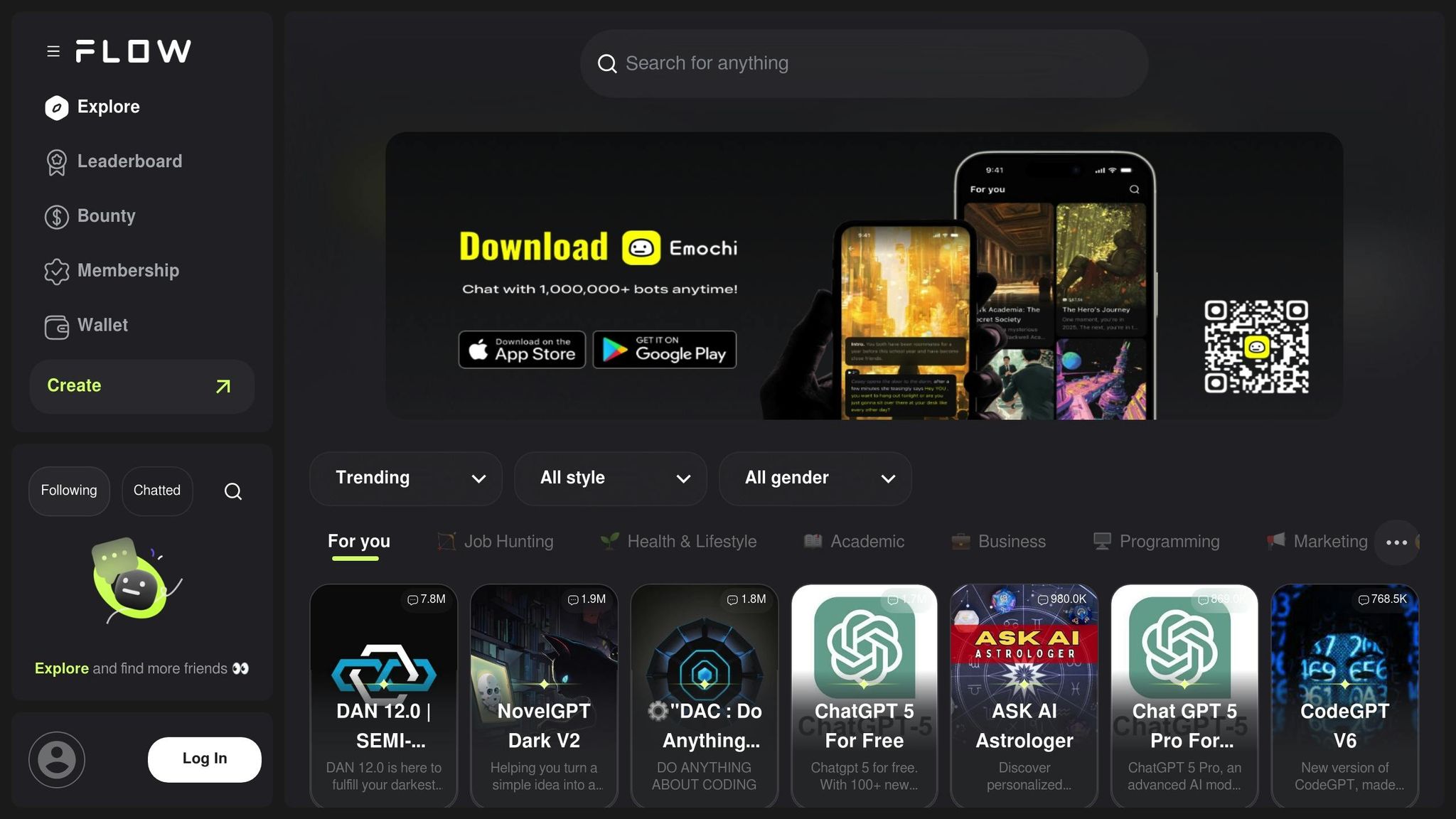
FlowGPT takes a unique, community-focused approach to AI prompts. Acting as a community-driven app store, it hosts a library of over 30,000 free prompts across various categories like business, programming, academic work, and creative roleplay. The platform features a visual interface, allowing users to manage conversations, craft stories, and organize projects using Flow boards. Additionally, users can upload files (PDFs, DOCX, or TXT) or share web links to ask ChatGPT specific questions about the content. With tools like the Creator Center and Leaderboard, FlowGPT showcases top-performing prompt engineers and trending prompts. Users also have the option to remix and customize existing prompts.
Prompt Quality
The quality of prompts on FlowGPT can be hit-or-miss. Roughly 10% of prompts are excellent, 30% are usable with some editing, and the remaining 60% tend to be generic. The platform relies heavily on community feedback - such as ratings, reviews, and comments - to highlight the best prompts. In February 2024, TechCrunch described FlowGPT as the "Wild West" of GenAI apps, noting its openness but also the variability in quality and safety. On average, users spend about 22 minutes browsing and testing to find a quality prompt. While the platform's pricing is appealing, reviewers have given it a Grade: C due to the time-consuming effort required to uncover high-quality prompts.
Pricing
FlowGPT offers a free, ad-supported plan, but users seeking advanced features can opt for paid tiers that use "Flux" credits as currency. The Plus Plan costs $14.99/month and includes 1,500 Flux credits, while the Ultra Plan is $24.99/month for 2,500 Flux credits, along with perks like AI memory multipliers and priority support. The platform uses a usage-based pricing model for its visual interface, measured in AI words. Free users get 20,000 AI words, 5 Flow boards, and 20,000 words of document uploads. For heavier usage, the Lite tier costs $50.00 for 100,000 AI words, and the Pro tier is $200.00 for 1 million AI words.
Usability
FlowGPT’s interface is clean and user-friendly, making it easier to refine and explore prompts. Users can filter prompts by "top-rated" or "recent updates" to quickly locate relevant options. However, because of its open marketplace model, users should carefully evaluate community submissions by checking ratings and creator activity before relying on a prompt for important tasks. It’s also worth noting that FlowGPT does not provide end-to-end encryption for chats, so sharing sensitive or confidential information is not recommended.
Target Audience
FlowGPT caters to a wide range of users, including students, writers, marketers, developers, and AI enthusiasts looking to experiment with AI models. Its community-driven approach appeals particularly to casual users, budget-conscious individuals, and roleplay fans who enjoy exploring creative prompts. Unlike subscription-heavy platforms, FlowGPT focuses on community contributions and experimentation, with a notable portion of its library dedicated to AI characters for anime, gaming, and scenario-based roleplay.
6. PromptLayer
Features
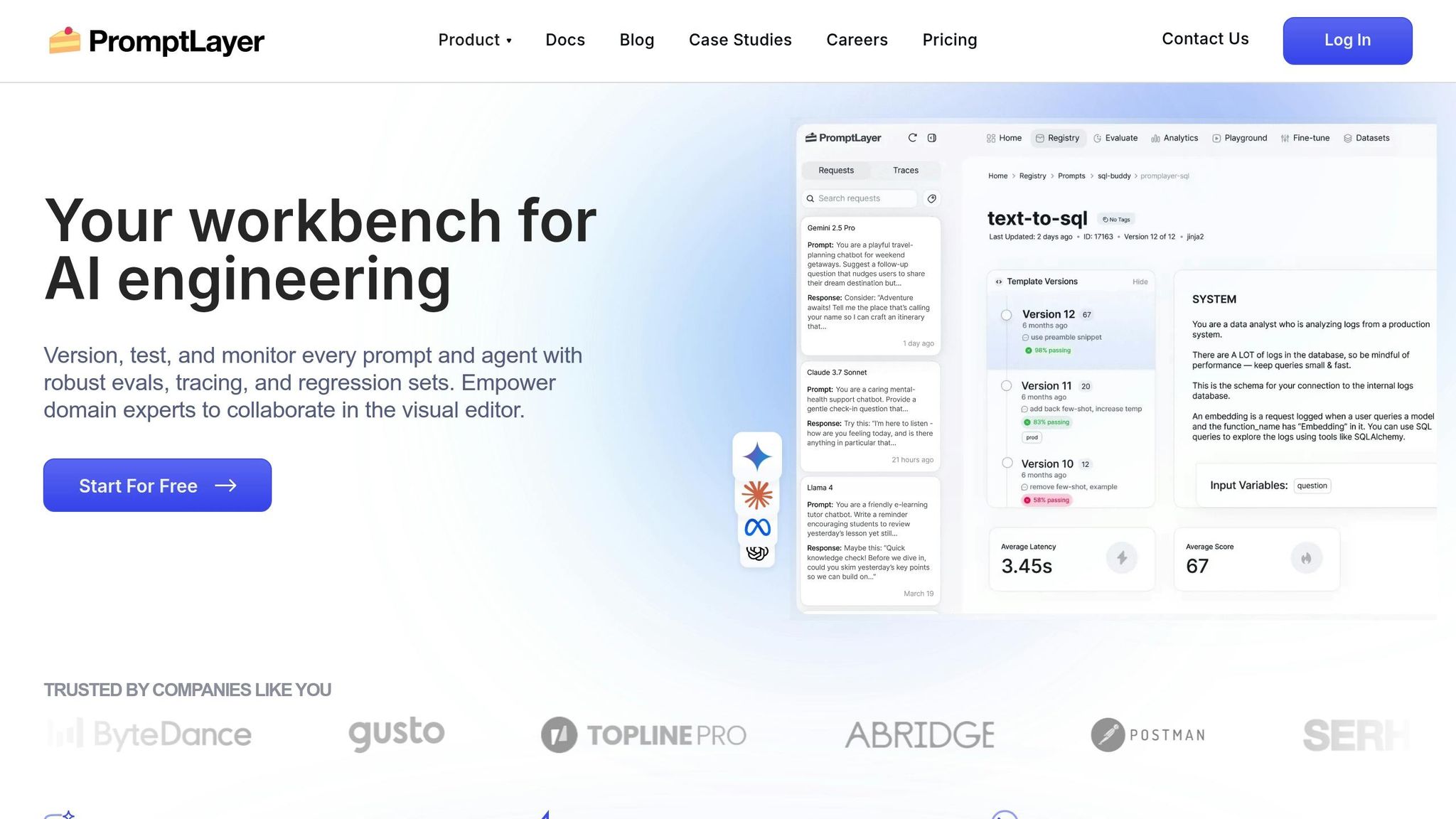
PromptLayer serves as a middleware solution, functioning like a content management system (CMS) specifically for prompts. It operates between your application and LLM tools and providers, allowing teams to manage, edit, and version prompts without needing to redeploy software. The platform logs all interactions, making it easy to track performance and conduct audits. With Git-style versioning, teams can monitor changes, revert to earlier versions instantly, and collaborate seamlessly on prompt development. Other key features include prompt pipelines with built-in guardrails, API access, and compatibility with workflow automation tools such as Zapier. This set of tools is designed to support teams looking for scalable solutions tailored to organizational requirements.
Pricing
PromptLayer follows a freemium model, offering free access to AI resources and community prompts while reserving advanced team-oriented features for paid plans. Unlike platforms that sell individual prompts, PromptLayer focuses on providing infrastructure for organizations managing their own internal prompt libraries.
Usability
This tool is built for professional workflows and team collaboration, emphasizing efficiency and reliability over simplicity. Its interface caters to users who need structured workflows, such as prompt pipelines, version histories, and deployment guardrails. While these features are powerful, they require some technical expertise, making the tool less accessible for beginners but highly effective for teams seeking consistent and controlled AI outputs.
Target Audience
PromptLayer is tailored for developers, product teams, and organizations that incorporate AI into their products. It’s designed for systematic prompt management with governance in mind, rather than casual users or those seeking one-off prompts. If your goal is to integrate AI into custom applications with full control over prompt logic and versioning, PromptLayer offers the tools needed for production-level deployment.
Pros and Cons
Here’s a breakdown of what each platform brings to the table, including their strengths and limitations.
AIPRM is a standout for its seamless integration with ChatGPT and Claude, offering one-click access to prompts. Its "AIPRM Verified" badges ensure a level of trust in quality. However, its focus is narrow, catering primarily to SEO and marketing tasks. This makes it less versatile for creative or technical needs, and the subscription-based pricing might not suit every budget.
PromptBase excels in quality control. Every prompt is manually reviewed before being listed, and it supports multiple models with detailed technical specs and example outputs. That said, the pay-per-prompt pricing model can add up quickly for frequent users, with prompts typically costing between $2.99 and $5.99. Additionally, sellers face a 20% commission fee.
PromptHero shines as a free discovery tool for visual content. It provides precise parameters like CFG scale, steps, and seeds, making it great for learning and replicating visual prompts. However, it’s limited to visuals - there’s no support for text-based tasks like coding or copywriting. Plus, the quality of community-submitted content can vary.
FlowGPT offers a vibrant, community-driven experience with features like bounties, hackathons, and a gamified system. Most of its content is free, supported by a native token system. With over 10 million users, it has a massive variety of prompts. However, quality can be hit or miss - a 30-day review found that 60% of prompts were subpar, with only 10% being genuinely useful. This inconsistency means users often spend extra time filtering through submissions.
Lastly, God of Prompt stands out with its extensive library of over 30,000 prompts, organized by business function. Its $150 lifetime access fee is appealing, but the platform requires Notion for access, which might be a hurdle for some users.
Here’s a quick comparison to help you decide:
| Platform | Key Strengths | Key Weaknesses |
|---|---|---|
| God of Prompt | 30,000+ prompts; $150 lifetime access; well-organized by business function | Requires Notion for access |
| AIPRM | Direct integration with ChatGPT/Claude; 4,500+ verified prompts; SEO/marketing focus | Platform-locked; subscription-based pricing |
| PromptBase | Manual quality checks; supports multiple models; 220,000+ prompts | Pay-per-prompt pricing; 20% seller commission |
| PromptHero | Free visual discovery; precise replication parameters | Visuals only; no text-based prompts |
| FlowGPT | Community-driven; gamified features; mostly free | Quality inconsistency; time-consuming filtering |
| PromptLayer | Git-style versioning; API access; team collaboration | Steep learning curve; developer-focused |
Each platform has its own strengths and trade-offs, so the best choice will depend on your specific needs and workflow.
Conclusion
Each platform serves different workflows and budgets, so the right AI prompt library depends on your specific needs and how you balance time and cost.
For those working across multiple AI models, God of Prompt's Complete AI Bundle offers lifetime access for $150, eliminating the hassle of recurring fees.
Marketing and SEO teams using ChatGPT might find AIPRM's browser integration a game-changer, with one-click prompts that streamline tasks - though it does come with a subscription fee.
If you're after a single, high-quality prompt for a specific project, PromptBase is a practical option. However, frequent use can become costly over time.
Visual creators will appreciate PromptHero's free gallery of millions of image prompts, complete with transparent parameters. It’s perfect for reverse-engineering stunning outputs.
For developers handling AI in production, PromptLayer offers Git-style versioning and API access, but it does require technical know-how.
Budget-conscious users can try FlowGPT, which offers free access and has drawn over 10 million users. That said, a 30-day test revealed that almost 60% of its prompts needed significant editing to be fully effective.
Ultimately, the best choice depends on your workflow. SEO specialists might benefit most from AIPRM, designers could thrive with PromptHero illustrations, and those seeking broad, cross-platform tools without ongoing costs may lean toward God of Prompt. Beginners can explore FlowGPT’s free tier to get started without any financial commitment.
Your time is valuable, and the right platform can save you hours of trial and error. Curated libraries deliver results quickly, while community-driven options might require more effort. Weigh your time investment against subscription costs to find the best return on your efforts.
FAQs
What should I look for when choosing an AI prompt library?
When you're picking an AI prompt library, there are a few important things to keep in mind to make sure it fits your needs. First up: prompt quality. A good library should offer prompts that are thoroughly tested, delivering accurate and consistent outcomes. This can save you a lot of time that might otherwise be spent tweaking or revising outputs.
Next, think about pricing. Whether it's a subscription model or pay-per-prompt, make sure the costs align with your budget while still offering solid value for the features and prompts provided.
You'll also want a library that covers a variety of use cases - whether you're working on marketing campaigns, coding projects, or something else entirely. The ability to customize prompts to suit your specific goals is another big plus. On top of that, look for seamless integration with the tools you're already using and an interface that's easy to navigate. These features can make your workflow much smoother.
Lastly, don't underestimate the importance of strong support. Clear documentation, responsive customer service, and an active user community can be incredibly helpful, especially if you're just starting out with generative AI.
What are the different pricing models for AI prompt libraries?
AI prompt libraries come with a variety of pricing options designed to suit different users. Many follow a freemium model, offering basic access at no cost, while unlocking extra features or prompts requires paid upgrades. These upgrades might involve monthly or annual subscriptions, or sometimes a one-time payment for lifetime access. For instance, some providers charge a flat fee between $0 and $150, which removes the need for ongoing payments.
Others operate on credit-based systems, where users buy credits to access prompts as needed, or offer tiered subscriptions that adjust pricing based on factors like usage, team size, or access to advanced tools. These options give users the flexibility to pick a plan that fits both their budget and their specific needs.
What is the best AI prompt library for professionals in fields like SEO or design?
For those working in SEO or design, God of Prompt is a standout tool. It offers an impressive library of over 30,000 pre-made prompts, catering to various tasks like creating keyword-focused blog outlines, writing meta descriptions, or designing UI mockups and visual-style prompts for platforms such as Midjourney and DALL-E.
What makes it even better is the ability to tweak prompts to fit specific needs. You can adjust factors like tone, length, and target audience. This means SEO professionals can generate content tailored to search intent, while designers can quickly create layouts, color palettes, and other creative elements. With pricing plans ranging from free to $150 per month, it’s a flexible option for both individuals and teams looking to grow.
Related Blog Posts

Loved by Business Owners


Based on 1K reviews
Get smarter on AI every week.
Ready to transform your business?