

Best AI Prompt Collections for Financial Advisors



AI prompts are changing the way financial advisors work by automating tasks, saving time, and improving client interactions. From creating meeting summaries to analyzing portfolios, these tools help advisors focus on what matters most - building relationships and delivering results. Here's what you need to know:
- Client Engagement: Use AI for sentiment analysis, automated follow-ups, and personalized educational content.
- Financial Analysis: Generate portfolio reports, track market trends, and create financial forecasts with AI-driven insights.
- Practice Management: Simplify meeting prep, compliance documentation, and client data organization.
- Business Development: Optimize lead scoring, craft targeted marketing content, and plan for growth.
Advisors using AI report saving up to 20 hours per week, boosting efficiency, and expanding their research capabilities. While AI is powerful, double-checking outputs for accuracy and compliance is critical. The key is blending AI's speed with human expertise for better outcomes.
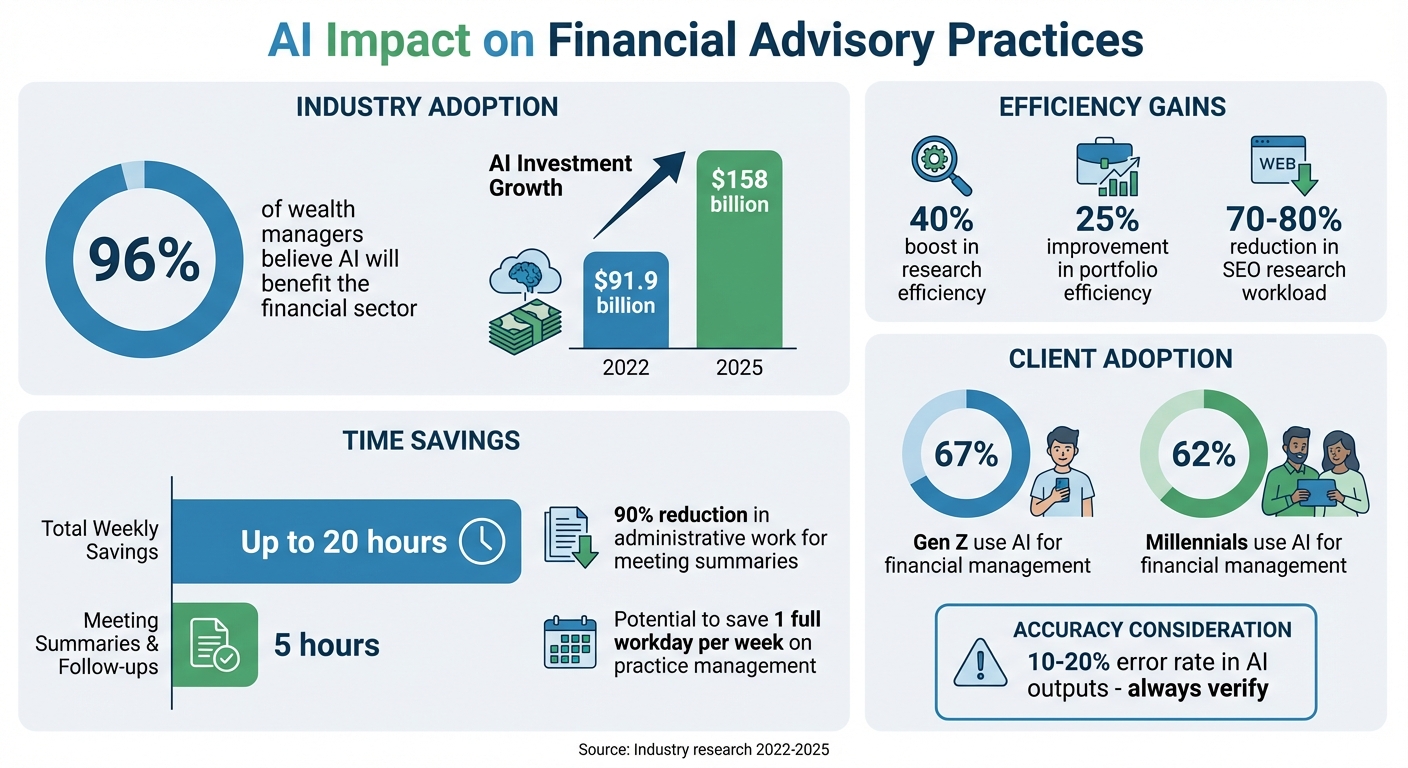
AI Benefits for Financial Advisors: Time Savings and Efficiency Statistics
AI Prompting 101: A Financial Advisor's Guide to Better Results
sbb-itb-58f115e
1. Client Engagement
AI prompts have become a game-changer in boosting client engagement. According to industry research, a whopping 96% of wealth managers believe artificial intelligence will benefit the financial sector. Advisors who rely on AI for tasks like meeting summaries and follow-ups can save about five hours each week. That’s time they can reinvest into building stronger, more meaningful relationships with their clients.
Here’s how AI prompts are reshaping client engagement:
Sentiment Analysis for Client Communications
One powerful application is sentiment analysis in client interactions. AI can pick up on emotional cues - like anxiety, confusion, or even panic - hidden in client emails, especially during turbulent market conditions. For instance, you could prompt AI with: "Analyze this message's emotional tone and craft a response that addresses both practical and psychological concerns, using principles of behavioral finance related to gains and losses." This approach ensures clients feel heard and supported.
Automated Meeting Follow-Ups
Streamlining post-meeting tasks is another area where AI shines. Meeting summaries generated by AI can cut administrative work by up to 90%. You might use a prompt like: "Create a detailed meeting summary that includes: 1) Topics discussed, 2) Decisions made, 3) Action items with owners and deadlines, and 4) A friendly follow-up email written in my voice." This not only saves time but also ensures nothing slips through the cracks.
Personalized Educational Content
Explaining complex financial concepts like tax-loss harvesting or asset allocation can be daunting. AI prompts make it easier by creating tailored, easy-to-understand guides for clients. To get the best results, instruct the AI to use relatable analogies while steering clear of compliance pitfalls like words such as "guarantee" or "promise." As Investopedia wisely notes:
"AI systems aren't mind readers. They're more like brilliant interns who need precise instructions".
These tools not only simplify communication but also enhance the overall client experience, making financial advice more accessible and personalized.
2. Financial Analysis
AI prompts are revolutionizing financial advising by enabling advisors to generate high-quality analyses in record time. By leveraging these tools, financial professionals can transform raw market data into actionable insights in just minutes. For instance, one investment advisory firm reported a 40% boost in research efficiency after adopting standardized AI prompts for tasks like value analysis and risk assessments. The key lies in crafting prompts that align with client-specific factors such as risk tolerance and investment horizons.
Portfolio Performance Reports
When analyzing portfolios, AI can evaluate critical metrics like the Sharpe Ratio, Sortino Ratio, standard deviation, and beta. By feeding the AI client-specific asset allocations and historical performance data, advisors can obtain tailored insights. If the results seem too broad, refine the prompts by incorporating established frameworks like Modern Portfolio Theory. This approach not only enhances the depth of analysis but also lays a foundation for tools like real-time market monitoring and predictive modeling.
Real-Time Market Intelligence
AI prompts are also a game-changer for staying on top of market developments. They can synthesize daily movements across major indices such as the S&P 500 and Nasdaq, while also tracking sector trends and geopolitical events. For even deeper insights, integrate alternative data sources like social media sentiment or satellite imagery to spot less obvious investment opportunities. A family office, for example, improved its portfolio efficiency by 25% by using AI prompts for systematic asset allocation that included alternative data.
Financial Forecasting and Scenario Modeling
When it comes to forecasting, provide the AI with at least six quarters of historical data and request a clear explanation of its reasoning. For scenario modeling, include variables such as potential revenue ranges, cost delays, and projected cash flow impacts to generate comprehensive best-case and worst-case scenarios. Incorporating current market trends and economic indicators ensures the analysis remains relevant. However, always review AI-generated insights critically. While these tools offer valuable frameworks, they should complement, not replace, professional judgment.
3. Practice Management
AI isn't just reshaping market analysis - it’s also making the day-to-day management of financial advisory practices far more efficient. Administrative tasks often eat into the time advisors could spend serving clients, but AI-driven tools can help reclaim those hours. By automating repetitive workflows with structured prompts, advisors can potentially save an entire workday each week when these tools are used thoughtfully and systematically. The challenge lies in maintaining the accuracy and compliance required in this highly regulated industry.
Meeting Preparation and Scheduling
Preparing for client meetings can be time-consuming, but AI makes it easier by generating comprehensive agendas. For example, prompts like "Create an agenda for a client financial review meeting covering portfolio performance, tax planning, and estate updates" ensure that every crucial topic is addressed. This not only saves preparation time but also ensures consistency across meetings, reducing the chance of missing important details during hectic schedules. Such a methodical approach supports compliance efforts and simplifies client record management.
Compliance Documentation
In the world of financial advising, regulatory compliance is non-negotiable, and keeping up with documentation can be overwhelming. AI can assist by creating tailored compliance checklists. Prompts such as "Generate a compliance checklist for meeting fiduciary responsibilities" or "Create an SEC audit readiness checklist for a wealth management firm" streamline this process. These automated outputs help advisors stay on top of regulatory demands while complementing the analytical advantages AI offers. However, it’s crucial to cross-check all citations and references against official regulatory standards to ensure accuracy.
Client Record Organization
Managing client data often involves sifting through unstructured information - from emails to tax forms to meeting notes. AI can simplify this by extracting key details and converting them into actionable CRM entries. For instance, it can organize data from 1099 forms or update records with details like children’s names and birthdates. That said, experts advise handling AI outputs with care, especially for sensitive tasks. When dealing with Social Security numbers or account details, it’s essential to rely on secure, enterprise-grade tools rather than public AI platforms to ensure compliance with industry regulations.
4. Business Development
AI prompts are reshaping how financial advisors approach growth and market expansion. While offering great service is essential, building a thriving financial advisory practice also requires smart client acquisition and effective marketing strategies. With AI tools, advisors can pinpoint high-value prospects, craft engaging content, and design data-backed growth plans.
Lead Scoring and Prospecting
Targeting the right clients is crucial for a profitable practice. AI-driven lead optimization tools can evaluate a prospect's profile against thousands of successful conversions to estimate their potential value. For example, prompts like "Evaluate this lead's likelihood to convert based on their assets, age, and goals" help prioritize outreach efforts. With global AI investment expected to jump from $91.9 billion in 2022 to over $158 billion by 2025, advisors who adopt these tools gain a competitive edge. The shift toward hyper-personalized communication is also transforming outreach strategies. Instead of generic messages, AI enables tailored follow-ups that resonate with individual prospects, laying the groundwork for stronger engagement and better conversion rates.
Content Marketing and SEO Strategy
Educational content is a powerful way to establish authority and draw in potential clients. AI prompts can quickly generate blog posts, newsletters, and social media updates that simplify complex topics like tax-smart investing or estate planning. On the SEO front, AI tools streamline research by cutting the workload by up to 70–80%, turning hours of effort into minutes. Prompts such as "Find keyword opportunities to attract high-net-worth clients in [your city]" allow advisors to dominate local search rankings. As Google Search Advocate John Mueller put it:
"AI won't replace SEO experts. But SEO experts using AI will replace those who don't".
This combination of AI-driven content creation and SEO optimization equips advisors with the tools to stand out in a crowded market.
Strategic Growth Planning
Expanding a practice requires a clear, actionable plan. AI prompts like "Develop a 12-month growth strategy for targeting retirees with $500,000+ in investable assets" provide detailed roadmaps for scaling operations. Similarly, sales mapping prompts offer step-by-step frameworks for acquiring and monetizing new clients. By automating parts of the strategic planning process, advisors can save up to an entire workday each week, freeing up time to focus on building stronger client relationships. The key lies in crafting prompts that deliver actionable steps, ensuring that advisors can implement strategies immediately to achieve measurable results.
Conclusion
AI prompt collections provide financial advisors with a practical way to handle the increasing demands of modern practice management. Whether it’s drafting tailored client emails or analyzing market trends in record time, these tools act like a virtual assistant, taking care of routine tasks so advisors can focus on building meaningful relationships and making strategic decisions.
Advisors who integrate AI into their workflows report notable time savings - some reclaiming up to an entire workday each week and others citing a 20-hour weekly reduction in workload. These efficiency gains highlight AI's potential to simplify operations, but they also come with the responsibility of ensuring accuracy.
Accuracy remains a critical concern. Large language models like ChatGPT are known to produce errors in 10% to 20% of their outputs. As Mark, a financial advisor at MileWealth, wisely points out:
"Assuming the tool is trying to sneak errors past you is a wise starting place".
This makes it essential to double-check technical details against official standards, start new chats for separate tasks to avoid context errors, and avoid entering sensitive client information - like Social Security numbers or bank account details - into public AI tools.
The key to success lies in combining AI's efficiency with human expertise. Danielle Mehia, Senior Vice President and Financial Advisor at Wealth Enhancement Group, explains:
"Rather than choosing between AI and a financial advisor, find the sweet spot between the two. Consider using AI for your day-to-day planning... and rely on your financial planner for your major money moves".
Start small. Use AI to create reusable "Clone Kits" that embed your style guides and decision-making logic, allowing you to scale your efforts across multiple client interactions. Craft detailed prompts that provide clear context about the purpose, audience, and tone to ensure professional outputs that save time rather than create more work. After all, the quality of AI outputs depends heavily on the quality of the prompts.
With 67% of Gen Z and 62% of millennials already using AI for financial management, it’s clear this technology is here to stay. Financial advisors who thoughtfully adopt AI - verifying outputs, safeguarding privacy, and maintaining a personal touch - can offer faster, more data-driven services while continuing to strengthen the client relationships that are fundamental to successful financial planning.
FAQs
How can financial advisors use AI prompts to enhance client engagement?
AI prompts empower financial advisors to deliver personalized, timely communication that keeps clients engaged and well-informed. By leveraging a client’s profile, advisors can quickly craft tailored email updates, financial summaries, or investment performance snapshots. These are formatted to U.S. standards - think dollar amounts like $12,500.00 and dates in MM/DD/YYYY format. This kind of proactive outreach not only strengthens trust but also reassures clients that their portfolios are being actively managed.
Beyond emails, AI prompts can simulate interactive conversations with clients. For example, they can ask targeted questions about financial goals, risk tolerance, or significant life events. These dynamic exchanges simplify complex financial topics, making them easier to grasp. They can also uncover opportunities for additional services, like retirement planning or tax strategies. On top of this, prompts can help advisors create educational content - such as blog posts or social media updates - to showcase their expertise and maintain client engagement between meetings.
Another major advantage? AI takes care of routine tasks like quarterly check-ins, market updates, and compliance notifications. This ensures consistent, accurate communication while freeing up advisors to focus on strategic planning. Clients, meanwhile, benefit from receiving the timely and relevant updates they expect in today’s fast-paced financial world.
What are the main advantages of using AI for financial advisors?
AI brings a host of benefits to financial advisors, primarily by taking over tedious tasks like data entry, report generation, and compliance documentation. By automating these processes, advisors can reclaim their time and focus on strategic, high-impact activities, ultimately boosting their productivity.
On top of that, AI-powered tools excel at producing personalized client communications - think emails, investment summaries, or financial reports. These tools ensure that communication is not only efficient but also professional and tailored to each client, fostering stronger engagement and trust.
When it comes to investment research, AI steps in to deliver faster and more precise insights. It can analyze market trends, weigh investment options, and develop customized strategies, making it easier for advisors to make informed, data-driven decisions. This edge is invaluable in staying competitive.
Lastly, AI simplifies compliance by generating up-to-date regulatory reports and securing sensitive client data. This reduces risks, strengthens trust, and ensures advisors are always aligned with the latest regulations.
How can financial advisors use AI tools while staying compliant?
Financial advisors can stay compliant by using AI as a helpful tool to enhance their work, not as a substitute for their professional expertise. It's crucial to integrate safeguards into workflows and opt for AI platforms that provide audit trails and human oversight. These features allow all inputs and outputs to be logged and reviewed, ensuring transparency and alignment with regulatory standards.
Choose secure, private AI solutions that safeguard client data and regularly monitor updates to regulations. Always double-check AI-generated outputs before presenting them to clients to ensure accuracy and compliance. Following industry guidelines, such as those from FINRA, can help advisors stick to best practices for data privacy, record-keeping, and model management. By adopting these measures, advisors can use AI to enhance their services while staying firmly within compliance boundaries.
Related Blog Posts

Loved by Business Owners


Based on 1K reviews
Get smarter on AI every week.
Ready to transform your business?