

Best AI Prompts for Real Estate Professionals




Want to save hours on repetitive real estate tasks? AI tools like ChatGPT and Midjourney can turn 15–20 hours of weekly work into just 3–5 hours. From crafting property listings to automating client follow-ups, the secret lies in writing effective prompts. Here’s what you can do:
- Write property descriptions in minutes: Generate tailored listings for MLS, brochures, and social media.
- Personalize client communication: Draft follow-up emails, clarify real estate jargon, or respond to objections with data.
- Build pricing strategies: Use local data to create tiered pricing options and predict market trends.
- Enhance outreach: Create engaging, personalized follow-ups that reflect client preferences.
AI doesn’t replace your expertise - it supports it. Start small by automating one task and refine the output with your personal touch. Tools like ChatGPT Plus ($20/month) can help you stay efficient and meet client expectations without burning out.
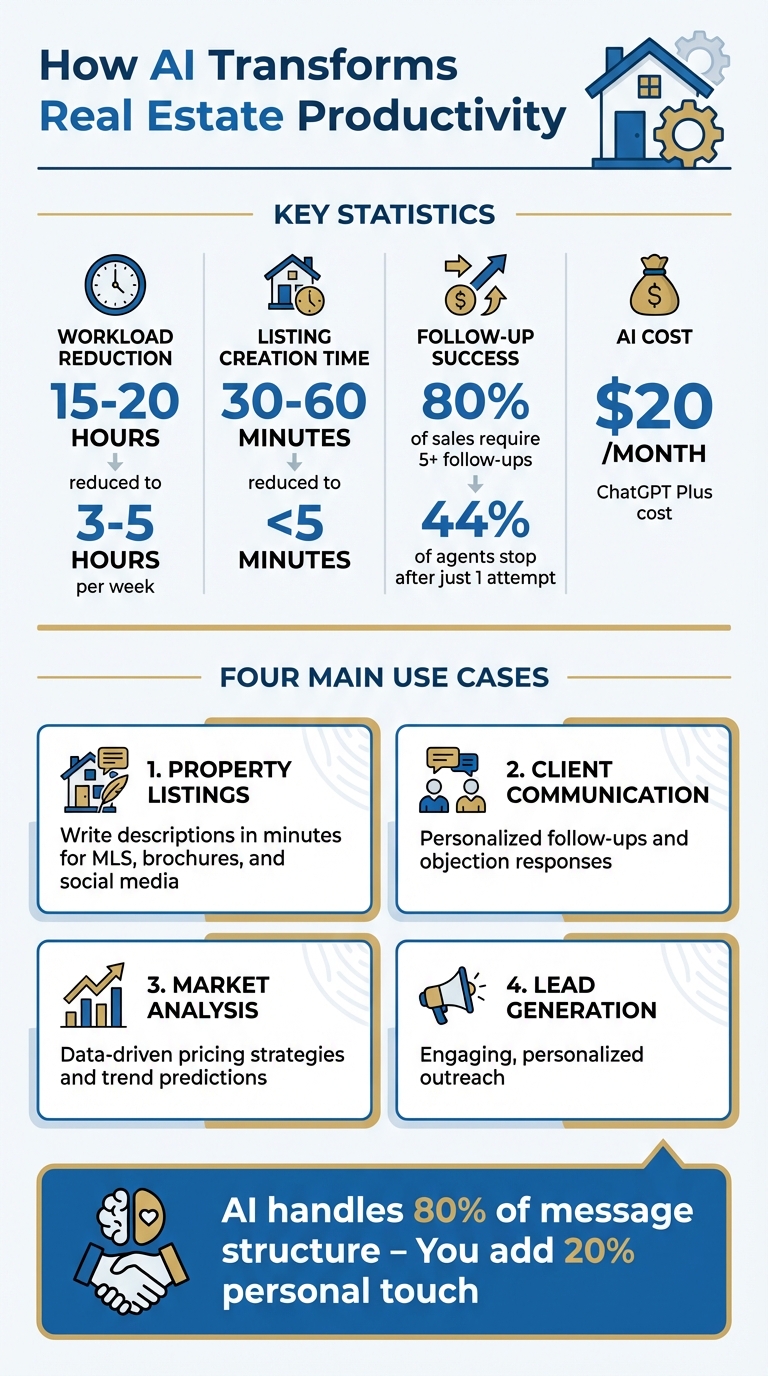
AI Time Savings for Real Estate Professionals: Key Statistics and Benefits
10 ChatGPT Prompts Every Realtor Should be Using in 2025.
sbb-itb-58f115e
1. Property Listings and Descriptions
Crafting a standout property listing can be a time-consuming task, often taking 30 to 60 minutes to complete. But with AI, that process can be trimmed down to less than five minutes. AI tools simplify the creation of property listings, saving valuable time while adding an extra layer of appeal. The trick lies in crafting prompts that go beyond the basics - ones that bring the property to life and evoke an emotional connection.
Create Multiple Listing Versions for Different Platforms
AI can whip up three versions of a listing in one go: a detailed 300-word write-up for the MLS, a mid-length version perfect for brochures, and a concise 50-word teaser for social media. All you need to do is provide the property details - like a "3-bedroom, 2-bath ranch in Scottsdale with a pool" - define the target audience (e.g., young families), and specify the word count for each format. AI takes care of the bulk of the work, leaving you to add those local, personal touches. The result? Listings that resonate emotionally with different buyer profiles across platforms.
Build Lifestyle-Focused Descriptions with Buyer Profiles
To make your listing truly stand out, focus on the lifestyle it offers rather than just rattling off specs. Start by defining your ideal buyer - whether it’s first-time homeowners, retirees, or affluent families - and guide AI to highlight how the property fits their lifestyle. For example, instead of saying "kitchen with large windows", you could prompt AI to write something like, "Start your day with a cup of coffee in a sunlit kitchen nook."
Tom Ferry sums it up perfectly:
"The best listing descriptions are capable of influencing a consumer's psychology to change what they'll see before they even step foot in the home".
Including the seller’s personal favorites, like "breathtaking sunset views from the master bedroom", adds an authentic, emotional touch.
Add Fair Housing Guardrails and SEO Keywords
To keep your listings legally compliant, instruct AI to "adhere to Fair Housing language standards" and avoid references to school districts, family status, or demographics. At the same time, enhance visibility by weaving in hyper-local SEO keywords - think neighborhood names or nearby landmarks. This approach ensures your listings stay compliant while gaining maximum online exposure.
2. Client Communication
Communicating with clients takes time but is absolutely necessary. Did you know that 80% of sales require at least five follow-ups to close, yet 44% of agents stop after just one attempt?. AI tools can help fill that gap by automating routine messages while still keeping them personal and professional. The trick is to provide the AI with specific context - such as client names, property details, or unique preferences - so the messages don’t come across as mechanical.
Craft Thoughtful Follow-Up Emails After Showings
A generic "just checking in" email rarely gets a response. Instead, you can use AI to draft follow-ups that highlight specific features the client appreciated during a showing and offer to schedule another visit. For instance: "Draft a follow-up email to [Client Name] about their tour of [Property Address]. Mention the sunlit kitchen they loved and offer to arrange a second showing." By referencing details that matter to the client, you turn a routine email into a meaningful and engaging conversation starter.
Respond to Objections with Data-Driven Replies
When clients express concerns about pricing or timing, AI can help craft a thoughtful, fact-based response. For example, you could use a prompt like: "Write a response to a seller who says, 'I think we should price higher.' Include market data and acknowledge their concerns while explaining your pricing strategy." This approach ensures your reply is professional, empathetic, and persuasive - without the stress of coming up with the perfect wording on the spot.
Simplify Real Estate Jargon for First-Time Buyers
For first-time buyers, real estate terms can feel like a foreign language. AI is great at breaking down complex concepts into plain, easy-to-understand language. You might ask it: "Explain how a 1031 exchange works in simple terms for a client new to investment properties, using no more than 150 words". It can also summarize contracts or create step-by-step guides for processes like getting a mortgage, making the information clear and actionable.
By letting AI handle about 80% of the message structure, you free up time while still adding your own 20% of local, personal touches. This way, your communication remains efficient without losing its personal touch.
This approach to personalized communication lays the groundwork for accurate market analysis and targeted outreach.
3. Market Analysis and Pricing
Getting the price right on a property can make all the difference in closing a deal. AI tools can help you create well-supported, data-driven pricing strategies. The trick? Feed the AI with hyper-local data - like median home prices, average days on market, and recent comparable sales - to avoid inaccurate results. For example, in March 2025, agent Jim Chambers successfully secured a $1.1 million listing for five hurricane-damaged condos by using AI-powered market analysis to back his pricing strategy. Once you’ve gathered the data, you can break it down into structured, tiered pricing options.
Develop 3-Tier Pricing Strategies Based on Market Conditions
Instead of asking the AI for just one price recommendation, consider requesting a pricing range with three tiers: conservative, likely, and aggressive. For example, you might prompt the AI with: "Using these comps, generate conservative, likely, and aggressive pricing tiers for a 3-bedroom home, including a brief explanation for each." This approach gives sellers flexibility while managing their expectations.
Why does this matter? Take the Oklahoma City housing market in July 2025. There was a $55,000 gap between the median list price ($285,000) and the median sales price ($230,000). This kind of disparity underscores the importance of having multi-tiered strategies to navigate different market dynamics.
Use Local MLS Data to Predict Market Trends
AI tools like ChatGPT Plus can now perform "Deep Research", pulling insights from trusted platforms like Redfin, Zillow, and the National Association of Realtors. These tools can analyze shifts in inventory and buyer behavior. By combining recent MLS data with web research, you can ask: "Synthesize this MLS data with current web research to predict inventory and price movements for ZIP code 73120 over the next six months."
By the end of 2025, agents using this method were producing accurate forecasts for specific ZIP codes by blending local data with broader economic trends. These forecasts not only aid in pricing but also set the stage for in-depth neighborhood comparisons.
Turn Neighborhood Comparisons Into Stories
Numbers alone don’t sell homes - clients want to understand the lifestyle a neighborhood offers. Use AI prompts to create comparisons that go beyond statistics, focusing on factors like school quality, commute times, walkable amenities, and the overall community vibe. For example, you could ask: "Compare neighborhoods A and B for a family with two kids. Include school ratings, average home prices, commute times to downtown, and local amenities like parks and coffee shops."
This approach transforms raw data into a compelling narrative, helping clients imagine what life could look like in their new home. It’s not just about the numbers; it’s about painting a picture that resonates with buyers.
4. Lead Generation and Outreach
Craft Personalized Follow-Ups That Reference Real Interactions
Generic follow-up emails often get ignored. To stand out, craft messages that reflect specific details from your CRM. For instance, if a lead mentioned loving a particular feature or shared their budget, weave those details into your outreach. Here’s an example: "Write a follow-up email to Sarah, who toured 123 Oak Street last weekend. Mention that she loved the modern kitchen and is aiming to stay under $750,000. Keep the tone casual."
The trick is letting AI handle the groundwork while you add the finishing touches - like a local reference, a relatable anecdote, or a detail that builds trust. Instead of just listing stats like square footage or bedroom count, paint a picture of the lifestyle: "Picture yourself enjoying your morning coffee under that beautiful maple tree in the backyard." This approach not only personalizes your outreach but also opens the door to a variety of engagement strategies.
For leads who are "just looking", avoid pushing too hard. Instead, try a prompt like: "Write a friendly email to a buyer who said they're just browsing. Briefly explain why getting pre-approved early can be helpful. Keep it casual and end with a no-pressure call to action for a discovery chat." This gentle tone keeps the conversation alive without overwhelming them, ensuring you stay top-of-mind when they’re ready to take the next step.
Conclusion
Imagine cutting your administrative workload from 15–20 hours a week down to just 3–5 hours. That’s exactly what real estate professionals are achieving by weaving AI prompts into their daily routines. These tools don’t replace your skills - they enhance them by handling repetitive tasks.
"The agents who embrace AI prompts aren't replacing their expertise. They're amplifying it." – Colibri Real Estate
From crafting polished property listings to creating personalized client messages, AI can help you work smarter. Start small: automate one time-consuming task and gradually build a library of ChatGPT mega-prompts tailored to your needs. Let AI handle the heavy lifting for a first draft, and then refine it with your unique style and expertise.
The best part? These tools are accessible. The free version of ChatGPT covers most basic tasks, while ChatGPT for business applications often require more robust setups. while ChatGPT Plus, at just $20 per month, unlocks advanced features like voice mode for practicing scripts or analyzing PDFs. It’s a minimal investment for a tool that offers speed, scale, and the ability to meet modern buyers' expectations for quick responses and engaging storytelling - all without the risk of burnout.
FAQs
How can AI tools improve my real estate property listings?
AI tools are a game-changer when it comes to crafting engaging, SEO-friendly property descriptions that emphasize a home's standout features and connect with the right buyers. These tools can also take care of time-consuming tasks like editing and formatting, ensuring your listings look polished and professional without the extra effort.
On top of that, AI can create lifestyle-oriented content that speaks directly to buyers, helping your properties shine in a crowded market. By letting AI handle the heavy lifting of content creation, you can simplify your workflow and focus on what really matters - closing deals.
What are the advantages of using AI for communicating with clients in real estate?
AI is transforming the way real estate professionals communicate with their clients, making interactions faster and more efficient. With AI tools, agents can craft polished emails, follow-up messages, and market updates in just minutes. These messages maintain a professional tone while being customized for each client - whether it’s a personalized greeting, property highlights, or clear explanations of market trends.
Routine tasks like answering inquiries and scheduling follow-ups can also be automated, ensuring timely responses and consistent communication. This frees up agents to dedicate more energy to building relationships and closing deals. The outcome? Enhanced productivity, stronger client connections, and a standout experience in an increasingly competitive market.
How can AI prompts assist real estate professionals with market analysis and pricing?
AI prompts are transforming how real estate professionals handle time-consuming tasks like market analysis and pricing research. Instead of spending hours sifting through data, agents can now generate detailed insights in seconds. For instance, a prompt such as “Analyze market trends for single-family homes in the Dallas-Fort Worth area for Q4 2025, including average price per square foot, inventory levels, and buyer preferences” can produce a clear, actionable report. This helps agents quickly gauge whether home prices are climbing, holding steady, or dropping - and identify the factors behind these shifts.
When it comes to pricing strategies, AI prompts shine by creating comparative market analyses (CMA), suggesting optimal list prices, and even running pricing simulations. Imagine using a prompt like “Calculate the median sale price for 3-bedroom homes within a 5-mile radius of 123 Main St, Chicago, IL, over the past 12 months, adjust for a 2% seasonal uplift, and recommend a competitive list price”. Within moments, agents receive data-driven recommendations that align with market trends, allowing them to set prices that balance seller expectations with buyer demand.
By handling these labor-intensive tasks, AI prompts free up agents to focus on higher-value activities like decision-making and client interactions. They also ensure agents stay informed about market changes in real time and deliver polished, U.S.-formatted reports to clients. The outcome? Faster, more precise pricing strategies and a sharper edge in the competitive real estate landscape.
Related Blog Posts

Loved by Business Owners


Based on 1K reviews
Get smarter on AI every week.
Ready to transform your business?