AI prompt libraries make working with tools like ChatGPT, Claude, and Midjourney faster and easier by offering pre-made instructions. Instead of spending time creating prompts from scratch, these libraries provide options that save users hours each week. The article compares five major platforms – God of Prompt, PromptBase, AIPRM, PromptHero, and FlowGPT – focusing on their features, pricing, supported AI tools, and best use cases.
Key Takeaways:
- God of Prompt: Offers over 30,000 prompts (50,000+ with premium) for $150 lifetime access. Best for business and marketing tasks.
- PromptBase: A marketplace with 240,000 prompts, priced $1.99–$9.99 each. Ideal for one-off, specific needs.
- AIPRM: A browser extension for ChatGPT and Claude, with 4,500+ curated prompts. Free and premium tiers available. Great for SEO and marketing workflows. You can also use specific prompts for SEO writing to streamline content production.
- PromptHero: Millions of prompts focused on image generation across tools like Midjourney and Stable Diffusion. Best for visual creators.
- FlowGPT: Community-driven platform with free and paid options. Best for general use but may require extra effort to find high-quality prompts.
Quick Comparison
| Platform | Library Size | Supported Tools | Pricing | Best For |
|---|---|---|---|---|
| God of Prompt | 30,000+ (50,000+ paid) | ChatGPT, Claude, Midjourney, Gemini | $150 lifetime | Business & marketing tasks |
| PromptBase | 240,000+ | ChatGPT, Midjourney, DALL-E, others | $1.99–$9.99 per prompt | Specific, one-off projects |
| AIPRM | 4,500+ | ChatGPT, Claude, Custom GPTs, Midjourney | Free and premium tiers | SEO & marketing workflows |
| PromptHero | Millions | Midjourney, Stable Diffusion, others | Free with optional upgrades | Image generation |
| FlowGPT | Thousands | ChatGPT, limited others | Free, $50–$200 tiers | General use, varied quality |
Each platform has strengths depending on your goals. For text-based tasks, AIPRM or God of Prompt are strong options. Visual creators may prefer PromptHero or other top AI art generators, while PromptBase is perfect for specific needs. FlowGPT offers flexibility but may require more effort to find quality prompts.
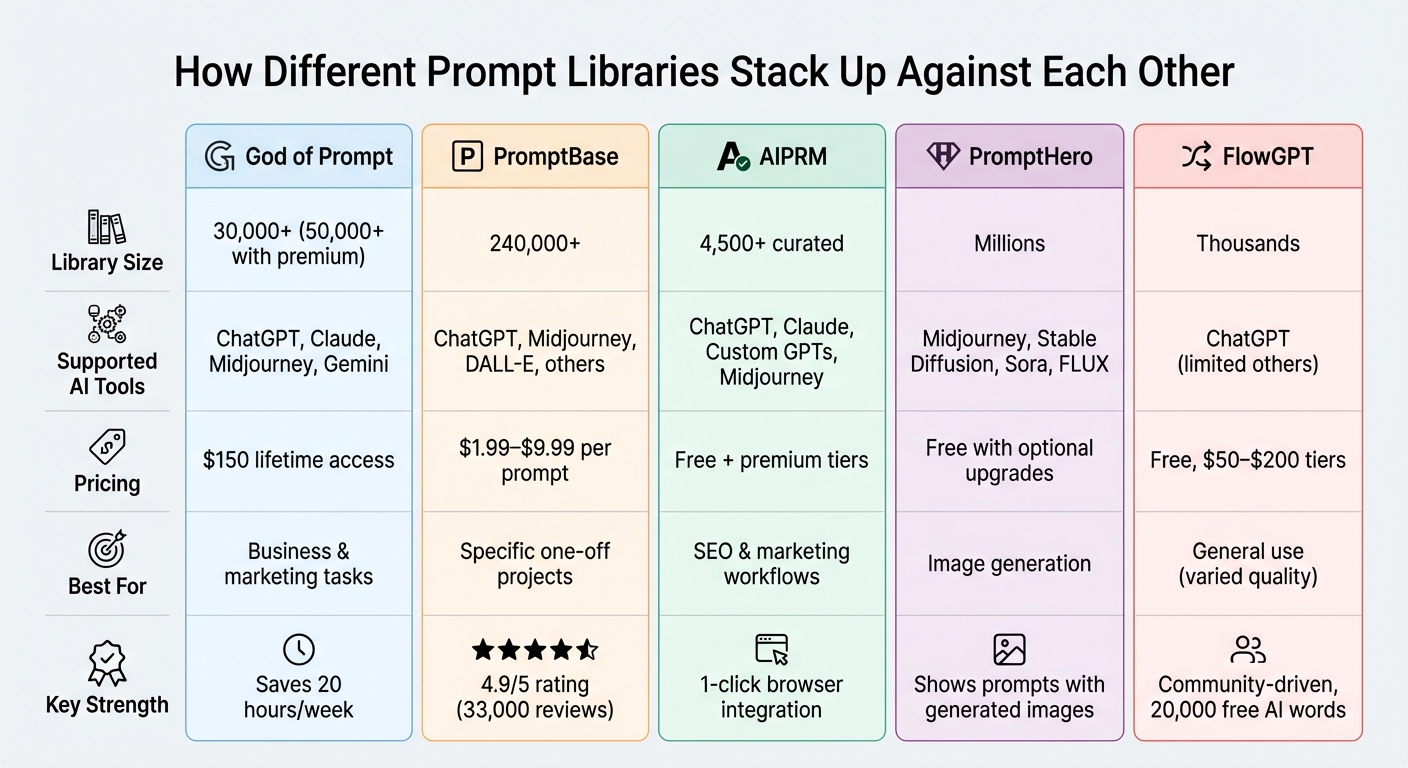
Comparison of 5 Major AI Prompt Libraries: Features, Pricing, and Use Cases
Best AI Automation Prompt Formula
1. God of Prompt
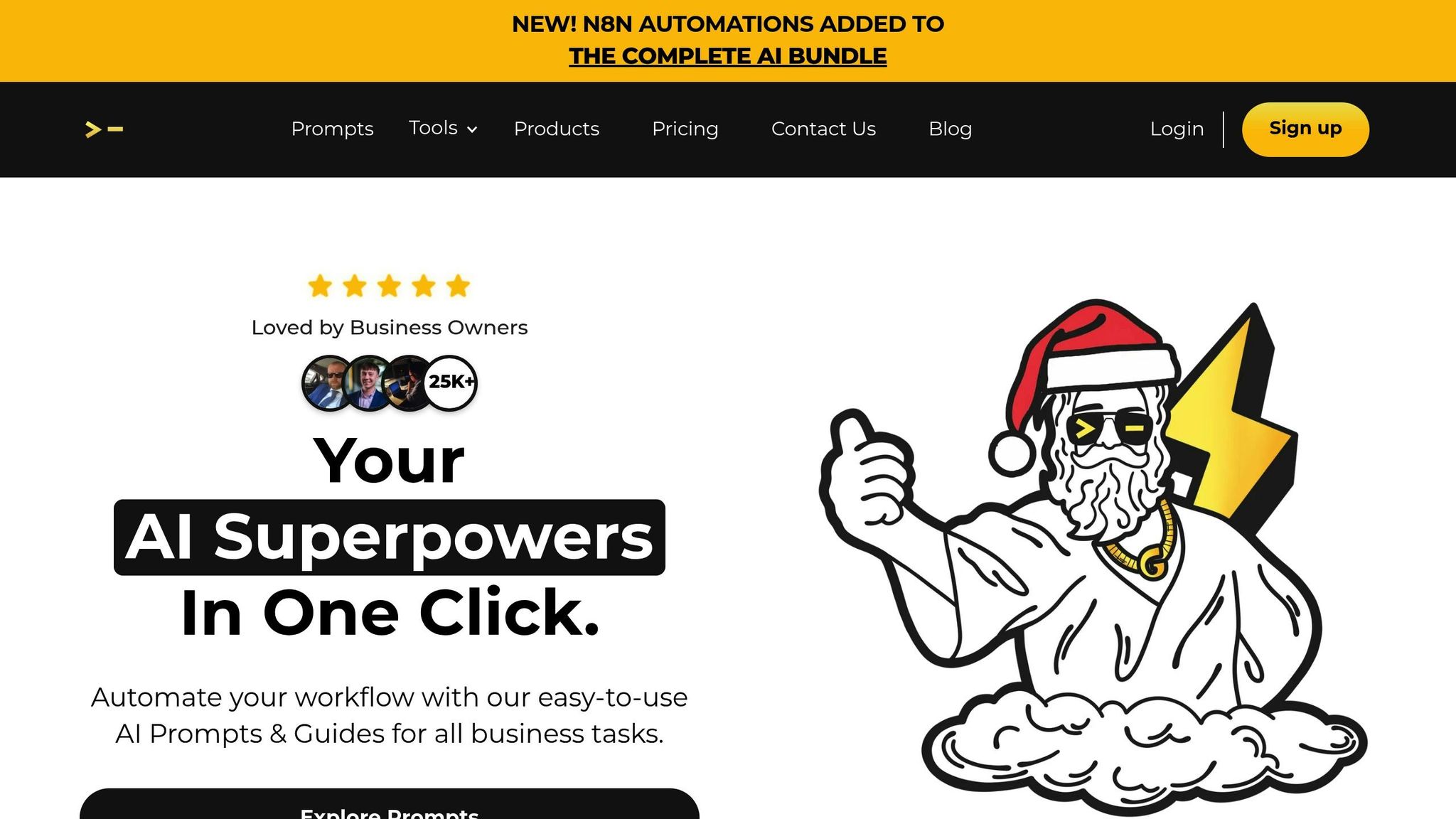
God of Prompt is a comprehensive library designed to help professionals access AI prompts tailored for multiple platforms. With more than 25,000 business owners relying on it, this resource claims to save users up to 20 hours per week.
Library Size
The free tier provides access to over 30,000 prompts, catering to both business and creative needs. If you upgrade to the premium Lucy+ tier, the library expands to over 50,000 prompts. These prompts cover a wide range of topics, including business strategy, marketing campaigns, product photography, creative writing, data analysis, and technical documentation.
Supported AI Models
God of Prompt supports some of the most popular AI models, such as ChatGPT and Claude (including GPT-4, GPT-4 Turbo, and Custom GPTs), Midjourney, and Gemini AI. This versatility makes it suitable for tasks like copywriting, SEO, visual content creation, and automation. Additionally, the platform offers tools like Custom Instructions and Custom GPTs Toolkits, allowing users to fine-tune AI responses for their specific business requirements.
Pricing
The platform offers a one-time purchase option for its Complete AI Bundle at $150.00, which includes lifetime access to over 30,000 prompts and unlimited updates. For more targeted needs, there are individual bundles available:
- ChatGPT Bundle: $97.00
- Midjourney Bundle: $67.00
- Writing Pack: $37.00
All purchases include a 7-day money-back guarantee. The platform has received a 4.8 out of 5 rating from 743 reviews, reflecting its popularity among users.
Primary Use Cases
God of Prompt is particularly useful for marketing, business operations, copywriting, SEO, and creating visual content. Its SEO prompts are designed to boost website visibility, while its integration with n8n automation helps streamline workflows by incorporating AI into broader processes.
"My team’s output has drastically increased. Highly recommended." – Lucas Kendall, @vverev
Next, we’ll take a closer look at other libraries to see how they stack up in terms of features and usability.
2. PromptBase
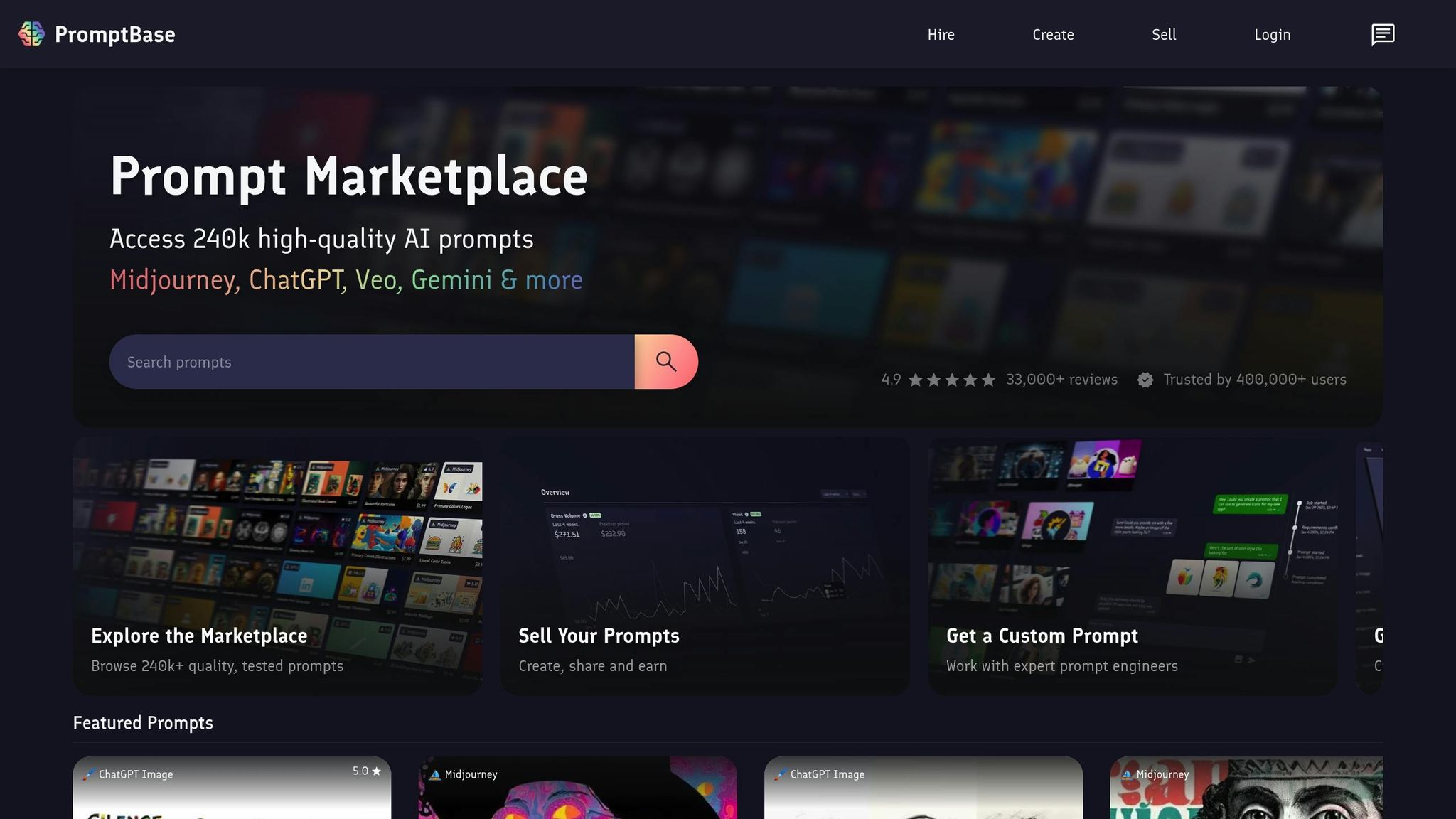
PromptBase is a bustling marketplace showcasing a collection of 240,000 carefully selected prompts crafted by experts. Among these, 2,600 prompts are available for free. With over 400,000 active users and an impressive 33,000 reviews averaging 4.9 out of 5, the platform has established itself as a reliable source for high-quality prompts.
Supported AI Models
The platform supports a wide range of AI models tailored for image and video generation. These include popular tools like Midjourney, ChatGPT, Gemini, FLUX, DALL-E, Leonardo AI, Ideogram, and Imagen. For video-focused projects, PromptBase also works with generators such as Sora, Veo, and KLING. This broad compatibility makes it an excellent resource for professionals who work across various AI platforms and require prompts tailored to specific creative or business needs.
Pricing
PromptBase uses a pay-per-prompt pricing model, with individual prompts typically costing between $1.99 and $9.99. Most prompts fall in the $2.99 to $5.99 range. However, this pricing structure has its critics. Entrepreneur and product designer Jess shared their perspective:
"PromptBase doesn’t scale. If you need one ultra-specific prompt for a one-time project? Sure… But if you’re using AI regularly for work, buying prompts one-by-one is like buying songs on iTunes in 2024. Why would you do that when Spotify exists?"
Primary Use Cases
PromptBase shines in delivering highly specific prompts tailored for professional tasks. These include creating marketing visuals, product photography, architectural renderings, and business proposals. For example, a $6.99 ChatGPT prompt designed for executive proposals reportedly saved one user nearly two hours of work.
Collaboration Features
The platform also offers tools for collaboration. Through its "Hire" feature, users can commission custom prompts, while the "Chat" function allows for direct communication with prompt creators. Additionally, experienced prompt engineers have the opportunity to monetize their skills by opening mini prompt stores on the platform.
Next, we’ll take a closer look at other platforms to see how they stack up and what sets them apart.
3. AIPRM
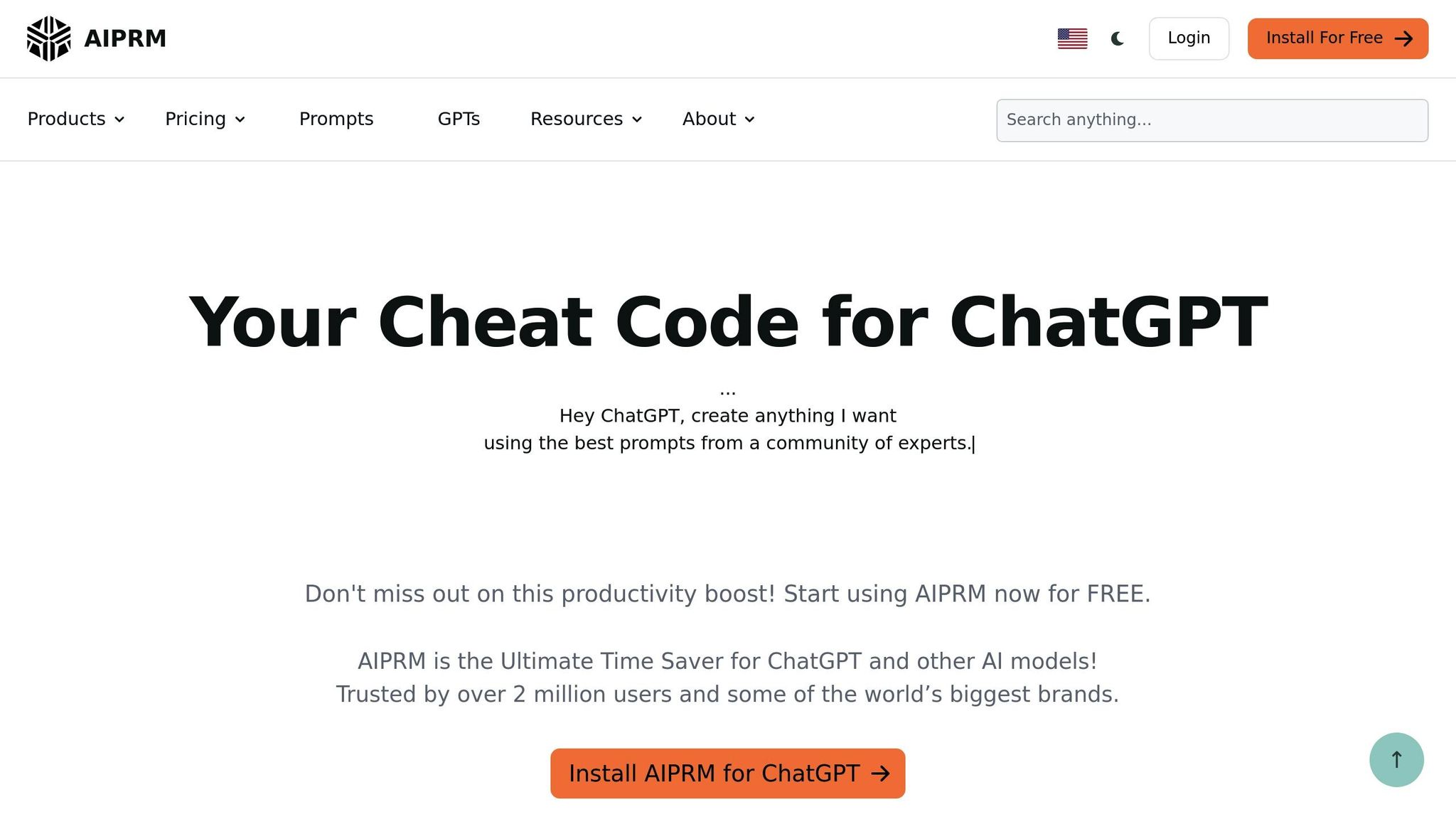
AIPRM integrates seamlessly into ChatGPT and Claude interfaces using a browser extension, making it incredibly easy to access over 4,500 carefully reviewed public prompts, along with a rich collection of private entries – all without leaving your workflow. Instead of navigating through a separate marketplace, you get 1-click access to prompts right where you’re already working. The platform caters to a wide user base and supports both public and private prompt collections [1,15,16].
Library Size
AIPRM’s library is packed with over 4,500 public prompts, all reviewed by expert prompt engineers to ensure reliability and effectiveness. You can even turn your ChatGPT into an expert prompt engineer to help refine your own custom creations. This vetting process eliminates the hassle of sifting through unverified options, giving you a streamlined experience. The platform is particularly tailored for business-focused workflows, covering areas like SEO, marketing, sales, and software development. Tasks such as creating user stories or writing technical documentation become much easier with these ready-made templates [1,15,16].
Supported AI Models
AIPRM connects primarily with ChatGPT and Claude through its browser extension, and it also supports OpenAI‘s Custom GPTs. This allows users to manage prompts across different GPT configurations efficiently. Additionally, some prompts are designed for Midjourney, expanding its utility for creative tasks. By focusing on specific AI models, AIPRM helps businesses maintain consistent standards in prompt engineering without juggling multiple tools [15,16].
Pricing
AIPRM offers a freemium model, making it accessible to all users with a free tier that includes access to public prompts. For those seeking advanced capabilities, paid subscriptions unlock features like private team prompt lists, custom variables, personalized tones, and brand-specific writing styles. The Chrome extension has garnered a 3.9/5 rating from around 3,300 users, reflecting its solid performance. Premium users also gain access to tools like "Live Crawling" for URL analysis and "Prompt Forking", which allows you to clone and tweak public prompts to suit your needs [1,15].
Primary Use Cases
AIPRM is a go-to tool for marketing and SEO professionals who need reliable, repeatable workflows. For instance, Moises Otero Fajardo, Founder & CEO at MidPointFX, praised its efficiency:
"Many time wasted writing prompts. This extension save that. I love it. For SEO it’s great!"
Similarly, Jun Takakura, an Independent Herbalife Distributor, highlighted its impact on his content creation:
"I started using AIPRM to help me write blog posts and to create video scripts. It is fantastic how it organizes all the information I need in the exact format I want."
The platform’s research shows that 53% of business owners aim to use AI for time-saving purposes, and AIPRM delivers on this promise. It’s particularly useful for tasks like keyword research, generating blog content, planning social media strategies, closing sales leads, and crafting customer support responses. To make it even more versatile, AIPRM includes tools for team collaboration [15,16].
Collaboration Features
AIPRM isn’t just for individual users – it’s built to enhance team productivity. With its "Teams" feature, businesses can share curated prompt lists across their organization, ensuring consistency in AI-generated outputs. The platform also supports "Custom Profiles", allowing users to embed company-specific data into prompts. This ensures that your brand voice remains consistent, no matter who’s using the tool. Amelia Sanz Duran, Socio Director at First Step Consultores, SL, summed it up well:
"AIPRM for ChatGPT: A marketer’s dream saving time, money, and offering a near-perfect collaboration."
sbb-itb-58f115e
4. PromptHero
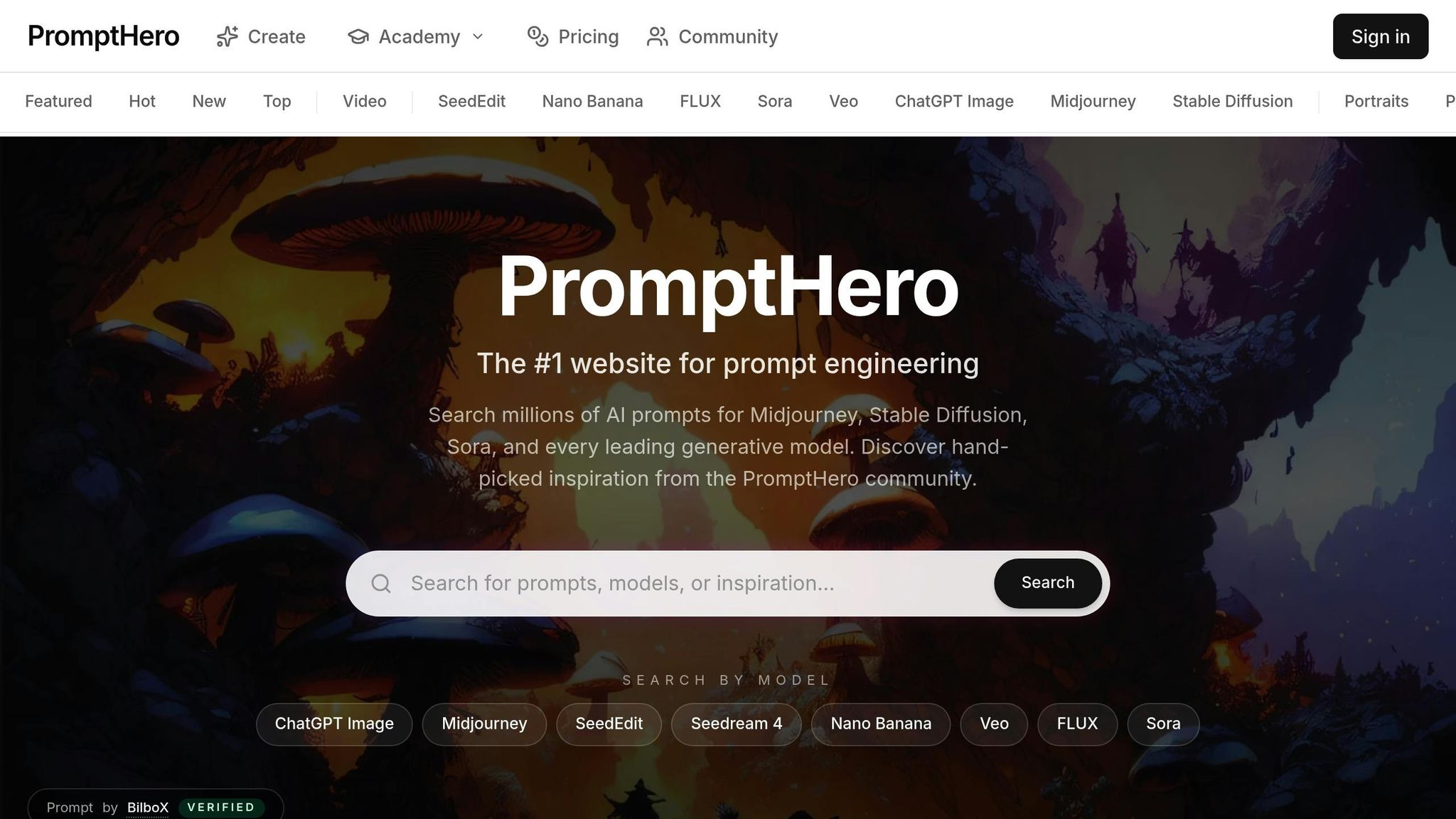
PromptHero positions itself as a leading platform for prompt engineering, offering a massive library packed with millions of AI prompts. What makes it stand out is its unique feature of showcasing the exact prompts alongside the AI-generated images. Let’s dive into its library, supported models, and how professionals use it.
Library Size
With millions of prompts at your fingertips, PromptHero boasts one of the largest collections tailored for creative AI projects. Whether you’re into architectural visualization, fashion photography, product design, or experimental mashups, there’s something for everyone. The platform thrives on contributions from its community, encouraging users to share their best ideas. Many prompts come with a "Verified" tag, signaling their effectiveness and reliability. This extensive library is a treasure trove for professionals looking to boost both creativity and productivity.
Supported AI Models
PromptHero doesn’t limit itself to just one or two tools – it supports a wide range of AI models, including Midjourney, Stable Diffusion, Sora, ChatGPT, FLUX, Veo, and others. The "Search by model" feature allows users to quickly find prompts compatible with their preferred AI tool. It also supports models for both image and video generation, making it a go-to resource for motion graphics and cinematography enthusiasts.
Primary Use Cases
PromptHero caters to a diverse audience, from artists to marketing teams. Photographers and designers use it to create hyper-realistic images with precise technical details. Meanwhile, marketers, product designers, and architects leverage the platform to visualize concepts, craft social media content, and design prototypes. Artists find inspiration in prompts that span a variety of styles, blending everything from anime and cyberpunk to historical art movements, creating a fusion of classic and contemporary aesthetics.
5. FlowGPT
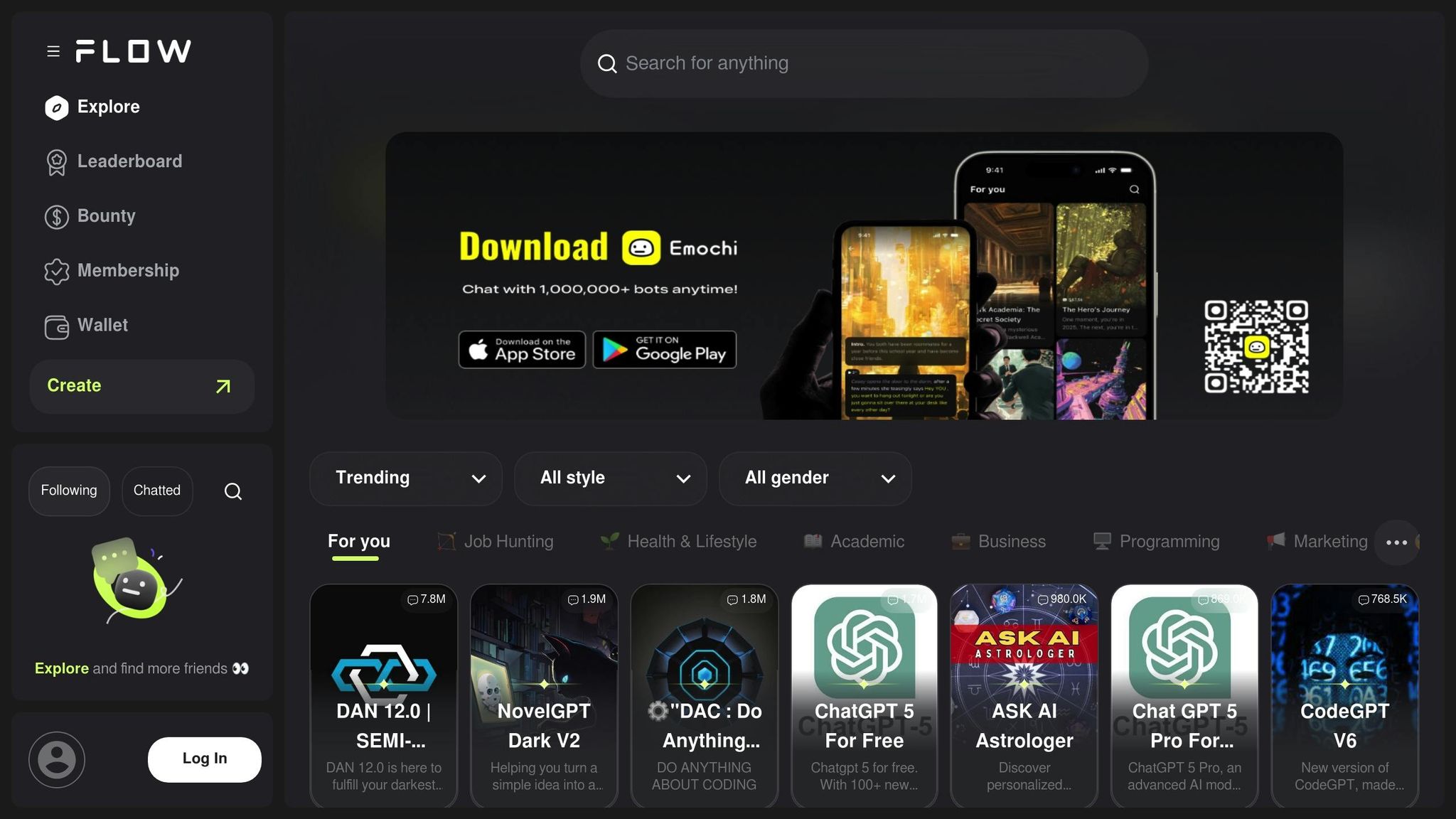
FlowGPT is a platform built around community contributions, where users can share and explore prompts spanning thousands of categories. It offers a mix of advantages and trade-offs in terms of quality, pricing, and usability. From business strategies and marketing campaigns to academic tools and creative roleplay, FlowGPT covers an extensive range of topics. However, since content is user-submitted and not professionally curated, the quality of prompts can vary significantly.
Library Size
FlowGPT hosts a vast collection of prompts contributed by its community, touching on professional, creative, and technical fields. You’ll find resources for job applications, programming, anime character creation, and even prompts for fictional storytelling. A product designer who tested the platform for 30 days noted that just 10% of prompts met high standards, 30% needed significant editing, and 60% were of lower quality.
Supported AI Models
Unlike curated platforms, FlowGPT emphasizes accessibility and primarily supports OpenAI’s ChatGPT (gpt-3.5-turbo) API, with GPT-4 integration marked as "coming soon" across all tiers. While its focus is on ChatGPT, it offers limited compatibility with other AI tools like Midjourney and Claude. The platform also includes unique features like "Flow boards" for managing conversations visually and a tool for uploading documents in formats like PDFs, DOCX, and TXT.
Pricing
FlowGPT operates on a pay-as-you-grow model, charging based on "AI words" (units of text) rather than a flat monthly subscription. New users start with 20,000 free AI words. The Lite tier is priced at $50 for over 100,000 AI words and includes unlimited Flow boards, while the Pro tier costs $200 for more than 1,000,000 AI words. Both tiers grant access to over 100 featured prompts.
Primary Use Cases
FlowGPT caters to a variety of needs. Professionals rely on it for tasks like job hunting, marketing campaigns, and business planning, while educators and researchers use it for classroom tools and academic projects. Creative users gravitate toward its roleplay and storytelling prompts, such as character creation and narrative building using an AI story generator. Another standout feature is "Parallelism", which allows users to generate and compare multiple outputs side-by-side, making it particularly useful for refining professional writing.
Collaboration Features
Community engagement is at the heart of FlowGPT. Its Creator Center enables prompt engineers to manage submissions, while leaderboards highlight trending prompts and top contributors. An active Discord community fosters feedback and collaboration, though the open submission model means users may need to invest extra time in curating and refining content.
Strengths and Weaknesses
Prompt libraries come with varying levels of quality control, specialization, and user experience. Knowing these differences can save you time and money by helping you pick the right tool for your workflow.
Quality control is a major factor that sets curated platforms apart from community-driven ones. Libraries with professional reviews often deliver consistent results but can come with pricing models that add up over time. On the other hand, community-driven platforms usually provide a wealth of free content but may require extra effort to sift through and find useful entries. Beyond quality, the focus and scope of each platform further highlight their differences.
Specialization versus versatility is another key consideration. For example, AIPRM is highly effective for ChatGPT integration and SEO or marketing tasks, but it doesn’t support other AI models like Midjourney or Claude. While this narrow focus is great for content marketing, it may limit options for future adaptability. By contrast, platforms that work with multiple AI models offer the flexibility to try out different systems, though they might not excel in any one area.
Learning curves and accessibility also vary widely. Some platforms allow deep customization and programmatic control, which can be a big plus for technical users but intimidating for those without coding expertise. On the flip side, platforms designed for quick and easy use often rely on generic prompts, which can reduce effectiveness for more complex or high-stakes business needs.
Enterprise readiness is where many user-friendly libraries fall short. Features like audit trails and permissions, which are crucial for large organizations, are often missing. While some tools include versioning, they frequently lack detailed token-level visibility, making it harder to troubleshoot intricate, multi-step AI workflows. While these gaps might not matter much for individual users, they can become significant hurdles for teams managing AI at scale. These factors should play a big role in selecting a prompt library that fits your professional needs.
Conclusion
This analysis sheds light on which prompt library aligns best with various professional needs.
For those juggling multiple AI platforms like ChatGPT, Midjourney, and Claude, a unified prompt library can be a game-changer. Back in late 2026, entrepreneur Jess discovered that using a unified library saved her 10–15 hours per week on client campaigns, cutting annual subscription costs by about $1,080.
If you’re a marketing or SEO professional focused solely on ChatGPT, AIPRM offers seamless integration right within the interface – no need to constantly copy and paste from external tools. Visual creators, on the other hand, can explore PromptHero, which excels at simplifying image generation through its discovery platform. For those working with tight budgets, FlowGPT provides free access, though you might need to spend extra time filtering community submissions.
When time is of the essence, quality often outweighs quantity. With over 130,000 reviewed prompts, PromptBase is a reliable option for one-off projects. Curated libraries like this help professionals avoid the trial-and-error process that can eat into billable hours.
"Free isn’t free if it costs you hours"
As workflows evolve to include text, image, and video generation, the demand for libraries that support multi-modal tasks in one place has grown. Instead of relying on platform-specific tools, professionals are seeking all-in-one solutions. With 65% of organizations already leveraging generative AI and adoption rates expected to hit 72% by 2026, choosing the right prompt library has become more than just a convenience – it’s now a vital part of staying competitive in the AI-driven world.
Start by exploring free tiers to assess quality and identify ways to streamline your AI workflow. Cutting redundant costs and saving time is key. Ultimately, the best prompt library is the one that aligns with your unique needs, whether that’s producing content quickly, creating stunning visuals, or tackling technical projects.
FAQs
What sets the prompt libraries featured in this article apart?
This article dives deep into God of Prompt, breaking down its features, pricing, user-friendliness, and how it can be applied in areas like business, marketing, and productivity. Through practical examples, you’ll see exactly how this platform can fit into your workflow and make an impact in the AI prompt space. Whether you’re an entrepreneur juggling multiple tasks or a professional looking for efficient tools, this guide is designed to help you decide if it aligns with your objectives.
What makes God of Prompt the best choice for marketing and SEO tasks?
For marketing and SEO professionals, God of Prompt stands out as a powerful tool. With a massive library of over 30,000 ready-made prompts, it simplifies tasks like crafting ad copy, building email campaigns, fine-tuning SEO content, and planning social media strategies. Instead of spending hours on content creation, teams can now generate high-quality material in just seconds.
The platform also offers flexible customization, allowing users to adjust prompts to match their brand’s voice or specific keyword goals. Pricing starts at $0 and goes up to $150 per month, making it a practical option for everyone – from solo entrepreneurs to large agencies. Plus, it seamlessly integrates with popular AI tools like ChatGPT, Midjourney, and Claude, ensuring that these prompts fit right into your workflow. This not only speeds up content creation but also helps enhance search engine performance.
What are the common pricing models for AI prompt libraries?
AI prompt libraries generally offer three pricing models, catering to different user preferences and budgets:
- Pay-per-prompt: This option lets users buy individual prompts, typically priced between $2.99 and $5.99. It’s a straightforward choice if you only need a few prompts without committing to a larger plan.
- Subscription plans: Starting at around $19 per month, these plans provide access to premium prompts and advanced features. Higher-tier subscriptions often include additional tools and expanded capabilities.
- Freemium model: Free tiers grant access to basic or community-created prompts, while paid plans offer curated, high-quality collections and extra features for those seeking more robust options.
These pricing structures give users the flexibility to pick what works best for them, whether they want a pay-as-you-go approach, a comprehensive subscription, or a free entry point with the option to upgrade.
Related Blog Posts
- Best All-in-One AI Prompt Libraries for Professionals
- Best Starter Prompt Libraries for First-Time AI Users
- Best Prompt Libraries for Midjourney and AI Image Creation
- Best Visual Content Prompt Libraries for Marketing
Keep going: the prompt library has the 30,000+ prompt library and ChatGPT prompts ready to copy and run.