How AI Portals Reduce Support Costs
AI-powered self-service portals reduce ticket volumes and response times by automating routine tasks, cutting support costs per interaction and delivering fast ROI.

On this page
- We Automated 80% of Customer Support With One AI Agent (No Code)
- Measuring Cost Savings: Key Metrics and Data
- Cost Savings by Industry
- Lower Ticket Volume Through Case Deflection
- How Automation Improves Operations
- Handling Repetitive Tasks Automatically
- Faster Response Times and Higher Resolution Rates
- Implementation and ROI: What to Expect
- Time-to-Value and ROI Data
- Scaling and Long-Term Cost Benefits
- Conclusion: Achieving Cost Efficiency with AI Portals
- Main Benefits for Businesses
- Using AI Resources for Better Results
- FAQs
- How long does it take for businesses to see ROI after adopting AI portals?
- What types of customer support tasks can AI automate effectively?
- How do AI portals impact the role of customer support agents?
- Related Blog Posts
AI-powered self-service portals are cutting customer support costs dramatically. While live support costs $6–$12 per interaction, AI-driven solutions reduce this to just $0.25, saving up to 75%. These tools – like chatbots, knowledge bases, and automated troubleshooting – handle routine tasks such as password resets or order tracking 24/7. This reduces ticket volumes, improves response times, and frees human agents to focus on complex issues. Companies like Oracle and Red Hat have saved millions annually by adopting AI portals, with automation rates reaching 85% in some industries. Whether you’re in SaaS, e-commerce, or finance, these systems offer measurable ROI within 6–18 months and scale effortlessly without increasing staff. AI portals are transforming support operations, delivering faster resolutions and significant cost savings.
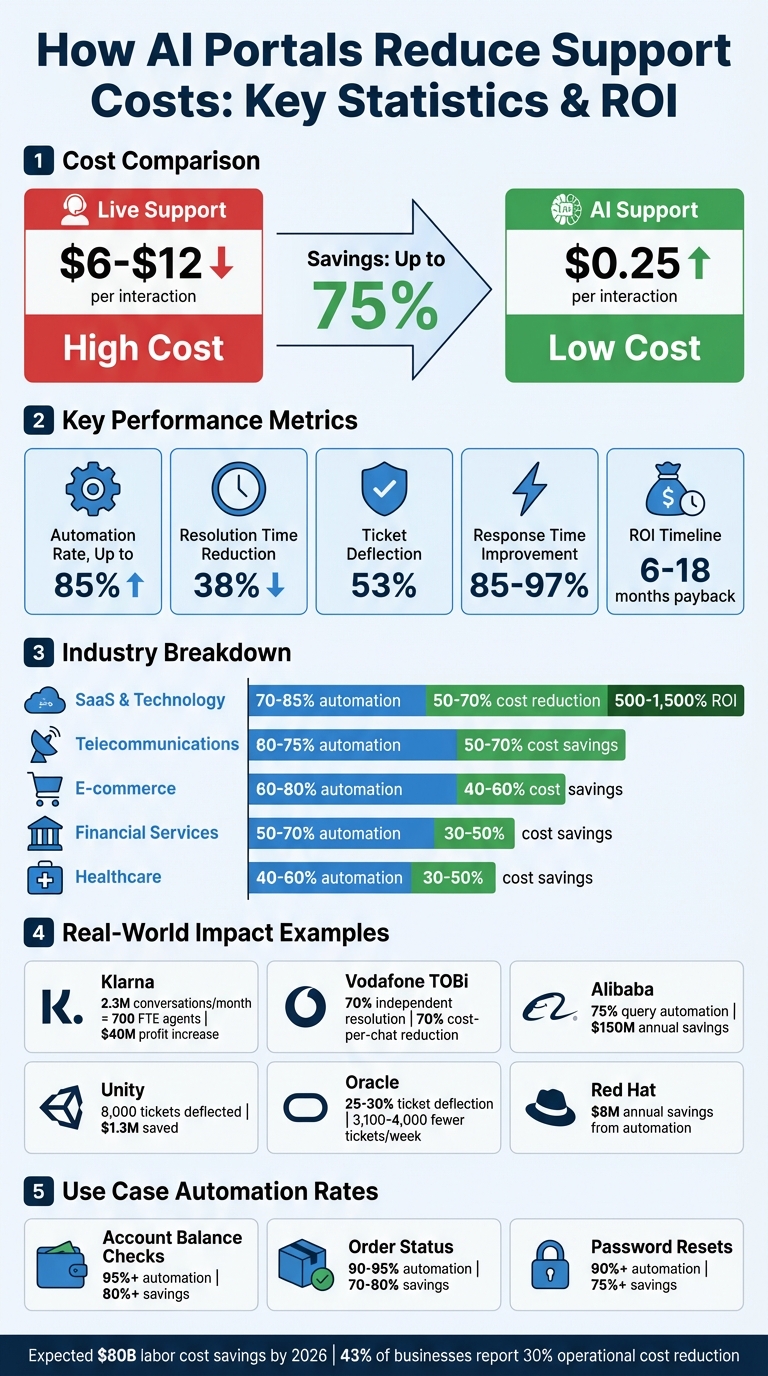
AI Portal Cost Savings: Key Statistics and ROI Across Industries
We Automated 80% of Customer Support With One AI Agent (No Code)
Measuring Cost Savings: Key Metrics and Data
Tracking the right metrics is crucial to understanding how AI portals impact support costs. Key indicators like automation rate, cost per interaction, ticket volume reduction, and first-contact resolution (FCR) help quantify these benefits. Companies often calculate avoided headcount and compare savings to implementation costs to determine ROI.
For example, conversational AI is expected to cut contact center labor costs by a staggering $80 billion by 2026. Among businesses already using AI, 43% report operational cost reductions of around 30%. AI chatbots can handle up to 85% of customer queries, while generative AI features can reduce resolution times by as much as 38%. Impressively, some companies have slashed cost-per-chat by 70% after introducing AI assistants. Let’s dive deeper into how these savings play out across different industries.
Cost Savings by Industry
AI-driven cost reductions differ across industries due to varying complexities in customer queries and regulatory requirements. Here’s how some sectors are benefiting:
- SaaS and Technology: Automation rates range from 70–85%, leading to cost reductions of 50–70% and ROI between 500–1,500%.
- Telecommunications: Achieves 60–75% automation, translating to 50–70% cost savings.
- E-commerce: Automates 60–80% of queries, cutting costs by 40–60%.
- Financial Services and Healthcare: With tighter regulations, automation rates are slightly lower at 50–70% and 40–60%, respectively, resulting in cost reductions of 30–50%.
Real-world examples highlight these savings. In 2024, Klarna’s AI assistant handled 2.3 million conversations monthly, matching the workload of 700 full-time agents and boosting profits by $40 million. Vodafone’s "TOBi" assistant independently resolves 70% of customer inquiries, slashing cost-per-chat by 70% across a massive 300 million customer base. Alibaba’s AI chatbots manage 75% of online queries, saving approximately $150 million annually. These cases clearly show how AI is reshaping support economics.
Lower Ticket Volume Through Case Deflection
AI portals significantly reduce support ticket volume by addressing common issues before they escalate to human agents. Generative AI-powered self-service tools achieve ticket deflection rates of around 53%, while automation enhances response times by 27%. Specific use cases demonstrate even higher efficiencies:
- Account Balance Checks: Over 95% automation with 80%+ cost savings.
- Order Status Inquiries: 90–95% automation with 70–80% cost reductions.
- Password Resets: 90%+ automation with 75%+ savings.
Unity, a gaming technology company, offers a compelling example. By integrating an AI agent for developer support, they removed 8,000 tickets from the human queue, saving $1.3 million. This system operates 24/7, delivering technical support without increasing staff, allowing businesses to scale efficiently while transforming the economics of customer service.
How Automation Improves Operations
AI portals take over routine tasks, freeing up human agents to tackle more complex challenges. Tasks like password resets or checking order statuses are handled seamlessly by AI, allowing support teams to focus on higher-value problems. This shift isn’t just about cost savings – it’s a game-changer for how support teams operate. By automating repetitive work, companies improve business operations and create more impactful support experiences.
These operational upgrades shine in two main areas: managing repetitive tasks and speeding up response times. When AI handles predictable, high-volume queries, human agents can focus on solving intricate issues. This approach lets businesses scale their support operations without increasing headcount or training expenses.
Handling Repetitive Tasks Automatically
AI portals are perfect for managing straightforward, high-frequency queries. Think of tasks like resetting passwords, tracking orders, answering billing questions, or providing shipping updates. These types of inquiries make up a significant portion of support tickets for most companies – and they’re exactly what AI handles best.
A great example comes from Oracle’s IT Employee Support team. In early 2024, they were overwhelmed by 50,000 monthly tickets and an underperforming rule-based Slack bot. Led by Sudhir Dureja, Senior Director of Enterprise Engineering, the team introduced a Generative AI "AI Service Desk" built on RAG (Retrieval-Augmented Generation) architecture. The results? A 25-30% ticket deflection rate, which translates to 3,100–4,000 fewer tickets per week. This freed up engineers to concentrate on specialized Tier 2 support tasks.
Some companies are taking automation even further with runbooks – predefined workflows that guide AI agents through complex tasks like diagnosing API errors or verifying account details. For instance, Red Hat’s Experience Engineering team launched a tool in December 2024 that automatically drafts standardized knowledge base articles from case comments. This tool is expected to save $8 million annually by reducing manual effort. Such innovations are reshaping how teams handle edge cases that previously required human intervention.
Faster Response Times and Higher Resolution Rates
AI doesn’t just handle tasks – it also speeds up support processes, slashing response times dramatically. Quick responses are crucial in customer support, and AI portals deliver impressive results. In June 2025, AssemblyAI adopted Pylon‘s AI-powered support platform under the leadership of Lee Vaughn, Manager of Support Engineering. The impact was remarkable: first response time dropped from 15 minutes to just 23 seconds – a 97% reduction. Their AI agent, "Sonny", also doubled the automated resolution rate from 25% to 50%, all while enabling 24/7 support without increasing staff.
These improvements aren’t limited to one industry:
| Industry | Traditional Response Time | AI-Powered Response Time | Improvement |
|---|---|---|---|
| B2B SaaS | 2–4 hours | 30 seconds – 2 minutes | 85–95% |
| E-commerce | 1–2 hours | 15–45 seconds | 90–97% |
| Financial Services | 4–8 hours | 1–3 minutes | 92–98% |
| Healthcare Tech | 6–12 hours | 2–5 minutes | 88–95% |
These faster response times lead directly to cost reductions. Companies automating workflows report a 27% drop in average resolution time, while generative AI features can reduce resolution times by up to 38%. AI achieves this speed by instantly accessing and synthesizing information from multiple sources, cutting out the time agents spend hunting for answers or waiting on other teams.
"Runbooks have helped us handle weird edge cases much more intelligently. Instead of failing the conversation, the agent now guides customers to the right resources automatically." – Lee Vaughn, Manager of Support Engineering, AssemblyAI
This operational shift goes beyond individual metrics. By automating repetitive tasks, AI reduces agent burnout and allows staff to focus on strategic problem-solving. This not only increases job satisfaction but also enhances the overall value each team member brings to the organization.
Implementation and ROI: What to Expect
You can set up an AI portal fairly quickly – basic functionality takes about 2–4 weeks, while more complex integrations may require 3–6 months. It’s best to begin with the core features that address your most common customer queries. Over time, you can build on this foundation, adding more advanced features as you refine your understanding of what works.
Time-to-Value and ROI Data
Most companies start seeing measurable cost savings within 6–18 months. The exact timeline depends on factors like the quality of your data and the state of your existing systems. Businesses with clean, well-organized data and modern infrastructure often achieve payback in 6 to 8 months. On the other hand, those dealing with outdated systems or messy data might need 12 to 18 months to break even. A Forrester study reported that businesses modeled in their research achieved a 210% ROI over three years, with many recovering their investment in under six months.
For SaaS companies in particular, the financial impact can be dramatic. For example, the cost-per-contact can drop from $15 to $8 within six months of deploying AI. This happens thanks to reduced ticket volumes (AI can handle up to 85% of queries), faster resolution times (up to a 38% improvement), and increased productivity from human agents (around a 14% boost). These early gains pave the way for even greater savings as the system scales.
Scaling and Long-Term Cost Benefits
Once the initial benefits are clear, the savings from an AI portal tend to grow as your business scales. AI tools can handle massive workloads without needing additional staff. For instance, a single help article or chatbot can assist thousands of users at once, creating a "one-to-many" support model that traditional teams simply can’t match. This capability is especially useful during high-demand periods like product launches or holiday seasons, where traditional support teams would require significant staffing increases.
Some AI systems are already achieving impressive results. Leading AI assistants manage up to 2.3 million conversations per month, which is equivalent to the workload of 700 full-time agents. Companies like Qonto have saved 50,000 hours annually through automation – equal to the work of 24 full-time employees. Malt, another example, cut their ticket resolution time in half using AI-powered platforms. These aren’t just one-off wins; they’re ongoing improvements that grow alongside your customer base.
To maximize long-term success, treat your AI portal as an evolving system. Use analytics to identify where customers are struggling – failed searches, for instance, can guide you on what new content to create. Modern platforms also support model agnosticism, meaning you can upgrade to better language models as they become available, without overhauling your infrastructure. This adaptability ensures your investment continues to deliver value as AI technology advances, keeping your ROI strong for years to come.
Conclusion: Achieving Cost Efficiency with AI Portals
Main Benefits for Businesses
AI-powered self-service portals offer clear cost-saving opportunities while streamlining your support operations. For instance, self-service interactions can cost as little as $0.25, compared to $6–$12 for live agent interactions – representing up to a 75% cost reduction. Some companies have already saved millions in support costs and boosted profits by tens of millions by automating customer service tasks equivalent to the workload of hundreds of full-time agents.
These portals also enable a scalable support model that grows alongside your business. Unlike traditional support systems that require more staff as your customer base expands, AI can handle thousands of users simultaneously. This "one-to-many" capability allows you to grow your customer base significantly without seeing a proportional increase in support costs.
The operational benefits go beyond cost savings. AI portals contribute to faster resolutions and more efficient resource use. Resolution times can drop by 60–85%, and ticket deflection rates range from 25–53% across industries. Meanwhile, human agents can focus on complex, high-value tasks rather than repetitive ones like password resets or order tracking. As Mandy Elliott from Red Hat explains:
"AI augmentation doesn’t just improve efficiency; it also enhances content creation and may contribute to job satisfaction".
These efficiencies lay a strong foundation for incorporating advanced AI strategies to further improve performance over time.
Using AI Resources for Better Results
Maintaining these cost efficiencies requires ongoing refinement. The effectiveness of your AI portal depends on well-structured prompts and targeted implementation. Crafting high-quality prompts and integrating a robust knowledge base are key to maximizing AI performance. Tools like God of Prompt (https://godofprompt.ai) offer over 30,000 AI prompts and guides tailored for platforms like ChatGPT, Claude, and Gemini AI. These resources can help you fine-tune your portal, improve knowledge base content, and adopt workflows that maximize efficiency from the start.
FAQs
How long does it take for businesses to see ROI after adopting AI portals?
Businesses can start seeing a return on their investment (ROI) from AI-powered portals in as little as six months. Studies reveal that many companies reach this milestone quickly, particularly when they scale AI-driven customer support solutions effectively.
By handling routine inquiries automatically and simplifying support workflows, AI portals not only cut down operational costs but also boost efficiency – making them a solid choice for reducing expenses in the long run.
What types of customer support tasks can AI automate effectively?
AI shines when it comes to automating repetitive, high-volume, and straightforward tasks in customer support. Think about answering FAQs, walking users through troubleshooting steps, providing how-to guides, or explaining company policies. By taking care of these routine inquiries, AI lightens the load on human agents, giving them more bandwidth to tackle complex, high-priority issues.
Beyond that, AI can handle account management, automate responses across different communication channels, and streamline customer workflows. This not only speeds up response times but also allows businesses to expand their support efforts without a big jump in costs. In short, AI is a great fit for handling simple, repetitive tasks, leaving human teams free to focus on challenges that require a personal touch.
How do AI portals impact the role of customer support agents?
AI portals are transforming customer support by taking over repetitive tasks, which frees up human agents to handle more intricate and valuable interactions. Companies that use AI-driven self-service portals have reported noticeable drops in ticket volumes and faster resolution times. This not only reduces support costs but also boosts overall productivity.
These portals give customers the tools to solve routine problems on their own, cutting down the need for human involvement in standard inquiries. This shift allows support agents to focus on more complex challenges, ultimately improving the quality of service. On top of that, AI tools act as a helpful resource for new agents, offering guidance and best practices that speed up their learning curve and enhance team performance.
Related Blog Posts
- How To Automate Your Business & Marketing With AI Agents (Beginner’s Guide)
- Top 7 No-Code AI Tools for Live Chat
- AI in Web Ops: The Few Automations that Actually Save Time
- Ultimate Prompt Collections for Customer Service Teams
Next step: turn this article into output with business prompts, or go deeper with productivity prompts.
Prompts for this topic
Put this article to work with ready-to-use prompts from the God of Prompt library.
Keep reading
Clawdbot Complete Guide 2026: Features, Costs, Setup & Alternatives
The viral AI assistant running 24/7 on a $5 server. Here’s what works, what breaks, and whether the security risks are worth it in 2026.

Top 7 Companies Building Custom Autonomous AI Agents for US Businesses in 2026
Can AI Find Your Personal Information? Digital Identity Risks
AI can assemble an identity trail from public records, broker data and old accounts. What that means for digital identity risk, verification, and reducing your exposure.

The best of the blog, in your inbox
One email when notable prompts, tools, and model updates land. No spam, unsubscribe anytime.
Join 100,000+ subscribers. One email a week, real prompts, tools, and model updates. Unsubscribe anytime.