
Advanced AI Resources for Serious Business Users



Adopting AI is no longer optional - it’s a must for businesses aiming to save time, reduce costs, and stay ahead. Tools like ChatGPT and Claude 3 Opus are transforming workflows, automating tasks, and improving productivity. From pre-built automation workflows to AI-powered marketing tools and image generators, businesses now have access to powerful resources that simplify operations and boost efficiency. Here’s what you need to know:
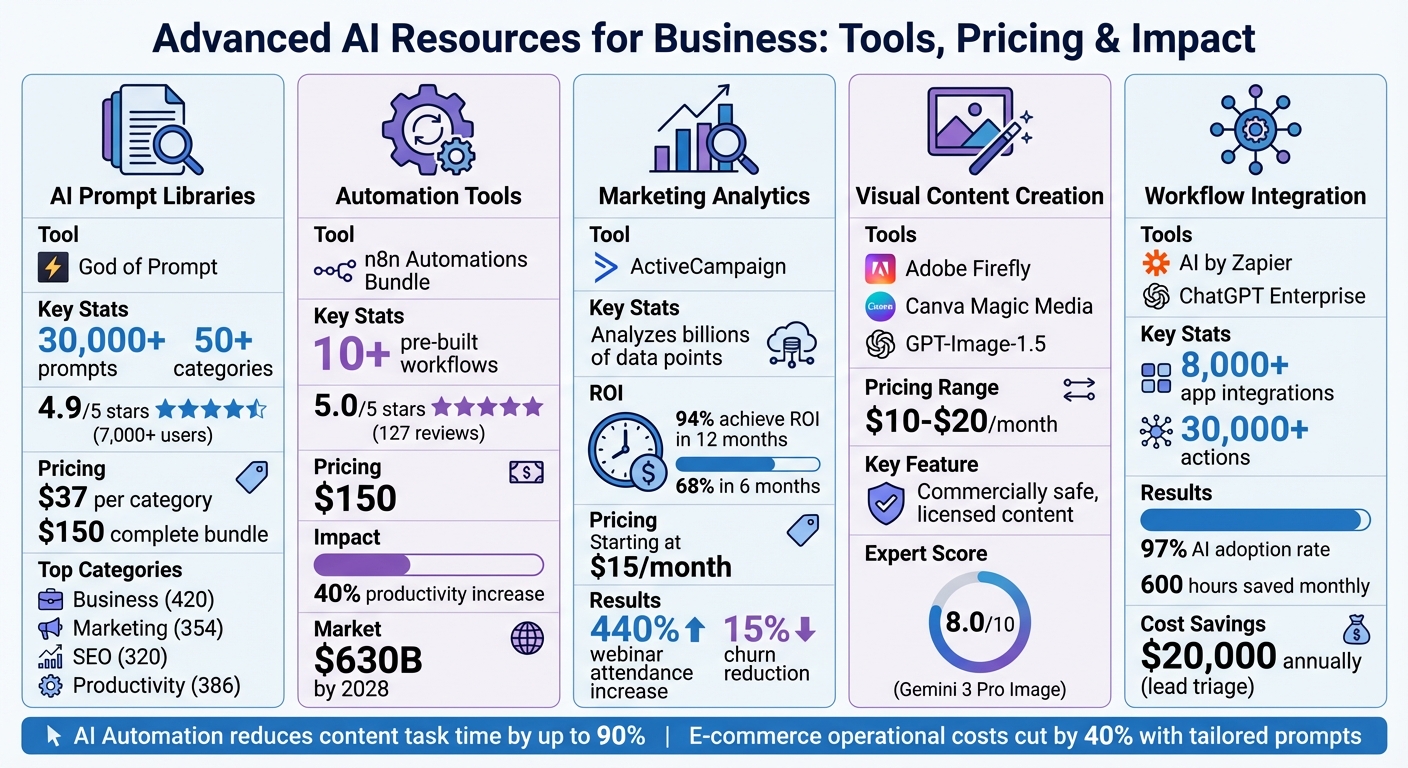
- Prompt Libraries: Tools like "God of Prompt" offer 30,000+ structured prompts tailored for business, marketing, SEO, and productivity. Pricing starts at $37 per category or $150 for the full bundle.
- Automation Tools: Platforms like n8n and Agentic AI simplify backend processes with pre-built workflows, saving hours of manual work.
- Marketing Analytics: AI tools like ActiveCampaign and Adobe Mix Modeler predict outcomes, optimize budgets, and provide actionable insights.
- Visual Content Creation: AI-driven tools like Adobe Firefly and Canva Magic Media enable quick, professional-quality image creation for marketing and branding.
- Workflow Integration: Solutions like AI by Zapier and ChatGPT Enterprise connect AI across systems, automating repetitive tasks and improving overall efficiency.
The key takeaway? AI is no longer just a tool - it’s an integral part of how businesses operate. Whether it’s automating workflows or generating insights, these tools can help you focus on what matters most: growth and strategy.
Top AI Tools for Business: Features, Pricing & ROI Comparison 2026
I Tested 500+ AI Tools, These 12 Will Blow Up Your Business
1. AI Prompt Libraries
God of Prompt is a go-to resource for business professionals who need ready-to-use, effective AI prompts. With over 30,000 expertly designed prompts spread across 50+ categories, it caters to a wide range of needs. Categories include Business (420 prompts), Marketing (354 prompts), SEO (320 prompts), and Productivity (386 prompts), among others. Each prompt is crafted using advanced frameworks that define roles, contexts, and output formats, ensuring they are tailored for professional use.
The platform has garnered a 4.9/5 star rating from more than 7,000 users, thanks to its Complete AI Bundle. Reviews highlight the time-saving benefits and practical value. One user, Misel@MiselGPT, shared: "Subscribed 10+ months ago and never really questioned my decision... probably the best money spend on 'AI' up until now". Similarly, Ihtesham Haider commented: "These prompts have helped me finish tasks I've been putting off for months. This is the only prompt library you need".
What sets these libraries apart is their prompt engineering guide. Instead of generic, one-line prompts, they follow a detailed 6-step model: Goal, Role, Context, Constraints, Output Format, and Tone/Style. For instance, instead of simply asking "Write an email", a well-structured prompt might say: "Act as an email marketing specialist and create a 200-word promotional email for a gluten-free bakery targeting health-conscious parents aged 30–45, using a warm tone with a clear call-to-action."
Pricing is straightforward and flexible. You can purchase individual category packs for $37, the ChatGPT Bundle for $97, or opt for the Complete AI Bundle, which includes all 30,000+ prompts, for $150 one-time or $15/month. All plans come with lifetime updates and are delivered via Notion, making it easy to organize and share with your team.
To get the most out of these prompts, customization is key. Replace placeholders with details specific to your industry, location, and brand voice. For example, instead of using a generic template, you could specify "a gluten-free bakery in Richmond, Virginia." Users who personalize prompts with local and industry-specific information often see much better results, turning AI into a powerful tool that aligns with their business needs.
2. Business Automation Tools
Automation tools, powered by advanced prompt libraries, are revolutionizing backend operations, making processes smoother and more efficient.
n8n Pre-Built Automation Workflows
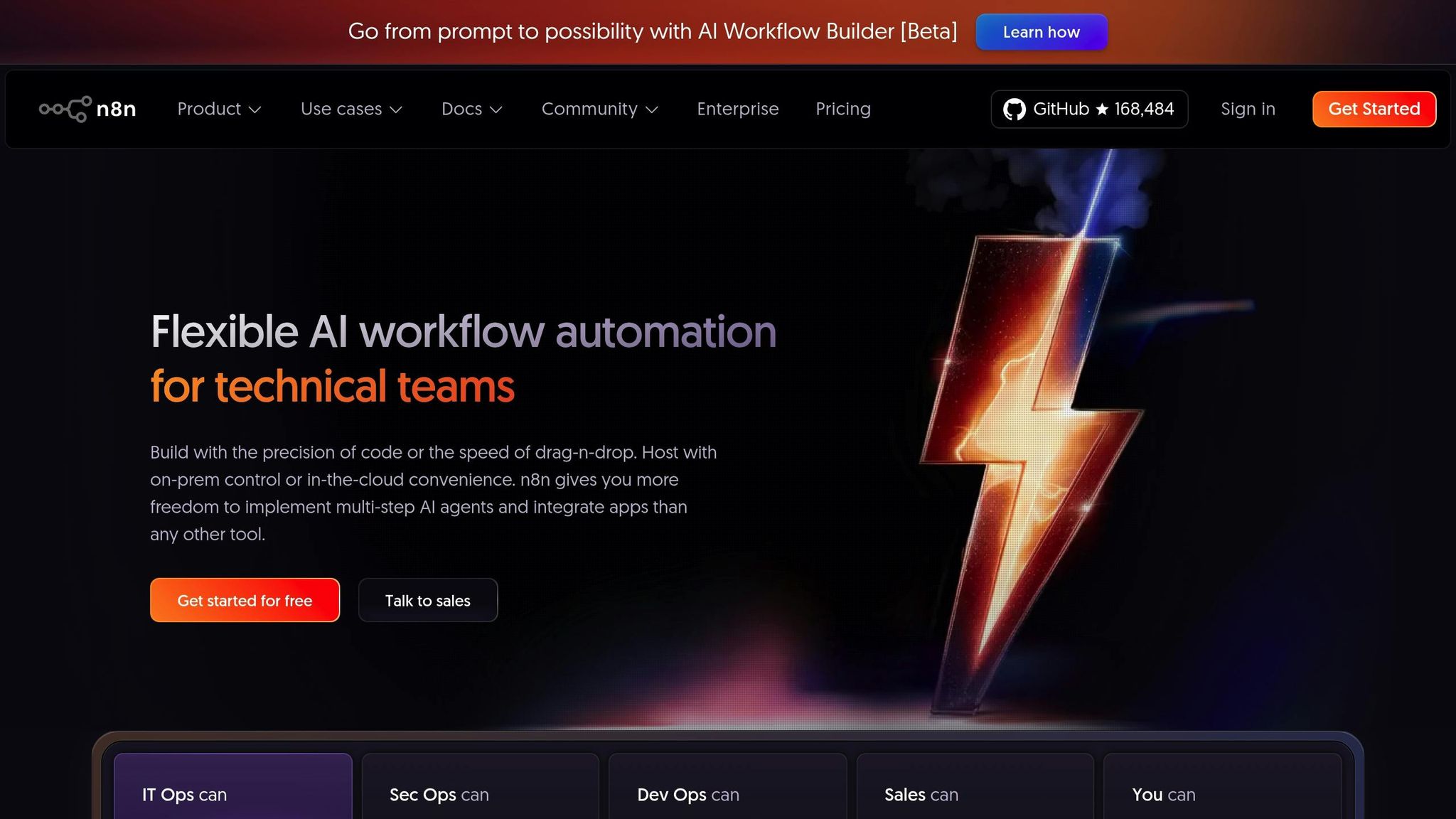
Gone are the days when automating business tasks required deep technical skills. The n8n Automations Bundle simplifies everything with over 10 pre-built workflows designed for operations, marketing, and sales. Each workflow is paired with video tutorials, making it easy to set up and deploy advanced automations in just minutes. Priced at $150, this bundle has received glowing feedback, boasting a 5.0/5 rating from 127 reviews.
These workflows tackle common challenges like auto-enriching CRM leads, sorting IT tickets based on sentiment, and reconciling financial transactions. Recent industry data shows that businesses strategically using AI-driven automation enjoy a 40% increase in productivity. What sets these tools apart is their ability to understand natural language, adapt based on past interactions, and handle exceptions without constant oversight.
Agentic AI is pushing the boundaries of business automation. Unlike traditional rule-based bots, these modern AI agents can independently process and reason across multiple systems. For instance, ChatGPT Atlas can browse web content, conduct research, and even autonomously fill out forms - eliminating tedious manual tasks. With global spending on AI automation expected to surpass $630 billion by 2028, it’s clear how essential these tools are becoming for staying competitive.
When choosing automation tools, focus on platforms that provide API access and customization options to tailor workflows to your business needs. Opt for low-code or no-code templates to speed up deployment. Additionally, ensure compliance with key data protection standards like SOC 2, GDPR, and CCPA to safeguard sensitive information. Generative AI, in particular, has been shown to reduce time spent on content-related tasks by up to 90%, significantly boosting operational efficiency.
3. Marketing and Analytics Resources
AI isn't just about automating tasks or generating prompts - it’s revolutionizing marketing by offering predictive insights that help businesses make smarter decisions.
AI-Powered Marketing Analytics Platforms
Today’s AI tools go beyond basic analysis. They predict outcomes, fine-tune budgets, and uncover patterns in customer behavior, giving marketers a competitive edge.
ActiveCampaign leads the pack with its "Active Intelligence" engine. This tool analyzes billions of data points to provide real-time, goal-focused recommendations. It continuously tracks campaign performance and suggests adjustments to improve results. Impressively, 94% of ActiveCampaign users report achieving ROI within 12 months, with 68% seeing results in just 6 months. With plans starting at $15/month, it’s a budget-friendly option for businesses of all sizes.
ChatGPT by OpenAI is another game-changer. It can sift through marketing spreadsheets to identify high-ROI channels, spot early signs of customer churn, and even forecast lead volumes using specialized market analysis prompts - all in a fraction of the time it would take to do manually.
For those seeking advanced insights using data analytics prompts, Adobe Mix Modeler delivers fast, AI-driven marketing analytics designed to maximize ROI. When choosing analytics platforms, look for tools that integrate seamlessly with your CRM and e-commerce systems. Opt for solutions that offer predictive insights, not just descriptive data, to stay ahead in today’s fast-paced market.
sbb-itb-58f115e
4. Visual Content Creation Tools
AI-Powered Image Generators for Business
Gone are the days when creating professional visuals required advanced design skills or hours spent in Photoshop. With AI-driven image generators, businesses can now produce high-quality, commercially safe visuals quickly and efficiently. These tools are transforming how companies approach marketing campaigns, presentations, and branding. Let’s take a look at some of the top options available.
Adobe Firefly is a standout choice for professional use. Why? It’s trained exclusively on Adobe Stock’s licensed and public domain content, ensuring every image generated is commercially safe - a key factor given the copyright issues faced by tools like Midjourney. Starting at $10 per month, Firefly integrates seamlessly with Photoshop and Creative Cloud, making it a natural fit for teams already using Adobe’s ecosystem.
For businesses focused on creating infographics or visuals with data, Google's Nano Banana Pro (Gemini 3 Pro Image) is particularly effective. It earned an expert score of 8.0/10 in 2026, thanks to its ability to render clear, legible text - perfect for charts, presentations, and marketing materials. Subscriptions for this tool start at $20 per month.
OpenAI's GPT-Image-1.5 offers a unique chat-to-edit feature, allowing users to refine images iteratively without starting over. For those new to this technology, learning how to use ChatGPT to create images can significantly speed up the learning curve. This workflow is a huge time-saver when fine-tuning brand assets or marketing visuals.
For teams handling sensitive or proprietary projects, Canva's Magic Media prioritizes privacy by not using user-generated content for training purposes. This ensures that confidential business materials and designs remain secure. With pro plans starting at $13 per month and an intuitive interface, it’s an excellent option for teams without in-house design expertise.
5. Integration and Workflow Optimization
Connecting AI Across Your Business Stack
The true potential of AI lies in seamlessly integrating it into your existing systems, enabling it to work automatically across platforms. Think of this as intelligent automation - not just rigid rules like "if this, then that", but AI that can interpret context, make decisions, and handle tasks that typically require human judgment. By embedding AI into your workflows, you ensure operations across platforms are coordinated and context-aware, building on the automation and prompt strategies discussed earlier.
Take AI by Zapier as an example. It’s a great entry point for businesses looking to incorporate AI into their workflows. With models like GPT-4o mini, Anthropic, and Google, you can add AI-driven actions directly into automated processes. For instance, you can program AI to extract vendor names, amounts, and categories from emailed receipts and input that data into your accounting software automatically. Remote's IT team uses a similar setup to manage 28% of their support tickets, saving over 600 hours every month.
For CRM-heavy operations, ChatGPT Enterprise offers integrations with tools like HubSpot, Google Drive, SharePoint, and Salesforce. This allows AI to tap into your internal knowledge base and interact directly with your business systems. A practical example? Analyzing HubSpot campaign data to pinpoint which marketing efforts are driving your most valuable deals.
The results from integrating AI into workflows speak for themselves. ActiveCampaign saw a 440% increase in webinar attendance and a 15% reduction in early customer churn. Popl saved $20,000 annually by using AI for lead triage. Meanwhile, Zapier achieved a 97% AI adoption rate across teams by documenting their successes and learning from missteps.
To maximize these benefits, focus on high-impact, repetitive tasks that involve human judgment - like categorizing support tickets by tone or routing leads based on intent. Using a "human-in-the-loop" approach ensures people provide oversight and refine AI decisions, maintaining accuracy as you scale. This governance layer prevents workflows from spiraling into error-prone chaos as your systems grow.
Conclusion
AI has moved beyond the stage of mere experimentation and is now a key player in strategic business execution. Companies that view AI as a core asset rather than a passing trend are reaping tangible benefits, especially in areas where efficiency and cost management are critical.
The tools we’ve discussed aren’t just about convenience - they deliver measurable results. For instance, advanced AI resources can significantly streamline operations. Take specialized prompt libraries: they save users hours each week, and in e-commerce, tailored AI prompts can slash operational costs by as much as 40%. That’s the difference between scaling efficiently and getting bogged down by manual processes.
"Picking the 'best' LLM isn't a research project - it's an execution choice." - Faisal Irfan, Co-Founder, The Rank Masters
To make the most of AI, consider deploying tools like GPT-4o for creating balanced drafts, Claude 3.5 for in-depth research, and Gemini for workflows centered on Google Workspace. Pair these tools with automation platforms capable of handling over 30,000 actions across 8,000+ apps. Start small - run a 14-day trial with clear goals, such as producing 4 posts or testing 12 ad angles, and track their impact on key metrics like demo rates and trial-to-paid conversions.
Looking ahead to 2026, businesses that build secure, revenue-focused workflows will have a competitive edge over those relying solely on large budgets. These companies implement safeguards like PII redaction and focus on revenue-driving activities such as accelerating content production, optimizing ad strategies, and clarifying research processes. They treat AI not as a source of inspiration but as a foundational part of their infrastructure - and they’re already seeing the payoff. By adopting these targeted AI strategies, businesses can streamline operations and maximize their return on investment.
FAQs
How can 'God of Prompt' help businesses boost productivity with AI?
God of Prompt helps businesses work smarter by offering a collection of ready-made, expertly designed AI prompts tailored for tasks like marketing, data analysis, customer support, and more. These prompts take the guesswork out of the equation, allowing teams to produce high-quality results quickly while focusing on bigger-picture priorities instead of repetitive tasks.
The platform is compatible with leading AI models like ChatGPT, Claude, and Midjourney, making it simple to integrate into existing workflows or no-code tools. This seamless integration helps businesses streamline operations, maintain team-wide consistency, and efficiently scale activities like creating reports or planning social media content.
Prompts are neatly categorized by business function, so even users without technical expertise can quickly find what they need. This reduces training time and helps businesses get the most out of their AI investments, making it a practical choice for professionals aiming to boost productivity and achieve measurable outcomes.
What are the main advantages of using AI automation tools in business workflows?
Integrating AI automation tools into business workflows allows companies to handle tedious, repetitive tasks more efficiently, freeing up employees to concentrate on more impactful work. By automating tasks like data entry, document creation, and analytics, businesses can increase productivity, reduce mistakes, and operate more smoothly.
Today's AI platforms come equipped with features such as enterprise-level security, easy integration with existing software, and the capability to perform actions independently. When linked with tools like CRMs or project management systems, AI can simplify even complex workflows with minimal technical know-how, saving both time and resources.
On top of that, curated prompt libraries - like those offered by God of Prompt - help teams adopt AI quickly while maintaining consistent, high-quality outputs. The result? Faster processes, reduced expenses, and a stronger return on investment (ROI), making AI automation a smart move for businesses looking to stay competitive.
How can AI-powered marketing analytics give businesses a competitive advantage?
AI-powered marketing analytics tools are transforming how businesses approach data. These platforms take massive amounts of raw information - like social media metrics or ad spend reports - and turn it into actionable insights in no time. Forget about tedious manual work; with real-time dashboards, businesses can monitor performance and make decisions faster. Plus, they integrate seamlessly with tools like email platforms and CRMs, enabling automated actions that save time and effort.
But these tools don’t stop at crunching numbers. They use predictive modeling to pinpoint which audiences are most likely to connect with specific campaigns. Tasks like audience segmentation and even content creation can be automated, allowing businesses to deliver personalized experiences on a large scale. The result? Higher conversion rates and better ROI. With rapid insights, automation, and predictive precision, companies can fine-tune their marketing strategies, make smarter budget decisions, and maintain a competitive edge.
Related Blog Posts

Loved by Business Owners


Based on 1K reviews
Get smarter on AI every week.
Ready to transform your business?