

20 AI Prompts for Smarter Candidate Screening




Sorting through job applications can feel overwhelming, especially with the rise of one-click applications and AI-generated résumés. Many recruiters now face hundreds of submissions per job, with up to 45% more applications in recent years. AI tools like ChatGPT, Claude, and Gemini simplify this process by analyzing résumés, ranking candidates, and identifying top prospects in seconds.
Here’s how AI prompts can help you:
- Extract and assess skills relevant to the role.
- Categorize technical skills by proficiency.
- Spot employment gaps and red flags.
- Compare candidates side-by-side for better decisions.
- Reduce bias by anonymizing résumés and focusing on qualifications.
By using these prompts, recruiters can process applications faster, evaluate candidates thoroughly, and improve hiring efficiency. Currently, only 14% of companies fully leverage AI in hiring - leaving a huge opportunity for teams to gain an edge. The right prompts can cut administrative tasks by 50% and double qualified candidate matches in under two weeks.
Start with smarter prompts to save time and hire better.
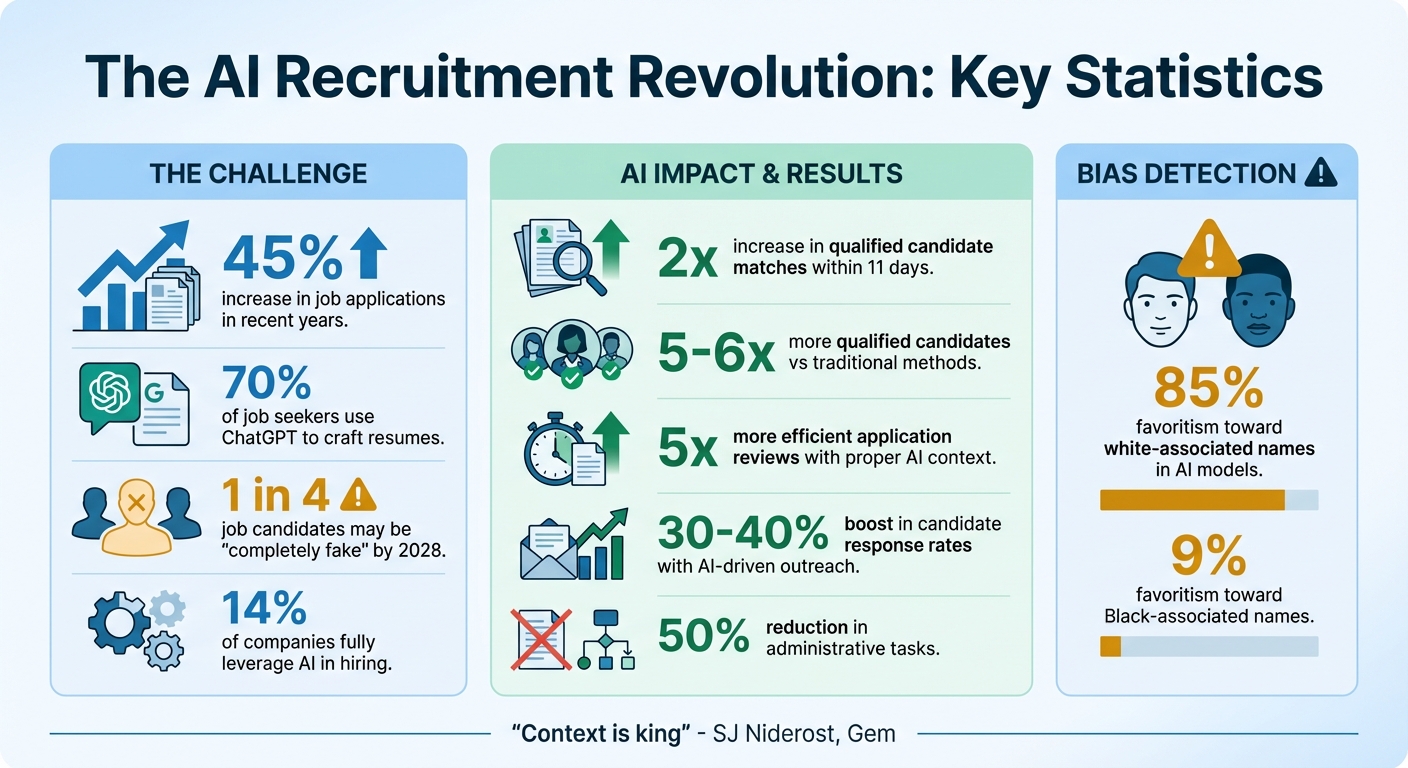
AI-Powered Recruitment Statistics and Impact Metrics
AI Screening in Recruitment - What Is It and How Is It Transforming Hiring?
sbb-itb-58f115e
1. Resume Analysis
Extract Skills That Match the Job Title
Start with a simple yet effective approach: "Extract key skills listed on the resume that match the role of [Job Title]". This gives you an immediate overview of how well the candidate's skills align with the job requirements, without needing to comb through every detail. It's a quick way to pinpoint relevant competencies.
Categorize Technical Skills by Proficiency Level
Not all skills are created equal. Use this prompt: "Detail the technical skills and tools mentioned on the resume. Categorize them by proficiency level (beginner, intermediate, advanced)". This method helps you separate foundational knowledge from expertise, which is crucial when assessing candidates for specialized positions.
Audit Certifications and Training Programs
Formal credentials often play a key role in hiring decisions. Try this: "List all professional certifications, courses, and training programs from the resume and assess their relevance to the role". Given that around 70% of job seekers now use ChatGPT resume prompts to craft their applications, this approach helps you focus on verifiable qualifications and avoid being misled by inflated claims.
Rate Technical Fit on a 1-10 Scale
For a clear and actionable assessment, ask: "Evaluate whether [candidate name]'s technical skills listed on their resume are a good fit for this role. Provide a rating from 1-10". This scoring system enables you to quickly compare candidates and prioritize those with the strongest fit, especially when reviewing a large number of applications.
Identify Red Flags and Employment Gaps
To spot potential issues, use: "Identify any significant time gaps in the candidate's employment history and provide possible reasons based on the resume content". AI can also cross-check claimed skills with actual project outcomes to detect vague or unsupported achievements. With predictions suggesting that 1 in 4 job candidates may be "completely fake" by 2028, this step is becoming increasingly important for thorough vetting.
2. Candidate Evaluation
Refining candidate evaluation goes beyond just analyzing résumés. These prompt resources for HR professionals are designed to make hiring decisions smarter and more efficient.
Compare Candidates Side-by-Side Using Key Skills
When you're narrowing down your finalists, try this:
"Compare two candidates based on [key skills] and rank them according to [job role] alignment".
This method simplifies decision-making by clearly showing which candidate aligns better with the role, especially when technical expertise is a priority.
Create Bias-Free Scorecards for Consistent Assessment
Standardize your hiring process with this prompt:
"Create a scorecard for assessing collaboration and expertise with a bias-free rating for each level".
Using consistent criteria reduces subjective bias, ensuring every candidate is evaluated on the same playing field. This not only promotes fairness but also strengthens your hiring process.
Synthesize Feedback from Multiple Interviewers
After conducting interview rounds, use:
"Summarize findings from multiple interviewers by strengths, areas for improvement, and consensus ratings".
This prompt organizes feedback into a single, cohesive summary, making it easier to identify shared opinions and any differing perspectives.
Identify Transferable Skills for Career Pivoters
For candidates transitioning into a new industry, consider:
"Identify transferable skills in this resume for candidates attempting a career pivot into [new industry]".
This helps uncover hidden strengths and relevant experience that may not be immediately apparent, giving career switchers a fair chance.
Detect Skill Gaps Before Making an Offer
To evaluate potential training needs, ask:
"Review this resume and identify gaps in technical skills relevant to [job title]".
This step allows you to pinpoint areas requiring development, helping you decide if additional training can close the gaps or if they might hinder performance. Teams that have adopted such precise evaluation techniques report a 2x increase in qualified candidate matches within just 11 days, proving how targeted approaches can deliver quick results.
3. Screening Optimization
Refining candidate evaluation starts with smarter, more focused screening methods.
Process Resumes in Small Batches for Better Results
When managing a large number of applications, screening resumes in smaller groups - around five at a time - can help maintain accuracy and prevent errors. This step ensures that the AI delivers precise results without being overwhelmed, especially during the initial filtering stage. It’s a practical way to sift through hundreds of resumes while keeping the quality of analysis high.
Leverage Semantic Search Over Keyword Matching
Modern AI tools excel at understanding context, which means you don’t have to rely on exact keyword matches. Instead, craft prompts that describe the qualities or experiences you’re seeking, such as "Find candidates with experience in early-stage startups". This method broadens the search to include candidates who might phrase their experiences differently but are equally qualified, offering a more comprehensive talent pool without compromising on relevance.
To refine the process further, clear evaluation patterns and ranking techniques can make a significant difference.
Use Two-Shot Prompting for Consistent Screening
For consistent results, provide the AI with two examples of ideal candidate profiles. This helps establish a pattern the AI can follow when evaluating resumes. For instance, if you’re hiring for a senior engineering position, sharing profiles of your top-performing engineers can guide the AI in identifying candidates with similar qualifications and expertise.
Create Automated Ranking Tables for Faster Comparisons
Simplify decision-making by asking the AI to generate comparison tables that highlight each candidate’s strengths and weaknesses side by side. These tables make it easy to quickly identify top contenders, saving time and effort. Teams that adopt this method often see a 5-6x improvement in the number of qualified candidates identified compared to traditional methods.
Request Explanations for Ranking Decisions
To ensure transparency, ask the AI to explain its ranking choices. For example, prompt it with something like, "Rank these five resumes based on the job description and explain your reasoning for each ranking". This not only adds clarity to the process but also allows you to verify that the AI’s decisions align with your expectations and criteria.
4. Bias Reduction
When it comes to fair hiring practices, reducing bias in AI assessments is critical. By designing prompts that focus on qualifications and keeping evaluations objective, we can ensure a more balanced approach to hiring.
Strip Personal Identifiers Before Analysis
One effective way to eliminate bias is by using ChatGPT custom instructions to remove personal details, such as names, addresses, graduation years, and zip codes, from resumes before analysis. These details can unintentionally reveal information like gender, race, age, or socioeconomic status, potentially influencing the assessment. For instance, research shows that modern language models have favored white-associated names 85% of the time compared to Black-associated names, which were favored only 9% of the time. By anonymizing resumes, the AI can focus entirely on evaluating skills and experience.
Evaluate Skills Instead of Prestige Markers
Another way to reduce bias is to shift the focus from institutional prestige to tangible skills. Prompts should prioritize measurable abilities and work deliverables rather than factors like the university attended or years of experience, which can often reflect privilege rather than capability. This approach ensures that candidates are assessed based on what they can do, creating a more standardized and equitable evaluation process.
Generate Standardized Questions for Every Candidate
Consistency is key in interviews. By using AI to generate a uniform set of skill-based or behavioral questions for all candidates, you can minimize subjective differences in the evaluation process. This ensures every candidate is assessed on the same criteria, promoting fairness and increasing accountability in hiring decisions.
Require Detailed Explanations to Detect Bias Proxies
Transparency matters. Instruct the AI to provide clear reasoning for its scoring decisions. This helps identify if the algorithm is inadvertently favoring proxies like club memberships or geographic indicators, which might correlate with protected characteristics. By understanding the "why" behind the scores, you can address potential biases more effectively.
Test for Bias Using Name Variations
A practical way to check for bias is by running the same resume through the AI multiple times, changing only the candidate's name to reflect different genders or ethnicities. If the scores differ significantly, it’s a sign that the prompts need refinement to eliminate bias and focus solely on qualifications. This method ensures that name changes have no impact on evaluation outcomes, reinforcing the objectivity of the process.
Conclusion
AI is transforming the way recruitment teams operate. The 20 prompts discussed in this guide tackle some of the most challenging aspects of hiring - like analyzing résumés, evaluating candidates, optimizing screening and interview scheduling tools processes, and addressing bias. Teams leveraging these prompts have reported impressive results, including a 2x increase in qualified candidate matches within just 11 days. AI-powered sourcing has shown to deliver 5–6x more qualified candidates compared to traditional approaches. Additionally, application reviews become up to 5x more efficient when AI is given the right context, while personalized, AI-driven outreach can boost candidate response rates by 30–40%.
"The difference between 'meh' AI outputs and game-changing productivity gains is that context is king."
- SJ Niderost, Content Marketing Manager, Gem
The key takeaway? Context matters - a lot. The quality of your prompts determines the quality of your AI results. Vague instructions lead to average outputs, while detailed, well-thought-out prompts unlock the full potential of AI. By providing specifics about your company culture, technology stack, and ideal candidate profiles, you set the stage for better outcomes.
For teams looking to take recruitment to the next level, advanced prompt libraries offer a powerful solution. God of Prompt (https://godofprompt.ai) provides over 30,000 tailored AI prompts designed specifically for recruitment, HR, and business workflows across platforms like ChatGPT, Claude, and Gemini. These templates make it easier to standardize evaluations, minimize bias, and save time - eliminating the need to create prompts from scratch. With only 14% of companies fully integrating AI into their talent acquisition processes, there's a huge opportunity to gain a competitive edge. Smart AI prompts not only streamline hiring but also promote a fairer and more strategic recruitment process.
FAQs
How do I safely anonymize resumes before AI screening?
To prepare resumes for AI screening while maintaining anonymity, it's important to strip away any personally identifiable information (PII). This includes details like names, addresses, social media profiles, and educational institutions. To achieve this, you can rely on tools like redaction software or AI-driven features designed to obscure or delete sensitive data. Always double-check to confirm that all PII has been completely removed. Once anonymized, securely share the resumes to protect privacy and help reduce bias in the screening process.
What info should I include so the AI ranks candidates accurately?
To ensure the AI evaluates candidates accurately, it's essential to provide clear, detailed information about several key areas:
- Skills and Qualifications: Highlight both technical and non-technical abilities that are essential for the role.
- Experience: Specify relevant work history, industries, or projects that align with the job.
- Soft Skills: Include attributes like communication, teamwork, or problem-solving that are important for the position.
- Role Requirements: Clearly outline what the job entails and the expectations for the candidate.
- Team Fit: Describe the values, work environment, and dynamics to help gauge compatibility.
Using descriptive and specific prompts ensures the AI understands the context and criteria, allowing for a more accurate and tailored evaluation.
How can I check if AI screening is biased?
To address bias in AI screening, consider implementing bias audits and fairness analyses. Techniques like correspondence experiments - where application details such as names are altered - can highlight disparities in how candidates are evaluated. Studies reveal that AI tools might unintentionally favor or disadvantage applicants based on attributes like race or gender. Conducting regular audits, including fairness impact ratio analyses, can help pinpoint and mitigate these biases, promoting fairer hiring practices.
Related Blog Posts

Loved by Business Owners


Based on 1K reviews
Get smarter on AI every week.
Ready to transform your business?