
AI Icebreakers vs Traditional Icebreakers



When it comes to breaking the ice in meetings or team settings, you have two main options: AI-driven icebreakers or traditional methods. Here's the gist:
- AI Icebreakers: Use advanced tools to create personalized, data-driven prompts in seconds. They’re great for remote or hybrid teams, scalable for any group size, and require minimal setup.
- Traditional Icebreakers: In-person activities like “Two Truths and a Lie” or group challenges. These are simple, familiar, and effective in face-to-face settings but often require more time and resources.
Each approach has strengths and limitations, and the best choice depends on your team’s needs, goals, and format (in-person vs. remote).
Quick Comparison
| Criteria | AI Icebreakers | Traditional Icebreakers |
|---|---|---|
| Setup Time | Instant | Minutes to hours |
| Group Size | Scales from 3 to 300+ | Limited by physical space and logistics |
| Format | Works for remote, hybrid, and in-person | Best for in-person |
| Personalization | Tailored prompts based on data | Generic or facilitator-driven |
| Cost | Often free, no props needed | May require materials or equipment |
AI tools like ChatGPT or God of Prompt are ideal for team management and scalable solutions, while traditional methods work well for fostering in-person connections. Choose based on your team’s format and objectives. For more complex needs, you can even build team-specific AI workflows to automate these interactions.
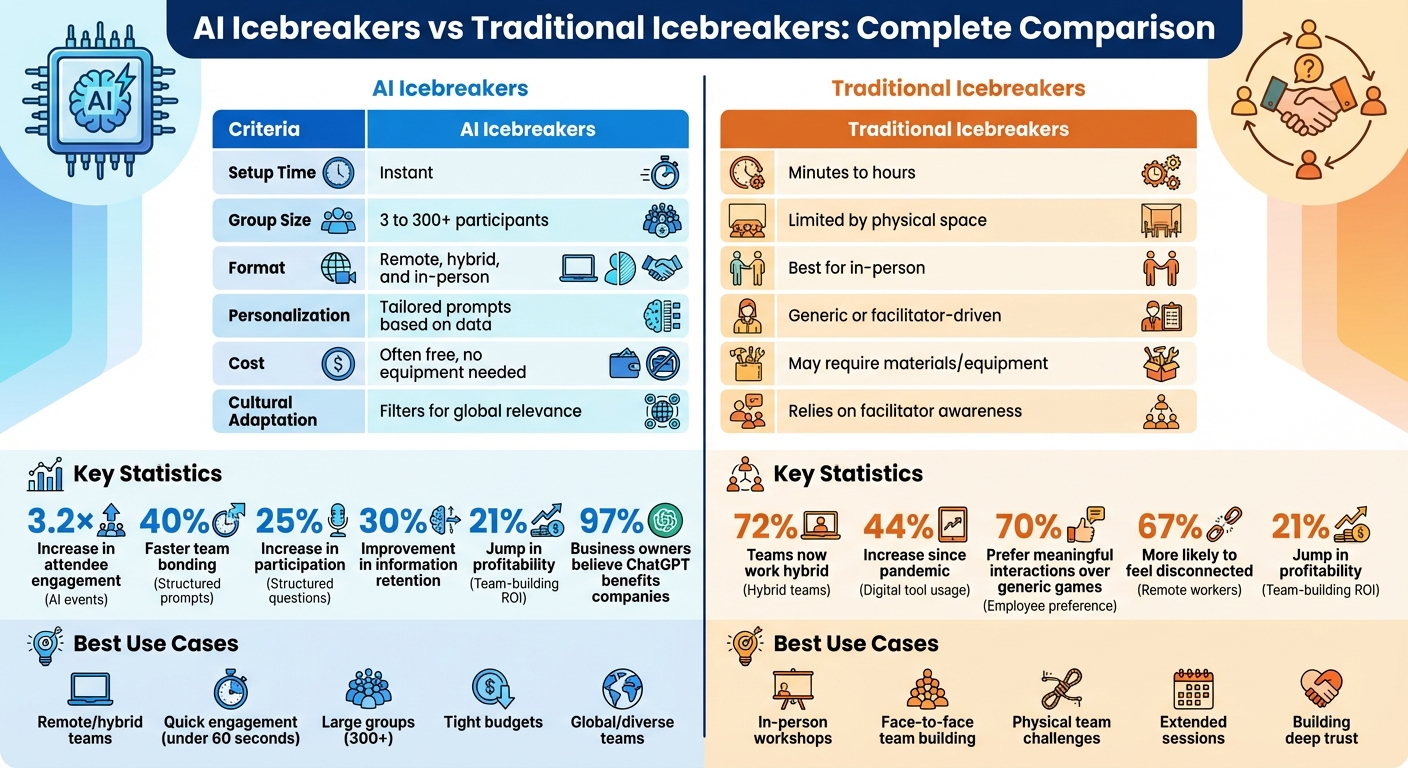
AI vs Traditional Icebreakers: Complete Comparison Chart
AI Icebreakers: Features, Benefits, and Use Cases
How AI Improves Icebreaker Activities
AI takes the concept of icebreakers to the next level by transforming generic, one-size-fits-all activities into personalized and data-driven tools. Instead of relying on random prompts, AI platforms analyze professional details - like LinkedIn profiles - to craft questions that reflect shared experiences or complementary skills. For instance, Copy.ai incorporates this feature into sales and onboarding workflows, making it easier for teams to connect even before meetings begin.
Another major advantage is how AI reduces what experts call the "facilitation burden". By generating context-aware prompts based on categories like humor, work-focus, or depth, AI eliminates the need for a skilled facilitator. These tools even track previously used questions to avoid repetition, ensuring fresh content for recurring meetings. As Lewis Lin explains:
"ChatGPT acts almost like a passive personality test - without making anyone fill out long questionnaires".
This capability offers unbiased insights into communication styles without the awkwardness of traditional assessments.
For hybrid teams, AI tools like God of Prompt provide 30,000+ customizable prompts tailored for platforms like Slack, Microsoft Teams, and Zoom. These prompts are organized into bundles for various business scenarios, ranging from quick warmups to deep trust-building exercises, and are updated weekly to align with workplace trends.
All these advancements make AI-powered icebreakers a game-changer for team interactions.
Benefits of AI Icebreakers
AI icebreakers bring more than just personalization - they also deliver scalability and efficiency. Whether you're working with a small group of three or a massive team of 300+, AI tools adapt seamlessly. There’s no need for physical materials or complex setups. A team leader in New York can generate the same high-quality prompts as one in Los Angeles, instantly - a level of convenience that traditional methods can't offer.
What once took hours of brainstorming can now be handled in seconds. As Jen Quraishi Phillips from Airtable notes:
"Copy.ai has enabled me to free up time to focus more on where we want to be in say three months from now, six months from now, instead of just deep in the weeds".
This efficiency allows leaders to shift their focus from administrative tasks to long-term strategic goals.
AI also enables deeper customization. For example, tools can create "vulnerability ladders" or "tone tiers", starting with lighthearted prompts and gradually introducing more meaningful questions as trust builds. Research supports this approach, showing that structured prompts can speed up team bonding by 40% compared to unstructured small talk. At the same time, these tools maintain the psychological safety necessary for authentic interactions.
Real-world examples highlight how these benefits play out in practice.
Examples of AI Icebreakers
AI-generated icebreakers come in various forms, from simple conversation starters to more intricate team-building exercises:
- Conversation starters: For remote teams, the "Waterfall Technique" involves everyone typing their answers into a chat but waiting for a countdown to hit send simultaneously. Copy.ai’s LinkedIn integration takes this further by analyzing career histories to craft prompts about shared industries or milestones.
- Team-building games: AI can power asynchronous activities, ideal for distributed teams. Water Cooler Trivia, for instance, uses AI to create weekly quizzes that employees can complete in different time zones. Similarly, Quizbreaker generates personalized question sets based on team responses over time. For larger virtual events, Remo analyzes audience demographics and event themes to tailor relevant questions.
-
Reflection prompts: These encourage deeper engagement. For example, teams can use ChatGPT to ask thought-provoking questions like:
This method provides neutral feedback, revealing blind spots without the pressure of formal assessments. The "Three-Tier Ladder" approach - progressing from light warmups to collaboration-focused and trust-building questions - helps teams connect meaningfully while respecting individual comfort levels."From all of our interactions, what is one thing that you can tell me about myself that I may not know?".
With 97% of business owners believing ChatGPT benefits their companies and remote workers being 67% more likely to feel disconnected from their teams, AI icebreakers address an urgent need in today’s workplace culture.
sbb-itb-58f115e
Traditional Icebreakers: Strengths and Limitations
Common Traditional Icebreaker Methods
Traditional icebreakers come in a variety of forms, each tailored to different team dynamics. For example, question-based activities like "Would You Rather", "Two Truths and a Lie", or "Rose, Bud, Thorn" (where participants share a highlight, a goal, and a challenge) are great for sparking conversation. These work particularly well in daily standups or virtual meetings, where structured prompts can help ease participants into discussion.
Then there are physical or collaborative activities that get people moving or working together. Think of the "Marshmallow Challenge", where teams compete to build the tallest structure, or the "Human Knot", where participants untangle themselves from a circle. Another classic is the "Helium Stick", where a group must collectively lower a rod to the ground without losing coordination. Communication-focused exercises, like "Back to Back Drawing", emphasize verbal clarity and listening skills. In this activity, one person describes an image while the other attempts to draw it.
For larger gatherings, mingling games like "Human Bingo" (where participants find others who match traits on a card) or "Speed Networking" (short, timed conversations with various partners) help break the ice. Professional facilitators often classify these activities into tiers: Tier 1 for light warmups, Tier 2 for collaborative exercises, and Tier 3 for trust-building activities. This tiered approach allows facilitators to align the activity with the group’s specific needs.
Strengths of Traditional Icebreakers
There’s no denying that traditional icebreakers can be highly effective in fostering connection and easing social tension. In fact, structured conversation prompts used in in-person settings have been shown to speed up team bonding by as much as 40% compared to unstructured interactions. They also boost engagement - structured questions can increase participation by 25% and improve information retention by 30%. Even from a business perspective, organizations that prioritize team-building activities have reported a 21% jump in profitability.
One of the standout features of traditional icebreakers is their simplicity. Games like "Two Truths and a Lie" are easy to understand and require minimal effort to participate, making them accessible to people from diverse backgrounds. Physical challenges, on the other hand, reveal team dynamics and communication styles, while shared laughter during these activities often releases oxytocin, which helps build lasting connections.
Andrea Rajic from Gable highlights that well-chosen icebreakers can create inclusive environments by breaking down initial awkwardness and helping participants feel like they belong. The key is picking the right activity for the moment: quick, light games like a "One-Word Weather Check" are perfect for short sessions, while more involved activities like the "Marshmallow Challenge" are better suited for extended team-building events.
Limitations of Traditional Icebreakers
Despite their strengths, traditional icebreakers aren’t without their flaws - especially in today’s evolving workplaces. Many employees find these activities awkward or forced, which can have the opposite effect of what’s intended. Instead of sparking connection, they sometimes lead to uncomfortable silences. In fact, 70% of employees say they prefer meaningful interactions over generic icebreaker games.
Logistics can also be a hurdle. Physical games often require specific equipment, ample space, and time for setup, making them impractical for large groups or remote teams. With 72% of teams now working in hybrid environments, activities designed solely for in-person settings often fall short. Additionally, some icebreaker prompts rely on references that are more familiar to North American audiences, such as specific sports or holidays, which can unintentionally alienate global participants.
Another challenge is maintaining psychological safety. Asking participants to share personal details too early can make some feel uncomfortable and disengaged. For teams that need quick engagement - say, within 60 seconds - traditional icebreakers can be too time-consuming to set up and execute effectively.
As IcebreakerQuestions.net puts it:
"The biggest mistake people make with icebreakers is treating them as a box-checking exercise rather than an opportunity for genuine connection".
These challenges highlight the need for fresh approaches, paving the way for a comparison with AI-driven icebreakers in the next section.
Use ChatGPT to create fun and engaging Ice Breakers for your next training course / group event!
AI Icebreakers vs Traditional Icebreakers: Direct Comparison
Looking at the benefits mentioned earlier, it's clear that AI-powered icebreakers bring some distinct advantages over traditional methods. Here's a closer look at how they stack up.
Effectiveness: Engagement and Outcomes
AI-driven icebreakers shine when it comes to boosting engagement. Events that use AI tools report a 3.2× increase in attendee engagement compared to traditional approaches. The secret lies in how these tools create and deliver prompts.
AI excels at personalization on a large scale. It can analyze event themes, goals, and audience data to craft tailored prompts in minutes. Traditional methods, on the other hand, often rely on generic, pre-made lists. Plus, AI-generated prompts can act as neutral tools for feedback. Lewis Lin, CEO of ManageBetter, explains:
"Because ChatGPT isn't human, there's no fear of judgment or bias. It delivers its reflections neutrally, helping to create a safe environment where people feel more comfortable receiving feedback".
Traditional icebreakers, however, rely heavily on the facilitator's skill and the group's existing comfort level, which can result in inconsistency or bias. AI's ability to engage participants efficiently also ties directly to its ease of use, as explored below.
Ease of Use: Accessibility and Implementation
AI-powered tools make setup a breeze. They can generate curated prompts in seconds, while traditional methods often require hours of brainstorming or combing through pre-made lists. For example, platforms like icebreakerquestions.net and Remo's AI generator offer free, ready-to-use solutions that can be deployed instantly on platforms like Zoom, Slack, or Microsoft Teams.
In contrast, traditional icebreakers often require physical props, dedicated spaces, and careful coordination - challenges that can be difficult to manage in today's hybrid work settings. While AI tools allow anyone to lead a session with minimal preparation, activities like the "Marshmallow Challenge" or "Human Knot" demand more expertise to run smoothly. The increased reliance on digital collaboration tools since the pandemic - up 44% - has only fueled the demand for digital-first solutions. As IceBK puts it:
"Icebreaker questions are the fastest, most scalable way to build connection in any group setting. Unlike physical activities or complex games, well-crafted questions work in person, remotely, or hybrid formats with zero equipment required".
Flexibility and Scalability
AI icebreakers are built for scalability, adapting easily to groups of any size - from small teams of 3 to large crowds of 300+ - without requiring extra effort. Traditional icebreakers, by comparison, often struggle with larger groups, needing coordination and sub-grouping to function effectively. Modern AI tools also filter out cultural idioms, ensuring prompts are relevant to diverse, global audiences.
| Factor | AI Icebreakers | Traditional Icebreakers |
|---|---|---|
| Group Size | Works for 3 to 300+ participants | Limited by physical space and setup |
| Setup Time | Instant generation and sharing | Requires minutes to hours of planning |
| Format Flexibility | Supports remote, hybrid, and in-person | Primarily designed for in-person settings |
| Cultural Adaptation | Filters for global relevance | Relies on facilitator's cultural awareness |
| Cost | Often free, no equipment needed | Costs vary; may need props or materials |
For teams working across time zones or looking for quick engagement, AI's ability to create asynchronous prompts - like Slack questions with 24–48-hour response windows - offers a level of flexibility that traditional methods can't match.
Conclusion: Choosing the Right Approach
The choice between AI-driven and traditional icebreakers depends on what your team needs most. AI-driven options stand out for their ability to personalize and scale, making them ideal for remote and hybrid teams. On the other hand, traditional icebreakers shine in face-to-face workshops where deeper engagement is the goal.
Start by identifying your primary objective. Are you aiming to boost morale, onboard new hires, or improve team communication? Done right, icebreakers can even contribute to profitability. A structured approach, like the Three-Tier Ladder, can help: begin with light warm-ups, transition to collaboration-focused activities, and finish with trust-building exercises.
Time and budget also play a major role. AI tools can generate tailored icebreakers in seconds with minimal cost, making them a practical choice for teams with tight schedules or budgets. Traditional activities, by contrast, often require more time and resources, such as physical materials and detailed planning. For teams stretched thin, AI tools offer a quick and cost-effective solution, consistently delivering fresh ideas.
Platforms like God of Prompt simplify the process even further. With a library of over 30,000 expertly crafted prompts, it covers everything from quick meeting warmups to detailed four-week engagement plans. With 17,060+ satisfied users, God of Prompt provides a fast and reliable way to implement effective icebreakers without the hassle of starting from scratch.
FAQs
When should I use AI icebreakers instead of traditional ones?
AI-driven icebreakers are a great way to enhance engagement, streamline processes, and add a personal touch. They’re particularly handy for remote or hybrid teams, providing quick and flexible solutions that can scale as needed. Unlike conventional approaches, AI tools eliminate logistical hurdles, making it easier to build stronger connections. Plus, they’re well-suited for creating activities that align with diverse team needs and today’s fast-paced work environment.
How do I keep AI icebreakers safe and appropriate for my team?
To make sure AI icebreakers create a safe and welcoming atmosphere, use prompts that encourage positivity and respect. Stick to inclusive, neutral questions that fit the level of trust within your team and the context of the interaction. Many AI tools allow you to customize prompts, using filters to steer clear of sensitive subjects and help build meaningful connections. Choose questions that spark uplifting conversations while maintaining professional boundaries.
How can I combine AI and traditional icebreakers in one session?
To mix AI with classic icebreakers, kick things off with an AI-generated question or activity to spark interest and get people talking. Once the group is warmed up, shift to a more personal approach, like sharing stories or breaking into smaller discussion groups. You can even use AI tools like ChatGPT to offer feedback or add insights during these traditional activities. This approach blends modern technology with genuine human interaction, creating a session that's both engaging and relatable.
Related Blog Posts

Loved by Business Owners


Based on 1K reviews
Get smarter on AI every week.
Ready to transform your business?