Best AI Prompts for High-Converting Sales Copy
Actionable AI prompts and frameworks for landing pages, emails, product descriptions, ads, scripts, and lead magnets to improve conversions.


On this page
- 1. Landing Page Copy
- The Multi-Framework Hero Section Generator
- 2. Email Sales Sequences
- Building Multi-Email Sequences with a Self-Reflection Approach
- Example Prompt for High-Impact Email Sequences
- 3. Product Descriptions
- Turning Features into Benefits with the FAB Framework
- Example Prompt for Writing Benefit-Focused Descriptions
- 4. Ad Campaigns
- Writing Platform-Specific Ads That Stop the Scroll
- 5. Sales Scripts and Upsells
- Turning Conversations Into Revenue With Persona-Based Scripts
- 6. Lead Generation Copy
- Crafting Lead Magnets That Actually Capture Contacts
- The AI Copywriting Method that Works Every Time V3
- Conclusion
- FAQs
- How do I write effective AI prompts for creating high-converting sales copy?
- What are the best frameworks for writing persuasive product descriptions?
- How can I optimize AI-generated ad copy for platforms like Facebook, Instagram, and Google?
- Related Blog Posts
Creating sales copy that converts is tough – most landing pages convert at less than 2%. The secret? Crafting precise AI prompts. This guide reveals prompts for writing persuasive copy across landing pages, emails, product descriptions, ads, and more. Here’s what you’ll learn:
Landing Pages: Use frameworks like PAS and BAB to create attention-grabbing hero sections and test variations.
Email Sequences: Structure concise, high-impact emails with clear goals and triggers for better open and click-through rates.
Product Descriptions: Turn features into emotional benefits using the FAB framework.
Ad Campaigns: Tailor copy to specific platforms (e.g., Meta, Google) and experiment with angles like pain points and urgency.
Sales Scripts: Personalize pitches for buyer personas and upsell effectively.
Lead Magnets: Develop valuable resources using clear frameworks to capture leads.
The key takeaway? AI outputs are only as good as the prompts you provide. By being specific and detailed, you can generate tailored, action-driving copy that resonates with your audience.
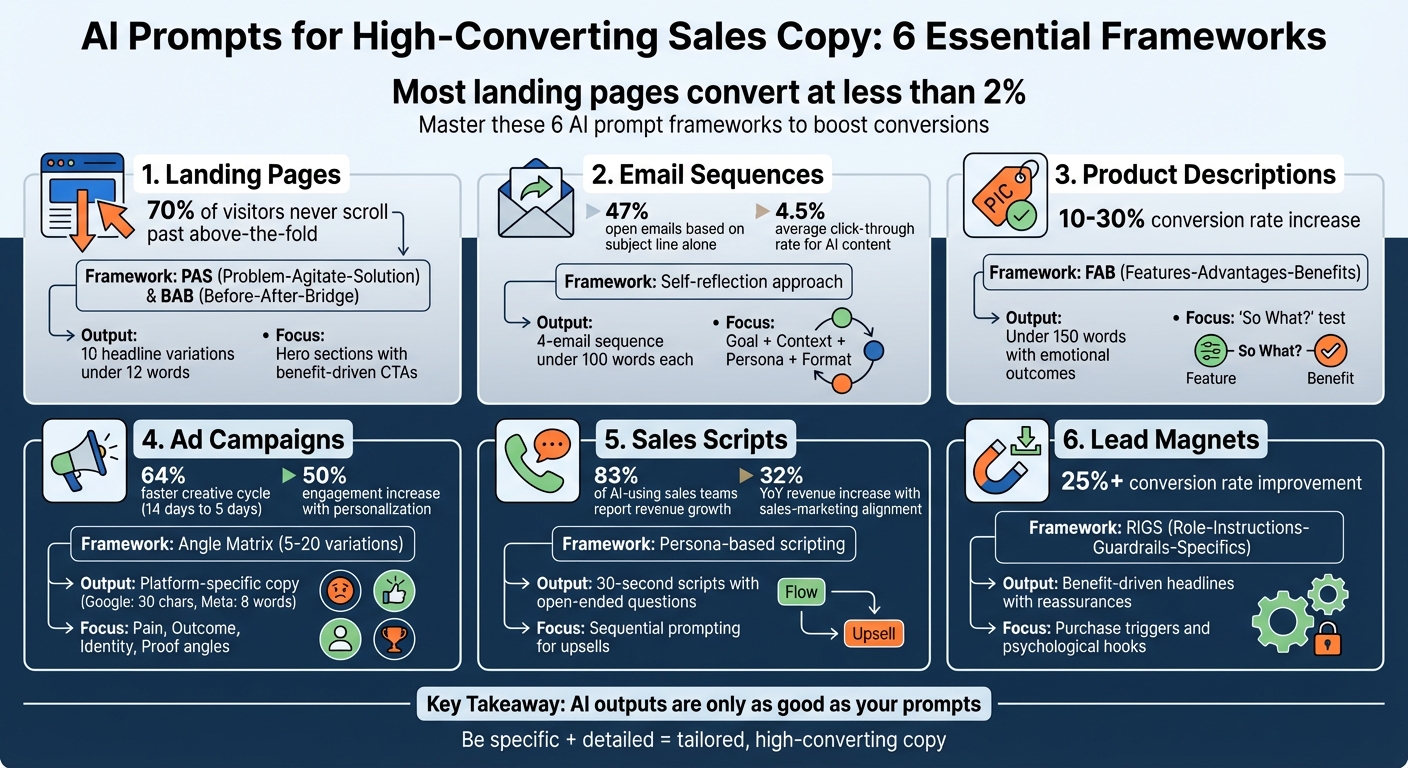
AI Prompt Framework Guide for 6 Sales Copy Types
1. Landing Page Copy
The Multi-Framework Hero Section Generator
Did you know that about 70% of visitors never scroll past the above-the-fold section? That’s why your hero section has to grab attention immediately. The following prompt is designed to create complete hero sections using trusted frameworks like PAS (Problem-Agitate-Solution) and BAB (Before-After-Bridge). It ensures your headlines are punchy and impactful.
To get the most out of this, position the AI as a conversion copywriting expert. Provide details about your audience, product, and the results you want to achieve. Then, request headline variations tailored to different angles – such as curiosity, urgency, benefits, problem-awareness, and outcomes – for A/B testing to increase conversions. Here’s a great reminder from Jonathan Miksis:
"Your headline is your first – and sometimes only – shot to hook a visitor. If it’s weak, they bounce. If it hits, they scroll."
The Prompt:
"You’re a conversion copy expert. Write a complete hero section for [Product Name] targeting [specific audience, e.g., manufacturing companies with 50-200 employees in the Midwest]. Generate 10 headline variations under 12 words each using these angles: benefit-driven, curiosity-driven, problem-aware, urgency-based, and outcome-focused. For each headline, add a subheadline (under 20 words) that bolsters credibility. Use PAS to highlight the pain and show [Product] as the solution. Generate 5 first-person CTA options (under 6 words) that focus on benefit."
This approach creates a hero section that directly speaks to your audience’s pain points and delivers a conversion-focused, testable solution.
2. Email Sales Sequences
Building Multi-Email Sequences with a Self-Reflection Approach
Once you’ve created compelling landing pages, the next step is guiding your leads through well-structured email sales sequences. These sequences are essential for building trust and driving conversions. Here’s a key stat to keep in mind: 47% of email recipients decide to open an email based solely on the subject line. And while the average click-through rate for AI-generated email content hovers around 4.5%, you can exceed this benchmark with a carefully designed approach. Part of that approach is humanizing AI copy before it sends, which strips the stiff, templated phrasing that makes machine-written emails easy to ignore.
A great way to improve your email copy is by using the "self-reflection" technique, a method championed by Samuel Thomas Elliot of Apollo Labs. This approach encourages clarity before generating content. Elliot explains:
"AI isn’t an expert – it’s just all-knowing. And it’s almost too intelligent for its own good. If you don’t clearly explain what you’re looking for, it’s not going to know what you want."
By integrating self-reflection, you can ensure your emails address customer pain points and hit the right conversion triggers. To structure your prompt effectively, focus on four key elements:
Goal: Define the specific action you want the recipient to take.
Context: Include product details and highlight the customer’s challenges.
Persona: Frame the AI as a seasoned B2B sales representative.
Format: Specify the email’s length, tone, and structure.
For email sequences, outline the timing and trigger for each message. For example, you might schedule one email "3 days after a demo" or "immediately after cart abandonment." Keeping each email under 100 words can significantly boost engagement.
Example Prompt for High-Impact Email Sequences
Here’s how you can craft a detailed prompt to create a 4-email sequence that converts:
The Prompt:
"You’re an experienced B2B sales rep. Before writing, ask me five clarifying questions about my offer and audience. Then create a 4-email sequence for [Product Name] targeting [specific segment, e.g., HR directors at companies with 100-500 employees]. Email 1: Welcome (sent immediately after signup). Email 2: Problem-focused (sent 3 days later). Email 3: Case study/social proof (sent 5 days after Email 2). Email 4: Urgency-based offer (sent 4 days after Email 3). Use the BAB framework. Each email should be under 100 words, conversational tone, avoid exclamation points. Generate three subject lines per email (under 60 characters). Include a single clear CTA per email focused on [desired action, e.g., booking a 15-minute call]."
This approach ensures your email sequences are not only concise and engaging but also tailored to your audience’s needs, ultimately driving better results.
3. Product Descriptions
Turning Features into Benefits with the FAB Framework
Product descriptions aren’t just about listing specs – they’re a chance to connect with customers and drive conversions. By translating features into meaningful benefits, you can create descriptions that resonate on a personal level. Jennifer Martinez, an E-commerce Manager, sums it up perfectly:
"I used to spend 20-25 hours each week just on product content and email campaigns. With strategic AI prompts, I’ve compressed that to about 6 hours while actually producing more engaging copy".
The FAB framework is key here. It involves breaking down Features, explaining their Advantages, and tying them to emotional Benefits. The "So What?" test is a helpful tool: for every feature, ask yourself, "So what does this mean for the customer?" Then connect the dots with "which means…" to highlight the emotional payoff .
AI can further refine this process, crafting persuasive, benefit-driven copy that increases conversion rates by 10-30%. Incorporating real customer reviews and focusing on customer-centric language can also significantly enhance engagement.
The bottom line? Clear, customer-focused messaging is what makes product descriptions truly effective.
Example Prompt for Writing Benefit-Focused Descriptions
The Prompt:
"You’re a luxury copywriter specializing in e-commerce. First, analyze these 10 customer reviews I’m pasting below and list the top 3 pain points and the top 3 benefits customers mention. Then, write a product description for [Product Name] targeting [specific audience, e.g., busy professionals aged 30-45]. Use the FAB framework: for each of the 3 main features, explain the advantage and then the benefit using ‘which means…’ to connect to an emotional outcome. Structure your output as follows: 1) Benefit-driven headline (under 60 characters), 2) Opening paragraph highlighting the primary benefit (2-3 lines for mobile), 3) Three feature sections with FAB breakdown, 4) A snippet of social proof using actual customer phrases, and 5) A risk-reversal guarantee statement. Maintain an empathetic yet uplifting tone. Keep the total length under 150 words and conclude with a value-focused call to action (avoid simply using ‘Buy Now’)."
This method, much like strategies for landing pages and emails, transforms plain product details into compelling, conversion-optimized copy.
4. Ad Campaigns
Writing Platform-Specific Ads That Stop the Scroll
When it comes to ad copy, a one-size-fits-all approach simply doesn’t work. What grabs attention on Google might flop on Meta, and TikTok requires an entirely different playbook. Success lies in tailoring your message to fit each platform’s unique style and technical requirements, all while keeping it sharp and focused on driving conversions.
Start by giving the AI a specific role, like "Meta Ads creative strategist" or "Google RSA specialist." This sets the tone for the expertise needed. Then, factor in platform-specific constraints: Google Responsive Search Ads, for example, limit headlines to 30 characters, while Meta headlines perform best when kept under eight words. These limitations force you to refine your message, ensuring it’s both concise and impactful.
To explore different approaches, try using the "Angle Matrix." This method generates 5–20 variations of ad copy, each focusing on a different angle – pain, outcome, identity, or proof . For instance, one headline might focus on a pain point: "Tired of wasting $500/month on ads that don’t convert?" Another might tap into identity: "Made for scrappy founders who refuse to overspend."
The effectiveness of this strategy is evident in real-world examples. In October 2025, a Fortune 500 insurance company used AI to streamline their display ad production, slashing their creative cycle time by 64% – from 14 days to just 5 – while maintaining consistent branding across formats. As Joey Mazars puts it, “AI earns budget by beating the control”.
Another powerful tactic is incorporating "disqualification hooks." By asking the AI to create headlines that specify who the product or service is not for, you can weed out low-intent clicks and improve your ad spend efficiency. Combine this with personalized messaging – shown to increase engagement by 50% – and you’re left with ads that not only catch attention but also drive meaningful conversions.
5. Sales Scripts and Upsells
Turning Conversations Into Revenue With Persona-Based Scripts
Once you’ve polished your landing pages, emails, and product descriptions, it’s time to focus on sales conversations. The success of a sales script often hinges on how well it aligns with the buyer’s unique decision-making style. AI can craft multiple versions of the same pitch, each tailored to different buyer personas – whether you’re dealing with a data-driven decision-maker who craves stats or a relationship-oriented buyer who prioritizes trust and connection.
To get started, give the AI a clear role and structure. For example, you might prompt it with something like:
"Act as a sales expert and create a 30-second cold call script that addresses [specific pain point] and ends with an open-ended question."
You can also enhance this process by including a self-reflection prompt, such as: "Before writing, list five questions you need answered to better understand the product or prospect." This step ensures the AI delivers scripts that feel natural, relevant, and well-informed.
For upselling, a sequential prompting approach works wonders. Start by asking the AI to identify five challenges your basic plan doesn’t fully solve. Then, have it design a conversational framework to explore these challenges before generating a script that highlights the premium plan’s benefits. End the script with an open-ended call-to-action, encouraging further dialogue. This method not only helps secure initial sales but also boosts revenue through thoughtful upselling.
Tailoring your approach across all types of sales copy – from ads to scripts – can lead to more consistent conversions. In fact, studies show that 83% of sales teams using AI have reported revenue growth, and businesses that align their sales and marketing efforts can see up to a 32% year-over-year revenue increase. The secret? Treat AI as a tool that thrives on clear guidance, not as an all-knowing fix.
6. Lead Generation Copy
Crafting Lead Magnets That Actually Capture Contacts
When it comes to lead generation, the goal isn’t just to collect an email address – it’s about offering something so compelling that your audience willingly shares their information. To do this effectively, your lead magnet must directly address their challenges and provide immediate value. While AI can assist in crafting these magnets, success hinges on providing it with a clear framework to follow.
One powerful method is the RIGS framework. Here’s how it works:
Role: Define the AI’s role, such as "senior conversion copywriter."
Instructions: Clearly state what you need, like a specific type of lead magnet.
Guardrails: Set boundaries for tone, length, and reading level.
Specifics: Provide industry context and highlight your audience’s pain points.
For example, instead of a vague request like "create a lead magnet", try something like this:
"Act as a conversion copywriter. Develop a checklist-style lead magnet for busy agency owners struggling with client reporting. Keep the language at an 8th-grade reading level and avoid overused words like ‘revolutionary.’ Provide 10 headline options and a 3-paragraph opt-in page."
Before diving into the copy, ask AI to identify purchase triggers – those moments when prospects realize they need your solution. A prompt like, "List 10 scenarios where a marketing director urgently needs a social media scheduling tool," can uncover the situations where your lead magnet will resonate most. By aligning your offer with these triggers, you’re positioning it exactly when your audience is ready to act.
When creating a landing page for your lead magnet, focus on benefit-driven headlines and add small but impactful reassurances, such as "unsubscribe anytime" or "no credit card required." These details can significantly improve conversion rates – by as much as 25% or more. As Daniel Chaudhary from Fello AI points out:
"The difference between copy that converts and copy that flops often comes down to understanding exactly which psychological triggers to pull and how".
The AI Copywriting Method that Works Every Time V3
Conclusion
Crafting sales copy that truly converts boils down to using the right prompts. This guide has provided you with tailored frameworks for hero sections, email sequences, product descriptions, ad campaigns, sales scripts, and lead magnets – each designed to tackle specific conversion hurdles. As Alec Chambers, Creator at ToolsForHumans, puts it:
"AI works best as a partner in your sales process, not a substitute for the human connection that ultimately wins deals. The quality of AI chatbot output depends entirely on how well you ask for what you need".
The key takeaway? Specific, well-thought-out prompts lead to targeted, high-performing copy. On the flip side, generic prompts will only deliver generic results. Now it’s time to put these strategies into action.
Identify the area where your sales copy needs the most attention – whether that’s refining product descriptions, revamping email sequences, or something else entirely. Use the prompts from this guide as a starting point, but don’t forget to layer in your own details: your pricing (like "$299/month"), your audience (such as "marketing directors at mid-sized agencies"), and your unique selling points. This personalization ensures your copy resonates with your target audience.
To see the best results, experiment with different variations, analyze performance, and fine-tune your approach based on the methods outlined here. With a little testing and adjustment, you’ll be on your way to creating copy that drives real results.
FAQs
How do I write effective AI prompts for creating high-converting sales copy?
To create AI prompts that deliver high-converting sales copy, start with clear and specific goals. Begin by defining the purpose of the copy. For example, you might want to "write an email persuading small business owners to try a $299/month software." Be sure to include key details about the audience, the product, and the desired outcome. Context is crucial – mention things like the audience’s pain points, business size, or the product’s main advantage, such as "increases average order value by 15%."
Don’t forget to outline formatting preferences. Specify the tone, length, and any must-have elements like a strong call-to-action. For instance, you could say, "use a friendly tone and highlight a 14-day free trial." A well-thought-out prompt might look something like this:
Write a 3-paragraph landing page headline and sub-headline for a SaaS tool that helps e-commerce brands boost average order value by 15%. Target audience: U.S. business owners earning $1M–$10M annually. Key benefit: "Earn an extra $5,000 per month on average." Include a bold call-to-action and use a confident tone.
By including specific numbers, clear benefits, and a defined tone, you make it easier for the AI to generate tailored, persuasive copy. Once you get the output, test and refine it. Small adjustments, such as tweaking urgency or rephrasing price details (e.g., "$299/month" versus "$299 per month"), can make a big difference in the overall effectiveness of the copy.
What are the best frameworks for writing persuasive product descriptions?
To craft product descriptions that grab attention and drive sales, tried-and-true copywriting frameworks can help shape your message effectively:
AIDA (Attention → Interest → Desire → Action): Start by capturing attention, spark interest, create desire, and wrap up with a compelling call to action.
PAS (Problem → Agitation → Solution): Identify a problem, emphasize its impact, and position the product as the ideal solution.
FAB (Features → Advantages → Benefits): Highlight the product’s features, explain their advantages, and show how they directly benefit the customer.
4U (Urgent, Unique, Useful, Ultra-specific): Add urgency and specificity to make the offer feel essential and one-of-a-kind.
AI tools like ChatGPT or Gemini can help you incorporate these frameworks seamlessly. By structuring your prompts around these methods, you can generate descriptions that are not only clear and engaging but also designed to convert casual browsers into loyal customers.
How can I optimize AI-generated ad copy for platforms like Facebook, Instagram, and Google?
To craft effective AI-generated ad copy for various platforms, it’s crucial to adapt your prompts to align with each platform’s specific style and audience expectations.
For Facebook and Instagram ads, aim for short, attention-grabbing text that resonates with users quickly. A solid prompt example could be: "Write three Facebook ad variations for [product] using the Problem–Agitate–Solution framework. Keep the tone conversational, start with a strong hook in the first two lines, and finish with a clear call-to-action. Each variation should stay under 150 words, with a headline no longer than 40 characters and primary text under 125 characters." This ensures the content matches Meta’s visually engaging and socially driven format.
When it comes to Google Ads, focus on search intent and adhere to character limitations. A useful prompt might be: "Generate five ad groups for [keyword]. For each group, write three headlines (30 characters max) and two descriptions (90 characters max) that emphasize the unique selling point, include pricing in US dollars, and end with a compelling call-to-action." This structure aligns with Google’s preference for concise, intent-focused messaging.
By tailoring your prompts to meet the technical requirements, tone, and audience expectations of each platform, you can produce persuasive ad copy that effectively drives conversions.
Related Blog Posts
Next step: turn this article into output with AI marketing prompts, or go deeper with SEO prompts.
Prompts for this topic
Put this article to work with ready-to-use prompts from the God of Prompt library.
Keep reading

12 AI Content Creation Systems That Generate High-Converting Sales Copy
Explore 12 AI tools that revolutionize sales copy creation, enhancing efficiency and conversion rates across various marketing formats.

Best Sales Enablement AI Prompt Libraries
A well-chosen AI prompt library can cut admin time and accelerate deals — pick cross-platform, integrated, or pay-as-you-go tools to fit your sales workflow.
AI Prompts That Help Close More Sales
Practical AI prompts to speed up lead qualification, personalize outreach, handle objections, analyze pipelines, and boost sales productivity.

The best of the blog, in your inbox
One email when notable prompts, tools, and model updates land. No spam, unsubscribe anytime.
Join 100,000+ subscribers. One email a week, real prompts, tools, and model updates. Unsubscribe anytime.