

Best AI Prompt Collections for Restaurant and Hospitality




- Efficiency Boost: AI-generated prompts streamline operations, saving time on tasks like inventory management, scheduling, and SOP creation.
- Marketing Power: Tailored prompts help create compelling social media posts and email campaigns, increasing guest engagement and sales.
- Data-Driven Insights: Prompts analyze menu data, categorize dishes, and suggest optimizations to cut costs and boost profits.
- Real-World Impact: Case studies, like Andrew Strickland’s use of AI for menu planning and customer segmentation, show how prompts can reduce effort and improve outcomes.
Quick Overview:
- Menu Optimization: Reduce waste and improve profitability with precise prompts.
- Staff Scheduling: Cut labor costs by 3–5% with AI-analyzed schedules.
- Marketing Campaigns: Use the R.A.F.T. method for targeted, engaging content.
- Prompt Bundles: Comprehensive collections like "God of Prompt's Complete AI Bundle" offer 30,000+ tailored prompts for $150 with lifetime updates.
AI isn’t a replacement but a tool to make your operations smoother and your marketing sharper. Let’s dive into how these prompt collections can elevate your business.
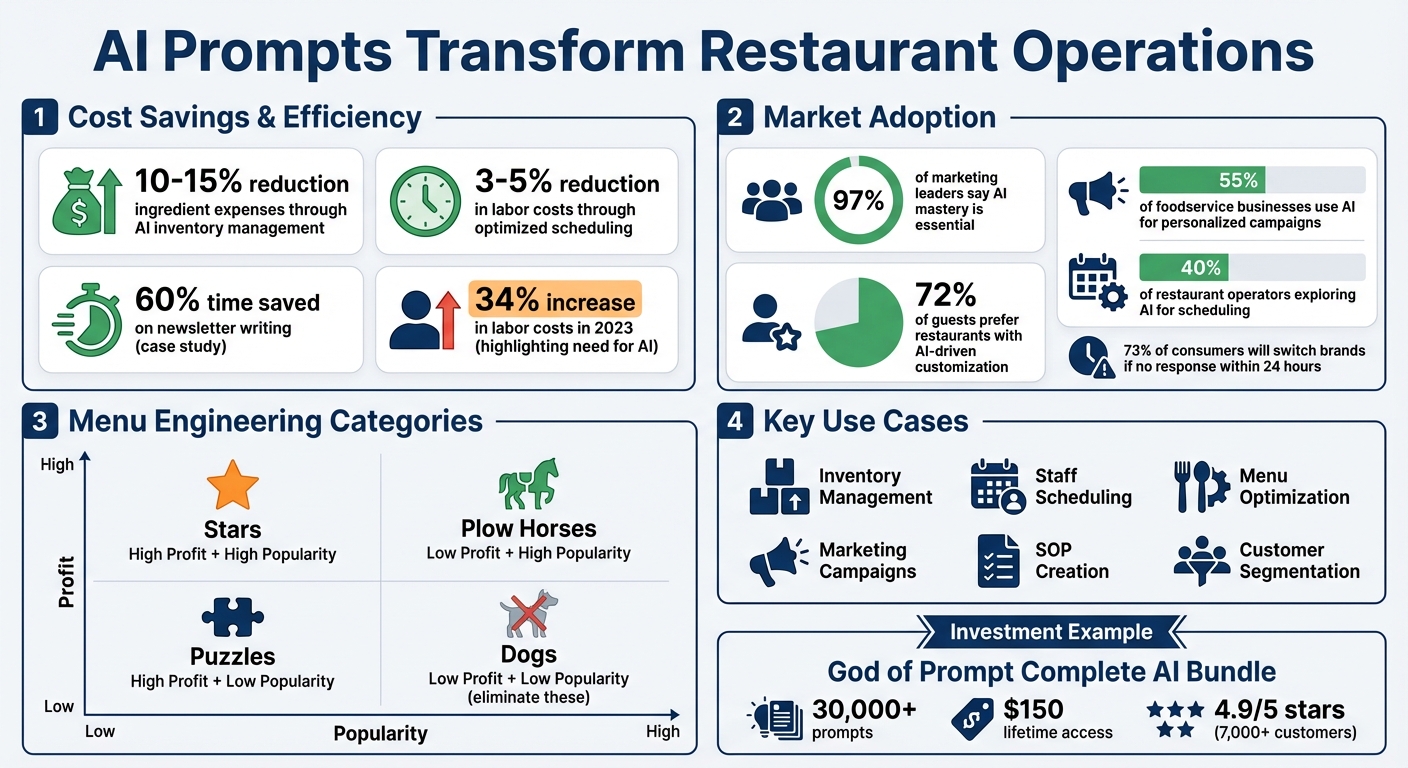
AI Prompt Impact on Restaurant Operations: Key Statistics and Benefits
1. Restaurant Operations Prompts
Inventory Management & Menu Engineering Prompts
Managing food costs and cutting down on waste are constant hurdles for restaurants. AI-powered prompts for inventory management can help reduce ingredient expenses by 10–15% through precise recipe costing and smart substitution suggestions. These prompts analyze inventory to recommend dishes that use up overstock or ingredients nearing their expiration date, saving money and reducing waste.
Menu engineering prompts take it a step further by categorizing dishes into four groups: "Stars" (high profit, high popularity), "Plow Horses" (low profit, high popularity), "Puzzles" (high profit, low popularity), and "Dogs" (low profit, low popularity). By identifying and eliminating "Dogs", restaurants can improve profitability and cut waste. For example, you could use a prompt like: "Analyze [Menu Data] and categorize items. Suggest 5 daily specials using [Existing Inventory] to meet a 28% food cost target." This approach ensures you’re making the most of what’s already in stock while maintaining profitability.
To make these prompts even more effective, include specific constraints, such as "use existing inventory," "maintain a 30% food cost," or "require no extra equipment." For instance, a prompt like "Calculate food cost for [Recipe]. Suggest 3 substitutions to reduce costs by 15%" can deliver a detailed breakdown that highlights costly or waste-prone ingredients and offers actionable solutions.
AI also simplifies staff scheduling and operational documentation. With labor costs rising by 34% in 2023 and 40% of restaurant operators exploring AI for scheduling, prompts that analyze current schedules can pinpoint inefficiencies and help reduce labor expenses by 3–5%. Managers can input data like projected daily sales, employee availability, and required roles to create balanced schedules that comply with labor laws while avoiding costly overtime. Additionally, AI can generate Standard Operating Procedures (SOPs) for tasks like shift-end inventory checks or waste management, ensuring consistent practices across the team.
By feeding real-world constraints - like sales data, inventory lists, and staffing needs - into these prompts, restaurants can generate tailored solutions in seconds. Whether it’s creating recipes to clear surplus inventory or drafting pre-shift meeting templates for daily specials and 86’d items, these prompts transform repetitive tasks into efficient, repeatable processes .
Next, we’ll dive into AI prompt collections designed to supercharge hospitality marketing.
sbb-itb-58f115e
2. Hospitality Marketing Prompts
Social Media & Email Campaign Prompts
When it comes to marketing for restaurants and hotels, generic content just doesn’t cut it. To stand out, you need prompts that are sharp, specific, and tailored to your goals. That’s where the R.A.F.T. method comes in handy: define the Role (e.g., "lead mixologist"), specify the Audience (like "eco-travelers"), decide on the Format (such as "5 Instagram Reels scripts"), and outline the Task (for example, "highlight locally-foraged ingredients"). This structured approach ensures your campaigns are not only creative but also deliver measurable results.
Why does this matter? The numbers speak for themselves. A whopping 97% of marketing leaders agree that mastering AI is essential for modern marketing. Additionally, 55% of foodservice businesses are already using AI for personalized campaigns, and 72% of guests say they prefer restaurants that offer AI-driven customization. Clearly, there’s a lot of untapped potential here.
To truly engage your audience, lean into sensory language. Instead of asking AI to “write a post about our new dessert,” get specific. Try something like: “Describe the caramelized sugar crust that cracks under a spoon, revealing vanilla bean custard infused with Madagascar bourbon.” Including details like your restaurant’s type, location, cuisine, and price point helps AI generate richer, more tailored content. And don’t forget to tailor prompts for the platform - whether it’s TikTok hooks that grab attention in seconds or LinkedIn posts aimed at B2B decision-makers.
Email campaigns can also benefit from this level of personalization. Instead of a vague prompt like “write a promotional email,” go for something more targeted, such as:
"Act as a W Hotels-style copywriter. Create a 5-email drip sequence for digital nomads who value co-working spaces and locally-roasted coffee. Include a 'day in the life' narrative for email 3 and a scarcity offer for email 5."
This kind of specificity taps into what matters most to your audience. And considering that 73% of consumers will switch to a competitor if a brand doesn’t respond to social messages within 24 hours, getting this right is crucial.
"AI is not here to replace your smile in the lobby... It is here so you actually have time to smile and to recommend tacos instead of sweating over Canva at midnight."
– Smart Pineapple
For more complex campaigns, break them into smaller, manageable prompts. Use one to brainstorm visual concepts, another to draft captions, and a third to generate hashtag ideas. If the initial output feels stiff or robotic, refine it by adding constraints like “budget under $500/month,” “gluten-free focus,” or “rustic, farm-to-table tone”. Think of AI as a tool that benefits from coaching - give it feedback, iterate, and fine-tune until the tone aligns with your brand.
3. AI Prompt Bundles Comparison
What to Look for in a Restaurant-Ready Bundle
The most effective prompt bundles go beyond generic templates by offering contextual customization. Look for options that incorporate key details like cuisine type, location, average check size, and target audience. These elements ensure the prompts align with your brand’s voice and specific goals.
A good bundle should address a wide range of operational needs, from guest services and staff training to revenue optimization. The prompts should be designed to produce actionable outputs, such as printable checklists, server scripts, comparison tables, or step-by-step standard operating procedures. This level of detail not only saves time but also eliminates the hassle of creating prompts from scratch. Features like these directly contribute to smoother operations and more effective marketing.
For example, God of Prompt's Complete AI Bundle offers over 30,000 prompts tailored for business, marketing, SEO, and productivity. Priced at $150.00 for lifetime access, it boasts a 4.9/5-star rating from more than 7,000 satisfied customers. This bundle includes lifetime updates and features everything from automated social media calendars to Midjourney prompts for professional-grade food photography.
It’s worth noting that even the best prompts can be fine-tuned for better results. Adding constraints like “budget under $500/month” or “gluten-free focus” can make them even more relevant to your needs.
"AI can function as your most knowledgeable operations consultant - available 24/7, never taking a day off, and ready to tackle everything from menu engineering to staff scheduling."
– RestaurantsForms.com
Restaurant Online Marketing: Use AI NOW or Get Left Behind!
Conclusion
The restaurant and hospitality industry stands at a crossroads, with a chance to leverage AI in ways that go beyond the basics. While many businesses already use AI tools, there's still untapped potential when it comes to marketing and copywriting. For those willing to invest in well-crafted AI prompts, the rewards can be substantial.
Take the case of Katelyn, a content marketer at SevenRooms. In May 2025, she reduced her newsletter writing time by an impressive 60% by using a custom GPT prompt tailored to her needs. This allowed her to shift focus toward strategic planning, demonstrating how AI can save time and improve productivity.
These kinds of success stories highlight how AI can streamline marketing efforts and strengthen brand consistency. By using specialized prompt collections, businesses can skip the trial-and-error phase and instead focus on addressing real challenges like meal planning, staff training, local SEO, and social media scheduling. As Andrew Strickland, F&B Manager at Gosford RSL Club, explains:
"ChatGPT won't work for your brand right out of the box, it needs training, coaching and constant tweaking. You need to adopt a hybrid model... treat it like an intern".
The key lies in ongoing refinement. When properly guided, AI becomes a powerful tool that amplifies results across various aspects of operations.
Whether you're aiming for consistent branding across platforms, reducing employee turnover with better training materials, or crafting menu descriptions that boost guest spending, the right prompts can make a noticeable difference. For instance, the God of Prompt Complete AI Bundle offers over 30,000 prompts for business, marketing, SEO, and productivity - all for $150.00 with lifetime access. It's an investment that quickly pays off in saved time and improved outcomes.
The examples above show how tailored prompts can enhance both efficiency and creativity. Start by identifying the areas where you spend the most time or encounter the biggest challenges. Include specifics like your restaurant type, seating capacity, cuisine, and pricing to fine-tune AI outputs to match your brand. The businesses seeing the best results aren’t just copying and pasting AI-generated content - they’re using smart prompts to train the AI and make it work for their unique needs.
FAQs
How can AI prompts help restaurants reduce food waste?
AI prompts offer restaurant teams practical ways to cut down on food waste by streamlining inventory management, predicting demand, and refining menu choices. For instance, managers can rely on prompts to develop inventory trackers that highlight items approaching their expiration dates and recommend appropriate reorder quantities. This proactive approach helps reduce spoilage and ensures better stock management. On the demand side, forecasting prompts use historical data and factors like weather to predict what customers will want, enabling chefs to prepare just the right amount of food.
When it comes to menu design, AI can analyze dishes to pinpoint overlapping ingredients, making it easier to use ingredients more effectively and cut down on leftovers. Prompts can also determine ideal portion sizes, striking a balance between minimizing plate waste and keeping diners happy. Beyond that, AI can automate waste tracking and suggest solutions, such as offering dynamic pricing for items nearing expiration. By doing so, restaurants not only save money but also enhance efficiency and take meaningful steps toward reducing waste.
What is the R.A.F.T. method for creating successful restaurant marketing prompts?
The R.A.F.T. method offers a clear framework for restaurant owners to craft focused prompts for AI tools like ChatGPT. It’s all about tailoring your marketing efforts to fit your restaurant’s unique goals and day-to-day operations. This method can simplify tasks such as creating personalized customer interactions, designing menus, and planning social media content.
Although guides often mention the R.A.F.T. method for building effective prompts, the exact meaning of the acronym isn’t always spelled out. Still, it remains a handy tool to ensure the AI-generated content aligns with your restaurant’s needs and delivers meaningful results.
What makes a great AI prompt collection for restaurants and hospitality?
A well-rounded AI prompt collection for restaurants and the hospitality industry should be clear, specific, and user-friendly for everyday tasks. These prompts should target practical goals like crafting menus, creating personalized guest interactions, or designing engaging social media campaigns. To make them effective, they should include rich details such as the restaurant's location, type of cuisine, budget (in dollars), or dietary needs. Using action-oriented language and adding constraints, like focusing on seasonal ingredients, helps ensure the results are both relevant and actionable.
This collection should address all major aspects of hospitality operations - marketing, guest services, compliance, and staff management. Prompts should be neatly organized into categories, with placeholders like [Restaurant Name] or [City, State] for easy customization. Additionally, they should suggest output formats such as tables or bullet points that meet U.S. standards, including prices in dollars and imperial measurements. Collections that also provide tips for refining prompts can help teams consistently achieve better outcomes, making them an essential resource for simplifying operations and improving customer satisfaction.
Related Blog Posts

Loved by Business Owners


Based on 1K reviews
Get smarter on AI every week.
Ready to transform your business?