
Email marketing is a powerful way to drive results, but standing out in crowded inboxes is a challenge. AI-driven prompts can help you create impactful emails faster by automating time-consuming tasks like drafting, testing, and refining. These tools enable you to craft better subject lines, personalize content, improve cold outreach, and optimize campaigns – all while maintaining a consistent tone and quality.
Here’s what you’ll learn:
- AI Prompt Libraries: Tools like God of Prompt offer 30,000+ pre-tested prompts for email marketing, including free and premium options.
- Subject Line Prompts: Generate multiple variations to boost open rates and test psychological triggers.
- Personalization Prompts: Tailor emails for different customer segments using data like purchase history or engagement levels.
- Cold Outreach Prompts: Create personalized, attention-grabbing emails for lead generation.
- Campaign Optimization Prompts: Use AI to analyze performance and suggest actionable improvements.
- Advanced Techniques: Leverage multi-step prompts and role-specific outputs for complex workflows.
With AI, you can save time, improve email performance, and focus on strategy. Start small, test results, and refine your approach to make the most of these tools.
1. AI Prompt Libraries and Platforms
God of Prompt: Your Go-To Email Marketing Resource
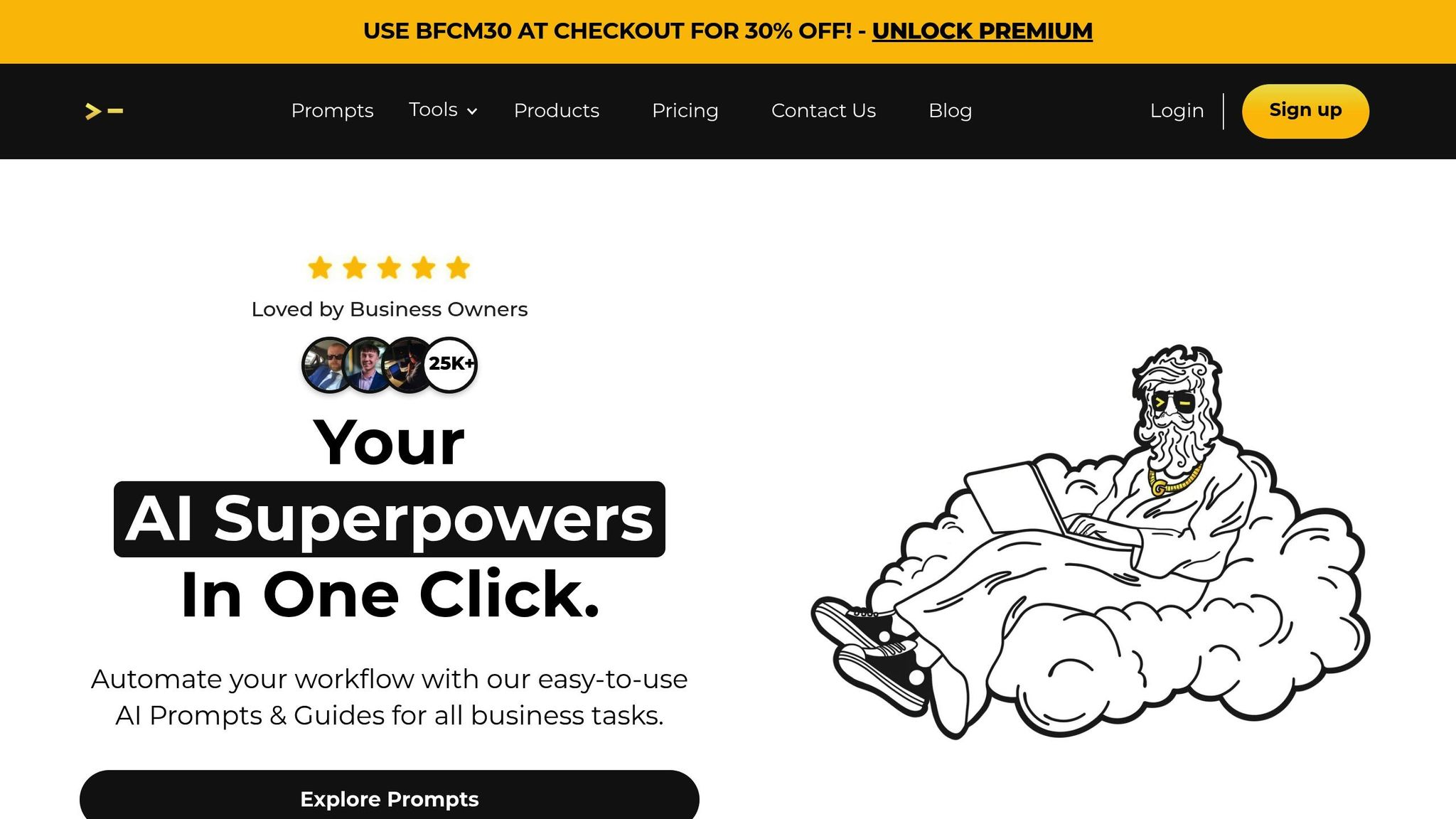
God of Prompt is a treasure trove for email marketers, featuring over 30,000 AI prompts tailored for tools like ChatGPT, Claude, and Gemini AI. It’s designed to simplify your workflow by categorizing prompts into areas like marketing, sales, and business communications, making it easy to find what you need.
The platform doesn’t just offer quantity – it’s packed with pre-tested frameworks that cover everything from crafting compelling subject lines to planning entire campaign sequences. For instance, the Marketing Pack alone includes over 2,000 advanced prompts, giving you a head start on your next project.
If you’re looking for the full experience, the Complete AI Bundle is available for $150.00, granting lifetime access to all 30,000+ prompts. For those wanting to test the waters, there’s a free tier that includes over 1,000 ChatGPT prompts and 10 advanced ones.
The prompts are delivered through Notion, making them searchable and easy to customize. You can simply copy, adjust, and paste them directly into your AI tool – no extra software or setup required. Plus, the platform provides guides and tips to help you refine your own custom prompts.
To top it off, there’s a 7-day money-back guarantee, so you can try the library on actual campaigns with zero risk. With its resources and flexibility, God of Prompt helps email marketers fine-tune their campaigns and improve ROI.
2. Subject Line Optimization Prompts
Crafting High-Performing Subject Lines with AI Prompts
Subject lines are the gatekeepers of email open rates. A well-crafted subject line can make the difference between an email that gets opened and one that’s ignored. AI prompts can help you brainstorm multiple variations quickly, experiment with psychological triggers, and fine-tune your approach for different audience segments.
When creating prompts, be specific about the tone, length, and psychological approach you want to use. For instance, you might ask for subject lines that create a sense of urgency without sounding overly aggressive or ones that spark curiosity by leaving just enough unsaid. Once you’ve set these parameters, you can refine your prompt further to generate subject lines that resonate.
Tools like God of Prompt provide ready-made prompts designed for A/B testing email subject lines across various scenarios. Whether you’re announcing a new product, sending out a newsletter, or trying to re-engage inactive subscribers, these prompts can help you craft variations that include power words, personalization, and even strategic emoji placement – always staying true to your brand’s voice.
Aim to generate 10–15 subject line options in each prompt session. This gives you a solid pool to test and identify patterns that work best. The most effective prompts can even guide the AI to explain why certain subject lines might perform well, giving you valuable insight into the psychology behind them. This knowledge can help you refine your strategy further.
Keep in mind the importance of mobile-friendly subject lines – stick to 40–50 characters to ensure readability. Also, steer clear of spammy words to strike the right balance between clarity and intrigue.
3. Content Personalization Prompts
Using AI to Create Tailored Email Experiences
Personalization means shaping your messaging, tone, and offers to fit your audience’s behavior, preferences, and stage in their journey with your brand. AI prompts make this process easier, allowing you to craft customized content for different audience segments without spending hours writing individual emails.
To get started, design prompts that utilize specific customer data points. For example, include details like purchase history, browsing habits, or engagement levels. Add context about your audience’s pain points, motivations, and where they are in the customer journey. Let’s say you need three email variations: one for first-time buyers, another for loyal customers, and a third for subscribers who haven’t purchased in 90 days. For abandoned cart users, your prompt might highlight urgency and address potential objections. For loyal customers, focus on exclusive perks and gratitude. The more precise you are in your prompts, the better the AI can deliver tailored, relevant content.
Tools like God of Prompt can take this a step further. These specialized prompts help you create dynamic content blocks, fine-tune product recommendations, and adjust messaging based on customer demographics or psychographics. With these tools, you can generate several content variations at once, making it possible to implement detailed personalization strategies – even with a small team.
Don’t stop at basic email content. Extend personalization to call-to-action buttons, image alt text, or even footer details, tailoring them to subscriber preferences. You can also create prompts for conditional content – sections of an email that change based on triggers or data fields in your email platform.
As you go, track how each variation performs and refine your prompts accordingly. Over time, you’ll build a library of proven strategies that consistently resonate with your audience.
4. Cold Outreach and Lead Generation Prompts
Crafting Effective Cold Emails with AI
Using AI for cold outreach can transform bland, generic emails into personalized messages that actually get noticed. Cold outreach often involves reaching out to people who don’t know you, making it easy for your email to be ignored. The trick is to create emails that feel personal, relevant, and worth their time – and AI prompts can help you do this at scale.
Start by crafting prompts that focus on specific details about your recipient. Think about their industry, company size, recent achievements, or even challenges they might be facing. For instance, if you’re reaching out to SaaS companies that have just raised Series A funding, your prompt could highlight growth challenges, scaling operations, or hiring needs. By feeding the AI with targeted inputs, you’ll get outputs that sound genuine and tailored to the recipient.
Your initial email needs to grab attention and provide immediate value. Structure your prompts so the email includes a strong hook, a clear value proposition, and an easy call-to-action. The hook should stand out in the first sentence – maybe it’s a shared connection, a recent company milestone, or a specific problem you’ve noticed. The value proposition should focus on what the recipient gains, not just what you’re offering. And when it comes to the call-to-action, keep it simple, like asking for a quick 15-minute chat.
Don’t stop at the first email. When designing prompts for lead generation sequences, think about the follow-ups. Each message should build on the last while still standing on its own in case the recipient missed your earlier emails. For example:
- Your second email could include a relevant case study.
- The third might offer a free resource, like a guide or checklist.
- The fourth could highlight social proof, such as testimonials from similar companies.
This kind of progression keeps the conversation moving forward while adding value at every step.
If you’re targeting specific industries like e-commerce or healthcare, or even different business sizes, tools like God of Prompt provide templates for a variety of outreach scenarios. These prompts allow you to maintain consistent yet personalized messaging across all your segments. You can also generate multiple versions of each email, test different approaches, and see what resonates best with your audience.
To ensure your emails are effective, pay close attention to compliance and deliverability. Include instructions in your prompts to avoid spammy language, keep emails concise (50-125 words is a good range for cold outreach), and make the tone sound natural and human. Also, specify formatting preferences – short paragraphs, plenty of white space, and a clear structure make emails easier to read, especially on mobile devices where most professionals check their inbox.
Finally, experiment with different frameworks like problem-agitation-solution, storytelling, or data-driven messaging. Track metrics like open rates and response rates to fine-tune your approach. Over time, you’ll develop a library of prompts that consistently generate quality leads for your business.
sbb-itb-58f115e
5. Campaign Optimization Prompts
Using AI to Analyze and Improve Campaign Performance
Campaign optimization takes personalized messaging and targeted outreach a step further, focusing on measurable improvements with every email you send. Just as AI can enhance subject lines and personalization, it also plays a key role in refining campaign performance. Once your campaign is live, analyzing its performance becomes essential – and this is where AI prompts can make a big difference. Instead of manually sifting through data, structured AI prompts help you identify patterns, uncover opportunities, and develop strategies for improvement.
To get started, feed your campaign data into AI tools using prompts tailored for performance analysis. Include metrics like open rates, click-through rates, conversion rates, and unsubscribe rates, broken down by segments or time periods. For instance, if your Tuesday emails consistently outperform those sent on Fridays, or if one subject line leads to significantly higher open rates, AI can help you figure out why – and how to replicate those results.
When creating prompts for optimization, be specific about your goals. If you’re looking to improve click-through rates, provide benchmarks, current CTAs, and details about your audience segments. AI can then suggest actionable changes, such as experimenting with button colors, repositioning links, or using more action-oriented language. For example, you might find that a call-to-action like “Get Your Free Guide” resonates far better with your audience than a generic alternative. These insights often emerge through systematic testing and analysis.
A/B testing prompts are especially valuable for campaign optimization. Use them to generate multiple variations of key email elements, including subject lines, preview text, body copy, CTAs, and even send times. Instead of limiting yourself to just two options, AI can help you create several variations quickly, allowing you to narrow down the most effective ones. Just remember to test one variable at a time – this makes it easier to pinpoint exactly what’s driving the improvements. These techniques naturally extend into broader audience engagement strategies.
Take a closer look at engagement patterns across your subscriber base. Segment your audience based on their behavior – such as those who consistently open emails, those who click but rarely convert, and those who haven’t engaged in a while. Tailor re-engagement campaigns to each group. For example, highly engaged subscribers might appreciate exclusive content or more frequent emails, while less active ones may respond better to a compelling incentive designed to win back their attention.
Don’t forget the technical side of optimization. AI prompts can highlight ways to improve deliverability by identifying spam triggers, monitoring your sender reputation, and offering suggestions to enhance your email authentication practices. Simple tweaks, like adjusting your image-to-text ratio or avoiding spam-trigger words, can make a big difference in ensuring your emails land in inboxes rather than spam folders.
For teams managing multiple campaigns, tools like God of Prompt offer a range of optimization prompts designed to streamline the process. These include categorized bundles for performance audits and seasonal campaign planning, helping you maintain consistency while driving better results. You can analyze data to determine which product categories generate the most revenue, which customer segments have the highest lifetime value, or which email types lead to increased referrals.
Keep an eye on key metrics like revenue per email, average order value, and cost per acquisition on a regular basis – monthly or quarterly – to measure whether your strategies are delivering sustainable results.
Lastly, let AI transform your raw data into comprehensive optimization reports. These reports don’t just highlight low conversion rates – they contextualize them by comparing your performance to industry benchmarks and your own historical data. They also provide specific, actionable recommendations to help you achieve steady improvements over time. With this level of insight, you can turn numbers into clear strategies for success.
6. Advanced Prompt Engineering Techniques
Mastering Multi-Step Prompt Chains for Complex Email Workflows
Once you’ve nailed the basics of prompt engineering, it’s time to step up your game with multi-step prompt chains. These are perfect for managing complex email workflows, allowing you to create campaigns that are not only targeted but also highly refined. The idea is simple: break down a big task into smaller, logical steps where each prompt builds on the one before it. By doing this, you can achieve results that are far more strategic than what a single prompt could deliver.
Think of prompt chaining as an assembly line. Instead of asking AI to generate an entire campaign in one go, divide the task into phases. For example, start by asking the AI to analyze your target audience and identify their key challenges. Use that output in the next step to create messaging angles tailored to those challenges. Then, move on to crafting the actual email copy, incorporating the insights and messaging from earlier steps.
The key to success here is context layering. Each step in the chain should reference and build upon the previous outputs, creating a seamless flow of increasingly sophisticated results. Let’s say you’re launching a product for multiple customer segments. Start with a prompt that analyzes the unique traits and preferences of each segment. Next, use this data to generate tailored value propositions. Follow that up with subject line variations for each segment, and finally, craft full email bodies with specific calls-to-action (CTAs) that resonate with each group.
This approach works especially well for seasonal campaigns. Use historical data to guide your strategy. For instance, begin with a prompt that analyzes past holiday performance, then create a campaign calendar. From there, generate specific emails for each phase – whether it’s a teaser, launch announcement, mid-campaign boost, or last-chance messaging.
Advanced Prompting Strategies for Better Results
Beyond chaining, there are other advanced techniques to refine your email workflows further:
- Role-Based Prompting: Add depth by instructing the AI to respond from a specific perspective. For example, instead of asking for a generic email about a new feature, prompt the AI to write as if it’s a customer success manager who has helped hundreds of clients solve a related issue. This approach makes the messaging feel more genuine and relatable.
- Constraint-Based Prompting: Set clear boundaries such as word count, tone, or reading level to ensure concise and impactful copy. For instance, challenge the AI to explain a complex B2B software feature in 75 words, using simple language while maintaining a professional tone. Constraints like these force clarity and eliminate unnecessary fluff.
- Template Prompts: Save time and maintain consistency with reusable templates. These prompts include placeholders for variables like product names, customer segments, or industry-specific terms. When it’s time to create a new campaign, just fill in the blanks rather than starting from scratch. This ensures your messaging stays on-brand and cuts down on production time.
If you’re looking for ready-to-use resources, tools like the God of Prompt’s Complete AI Bundle offer pre-built chains designed for common scenarios like product launches, onboarding sequences, and win-back campaigns. These templates are fully customizable, making it easier to dive into advanced prompt engineering and apply it to your specific needs.
Tracking and Refining Your Prompt Strategies
To truly master these techniques, experiment systematically and maintain a library of your most effective prompts. Keep an eye on metrics like time saved, engagement rates, and conversion improvements tied to specific strategies. Over time, you’ll develop a knack for knowing which techniques resonate best with your audience and align with your business goals. Advanced prompt engineering isn’t just a novelty – it’s a powerful tool that can give you a real competitive edge when integrated into your email marketing workflows.
ChatGPT Prompts for Email Marketing
Conclusion
AI-powered prompt tools are giving email marketers a serious edge. The days of sending out generic, one-size-fits-all campaigns are quickly being replaced by highly personalized, data-driven messaging. The tools and strategies we’ve discussed here offer a clear path to making that shift happen.
Consider this: data reveals a 15% rise in outbound emails, a 10x boost in A/B testing efficiency with generative AI, and real-world examples of brands pulling in $30,000 in just 30 minutes. These numbers highlight the potential when smart strategies align with effective prompts.
What makes AI-driven prompts so impactful is their ability to streamline your entire email workflow. Tasks that once took weeks can now be completed in hours, all while improving results with every campaign. This creates an opportunity for immediate experimentation and tangible results.
So, where should you start? Begin with simple prompt applications – test basic ideas and see how they perform. From there, you can gradually incorporate advanced techniques like multi-step prompts and constraint-based approaches. Keep tracking your results, refine your methods, and build on what works.
The real magic lies in combining AI with your expertise. AI is a tool that enhances your ability to deliver faster and more personalized campaigns, but it’s your knowledge of your audience, your brand voice, and your goals that makes it all work. Together, they create a powerful formula for measurable success.
Whether your goal is to save time, drive engagement with personalized messaging, or fine-tune your campaigns through rigorous testing, the strategies and tools outlined here offer a solid starting point. Start small, measure your progress, and work your way up to more advanced techniques. Acting now not only improves your results but also gives you a head start in a competitive landscape.
FAQs
How can AI-generated prompts improve personalization in email marketing?
AI-generated prompts make it easier to create personalized email campaigns by helping marketers develop content, subject lines, and calls-to-action (CTAs) that align with specific audience segments. By examining customer data, AI can recommend messaging that matches individual preferences, behaviors, and needs.
This kind of tailored approach doesn’t just boost engagement – it also leads to higher conversion rates, making your email campaigns more effective overall.
What are the main advantages of using AI-driven prompt libraries like God of Prompt for email marketing?
AI-powered prompt libraries like God of Prompt are a game-changer for email marketing professionals. These tools simplify the process of creating campaigns, saving both time and effort while maintaining a high standard of quality. With tailored prompts, marketers can craft attention-grabbing subject lines, personalize email content, and ultimately improve conversion rates.
Beyond efficiency, these libraries help streamline workflows. They make it easier to brainstorm ideas, fine-tune messaging, and optimize campaigns for stronger performance. By automating these tasks, marketers can dedicate more energy to strategic planning and creative execution, driving better business results.
What are multi-step prompt chains, and how can they simplify complex email marketing workflows?
Multi-step prompt chains are a method of breaking down complex tasks into smaller, more manageable steps using AI-generated prompts. In email marketing, these chains can simplify and automate tasks such as creating subject lines, segmenting audiences, and customizing email content.
What sets multi-step prompts apart from single prompts is their ability to handle complicated tasks with greater accuracy. For instance, a multi-step chain might begin by analyzing audience data, move on to suggesting tailored content ideas, and then finish by generating polished email copy. This structured approach not only saves time but also minimizes errors and delivers consistently high-quality results for your email campaigns.