Top Advanced Prompt Libraries Beyond Basic ChatGPT
Compare top prompt libraries with templates, pricing, integrations, and workflow tools to speed up AI tasks across major models and teams.

On this page
- Quick Comparison
- 1. God of Prompt
- Features and Specialization
- Pricing and Value for US Users
- Workflow Integration
- 2. PromptBase
- Features and Specialization
- Pricing and Value for US Users
- Workflow Integration
- 3. AIPRM
- Features and Specialization
- Pricing and Value for US Users
- Workflow Integration
- Learning Curve and Accessibility
- 4. FlowGPT
- Features and Specialization
- Pricing and Value for US Users
- Workflow Integration
- Learning Curve and Accessibility
- Prompt Libraries You Need to Try Today!
- Strengths and Weaknesses
- Conclusion
- FAQs
- What are the main advantages of using advanced prompt libraries?
- What are the pricing options for advanced prompt libraries?
- What makes God of Prompt the best choice for integrating with existing workflows?
- Related Blog Posts
Manually creating AI prompts takes time. Advanced prompt libraries solve this by offering pre-built templates tailored for tasks like marketing, business, and creative projects. These libraries work with top AI models like ChatGPT, Claude, Midjourney, and Gemini, helping professionals use ChatGPT right and save 10–15 hours weekly. Features like custom workflows, automation tools, and Retrieval-Augmented Generation (RAG) streamline even complex tasks.
Here’s a quick breakdown of the top platforms:
- God of Prompt: Offers 30,000+ templates for text and visuals. Lifetime access starts at $37. Delivered via Notion for easy integration.
- PromptBase: A marketplace with 240,000+ prompts supporting 26+ AI models. Pay-per-prompt pricing ($2.99–$8.99) ensures flexibility.
- AIPRM: Browser extension with one-click templates for SEO, marketing, and more. Freemium model with advanced features in paid plans.
- FlowGPT: Community-driven platform with free and paid plans. Supports multiple AI models and allows creating interactive apps.
Each platform caters to specific needs, from budget-conscious users to teams managing complex workflows. Below is a quick comparison to help you choose.
Quick Comparison
| Platform | Key Features | Pricing | Best For |
|---|---|---|---|
| God of Prompt | 30,000+ prompts, lifetime updates | $37–$150 (one-time) | Professionals seeking lifetime access |
| PromptBase | 240,000+ prompts, pay-per-use | $2.99–$8.99 per prompt | Users needing specific prompts |
| AIPRM | One-click templates, browser extension | Free, paid plans for extras | Teams standardizing workflows |
| FlowGPT | Community-driven, multi-model support | Free, $64–$255 plans | Users exploring diverse AI models |
Pick the library that fits your workflow and budget to save time and improve results.
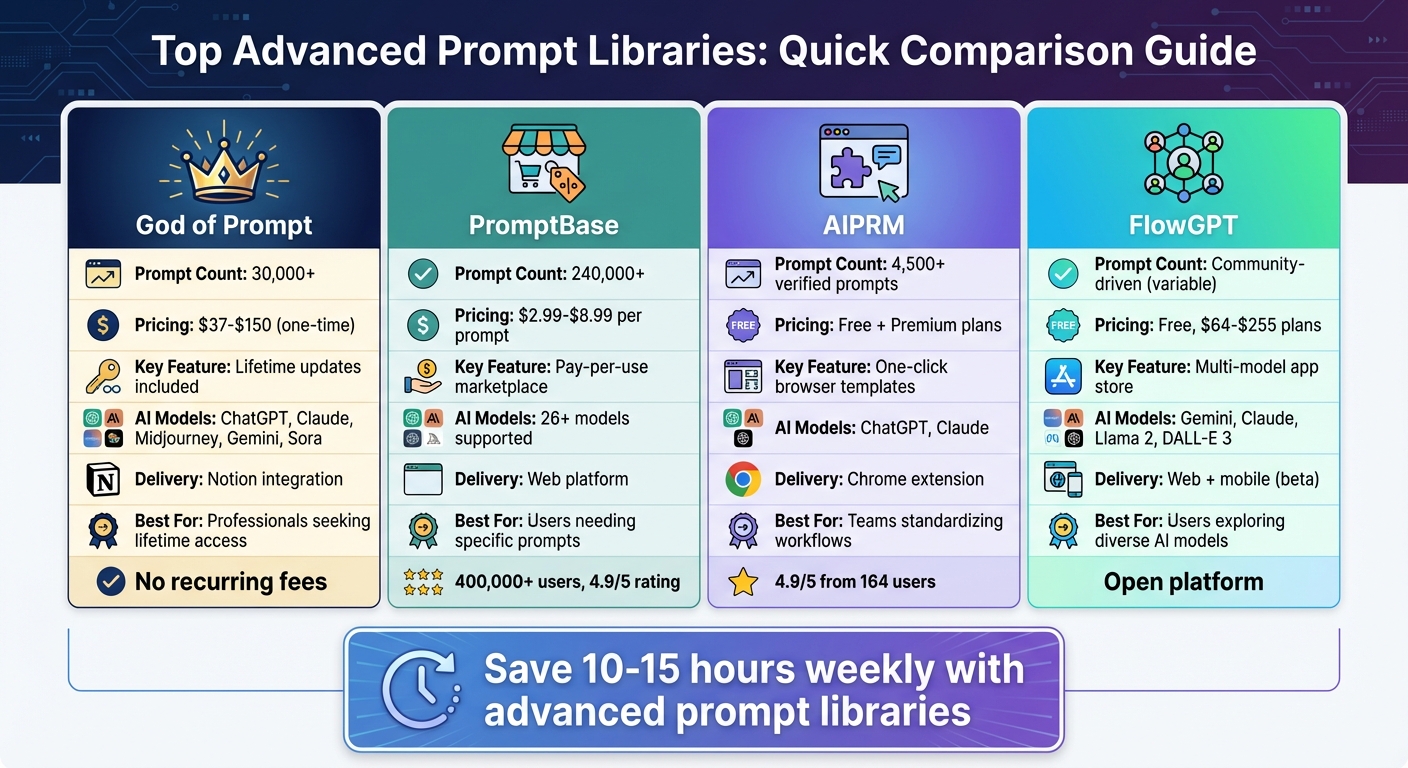
Advanced AI Prompt Libraries Comparison: Features, Pricing & Best Use Cases
1. God of Prompt
Features and Specialization
God of Prompt brings over 30,000 carefully crafted "mega-prompts" tailored for business and marketing needs, following expert prompt engineering techniques. These aren’t just any prompts – they’re professionally designed templates compatible with multiple AI models, including ChatGPT, Claude, Midjourney, Gemini, and Sora. Whether you’re tackling text-based tasks or generating visuals, these prompts are ready to handle complex workflows with precision.
For example, prompts like "Rembrandt lighting" and "rule of thirds" provide detailed guidance for image generation, ensuring polished results. The platform’s versatility allows these prompts to work seamlessly across both text and visual content creation, making it a go-to resource for diverse projects.
Pricing and Value for US Users
God of Prompt takes a refreshing approach to pricing by offering a one-time payment model, eliminating the need for recurring subscriptions. Here’s how the pricing breaks down:
- Writing Pack: $37.00
- ChatGPT Bundle: $97.00
- Midjourney Bundle: $67.00
- Complete AI Bundle: $150.00
Each option includes lifetime updates and comes with a 7-day money-back guarantee, giving users peace of mind. This pricing structure is designed to be straightforward and accessible, making it easier to integrate into your workflow without breaking the bank.
Workflow Integration
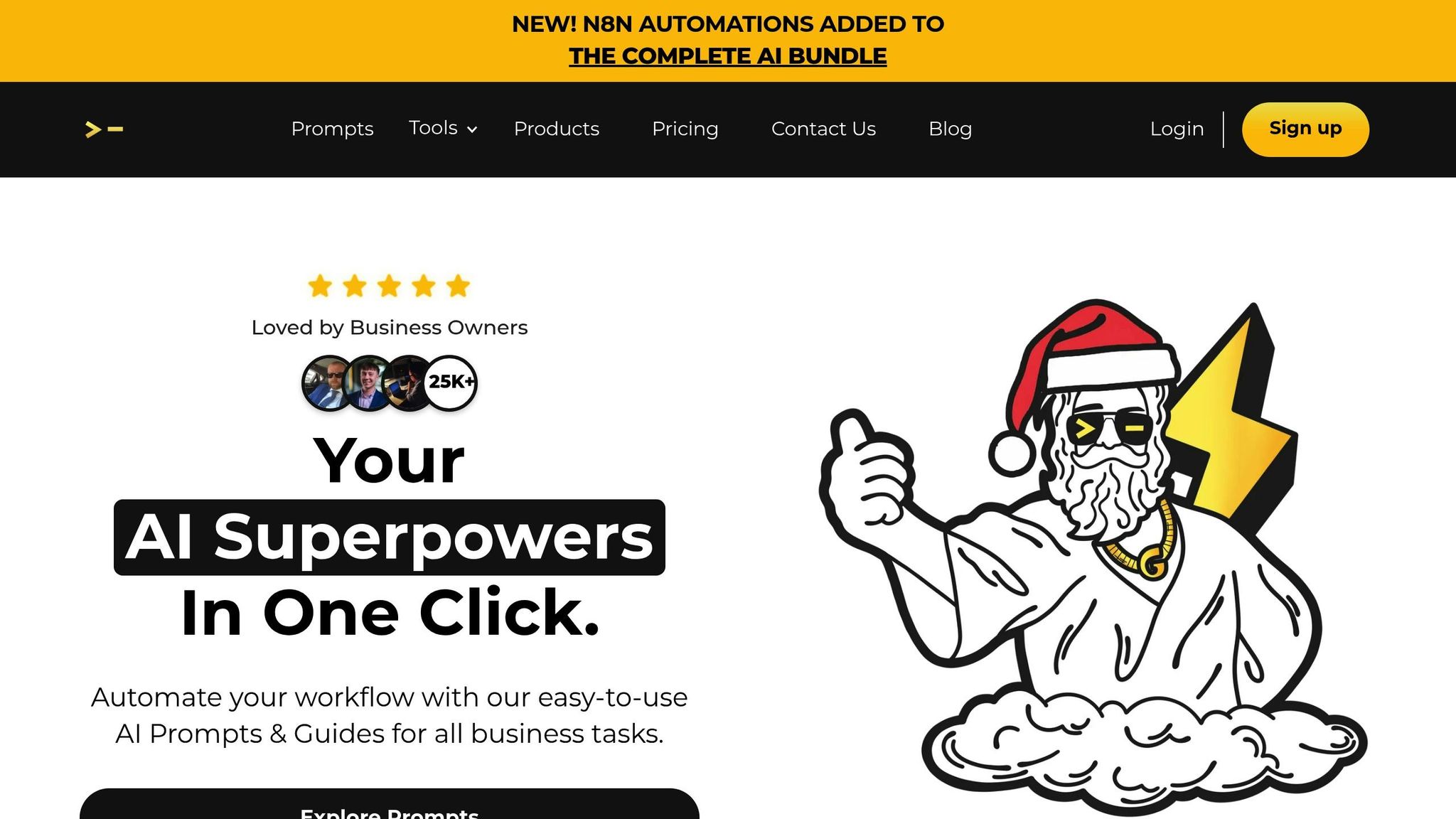
God of Prompt is delivered through Notion, a platform many users already rely on for organizing projects, taking notes, and managing tasks. This means you won’t need to learn a new system or juggle additional tools. The prompts are embedded directly into the tools you’re already using, streamlining your productivity. Plus, with one-click browser integration, accessing these prompts is quick and hassle-free, saving you even more time.
2. PromptBase
Features and Specialization
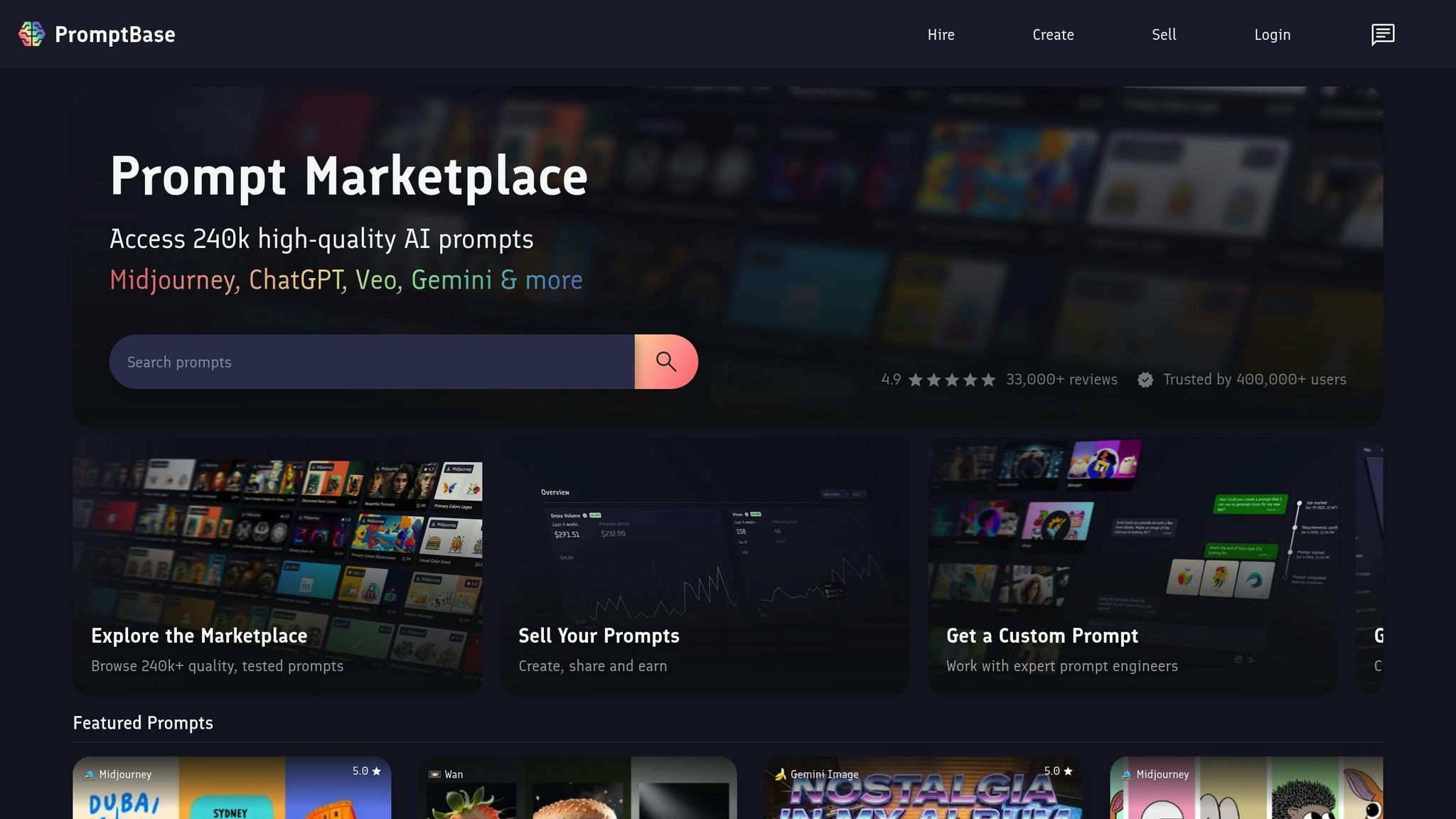
PromptBase goes beyond offering basic ChatGPT prompts, providing a robust marketplace for advanced AI workflows. With over 240,000 prompts available, it supports more than 26 AI models, including ChatGPT, Midjourney, Claude, Gemini, FLUX, Stable Diffusion, and video-centric models like Veo and Sora. Serving a community of over 400,000 users, the platform boasts an impressive 4.9/5 rating from more than 33,000 reviews.
One standout feature is its custom prompt engineering service, where professionals can commission personalized prompts. It also offers opportunities for entrepreneurs to create "tiny prompt stores" or develop AI-driven apps for tasks like content creation. Prompts are neatly categorized into areas such as SEO, Marketing, Finance, Copywriting, Code, and Product Ads, making it easy to find solutions tailored to specific business needs.
Pricing and Value for US Users
PromptBase adopts a pay-per-use pricing model, steering clear of subscription fees. Most prompts are priced between $2.99 and $8.99, with popular options typically costing $3.99 to $4.99. This structure allows users to purchase exactly what they need for individual projects without the commitment of recurring charges.
The platform often features discounts ranging from 15% to 40% off. Additionally, free prompts are available for various AI models, letting users evaluate quality before making a purchase. For creators in the US, PromptBase integrates with Stripe, enabling quick setup of a prompt store – users can start earning in as little as two minutes. This flexible pricing and earning potential make it an appealing option for integrating advanced prompts into daily workflows.
Workflow Integration
PromptBase functions as a centralized hub for browsing, purchasing, and implementing prompts. Its "App Store" feature streamlines the process by enabling direct content generation, removing the need for manual prompt input. For businesses handling repetitive tasks, purchased prompts can be used to build AI apps that generate outputs like marketing copy or code snippets, enhancing workflow optimization.
3. AIPRM
Features and Specialization
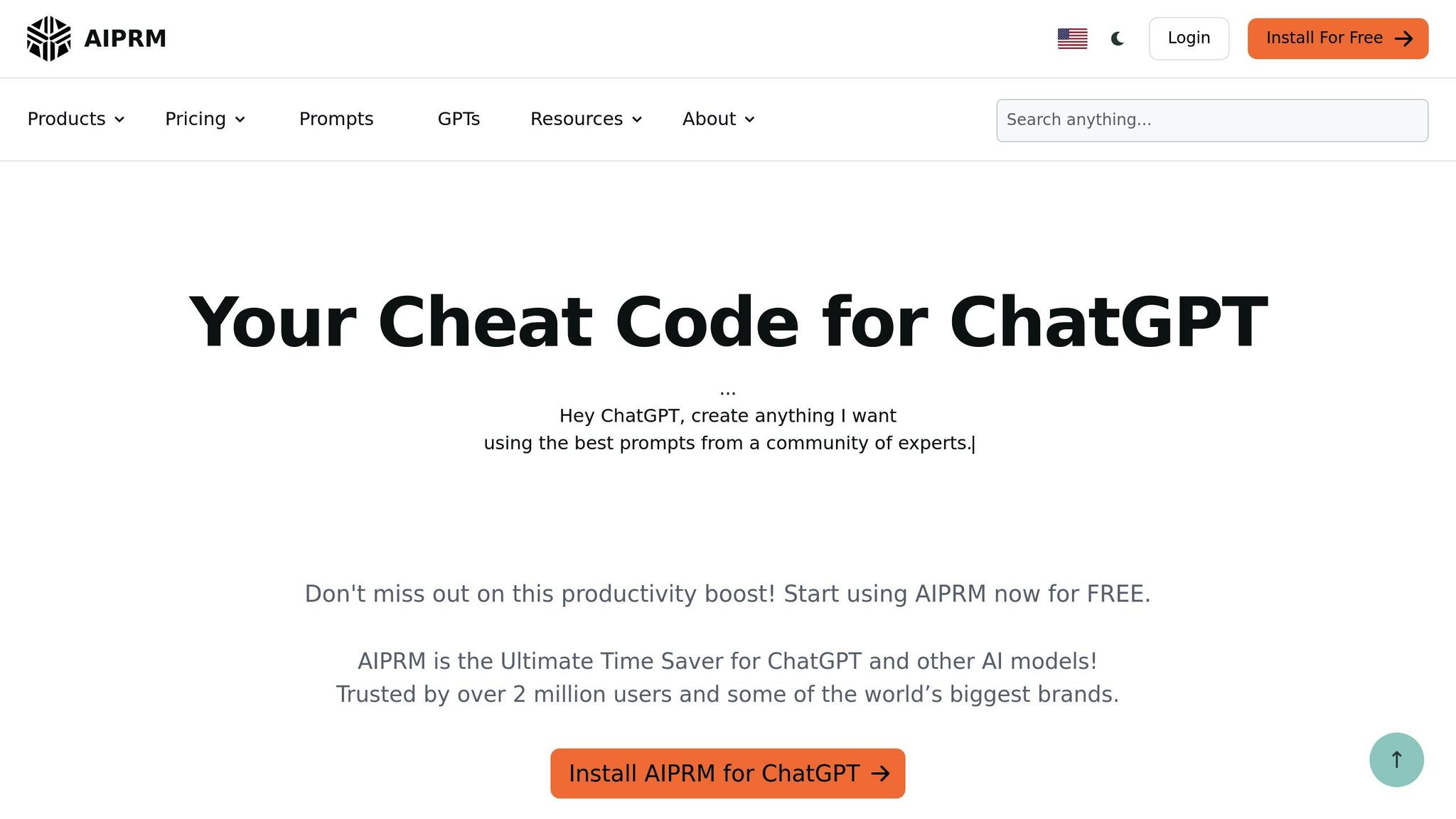
AIPRM simplifies the process of using AI tools like ChatGPT and Claude by offering one-click prompt templates tailored for professional fields such as SEO, SaaS, Marketing, Art, and Programming. This makes it a go-to resource for specialists who want reliable prompts without the hassle of constant tweaking or trial and error. With an impressive 4.9/5 rating from 164 users, the platform has proven its value across a variety of business applications. What sets AIPRM apart is its community-driven approach, where templates are validated and refined based on user feedback.
The platform uses a transparent, community-vetted system to highlight the most effective prompts. Public votes, usage statistics, and views ensure only the best templates rise to the top. For example, the "Create High-Converting Facebook Ad Copy" prompt has been used a staggering 232,825 times, while the "Amazon Unique Listing" prompt has 148,580 uses, and the "1-Click Presentation" tool has been utilized 27,172 times. The presentation tool, in particular, is a standout feature – it generates complete slide content, suggests images, and even provides color schemes instantly.
Pricing and Value for US Users
AIPRM operates on a freemium model, making it accessible to a broad range of users. The core browser extension is free to install and offers access to thousands of community-generated prompts, neatly categorized for convenience. For users needing more advanced features – like private prompt libraries, collaboration tools, and enhanced prompt management – paid plans are available.
For professionals, this tool is a game-changer. It eliminates the need to maintain spreadsheets of effective prompts or manually create new ones for every project. With just one click, users can execute complex templates, saving time and reducing "prompt fatigue." Agencies, in particular, benefit from its ability to standardize outputs across teams, which is crucial when managing multiple client accounts. The free version is robust enough for individual users to test the platform thoroughly before upgrading to premium features.
Workflow Integration
AIPRM integrates seamlessly into existing AI workflows through a Chrome browser extension compatible with both ChatGPT and Claude. Once installed, it adds a prompt management interface directly to your dashboard, complete with features like filtering, sorting, and preset modes tailored for tasks such as SEO or marketing.
The platform supports professional workflows with tools like prompt versioning, tagging, and folder organization. Teams can share prompt libraries with specific permission settings, ensuring consistency in tone and style across multiple users. However, to maintain functionality, users need to enable the extension specifically for the "ChatGPT.com" domain, especially with OpenAI’s domain updates.
Learning Curve and Accessibility
Getting started with AIPRM is straightforward. All you need is a Google account or an email address to sync prompts across devices. The interface is user-friendly: browse the categorized library, select a prompt template, and let it execute. Built-in sorting and filtering options make it easy to find top-rated prompts for specific categories, like SaaS or e-commerce, without wading through the entire library. For teams new to AI, the community ranking system – complete with upvotes and comments – provides a quick way to identify high-performing prompts, significantly reducing the time spent on trial and error.
4. FlowGPT
Features and Specialization
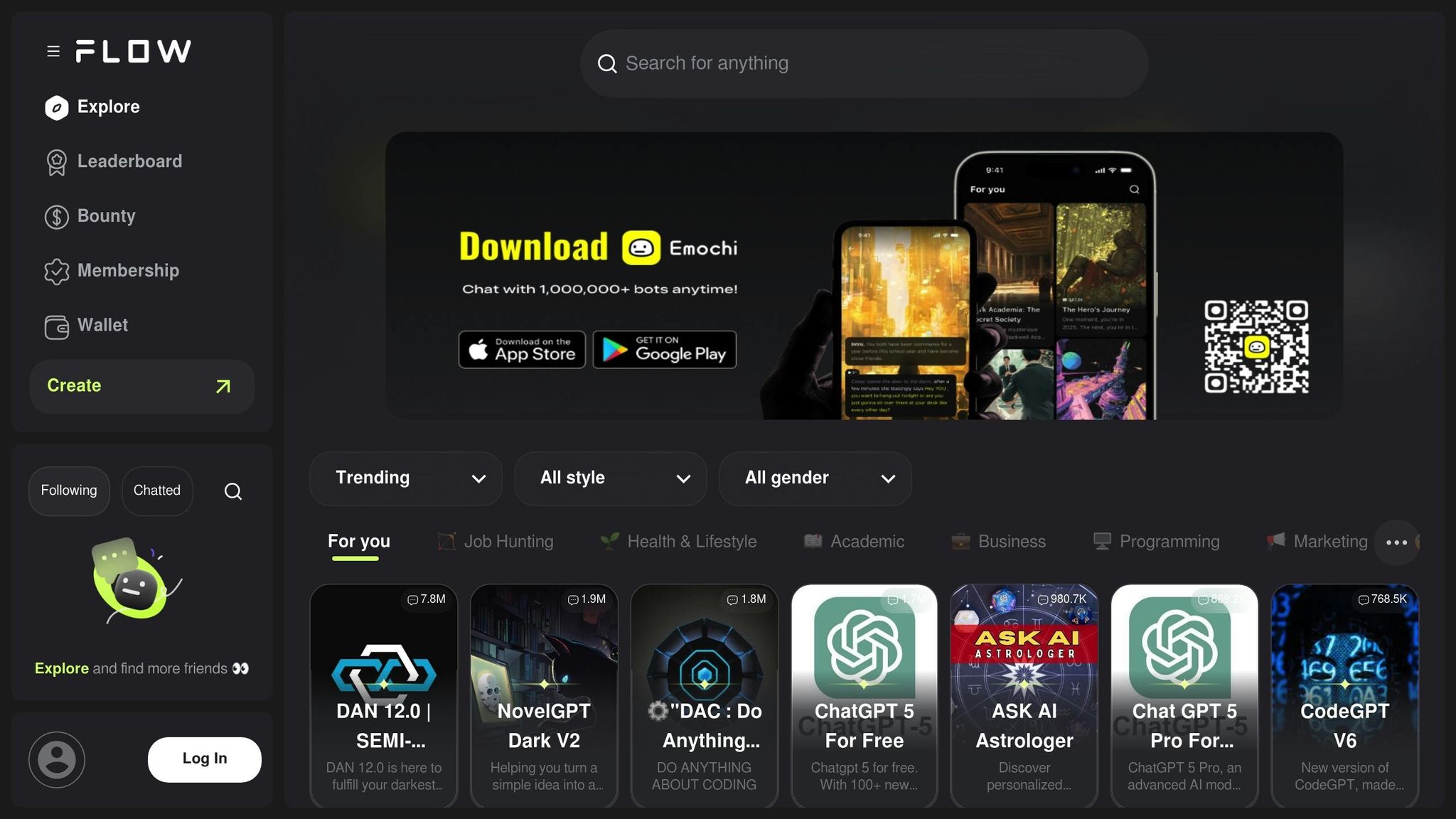
FlowGPT serves as an open "app store" for generative AI, offering a variety of prompt interfaces for models like Google’s Gemini, Anthropic’s Claude, Meta’s Llama 2, and OpenAI’s DALL-E 3. Unlike more restrictive platforms, it lets creators pick and recommend specific models for their apps. Users can explore prompts organized into trending categories such as "Programming", "Academic", "Game", and "Creative".
One of FlowGPT’s standout features is its willingness to host unconventional and controversial prompts, including jailbreak prompts like DAN or WormGPT. These prompts are designed to bypass standard AI safety filters, which can raise moderation concerns but also attract users looking for fewer restrictions on creativity. The platform allows creators to customize both the behavior and visual style of their apps, turning complex prompts into interactive tools complete with dedicated chat windows and suggested inputs. As co-founder Jay Dang explains:
"FlowGPT is making the bar lower in each iteration, making it more accessible".
These features set the foundation for its pricing model and integration into professional workflows, which are explored in the following sections.
Pricing and Value for US Users
FlowGPT’s pricing is designed to adapt to different usage levels. The free plan caters to casual users, offering limited AI tokens, basic flow boards, and minimal document uploads. For those needing more, the Lite plan, priced at around $64 USD, provides a larger token allowance and higher limits on boards and uploads. Heavy users and teams can opt for the Pro plan, costing approximately $255 USD, which includes significantly more tokens, unlimited boards, and higher document limits.
The platform also features a tipping system, allowing users to financially support app creators. As of February 2024, FlowGPT was testing a revenue-sharing model to complement this system. For US-based professionals juggling multiple AI subscriptions, FlowGPT could simplify access to various high-cost models through a single interface, potentially reducing the need for separate memberships.
Workflow Integration
FlowGPT integrates smoothly into professional workflows through a web-based chat interface. Features like thumbs-up buttons for apps, shareable conversation links, and tailored model recommendations make it user-friendly. The platform is also beta-testing mobile apps to improve accessibility. For entrepreneurs and product managers, FlowGPT is particularly useful for tasks like generating user personas, brainstorming A/B test ideas, and drafting app flow descriptions.
However, prompts are often designed for specific models, meaning they may not work as intended or could trigger safety filters if switched to a different model. Browsing for quality prompts can also be time-consuming – finding just eight good ones might take up to three hours. As Jess, an entrepreneur and product designer, aptly put it:
"Free isn’t free if it costs you hours".
Despite these challenges, FlowGPT aims to streamline workflows and maximize the potential of AI for professionals.
Learning Curve and Accessibility
FlowGPT is built to enhance productivity with minimal technical barriers. Its interface functions like a typical app store: users browse categories, select prompts, and interact through the chat interface. Gamified elements, such as prompt bounties and hackathons, encourage practical and task-oriented prompt creation. For professionals, FlowGPT works best as a source of inspiration rather than a provider of polished outputs. Refining AI-generated content to align with specific brand voices or technical needs remains essential, often requiring the skills of an expert prompt engineer.
The main hurdle is managing time effectively. Sifting through community submissions to find high-quality prompts can be tedious. To avoid issues with compatibility, it’s generally best to stick with the model recommended by the prompt creator. Industries that can benefit the most include mobile development (for rapid prototyping), marketing (for campaign ideation), education (for STEM problem-solving), and creative writing (for drafting case studies).
sbb-itb-58f115e
Prompt Libraries You Need to Try Today!
Strengths and Weaknesses
Each platform offers its own set of advantages and challenges, catering to different needs for U.S. professionals.
AIPRM simplifies workflows with its browser integration, embedding over 4,500 verified prompts directly into the ChatGPT interface. This eliminates the hassle of manual copy-pasting. However, advanced features like private team libraries are locked behind a paid tier, which might not appeal to solo entrepreneurs on a tight budget.
PromptBase focuses on pre-tested, commercially oriented prompts, priced between $2.99 and $5.99. While this pricing is accessible, the quality of sellers can vary, so it’s crucial to check ratings and samples before purchasing.
FlowGPT draws users in with its freemium model and engaging extras like prompt bounties and hackathons. That said, some users have reported occasional stability issues, which could disrupt workflows.
For American professionals, the decision often comes down to time versus money. Free tools can save costs but require more effort, while paid platforms offer ready-to-use, high-quality content that can save time.
Experts in the field emphasize the growing role of prompt libraries in professional settings. Aakash Gupta, a product management expert, highlights their significance:
"A prompt library eliminates reinventing the wheel. And it’s becoming a core skill that hiring managers are actually asking to see".
Conclusion
The comparisons above highlight that each platform caters to unique professional needs. Selecting the best advanced prompt library comes down to your specific workflow requirements and budget.
God of Prompt provides over 30,000 prompts with one-time payment options ranging from $37 to $150. This includes lifetime updates, making it an appealing choice for those who prefer to avoid recurring fees. For users who need highly specific prompts for niche tasks, PromptBase offers a pay-per-prompt marketplace that allows for flexibility. If your team requires ongoing access to curated collections and advanced prompt management, AIPRM’s subscription model could be a strong fit. Meanwhile, FlowGPT encourages creativity and refinement through its community-driven approach.
Ultimately, advanced prompt libraries play a key role in boosting efficiency and creativity across various workflows. Exploring each platform can help you identify the one that aligns best with your business or creative goals. Stay adaptable and refine your prompt engineering approach as your needs evolve to keep your workflows running smoothly.
FAQs
What are the main advantages of using advanced prompt libraries?
Advanced prompt libraries offer businesses a streamlined collection of reliable, pre-tested prompts, removing the guesswork from creating effective prompts. This approach helps teams save time and cut down on manual content creation expenses, allowing them to shift their focus to more strategic tasks and boost overall productivity.
These libraries also promote team collaboration and uniformity by enabling departments to share and reuse prompts that have already proven successful. This ensures a consistent brand voice while minimizing redundant work. On top of that, they give developers better control over AI outputs, ensuring responses are more precise and dependable, with the flexibility to adapt quickly as business needs evolve.
What are the pricing options for advanced prompt libraries?
God of Prompt offers a straightforward pricing model with a one-time payment starting at $37, granting lifetime access to its entire library. For larger teams or businesses, higher-tier packages are available, providing options that cater to various needs.
This approach stands apart from subscription-based platforms that often require recurring monthly or annual fees. By opting for an upfront payment, users can avoid ongoing costs, renewals, or unexpected charges. It’s an affordable option for entrepreneurs and professionals who want to make the most of their AI tools without stretching their budget.
What makes God of Prompt the best choice for integrating with existing workflows?
God of Prompt makes integrating prompts into your workflow straightforward and efficient. Each prompt is carefully categorized by business function, allowing you to quickly locate and implement them into your processes. Plus, with lifetime access, you can skip the hassle of constantly recreating or hunting for prompts, saving you both time and effort.
These pre-built prompts are tailored to fit seamlessly into tools for marketing, sales, and productivity. They help teams simplify automation and scale AI-powered tasks with ease, cutting down on unnecessary steps and boosting overall efficiency in your operations.
Related Blog Posts
- Top Prompt Libraries That Actually Save Time and Money
- Best All-in-One AI Prompt Libraries for Professionals
- Best Multi-Model AI Prompt Libraries in One Package
- Best Starter Prompt Libraries for First-Time AI Users
Keep going: the prompt library has the 30,000+ prompt library and ChatGPT prompts ready to copy and run.
Prompts for this topic
Put this article to work with ready-to-use prompts from the God of Prompt library.
Keep reading

Professional Advanced Prompt Libraries for Power Users
Pre-tested prompt libraries and bundles for ChatGPT, Midjourney, Claude and Gemini — save time, customize outputs, and streamline text and visual workflows.


Advanced Business Prompt Libraries for Scaling Companies
Curated AI prompt libraries save time, boost productivity, and standardize marketing, operations, finance, and hiring for scaling companies.

Professional AI Prompt Libraries for Advanced Use Cases
Compare professional AI prompt libraries: features, pricing, compatibility, and best business use cases for ChatGPT, Claude, Midjourney and more.

The best of the blog, in your inbox
One email when notable prompts, tools, and model updates land. No spam, unsubscribe anytime.
Join 100,000+ subscribers. One email a week, real prompts, tools, and model updates. Unsubscribe anytime.