
Top Prompt Resources for Legal Professionals




Legal professionals are increasingly leveraging AI tools to streamline tasks like research, drafting, case analysis, and compliance checks. The key takeaway? Clear, structured prompts lead to precise, actionable results. Here's what you need to know:
- Legal Research: Use jurisdiction-specific prompts to summarize case law or statutes. For example: "Summarize the key arguments in this appellate brief and identify relevant precedents from the 9th Circuit."
- Document Drafting: Provide specific inputs (e.g., "monthly fee of $4,000", "New York law") to generate accurate contracts or agreements using AI tools for legal document writing.
- Case Analysis: Assign roles (e.g., "Act as" ChatGPT prompts like "Act as a senior research associate") and focus on jurisdiction to map precedents effectively.
- Compliance Checks: Automate regulatory audits with prompts tailored to specific laws, like GDPR or state statutes.
- Prompt Engineering: Craft detailed instructions with personas, jurisdictions, and output formats for better results. For instance, "Summarize negligence case law in Illinois in a three-column table."
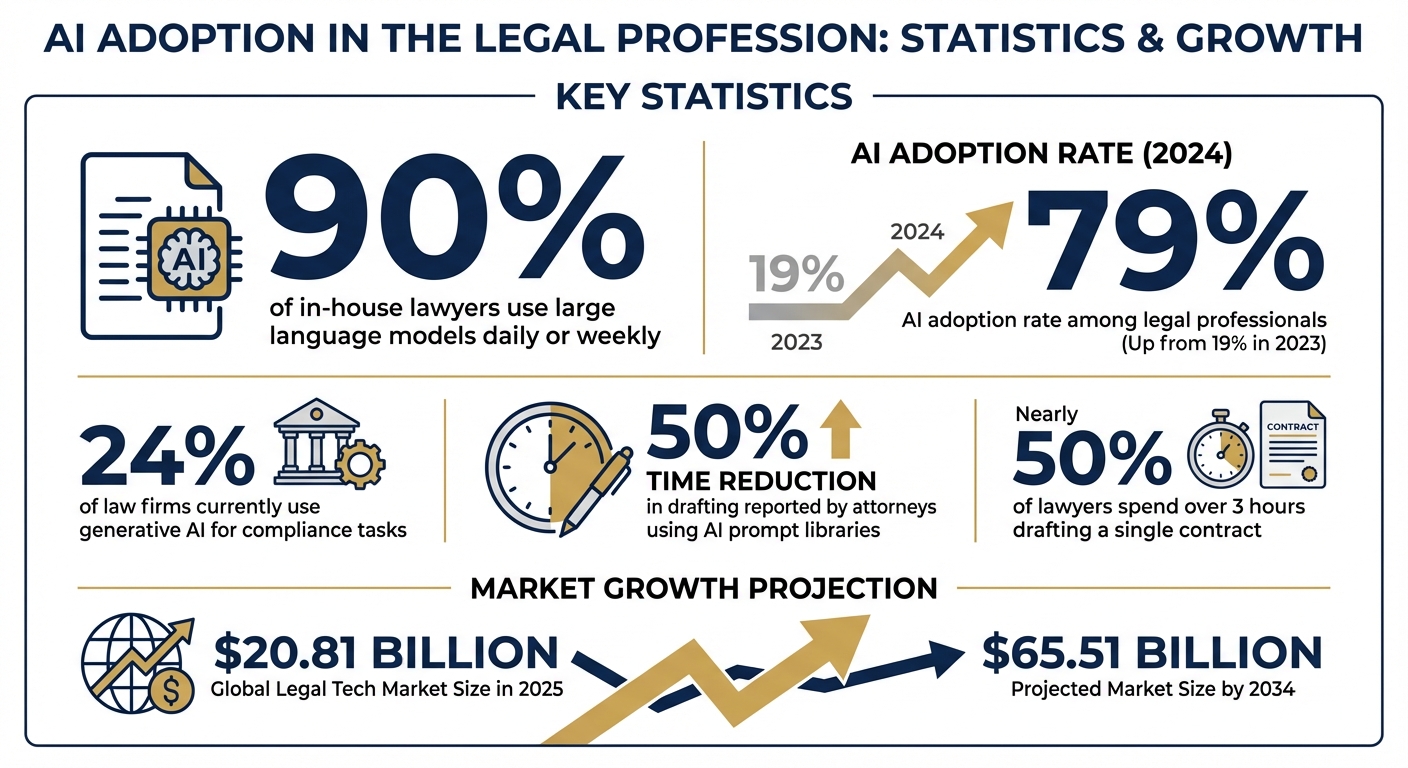
AI adoption in legal work is growing rapidly, with over 90% of in-house lawyers using it regularly. By mastering prompt construction, you can save time, boost efficiency, and focus on higher-level strategies.
AI Adoption Statistics in Legal Practice 2023-2024
1. Legal Research
Case Law Summarization with Jurisdictional Precision
AI tools are transforming legal research by quickly analyzing large volumes of case files. The key to leveraging these tools effectively lies in crafting precise, jurisdiction-specific prompts. Without this focus, the results risk being too generic to be useful.
Chris Dreyer, CEO & Founder of Rankings.io, provides a clear example of this approach with the following prompt:
Summarize the key arguments in this 85-page appellate brief and identify relevant precedents from the 9th Circuit.
This prompt combines role-based and jurisdiction-specific instructions to guide the AI. For instance, you can direct the AI by saying:
Act as if you're a legal assistant who is researching…
For medical malpractice cases, Rankings.io employs prompts like:
Summarize the relevant injuries, treatments, and follow-up care from these 200+ pages of medical records for a soft tissue case.
Advanced AI models, such as Claude, can process up to 200,000 tokens in one go, making it possible to analyze entire case files at once.
To ensure accuracy and reliability, always include verification phrases in your prompts, such as "provide citations or references", to minimize the risk of AI-generated inaccuracies. For example, when researching statutes, you might use a prompt like:
Outline the Texas statutes governing workplace discrimination.
This structured approach ensures the results are specific and verifiable.
However, it’s crucial to avoid entering confidential client data into public AI tools, as these platforms may use the input for training purposes, potentially breaching attorney-client privilege.
sbb-itb-58f115e
2. Document Drafting
Contract and Agreement Generation with Structured Inputs
After conducting thorough legal research, structured prompts can significantly streamline the document drafting process. AI tools excel at drafting contracts when provided with detailed, specific inputs. Instead of asking for a generic contract, include clear variables like "monthly fee of $4,000", "3-month term", and "New York law" to improve precision. Studies show that nearly half of lawyers spend over three hours drafting a single contract - AI prompt libraries can help cut that time dramatically for legal associates.
"The pressure to draft, review, and revise contracts swiftly - without compromising legal quality - is familiar to every transactional lawyer".
When drafting, using Markdown headers and bullet points can help organize contract sections effectively. For example, in a service agreement, you can outline key elements such as:
- Fee structure
- Term length
- Intellectual property ownership
- Confidentiality requirements
- Dispute resolution mechanisms
This structured approach minimizes errors and allows for quick updates or revisions to the document.
AI tools are also valuable for refining drafts. You can instruct the AI to adjust specific clauses, such as non-solicitation terms or indemnity provisions, to align with particular legal standards - whether it's "under California law" or "compliant with Delaware corporate statutes." Platforms like Write.law (starting at $29/month) or GC AI offer pre-designed templates tailored for both litigation and transactional drafting, making the process even more efficient.
It's essential to view AI as a collaborative drafting assistant rather than expecting a flawless document on the first attempt. Use follow-up instructions to refine sections iteratively. For instance, after generating an NDA, you could ask the AI to clarify the definition of "confidential information" or revise the document's data destruction requirements.
"Treat your interaction with ChatGPT as a dynamic conversation - it can become the legal operations assistant you always wished for".
Finally, always redact any client-identifiable information, and for critical legal documents, rely on specialized AI platforms capable of conducting comprehensive context analysis. This ensures both accuracy and confidentiality throughout the drafting process.
3. Case Analysis
Multi-Perspective Precedent Mapping
AI prompts are reshaping how precedents are analyzed, offering insights from multiple angles. By guiding the AI to locate relevant rulings within specific jurisdictions and presenting arguments for and against your position, you can broaden your legal strategy. This method complements traditional legal research by providing a more expansive view, rather than limiting the analysis to a single perspective.
To get started, assign the AI a role (e.g., "Act as a senior research associate") and specify the jurisdiction (e.g., "9th Circuit" or "Illinois") to ensure the results are both precise and applicable to your case. Focusing on jurisdiction is crucial, as it helps differentiate between binding authority and persuasive precedent - an essential factor in crafting a sound legal strategy.
Modern AI tools can now process full-length appellate briefs containing over 200,000 tokens, making it easier to extract key legal principles and identify relevant precedents. You can also use these tools to analyze deposition transcripts, asking the AI to highlight admissions or potential red flags that could influence your case strategy.
"AI is like having a really good trainee - it's really helpful, it speeds things up, it's really efficient, but you still ultimately take responsibility for the output." - Michael Haynes, General Counsel, Juro
The reliability of these tools is reflected in their adoption: 90% of in-house lawyers report using large language models daily or weekly for tasks like risk identification and legal summaries. To ensure accuracy, always request citations for any rulings the AI identifies, as this helps confirm their relevance and reduces the risk of errors or hallucinations. Iterative prompting can further refine your analysis - start with broad case summaries and then narrow the focus to jurisdiction-specific topics, such as "Missouri premises liability requirements".
This level of detailed analysis lays the groundwork for compliance and precision in prompt engineering, where accuracy is non-negotiable.
4. Compliance Checks
Automated Regulatory Audits with Structured Prompts
Expanding on earlier strategies for research and drafting, compliance prompts can streamline legal workflows by automating regulatory audits. Instead of manually cross-referencing laws, you can use structured AI prompts to verify adherence to federal and state regulations. For instance, a prompt like "Outline the statutes in Texas that govern workplace discrimination" provides jurisdiction-specific insights that are immediately actionable. This method is especially useful for organizations operating across multiple states, where regulatory requirements can differ significantly.
To create effective compliance prompts, it's essential to provide clear and detailed instructions. Always specify the jurisdiction and the regulatory framework you're addressing - whether it's GDPR Articles 5–30 for data privacy or the NY DFS Cybersecurity Regulation for financial services. Structured outputs, such as Markdown tables, can be particularly helpful for organizing findings. For example, when reviewing an employment contract, you might ask the AI to "Generate a standard employment contract template compliant with current labor laws, with a focus on non-disclosure clauses".
Currently, about 24% of law firms are leveraging generative AI for compliance tasks, such as identifying relevant statutes. However, it's critical to cross-check AI-generated findings against reliable sources like Westlaw or official government websites. Additionally, adhering to best practices for managing sensitive information is essential. Breaking down complex regulatory audits into smaller, manageable tasks can also help minimize the risk of inaccuracies or "AI hallucinations".
"Make sure you pay close attention to legal and regulatory requirements. There are a limited number of such requirements now, but there will be a flood of them within the next several years." – Sharon D. Nelson, John W. Simek, and Michael C. Maschke
For ongoing compliance monitoring, use prompts to summarize recent changes in data privacy laws and generate actionable steps for updating policies. This step-by-step approach ensures consistent and accurate compliance tracking.
5. Prompt Engineering
Mastering the Art of Legal Prompt Construction
Prompt engineering is the key to getting precise, actionable legal results from your AI interactions instead of vague or ambiguous outputs. At its core, it’s about crafting clear, task-specific instructions that guide the AI’s responses effectively. This skill directly contributes to the efficiency gains discussed earlier.
When creating legal prompts, it helps to follow best practices for prompt engineering: assign a persona, specify the jurisdiction and task, and define the desired output format. For example, you might say, "Act as a senior tax attorney and summarize negligence case law in Illinois; present findings in a three-column Markdown table." This level of detail reduces the chance of errors due to missing context. For more complex tasks, like analyzing contracts, consider breaking the process into smaller, sequential steps.
To further improve accuracy, use the Cognitive Verifier Pattern. This involves asking the AI to generate clarifying questions before diving into the analysis. For instance, instead of jumping straight into a contract review, you could prompt the AI with: "Generate questions about the jurisdiction, contract type, and key commercial terms before analyzing this agreement." This step ensures the AI gathers enough context to provide a thorough response. These techniques not only enhance document analysis but also align with the efficient workflows discussed earlier.
"Treat your AI like a smart, fast, occasionally overeager human intern." – GC AI
Prompt Engineering for Legal Professionals
Conclusion
The legal profession is undergoing a major transformation. In just a year, AI adoption among legal professionals skyrocketed - from 19% in 2023 to an impressive 79% in 2024. Today, over 90% of in-house lawyers regularly rely on large language models for their work, whether daily or weekly. But make no mistake, this shift isn’t about replacing legal expertise - it’s about enhancing it. Lawyers who embrace tools like prompt engineering now are setting themselves up to stay ahead as the global legal tech market grows from $20.81 billion in 2025 to a projected $65.51 billion by 2034.
The benefits are already tangible. One attorney shared that using the Prompt Library has cut their drafting time in half. With clear prompts, lawyers can quickly summarize lengthy agreements, spot contract risks, and produce results more efficiently. Think of AI as a highly literal assistant: assign it specific roles, define jurisdictions, and outline output formats to ensure accurate and consistent outcomes. Starting with broad queries and refining them with targeted follow-ups - like applying the Cognitive Verifier Pattern - can take the quality of AI-generated content to the next level.
AI has moved beyond being a futuristic concept; it’s now a critical tool in everyday legal practice. The real question isn’t whether to adopt these tools - it’s how fast you can integrate them into your workflow. By doing so, you can offload repetitive tasks and redirect your energy toward higher-level strategy and client advocacy.
As these advancements reshape how legal work is done, God of Prompt provides the tools to help legal professionals thrive in this new era. With specialized prompt collections tailored for research, drafting, analysis, and compliance, God of Prompt makes it easier to adapt and excel. These resources are ready to use - start leveraging them today.
FAQs
How can AI tools help legal professionals with research and drafting?
AI tools such as ChatGPT, Claude, and Gemini are reshaping how legal professionals tackle traditionally time-intensive tasks. With well-crafted prompts that specify jurisdiction, legal issues, and desired outcomes, these tools can swiftly identify relevant statutes, case law, and secondary sources. This allows attorneys to shift their focus from tedious manual research to in-depth legal analysis.
These tools also bring efficiency to drafting. They can produce initial drafts of clauses, pleadings, or memos that reflect a firm’s preferred style, incorporate standard legal language, and even flag potential issues like missing citations or inconsistent terms. Beyond drafting, AI can condense lengthy contracts into concise summaries, pinpoint risky provisions, and propose clearer or more compliant language. This not only saves time but also enhances precision.
By integrating AI into their workflows, legal professionals can minimize repetitive tasks, streamline operations, and devote more energy to strategic decision-making, ultimately increasing productivity and improving the quality of their work.
What are the best tips for crafting effective AI prompts for legal tasks?
To craft effective AI prompts for legal tasks, start by defining the AI's role clearly - for example, "Act as an experienced corporate attorney." Be specific about key details such as the jurisdiction, document type, and purpose. Include all relevant facts, like names, dates (e.g., January 15, 2024), and monetary amounts (e.g., $12,500). If the prompt will be reused, use placeholders for variable information. Breaking the task into clear steps - like "1. Summarize key issues, 2. Identify relevant statutes, 3. Draft a concise argument" - helps ensure the AI follows a logical process. You can also request that it cite relevant legal authorities or include a references section for added accuracy.
For better results, consider using role-based and chain-of-thought techniques. Assign the AI a specific persona, such as "You are a senior litigator specializing in employment law", and guide it step-by-step through its reasoning process. Ask it to identify facts, apply the law, and draw conclusions. Including a brief example of the desired output - like a sample clause - can help the AI replicate the format you need. Keep your instructions clear and focused on a single task to reduce errors. Avoid vague terms and test your prompt, making adjustments as needed to fine-tune the output for precision and accuracy.
How can AI help ensure compliance with specific legal regulations in the U.S.?
AI provides crucial support for legal professionals by aligning its outputs with specific jurisdictional regulations. By tailoring responses to particular laws and standards, it ensures compliance. For instance, a prompt like "Act as a U.S.-based attorney specializing in California privacy law" directs the AI to focus on statutes such as the California Consumer Privacy Act (CCPA). This approach ensures the content produced stays within the boundaries of the relevant legal framework.
Through role-specific prompts, built-in compliance checks, and access to current legal databases, AI can identify potential legal issues, recommend necessary disclosures, and format documents following U.S. legal drafting standards. This allows attorneys to concentrate on strategic decision-making while the AI handles repetitive and detail-heavy tasks, helping to minimize the risk of non-compliance with federal, state, and local laws.
Related Blog Posts

Loved by Business Owners


Based on 1K reviews
Get smarter on AI every week.
Ready to transform your business?