

Best AI Prompt Collections for Retail Businesses



AI prompt collections are changing how retail businesses operate. By using tools like ChatGPT, Claude, and Gemini, retailers can save time, reduce workloads, and improve results across key areas like product descriptions, inventory management, marketing, and SEO. For instance, e-commerce managers report slashing their weekly tasks by 50–70%, while producing better content and campaigns.
Key Takeaways:
- Product Descriptions: Automate feature-to-benefit translations, maintain brand voice, and use structured frameworks like RIGS for consistency.
- Inventory Management: Predict demand, generate audit reports, and optimize reorder workflows using tailored prompts.
- Marketing: Create personalized email campaigns, social media calendars, and customer retention strategies to boost engagement.
- SEO: Generate keyword-rich product pages, meta descriptions, and schema markup to improve search rankings.
With the right prompts, tools like ChatGPT excel at structured content, Claude personalizes customer interactions, and Gemini provides competitive insights. Retailers embracing these AI tools report higher efficiency and profit margins, proving that AI is no longer optional - it’s essential for staying competitive.
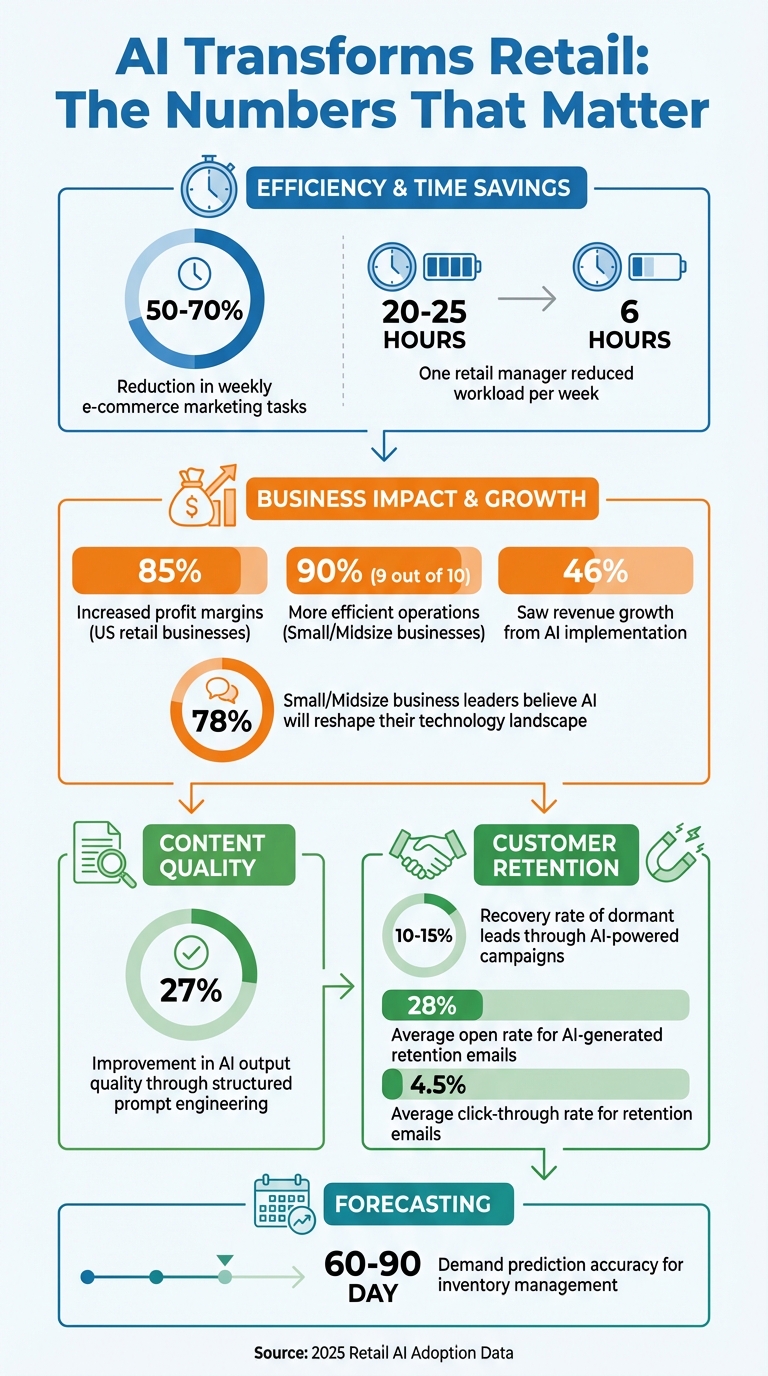
AI Impact on Retail: Key Statistics and Efficiency Gains
The AI Prompts That I use to 4x Clothing Brands on Shopify

1. Product Descriptions
Creating product descriptions at scale can be a time-consuming task for retail teams. But AI-powered prompts make this process faster and more efficient, helping businesses save time while crafting descriptions that resonate with customers. These strategies also tie into broader marketing and SEO practices, which we’ll touch on later. Here are three focused ways to optimize product descriptions using AI.
Feature-to-Benefit Translation
Instead of just listing technical specs, use AI to translate product features into clear customer benefits. For example, in 2025, Salesforce's Starter Suite provided a prompt tailored for eco-friendly kitchenware retailers: "Generate five compelling product descriptions for my new line of eco-friendly kitchenware, emphasizing unique features like biodegradable materials and modern design aesthetics." With this, small businesses could launch new product lines without spending hours writing descriptions manually.
A "Tech-to-Benefit" approach makes descriptions more relatable and engaging by turning technical jargon into user-friendly advantages. This method not only simplifies the message but also encourages higher customer engagement.
To ensure consistency, structure your prompts effectively.
Structured Framework Prompts
Rather than asking for a generic "description", use a detailed template. The RIGS framework works well here: Role (define the AI's role), Instruction (give clear commands), Guardrails (set tone, length, and formatting rules), and Specifics (include product details and target audience). A well-structured prompt might include elements like a headline, an opening paragraph highlighting key benefits, technical specs, use cases, and SEO-friendly keywords.
For instance, in September 2025, CarMax used generative AI to produce detailed car comparisons. These descriptions included specs, features, benefits, and even summarized customer reviews, helping buyers make informed decisions. This structured approach ensured consistency across thousands of listings while keeping quality and efficiency intact.
Lastly, don't overlook the importance of maintaining your brand's unique voice.
Brand Voice Consistency
When managing extensive product catalogs, it’s critical to keep the tone and style consistent. Specify in your prompts whether the voice should be "professional", "conversational", or "luxury." This ensures the copy aligns with your brand identity and avoids sounding generic, which can directly affect customer engagement.
In fact, training in structured prompt engineering has been shown to improve AI output quality by about 27%. With strategic prompting, businesses can cut their manual workload for e-commerce marketing tasks by as much as 50% to 70%.
2. Inventory Management
Managing inventory effectively is a cornerstone of retail success. If you overstock, you tie up valuable capital and risk cutting into profits. On the other hand, running out of stock can lead to missed sales and unhappy customers. It’s a balancing act that, when done right, can streamline operations and improve profitability. After sharpening your product descriptions with AI, refining inventory management is the next step toward operational excellence. AI tools can help retailers find this balance by automating demand forecasts, generating audit reports, and simplifying reorder workflows.
Demand Forecasting and Reorder Suggestions
AI has the power to analyze detailed sales data - right down to the SKU level - along with inventory levels, supplier lead times, and seasonal trends. This allows it to predict demand for the next 60–90 days with impressive accuracy. By feeding structured data (like a CSV or Excel file containing units sold, revenue, margins, return rates, and supplier details) into the system, you can use prompts like:
"Act as a retail inventory management expert. Analyze this sales data and identify products at risk of overstocking or stockouts. Suggest specific reorder quantities and timing for each SKU."
This method helps retailers dodge the pitfalls of excess inventory or empty shelves. Including historical sales data in these prompts can make the recommendations even more precise and actionable.
Automated Inventory Audit Reports
Regular audits are essential for catching problems before they snowball. AI can simplify this process by generating specialized reports that focus on critical areas like inventory aging, shrinkage, adjustments, and reconciliation. For instance, you might use a prompt such as:
"Generate a weekly inventory report identifying overstocked and understocked items, including recommendations for optimizing replenishment strategies."
These reports make it easier for inventory teams to identify slow-moving products, resolve discrepancies, and maintain accurate stock counts. Automating the audit process allows businesses to shift from merely reacting to problems to proactively managing their inventory. When paired with standardized procedures, these insights contribute to smoother operations.
Standardized Procedures and Supplier Communication
Consistency is vital, especially when multiple team members handle inventory tasks. AI can assist by drafting a standardized Inventory Control Procedure Manual, ensuring that everyone follows the same tracking methods. Additionally, AI-generated prompts can create professional templates for vendor communications. These templates can help you negotiate better terms, manage lead times, and address discrepancies. For even greater efficiency, prompts can integrate inventory updates across multiple e-commerce platforms and monitor the flow of raw materials into finished goods.
sbb-itb-58f115e
3. Marketing and Engagement
Once inventory is in order, the next step to retail success is connecting with your customers. AI-powered prompts can revolutionize marketing strategies by creating campaigns that directly address customer needs. With the right prompts, you can cut your marketing workload by as much as 50-70% while boosting engagement and results.
Personalized Email Campaigns
Email continues to be a powerhouse for retail marketing, but creating tailored messages for various customer groups often feels like a daunting task. AI prompts simplify this process by analyzing customer data - like demographics, purchase history, and browsing habits - to craft targeted email ideas, ad copy, and even SMS messages for specific audiences. These might include new customers, loyal repeat buyers, cart abandoners, or high spenders.
The secret lies in prompts that tap into segment-specific motivations. For example, some customers may value safety and reliability, while others prioritize convenience. A prompt like "Create an email for customers who viewed the premium collection three times but haven’t purchased in 30 days" can yield highly targeted content. This approach ensures your emails are more than just generic blasts - they become messages that resonate with individual customer needs.
Social Media Content Calendars
Keeping your social media channels fresh and engaging takes consistent effort, but AI prompts can lighten the load. They can generate content calendars tailored to each platform, balancing a variety of themes such as product highlights, educational posts, behind-the-scenes glimpses, and customer success stories. For example, you can request a tabular calendar that includes fields like Date, Content Pillar, Brief, and Design Idea.
To add even more depth, you can ask AI to create multiple versions of the same post, each appealing to different psychological triggers - like one emphasizing value, another focusing on exclusivity, and a third highlighting ease of use. This lets you test what resonates most with your audience without tripling your workload. A well-rounded content strategy like this not only keeps your followers engaged but also strengthens long-term customer loyalty.
Customer Retention Sequences
Retaining customers is far more cost-effective than acquiring new ones, but many retailers struggle to keep their existing audience engaged. AI prompts can help by generating templates for retention strategies like "win-back" campaigns targeting customers who haven’t purchased in 60-90 days, loyalty reward programs, and post-purchase follow-ups. These prompts can recover 10-15% of dormant leads and improve retention rates.
The most effective retention strategies follow a structured approach. For instance, prompts can define the AI's role, provide clear instructions, and set parameters for tone and length, all while tailoring messages to specific customer segments. Imagine targeting customers who bought "Product X" but skipped "Product Y" with a personalized cross-sell email. Retailers using AI for retention emails report impressive results, with average open rates of 28% and click-through rates of about 4.5%. These numbers highlight how AI can refine your retention efforts and keep customers coming back.
4. SEO Optimization
Keyword-Rich Product Pages
Getting your products to rank in search results takes more than just writing good descriptions - it requires content optimized for both search engines and your customers. AI can take on this challenge by generating keyword-rich product descriptions, clean URL slugs, meta descriptions, and even alt text for images, all while staying true to your brand’s voice.
A particularly effective strategy is "few-shot prompting." This involves giving the AI examples of your best-performing product pages to use as a guide. By doing this, you can ensure consistency across your catalog, even if it includes hundreds or thousands of products. Here’s an example of a simple prompt you might use:
"Input product titles, descriptions, and target keywords. Based on this, write an SEO-friendly description optimized for the target keywords. Create titles that are readable and appealing to both search engines and customers. Provide a URL slug designed to attract relevant traffic."
AI doesn’t stop at descriptions. It can also produce structured data (schema markup) to help search engines display rich snippets - those enhanced search results that show details like price, availability, and star ratings directly on the results page. Few-shot prompting is a reliable method for creating this kind of data.
Additionally, prompt engineering best practices can boost the quality of AI-generated content by about 27%. When it comes to generating alt text for images, applying a 75-character limit ensures both accessibility and SEO compliance.
Experts in the field understand how transformative these tools can be.
"Marketing and business operations are very deep subjects. Having an AI assistant that can help you understand how to set up, refine, and experiment with strategies - and interpret the results - is a massive power-up."
– Alex Pilon, Senior Developer, Shopify
AI also plays a big role in refining your overall keyword strategy.
For retailers aiming to drive more organic traffic, AI can identify gaps in competitor keywords and generate semantic keyword clusters centered on your main products. It spots search terms your competitors are targeting that you’re missing, giving you a roadmap for creating content to fill those gaps. By shifting from generic keyword lists to intent-focused clusters, you can effectively reach customers at every stage of their buying journey - from initial research to the final purchase - ensuring your visibility where it counts most.
Conclusion
The retail world is changing rapidly, and AI prompt collections are becoming indispensable. Consider this: 85% of US retail businesses report increased profit margins thanks to AI, and 9 out of 10 small and midsize businesses have achieved more efficient operations after adopting AI tools. One retail manager even shared how AI prompts reduced her weekly workload from 20–25 hours to just about 6 hours.
The real power of AI lies in tailoring tools to address specific retail needs. For example, ChatGPT excels at creating structured product content, Claude shines in personalized customer interactions, and Gemini provides sharp competitive insights. When used effectively, these tools can cut workloads by 50–70% while boosting the quality of outcomes.
Businesses that embrace AI strategically are pulling ahead. Seventy-eight percent of small and midsize business leaders believe AI will reshape their technology landscape, and 46% have already seen revenue growth as a result.
To maximize AI’s potential, focus on areas that drive the most impact - like crafting product descriptions, improving inventory forecasts, or creating personalized customer experiences. Use your own sales data and customer feedback to make sure AI-generated insights align with your business realities, not just generic trends. AI assistants can guide you through setting up, refining, and testing strategies, while also helping you interpret results to achieve the best outcomes.
FAQs
How can AI prompts help improve my retail business's SEO strategy?
AI prompts can revolutionize your SEO strategy by taking over tedious tasks like rewriting product titles, crafting meta descriptions, and generating alt-text. With keyword-rich, brand-aligned content, tools like ChatGPT can produce optimized copy for category pages, FAQs, and more. This not only saves you hours of manual effort but also helps improve your site's performance on search engines.
Beyond that, AI can dig into your data to find valuable, low-competition keywords and then draft SEO-friendly content tailored to those terms. For instance, you can ask it to create a detailed guide focused on specific seasonal trends, complete with FAQs and internal linking suggestions. This approach can boost your site's authority and make it more visible to your target audience.
AI prompts also simplify technical SEO by identifying areas for improvement, such as adding schema markup, refining header structures, or compressing alt-text. By weaving these tools into your workflow, you can improve rankings, attract more relevant traffic, and increase sales - all while ensuring your content stays consistent and on-brand.
How can I ensure consistent brand voice when using AI-generated content?
To keep your brand voice consistent when using AI-generated content, start by developing a detailed style guide. This should outline your tone, vocabulary, and overall personality (e.g., friendly yet professional) and include clear examples of what fits your brand and what doesn't. When setting up prompts for the AI, incorporate these guidelines along with specifics like preferred sentence structure, formatting rules (e.g., MM/DD/YYYY for dates), and any other unique preferences. This approach ensures the AI reflects your brand's identity.
Leverage prompt strategies to maintain uniformity, such as beginning with instructions like, "Write in the upbeat, conversational tone of [Brand]," or including a snippet of your brand voice for reference. Once content is generated, compare it to your style guide, refining prompts as needed to improve future results.
Additionally, create reusable prompt templates and organize approved AI-generated content in a centralized library. This makes it easier for your team to consistently deliver on-brand messaging across all platforms, whether it's product descriptions, marketing emails, or customer support responses.
How can AI tools like ChatGPT and Claude improve inventory management for retail businesses?
AI tools like ChatGPT and Claude are reshaping inventory management by turning sales and stock data into actionable insights. Take ChatGPT, for instance - it can create a weekly inventory report with the right prompt. This report can highlight overstocked or understocked items, spot discrepancies, and suggest ideal restocking levels. Store managers can use this information to quickly tackle inventory challenges and make smarter decisions based on data.
These tools also simplify larger workflows by merging sales trends with real-time inventory tracking. Claude, for example, can analyze sales patterns, keep tabs on stock levels, and predict future demand. This helps retailers avoid stock-outs, cut down on surplus inventory, and reduce carrying costs. By automating these tasks, AI tools not only save time but also improve accuracy, allowing staff to focus on strategic priorities instead of routine operations.
Related Blog Posts

Loved by Business Owners


Based on 1K reviews
Get smarter on AI every week.
Ready to transform your business?