
Top AI Prompts for Last-Mile Delivery



Last-mile delivery is the most expensive part of the shipping process, making up 53% of total shipping costs. With challenges like 25% failed deliveries due to incorrect addresses and 88% of consumers demanding faster options, AI-powered solutions are stepping in to improve efficiency, reduce costs, and enhance customer satisfaction. From optimizing routes to automating updates, workflow optimization prompts are helping logistics teams handle real-time issues and cut delivery costs by 20%–40%.
Key Takeaways:
- Route Optimization: AI adjusts delivery plans in real time, saving fuel and reducing delays.
- Customer Experience: Proactive notifications and automated responses lower missed deliveries and complaints.
- Efficiency: Smart driver scheduling and task allocation improve resource use.
- Sustainability: AI helps reduce emissions with eco-friendly routes and better fleet management.
AI is reshaping last-mile delivery by addressing pain points like high costs, failed deliveries, and urban congestion. Companies using AI report 90%-95% on-time rates, 25%-35% cost reductions, and improved delivery experiences. Tools like ChatGPT and ORION are leading the charge, offering tailored business prompts to meet growing demands.
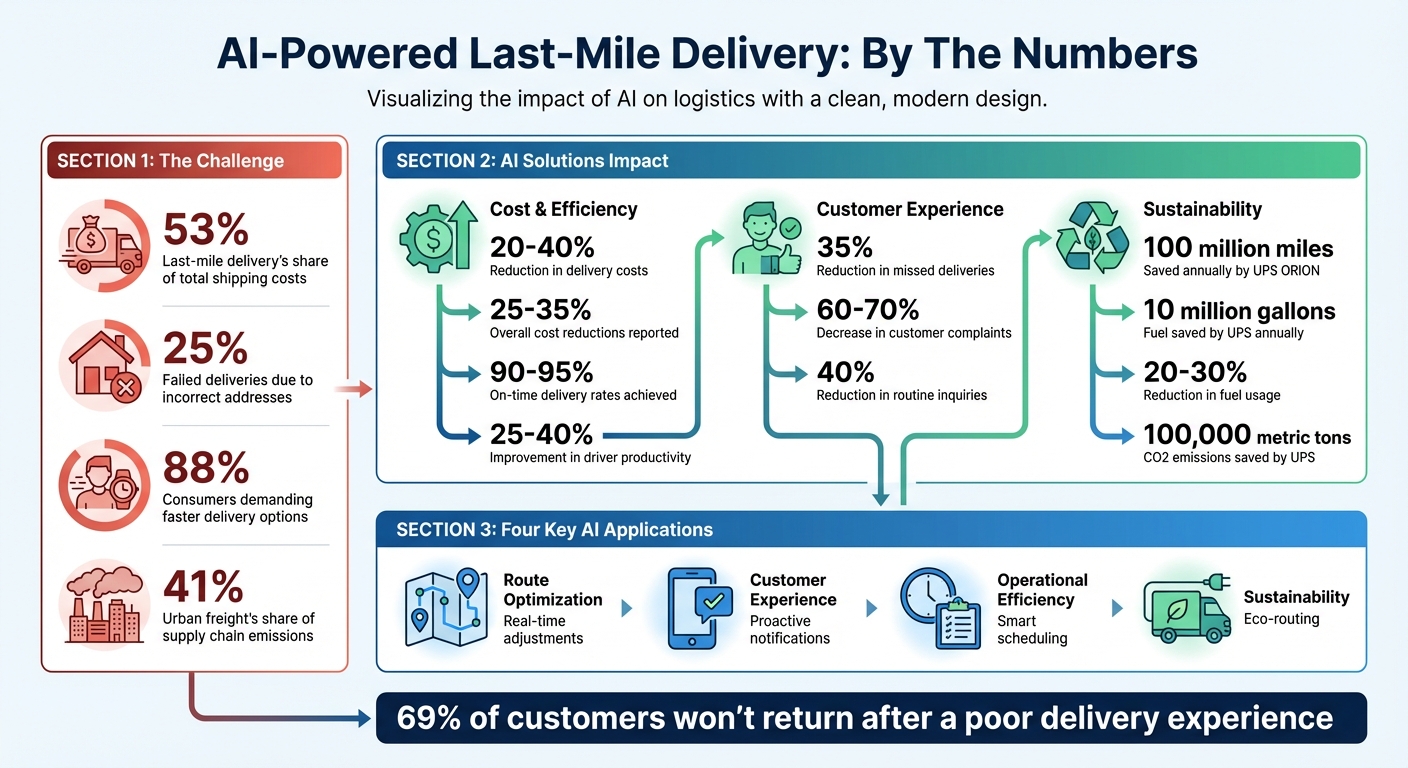
AI Impact on Last-Mile Delivery: Key Statistics and Benefits
1. Route Optimization
Dynamic Multi-Variable Route Planning
AI tools are transforming route planning by considering multiple factors like live traffic, weather, delivery windows, and driver capacity - all in real time. This eliminates the need for static maps or manual updates, making delivery operations more efficient.
Take UPS, for instance. Their AI-powered system, ORION (On-Road Integrated Optimization and Navigation), optimizes stop sequences and routing decisions. By September 2025, ORION had saved nearly 100 million miles and 10 million gallons of fuel annually by planning smarter routes. The system continuously integrates live data, allowing it to reroute instantly when faced with road closures or sudden traffic jams.
"Instead of producing a fixed plan that requires manual updates, agentic AI systems monitor conditions continuously and adjust routes on their own when circumstances change." - Nishith Rastogi, CEO and Co-founder, Locus
Example prompt: "Analyze delivery data and recommend the most efficient routes based on current traffic conditions, weather forecasts, and delivery time windows for the next 4 hours".
This type of real-time responsiveness not only improves delivery efficiency but also sets the foundation for uncovering cost inefficiencies in historical performance.
Cost-Saving Route Analysis
AI doesn’t just excel at real-time adjustments; it’s also a powerful tool for analyzing historical delivery data. By reviewing patterns over weeks or months, AI can identify inefficiencies like "dead miles" (unnecessary travel) and poorly sequenced stops that might go unnoticed during day-to-day operations.
For example, BigBasket, an e-grocery platform operating in over 25 Indian cities, leveraged AI-driven route optimization through Locus DispatchIQ. By batching orders based on factors like traffic patterns, rider capacity, and location density, they achieved a 99.5% on-time delivery rate. This approach also allowed them to increase the number of orders per vehicle without needing to expand their fleet. The AI system grouped deliveries into tightly-knit zones, reducing route overlap and maximizing efficiency. This level of workflow optimization ensures that resources are utilized to their full potential.
Example prompt: "Analyze the last month's delivery data and identify key performance metrics such as average delivery time, fuel consumption per route, and idle time between stops".
sbb-itb-58f115e
2. Customer Experience
Proactive Delivery Notifications
Beyond logistics automation, AI transforms how customers stay informed. With AI-powered notifications, customers receive real-time updates that eliminate guesswork. Instead of vague delivery windows, AI generates precise alerts like "5 stops away" or "15-minute countdown" updates, helping to reduce missed deliveries by up to 35%.
Crafting these notifications effectively requires four key elements: context (your business policies), tone instructions (e.g., "empathetic but confident"), constraints (e.g., "under 100 words"), and placeholders for dynamic data like [customer name] or [ETA]. For instance, a well-designed prompt might say:
"Create a friendly 'Arriving Soon' message for a customer who is 3 stops away. Remind them to have their [ID/Signature] ready and include a link to the live driver map."
Another example could address delays:
"A delivery is running [X] minutes late. Draft a notification that acknowledges the delay, explains the reason [reason], provides a new ETA, and includes a one-click reschedule link."
These notifications don't just inform - they offer proactive support, ensuring updates are timely, accurate, and customer-focused.
Automated Customer Support Responses
"Where Is My Order" (WISMO) inquiries make up a hefty 20% to 30% of logistics-related customer service volume. AI steps in to simplify this process by converting tracking data into clear, concise responses. The result? A reduction in customer complaints by as much as 60% to 70%.
AI-driven responses are not just fast - they’re consistent, meeting customer expectations across all touchpoints. They also enhance communication by generating templates for specific needs, like requesting gate codes or confirming safe-drop locations, which drivers can send instantly.
For businesses looking to refine their customer communication in last-mile delivery, detailed AI prompt templates can be found at God of Prompt. These resources provide ready-to-use solutions for improving both speed and satisfaction in customer interactions.
3. Operational Efficiency
Smart Driver Scheduling and Task Allocation
AI has revolutionized driver scheduling, turning it into a high-precision task. Advanced systems analyze multiple factors - like location, vehicle capacity, delivery windows, and past performance - to assign drivers in just milliseconds. The result? Fewer empty miles and better utilization of resources. When disruptions arise, such as a driver calling in sick or delays during a shift, AI steps in. It automatically redistributes remaining stops across the fleet, factoring in proximity, vehicle capacity, and time constraints.
"The system handles replanning automatically. When a driver becomes unavailable mid-shift, it reassigns their remaining stops across the fleet based on proximity, vehicle capacity, and delivery windows" - Nishith Rastogi, CEO and Co-founder, Locus
Here’s how AI can help streamline business operations:
- Prompt: "Analyze current driver performance data, real-time locations, and vehicle capacities to recommend the most efficient task allocation for today's delivery volume".
- Prompt: "Generate a dynamic driver schedule for the upcoming week that balances predicted order volume spikes with driver availability and fatigue risk".
By refining scheduling processes, AI helps identify inefficiencies and removes operational hurdles.
Identifying and Eliminating Bottlenecks
Operational bottlenecks are often hidden drains on time and resources. AI, however, can uncover these inefficiencies by analyzing historical delivery data. This analysis highlights patterns - like delays during specific times, problem-prone zones, or recurring customer complaints - that point to underlying issues.
One standout application is load optimization. AI can determine the best way to load packages, ensuring items are arranged in reverse delivery order. This simple change can cut search times at each stop by as much as 40%. And the benefits are real: in January 2026, DHL implemented AI-driven route optimization across 50+ countries, achieving a 10% reduction in logistics costs and a 15% improvement in on-time deliveries.
AI-powered prompts offer targeted solutions:
- Prompt: "Summarize the main complaints from these customer reviews to identify specific operational bottlenecks".
- Prompt: "Generate a preventative maintenance checklist to reduce vehicle downtime and avoid the $480 to $760 daily cost of fleet breakdowns".
AI in Supply Chain: Last Mile Delivery, Logistics and Supply Chain Management | Richard Savoie
4. Sustainability
AI is reshaping last-mile delivery by making it more sustainable, building on gains in efficiency and customer experience.
Eco-Routing and Carbon Footprint Reduction
Urban freight transport accounts for 41% of total supply chain emissions, and in dense urban areas, last-mile delivery emissions can be four times higher per package compared to upstream transportation. AI addresses this problem by designing delivery routes that focus on reducing emissions, rather than simply cutting travel time or distance.
For example, UPS's ORION system uses AI to optimize routes, resulting in savings of 100,000 metric tons of CO2 emissions and 10 million gallons of fuel annually. Similarly, Walmart employed AI to eliminate 30 million unnecessary miles, avoiding 94 million pounds of CO2 emissions.
Specific AI-powered marketing and operational prompts can further support eco-friendly delivery operations:
- Prompt: "Analyze delivery data to recommend the most eco-efficient routes, factoring in traffic, terrain, and fuel consumption to minimize emissions".
- Prompt: "Develop a checklist for drivers to adopt fuel-saving practices, such as reducing idling and maintaining optimal acceleration patterns".
"AI, when used ethically and intentionally, can deliver a future where rapid delivery does not come at the cost of planetary health." - Nitin Natesh Kumar, Director of Planning & Analytics, Fanatics
Sustainable Packaging and Fleet Transition Planning
AI's impact extends beyond routing to areas like packaging and fleet upgrades. Since logistics accounts for over 33% of global CO2 emissions, smarter packaging and vehicle electrification are critical for reducing the sector's environmental impact. For instance, Ocado, a UK-based online grocer, used machine learning to align delivery slots with local demand, cutting carbon intensity from 489 to 458 metric tons of CO2 equivalent per 100,000 orders - a 6% decrease.
AI can also help minimize packaging waste and guide fleet electrification strategies:
- Prompt: "Recommend eco-friendly packaging by evaluating recyclability, strength-to-weight ratios, and biodegradable options for various products".
- Prompt: "Design a roadmap for transitioning to an electric vehicle fleet, including battery range needs, off-peak charging schedules, and route assignments based on capacity".
Conclusion
Last-mile delivery makes up over half of shipping costs, but AI-powered prompts are turning this challenge into an advantage. Companies using AI-driven solutions report cutting costs by 25–35%, achieving on-time delivery rates of 90–95%, and reshaping their delivery operations from the ground up.
The key is tailoring AI prompts to specific delivery scenarios. Urban micro-fulfillment has different demands than rural routes. By integrating real business data - like vehicle capacity, service-level agreements, and historical traffic trends - AI can provide actionable strategies to address unique challenges. Using such data ensures prompts deliver practical, measurable results.
"AI is a powerful co‑pilot, it handles repetitive tasks, highlights issues, and speeds up support, while your platform and people drive the real mechanics of delivery."
With optimized routes and better customer support, AI prompts are reshaping last-mile delivery in areas like route planning, customer satisfaction, operational efficiency, and even reducing environmental impact. These tools can lower delivery costs by 25–35%, improve on-time rates to 90–95%, cut routine inquiries by 40%, reduce fuel usage by 20–30%, and enhance driver productivity by 25–40%. Considering that 88% of consumers expect same-day or next-day delivery and 69% won’t return after a poor delivery experience, these improvements directly protect a company’s bottom line.
For businesses looking to integrate AI prompts into their operations, platforms like God of Prompt offer over 30,000 business prompt collections covering logistics, operations, and customer communication. These tools, with categorized bundles and a prompt generator, help companies tackle challenges like the 25% of delivery failures caused by incorrect addresses or designing routes to minimize environmental impact. Start small - address one pain point, refine your prompts using real-world insights, and scale from there.
AI is proving to be a game-changer for last-mile delivery, offering practical solutions across a wide range of delivery challenges.
FAQs
What data do I need to get AI route optimization working?
To make AI route planning work effectively, you'll need a mix of key data points. This includes information on traffic conditions, delivery time windows, vehicle capacities, road conditions, and real-time traffic updates. Together, these elements ensure routes are planned efficiently and accurately, especially for last-mile deliveries.
How can AI reduce failed deliveries from bad addresses?
AI plays a crucial role in cutting down failed deliveries through advanced address validation and correction. By implementing real-time validation during checkout, it can tackle 40–60% of delivery issues. This is done by standardizing ZIP codes, verifying landmarks, and suggesting accurate area names. Large language models (LLMs) take it a step further by correcting typos, filling in missing information, and interpreting unconventional address formats. These tools work together to boost first-attempt delivery success, reducing rerouting expenses and enhancing customer satisfaction.
How do I start using AI prompts in last-mile delivery without a big tech build?
Platforms offering pre-designed AI prompts and tools can be a game-changer for last-mile delivery operations. These tools can assist with essential tasks like route optimization, customer communication, and tracking, all without the need for custom-built software. For example, services like God of Prompt provide a wealth of categorized prompts and guides, making it simple to incorporate AI into your processes. This approach allows businesses to boost efficiency while keeping tech investments minimal.
Related Blog Posts

Loved by Business Owners


Based on 1K reviews
Get smarter on AI every week.
Ready to transform your business?