
Ultimate Guide to AI Email Personalization




AI email personalization transforms generic campaigns into highly targeted messages tailored to individual behaviors, preferences, and engagement patterns. By leveraging AI tools, businesses can automate dynamic content, optimize send times, and predict subscriber actions, resulting in better performance and increased ROI.
Key benefits include:
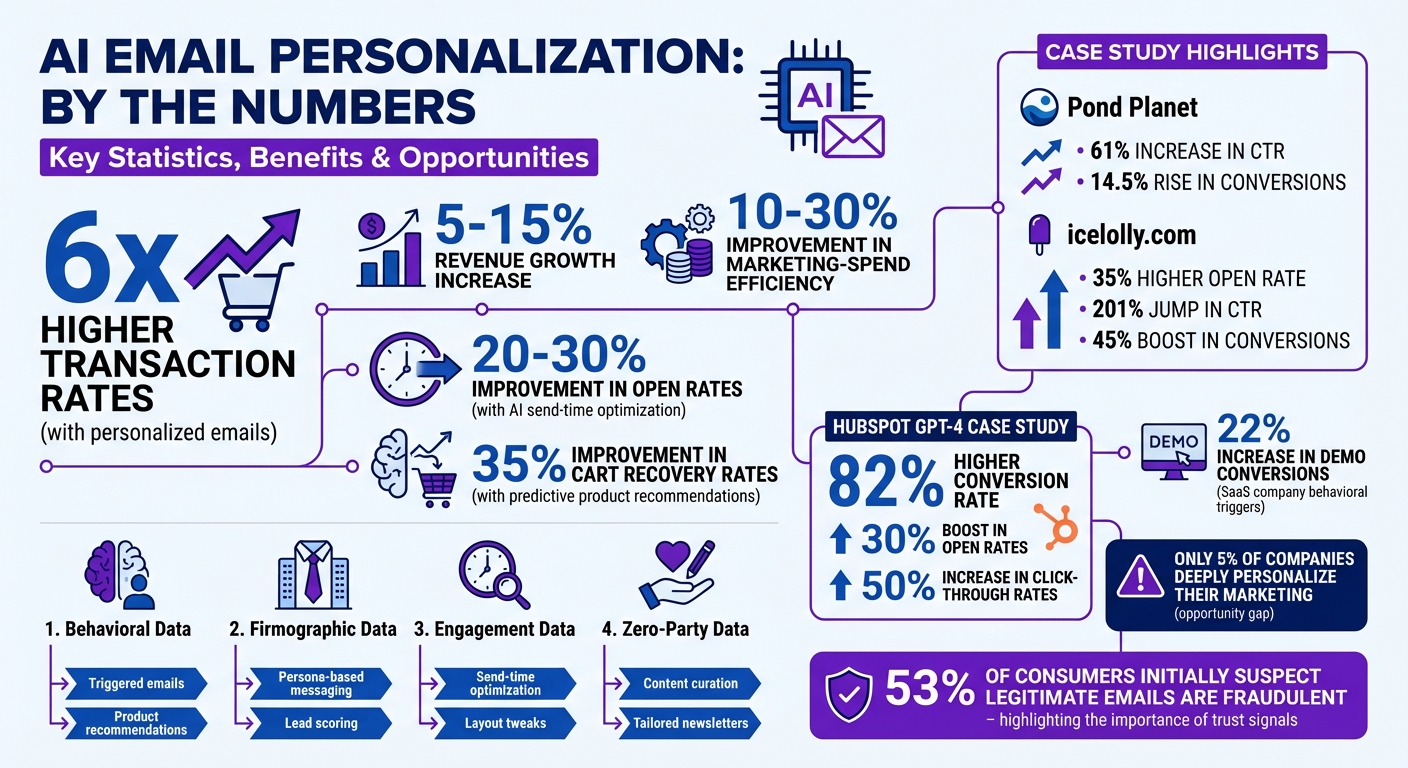
- Higher engagement: Personalized emails drive 6x higher transaction rates.
- Revenue growth: Contributes to 5–15% increases in revenue.
- Efficiency: Achieves 10–30% improvements in marketing-spend efficiency.
Practical strategies:
- Use dynamic templates to adapt content for each recipient.
- Implement behavioral triggers for real-time follow-ups.
- Optimize subject lines and send times using AI insights.
AI tools like Mailchimp, Klaviyo, and ActiveCampaign make it easy to apply these techniques. Start by cleaning your data, focusing on quality, and testing AI-driven campaigns to refine results. With AI, email marketing becomes smarter, more precise, and scalable.
AI Email Personalization Impact: Key Statistics and ROI Metrics
How to ACTUALLY AI personalize email outreach at scale (so that it works)
sbb-itb-58f115e
Core Strategies for AI Email Personalization
Here’s a look at practical AI-powered personalization strategies that businesses of all sizes can implement.
Dynamic Content Personalization
Dynamic templates let you create a single email that adapts to each recipient. By using dynamic blocks, you can swap out images, text, or product recommendations based on subscriber data like browsing habits, purchase history, or even location.
Imagine an e-commerce store: subscribers in colder regions might see winter coats, while those in warmer climates are shown swimwear - all within the same email campaign. AI-driven predictive product recommendations take this further by analyzing user behavior and comparing it to similar shoppers. This helps suggest items they’re most likely to buy. For instance, when used in abandoned cart emails, this method has been shown to improve recovery rates by 35%.
Another powerful tool is behavioral trigger campaigns. These automate emails based on real-time actions. Say someone visits your pricing page but doesn’t convert - AI can send a follow-up email with case studies or a limited-time offer. One SaaS company reported a 22% increase in demo conversions after implementing triggered emails for pricing page visits. If you’re just starting, focus on a couple of triggers, like cart abandonment or content downloads, and expand from there.
Once your dynamic content is in place, refine your targeting by diving into behavioral insights.
Behavioral Segmentation and Targeting
Traditional segmentation relies on static lists like “customers who bought in the last 90 days” or “subscribers in California.” AI changes the game by creating dynamic segments that update in real time based on micro-behaviors, such as email clicks, website visits, or purchase patterns.
With predictive segmentation, AI doesn’t just analyze current behavior - it forecasts future actions. For example, it can assign “churn risk scores” to disengaged subscribers and trigger reactivation campaigns before they leave. Similarly, it identifies high-value leads with strong buying intent and moves them into conversion-focused workflows.
"AI-powered email personalization uses machine learning, predictive analytics, and natural language processing to deliver highly relevant, one-to-one messages based on each subscriber's behavior, preferences, and lifecycle stage." - Jack Gonzalez, Email Marketer
When designing emails with AI-driven dynamic content, keep it simple. Stick to three personalized fields (like job title, industry, or recent activity) to ensure clarity and avoid overwhelming recipients.
Next, focus on fine-tuning subject lines and delivery timing for maximum engagement.
Personalized Subject Lines and Send Times
AI insights from dynamic content and segmentation can transform subject lines into attention-grabbing hooks. Generic subject lines often get ignored, but AI uses historical data to identify the best-performing words, emojis, and tones for different audience segments. It then generates multiple variations and delivers the most effective one to each recipient. This goes beyond just adding a first name - AI can incorporate recent actions, viewed products, or even social media activity.
For example, in December 2025, HubSpot’s demand generation team used GPT-4 to pair subscribers with educational courses based on intent signals. The result? An 82% higher conversion rate, a 30% boost in open rates, and a 50% increase in click-through rates.
"The 'best time to send' is a myth. It's different for every person." - Curt VanderWall, Kyleads
AI takes the guesswork out of timing by analyzing when each subscriber typically opens emails. It then schedules delivery at that exact time, improving open rates by 20–30%. Tools like Mailchimp and ActiveCampaign offer this feature, ensuring emails hit inboxes when recipients are most likely to engage - be it early morning or late at night. These platforms constantly learn from engagement data, refining their recommendations in real time.
If you’re a solopreneur, AI tools like ChatGPT can help brainstorm 10–20 subject line ideas in seconds. You can then tweak the best ones to match your brand voice. Before diving into AI optimization, though, clean your email list with validation tools to remove inactive contacts. AI thrives on high-quality data, and bad data leads to poor results.
Data and Tools for AI Email Personalization
Key Data Types for Effective Personalization
To create tailored email experiences, AI relies on four main types of data: behavioral, firmographic, engagement, and zero-party data. Each plays a unique role in shaping personalized content:
- Behavioral data tracks actions like browsing habits, cart abandonment, clicks, and purchase history.
- Firmographic data focuses on B2B details such as industry, company size, and job titles.
- Engagement data reveals when emails are opened, the devices used, and historical click-through rates.
- Zero-party data includes preferences users willingly share through surveys or preference centers.
As third-party cookies fade away, marketers are leaning heavily on first-party and zero-party data collected directly from customers. Keeping this data accurate and up-to-date is essential. Regularly auditing your contact lists and removing inactive subscribers can significantly boost campaign performance.
Centralizing data in platforms like a CDP or CRM helps eliminate fragmentation and ensures you have a single, reliable source of truth. Tools like Apollo or Clay can enrich basic email data by filling in gaps like job titles or buying signals. To maintain trust, always get explicit consent, comply with GDPR and CAN-SPAM regulations, and offer transparency about why users see certain content. Giving subscribers control over their preferences is equally important.
These data types power AI capabilities like dynamic content, precise targeting, and optimized delivery - key elements of effective email marketing.
| Data Category | Specific Data Types | AI Application |
|---|---|---|
| Behavioral | Recent web visits, cart abandonment, clicks | Triggered emails, product recommendations |
| Firmographic | Industry, company size, job title | Persona-based messaging, lead scoring |
| Engagement | Open times, preferred device, past CTR | Send-time optimization, layout tweaks |
| Zero-Party | Stated interests, survey responses | Content curation, tailored newsletters |
Once your data is organized and actionable, the next step is selecting the right AI tools to enhance personalization.
Top AI Email Personalization Tools
Several tools stand out for their ability to supercharge email campaigns with AI-driven personalization:
- Monday Campaigns: Combines CRM data with AI insights to recommend audiences and messaging, streamlining campaign launches.
- 6sense: Offers "AI Blocks" for dynamic content and tools like "Introduction Email Prompts" to shape campaign strategies.
- Litmus Personalize: Enables live dynamic elements such as countdown timers, polls, and social feeds.
For e-commerce, platforms like Klaviyo and Shopify Plus excel at providing product recommendations based on browsing and purchase history. Meanwhile, ActiveCampaign and Mailchimp offer predictive sending and AI-powered subject line suggestions. Salesforce Marketing Cloud goes further with features like lead scoring, lookalike audience creation, and real-time personalization across multiple channels.
When evaluating tools, focus on features like dynamic content blocks that adjust text, images, and calls to action based on user data. Predictive analytics can help forecast customer lifetime value and churn risks. Seamless CRM integration ensures email content reflects genuine customer journeys, while natural language processing fine-tunes tone and style for different segments. Continuous A/B testing ensures your campaigns evolve by automatically identifying top-performing subject lines and content.
These tools work seamlessly with your CRM, enabling real-time segmentation and dynamic content strategies. For instance, in 2025, Pond Planet used Litmus Personalize to add live social feeds, device-specific CTAs, and countdown timers, achieving a 61% increase in click-through rates and a 14.5% rise in conversions. Similarly, icelolly.com leveraged the same platform to showcase searched and abandoned deals, resulting in a 35% higher open rate, a 201% jump in click-through rates, and a 45% boost in conversions.
"Research has shown that emails personalized with just the first name - and not carried through the body of the email - are actually as likely to hurt performance as to help it. People see through this trick."
- Chad S. White, Head of Research, Oracle Digital Experience Agency
Start small by setting a clear goal, such as improving open rates with predictive subject lines or increasing order value through product recommendations. Keep an eye on model drift by retraining AI models periodically to adapt to shifting consumer behavior and seasonal trends.
How God of Prompt Simplifies Content Creation
Efficient content creation is crucial when scaling dynamic email strategies, and God of Prompt offers a solution. The platform provides over 30,000 AI prompts designed for tools like ChatGPT, Claude, and Gemini AI, along with specialized collections for marketing, sales, and e-commerce workflows. Pre-built playbooks generate foundational email templates, which can then be customized using individual-level data.
Pricing options include the Writing Pack ($37) with 200+ email campaign prompts or the Complete AI Bundle ($150) for unlimited custom prompts. Each prompt acts as a blueprint, outlining target personas, objectives, and messaging frameworks to help you launch campaigns faster. Plans come with lifetime updates, Notion access, and a 7-day money-back guarantee.
With God of Prompt, you can generate multiple content variations instantly and refine the best options to match your brand voice. Categorized bundles for business, marketing, and SEO ensure you always have a starting point, whether you're creating abandoned cart emails or reactivation campaigns.
Best Practices for Implementing AI Email Personalization
Building an AI-Powered Email Campaign
Start by cleaning up your CRM and ESP databases. This means removing duplicate entries, fixing any formatting issues, and eliminating inactive contacts. AI tools work best when they have accurate, clean data to analyze and act upon.
Next, define your campaign strategy. Identify your audience, set clear goals, and craft messaging that aligns with these objectives. Use AI-driven "dynamic content blocks" (often called "AI Blocks") to tailor emails to individual subscribers. Incorporate real-time behavioral triggers, like automated emails for cart abandonment, visits to pricing pages, or content downloads. Predictive sending is another powerful tool - AI can analyze subscriber behavior to send emails at the times they're most likely to engage. Modular email templates with dynamic content blocks can further refine personalization by automatically adjusting text, images, and calls-to-action based on each recipient's predicted preferences.
Always set up fallback text for personalized fields to avoid awkward gaps when subscriber data is missing. Before launching your campaign, preview emails across different audience segments, such as industries, job levels, or company sizes, to catch any formatting or content mismatches.
To maintain consistency, assign clear ownership of the campaign and conduct a human review of AI-generated content to ensure it aligns with your brand's voice. Train your AI tools carefully and only make updates when performance metrics indicate a clear need.
Once your campaign is ready and personalized, the next step is to focus on testing and optimization.
Testing and Optimizing Email Performance
A/B testing is key to understanding how AI personalization impacts your email campaigns. Compare AI-driven emails with non-personalized control versions to measure the difference. Test one variable at a time - such as subject lines, content blocks, or send times - to get actionable insights. Many modern AI tools can run continuous tests, learning and improving based on engagement data without requiring manual intervention.
Track metrics that align with your business goals. Open rates can tell you if AI-optimized subject lines and send times are effective. Click-through rates reveal whether the dynamic content resonates with your audience. Conversion rates show how well personalization is driving results, and revenue per email ties these efforts directly to financial impact. Keep an eye on unsubscribe rates to ensure your personalization efforts remain helpful and not overly intrusive.
Predictive analytics can further refine your strategy by forecasting customer lifetime value, churn risk, and purchase likelihood. This allows you to focus on high-value segments and adjust your messaging accordingly. For instance, adding AI-driven product recommendations to cart abandonment emails can boost recoveries by 35% and increase average order value by 25%.
Keep your AI models up to date. Consumer behavior changes over time, so what works during one season may not resonate in another. Monitor deliverability closely, especially if you're increasing email volume or frequency. If needed, consider using AI email warm-up services to maintain a strong sender reputation.
With your campaign optimized, you’ll want to ensure it complies with privacy regulations while maintaining customer trust.
Ensuring Privacy and Compliance
In 2026, consent must be explicit, specific, informed, and unambiguous. This means pre-checked boxes or vague opt-ins are no longer acceptable under GDPR rules. Even tracking pixels and behavioral profiling count as personal data processing and require clear disclosure in your privacy notices. In some areas, you may even need active opt-ins before collecting engagement data.
"The user owns their data. You are only borrowing it - with permission." – SendroAI
Conduct Data Protection Impact Assessments (DPIAs) for any AI systems that handle personal data or make decisions with significant consequences. Use automated tools to track data collection, retention, and deletion processes. When evaluating third-party AI tools, check for "zero-retention" options to ensure customer inputs aren’t used for model training.
Disable model training features in commercial AI tools. For example, turn off ChatGPT's "Improve the model for everyone" setting or Google Gemini's "Apps Activity". Opt for enterprise-level AI agreements when possible, as these often come with default settings that protect your data and offer stronger contractual safeguards.
Make it easy for subscribers to manage their preferences. Provide user-friendly options to control data usage and adjust communication frequency. To enhance trust, use Brand Indicators for Message Identification (BIMI) to display your official logo in inboxes. This helps reassure recipients of your email's authenticity - especially since 53% of consumers initially suspect legitimate emails are fraudulent.
Conclusion: The Future of AI Email Personalization
Key Takeaways
AI is reshaping email marketing, turning static campaigns into dynamic systems that continuously adapt using real-time data insights. For instance, AI-driven subject lines can boost open rates by 20–30%.
But personalization today goes beyond email automation. Machine learning enables a deeper level of customization by predicting user behavior and tailoring content at scale. This means every subscriber can receive individualized offers, content, and even optimized send times. A great example of this is HubSpot's demand generation team, which used GPT-4 in late 2025 to match users with content based on their intent - leading to noticeable increases in conversions, open rates, and click-through rates.
However, success hinges on having a solid data foundation. AI's effectiveness directly depends on the quality of the CRM data it processes. To make the most of AI, businesses need to clean up their databases, consolidate records, and prioritize first-party data collection. While AI can act as "rocket fuel" for your marketing, it doesn’t replace the need for human creativity and oversight. People are still essential for maintaining brand voice and ensuring accuracy.
For sustained success, focus on unifying your data and leveraging dynamic, adaptive content.
Next Steps for Your Business
Ready to take the leap? Start small with a clear, specific use case - like predictive subject lines or send-time optimization - to demonstrate ROI before scaling your efforts. Conduct a thorough audit of your data, adopt modular email templates with dynamic content blocks, and always include a layer of human review.
Looking ahead, the future lies in adaptive, contextual content that evolves based on when emails are opened, combined with real-time industry insights and hyper-localized segments. With only 5% of companies deeply personalizing their marketing, there’s a massive opportunity to stand out.
For help streamlining your AI efforts, check out resources like God of Prompt, which offers over 30,000 AI prompts and guides to refine your email strategies. Implement these tools and strategies to stay ahead in the evolving world of email personalization.
FAQs
How does AI help improve email engagement and boost conversions?
AI improves email engagement and boosts conversions by delivering deeply personalized and relevant content to every recipient. By analyzing customer data, it can predict individual preferences and behaviors, helping marketers create messages that feel tailored and meaningful. This approach often leads to better open rates, more clicks, and stronger overall engagement.
Beyond personalization, AI streamlines tasks like suggesting content, crafting dynamic messages, and scheduling campaigns. These tools ensure emails are sent at the right time and match the recipient's context. Businesses can scale their efforts without losing the personal touch, ultimately increasing conversions and enhancing marketing performance.
What are the best practices for using AI in email marketing?
To make the most of AI in email marketing, focus on personalization, automation, and data-driven strategies. AI can help you fine-tune subject lines, run A/B tests, and customize content for each recipient. The result? Higher open rates, better click-through rates, and emails that feel more relevant to your audience.
You can also use AI tools like dynamic content and predictive analytics to craft messages that match individual preferences and behaviors. Start by setting clear goals for your campaigns, leverage AI to generate tailored content, and regularly analyze performance to improve your approach. When used thoughtfully, AI can simplify workflows, boost efficiency, and help you scale your email marketing efforts effectively.
How does AI personalize emails while staying privacy-compliant?
AI manages to personalize emails while staying within the bounds of privacy regulations by combining ethical practices with cutting-edge technology. The process largely depends on first-party data - information that users willingly share, such as their website activity or purchase records. This method complies with laws like GDPR and CCPA, ensuring transparency and user control.
To protect sensitive user details, AI leverages tools like federated learning and differential privacy. These techniques anonymize or de-identify data, minimizing privacy risks while still allowing for tailored, relevant content. Additionally, businesses integrate clear consent processes, collect only the necessary data, and strictly follow privacy guidelines.
This careful balance between personalization and privacy enables companies to create engaging email experiences while maintaining user trust and compliance.
Related Blog Posts

Loved by Business Owners


Based on 1K reviews
Get smarter on AI every week.
Ready to transform your business?