7 AI Prompts for Better Habit Tracking
AI prompts turn vague goals into measurable habits—daily check-ins, 2-minute fallbacks, reward systems, and mood tracking to keep routines consistent.

On this page
- Key Takeaways:
- Quick Tip:
- I Gamified My Life with AI (It Only Took 30 Minutes)
- 1. Create Your Habit Tracking System
- 2. Daily Check-In and Accountability Prompt
- 3. Protect Your Habits on Busy Days
- 4. Build Your Morning Routine
- 5. Track Habits with Reward Systems
- 6. Analyze Your Habit Streaks
- 7. Track Habits by Mood and Energy Levels
- Tips for Using AI in Habit Tracking
- Conclusion
- FAQs
- How do I choose the right 3–5 habits to track?
- How can I set up a quick daily AI check-in under 2 minutes?
- What should I do after I miss a habit streak?
- Related Blog Posts
Want to stick to your habits without relying on willpower? AI tools like ChatGPT and Claude can help you design systems that work, even on tough days. Instead of vague goals, these prompts turn habits into measurable, achievable actions. From creating fallback plans to tracking mood and energy, AI can act as your personal coach to keep you consistent.
Key Takeaways:
- Set Clear Systems: Break big goals into small, trackable steps.
- Daily Check-Ins: Use AI to ask 6 habit-focused questions, summarize progress, and suggest improvements.
- Busy Day Hacks: Scale habits down to 2-minute versions to stay consistent.
- Morning Routines: Create flexible routines tailored to energy levels and schedules.
- Reward Systems: Build small, reliable rewards into your habits to stay motivated.
- Analyze Trends: Track mood and energy alongside habits for better insights.
- Protect Streaks: Use "Never Miss Twice" rules and AI feedback to prevent setbacks.
Quick Tip:
Start small. Focus on 3–5 habits and let AI guide you with prompts like:
"What’s one fallback version of my habit I can do today?"
By using these strategies, you can make habit tracking simple and effective without overwhelming yourself.
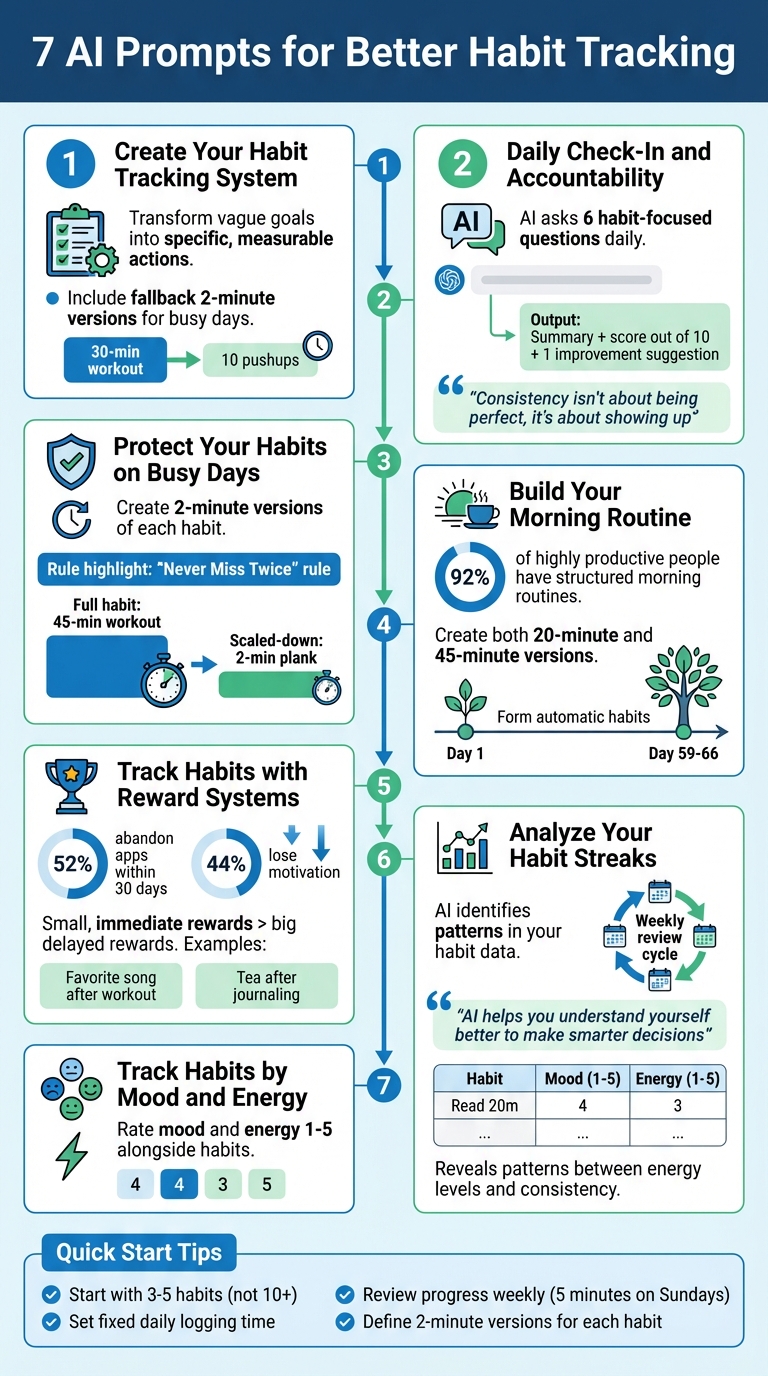
7 AI Prompts for Effective Habit Tracking System
I Gamified My Life with AI (It Only Took 30 Minutes)
1. Create Your Habit Tracking System
The secret to building habits that stick lies in creating a system that doesn’t depend on fleeting motivation. To do this, you need to define exactly what you’re tracking and plan for those inevitable disruptions. Many people dive into habit tracking without clear measurements or a backup plan, but AI tools can help you design a system that’s practical and flexible.
Start by asking tools like ChatGPT or Claude to transform a general goal into specific, actionable steps. For example, instead of setting a vague goal like "get healthier", AI might suggest concrete tasks like "meditate for 10 minutes" or "walk for 20 minutes." The key to success is making these habits measurable. AI often recommends using simple formats like Yes/No checkboxes, time logs, or numerical trackers to keep things straightforward, or explore productivity prompt collections for more ideas. This kind of clarity creates a solid foundation for your system.
"A good habit system survives on your worst days, not just your best days. It has ‘fallback’ options. It has clear triggers." – Vijai Gopal Veeramalla, Author
To make your system sustainable, include fallback tasks for days when sticking to your full routine isn’t possible. Think of these as 2-minute alternatives that you can manage even on your busiest or most chaotic days. For instance, if your usual 30-minute workout isn’t an option, you could do 10 pushups instead. This approach helps you avoid the all-or-nothing mentality that often derails progress.
Take Alex, a marketing professional, as an example. In February 2025, he used the Moore Momentum AI system to tackle his afternoon energy slumps. After identifying physical health as his main challenge, the AI suggested he join a "Community League Basketball" session at 8:30 PM – timed perfectly after his kids’ bedtime and located just 10 minutes from his home. This tailored plan shows how aligning habits with real-life constraints can make them much easier to follow.
Finally, decide on a format that works best for you. AI can help create a tracker in various formats – whether it’s a Markdown table, a CSV file with built-in formulas, or even a printable PDF. Pick the one that fits seamlessly into your daily routine.
2. Daily Check-In and Accountability Prompt
Once your tracking system is ready, the next step is to make it part of your daily routine. This is where AI steps in as your tireless, judgment-free accountability partner, asking the right questions to help you stay on track with personal growth goals. The idea is to turn habit tracking into something quick and meaningful, rather than just another task on your to-do list.
Set up a daily AI check-in with a maximum of six habit-focused questions. After you respond, the AI provides a short summary, a score out of 10, and one actionable suggestion for improvement the next day. This structured process keeps you engaged and motivated without taking up too much time, making it manageable even on your busiest days.
"Consistency isn’t about being perfect, it’s about showing up." – Spencer Lanoue, Product Builder and Startup Growth Expert
Here’s an example of a prompt you can use:
"Every day, ask me up to 6 questions about my habits. After I answer, give me a short summary, a score out of 10, and 1 suggestion for improvement tomorrow. Keep it friendly but firm."
This approach shifts AI from being just a tracker to an active coach that helps you stay accountable.
The AI doesn’t stop at daily tracking – it also reviews your habits over time. For example, it can analyze a week’s worth of data to identify patterns, like missed workouts on weekends or disruptions during travel. Based on these trends, the AI can suggest specific adjustments, such as tweaking your schedule or environment, so small slip-ups don’t snowball into bigger issues. This kind of analysis helps you prepare for challenging days with strategies tailored to your routine. With these insights in place, you’re better equipped to maintain consistency, even when life gets hectic.
3. Protect Your Habits on Busy Days
Sticking to your habits can feel impossible on days when your schedule is packed to the brim. Meetings run over, deadlines loom, and unexpected surprises throw everything off track. But here’s the thing: your habits don’t have to fall apart just because you’re short on time. The secret? Scaling them down to bite-sized versions that keep you moving forward without overwhelming you. This is where AI can step in as a helpful tool, using AI productivity methods to create a "minimum viable version" of your habits to maintain momentum, even on your busiest days.
In January 2026, productivity coach Shruti Gupta introduced a framework called "Habit Streak Protectors." This method uses AI to design 2-minute versions of more complex habits, focusing on minimum effort to ensure consistency. Gupta emphasizes that tracking "time + consistency" is far more effective than obsessing over perfection. For example, if your usual habit is a 45-minute workout, your scaled-down version could be as simple as doing 10 pushups or holding a plank for 2 minutes. The idea is to embrace imperfection so you’re never stuck in an all-or-nothing mindset.
Here’s a simple prompt to help you prepare for those hectic days:
"Create a 2-minute version for each of my habits that still counts as success for today. Also, write 5 emergency routines I can do when I’m tired, traveling, or dealing with unexpected meetings."
To make this even easier, set up "if-then" rules. For instance, if you’re short on time, automatically switch to the 2-minute version of your habit. A 2024 review showed that structured repetition and planning significantly boost habit consistency.
Another safeguard is the "never miss twice" rule. If you happen to skip a day, AI can step in the next morning with a simple restart plan, focusing on the smallest possible version of your habit. This prevents one missed day from spiraling into several. As one AI-powered journaling app phrases it:
"Consistency compounds; I will execute one small win today."
4. Build Your Morning Routine
Your morning routine sets the tone for your day. Like any good system, it works best when it’s tailored to your needs and measurable. Yet, many people either skip this step entirely or try to copy someone else’s routine, which might not fit their lifestyle. That’s where AI prompts for productivity can help—creating routines that align with your schedule, energy levels, and goals.
Research shows that 92% of highly productive individuals stick to a structured morning routine. However, many Americans still struggle to start their day effectively. The issue isn’t about lacking willpower; it’s about having a system that works for your unique circumstances.
Here’s a great way to begin:
"Create a morning routine for [goal] starting at [time], considering [job/school/kids]. Provide both a 20-minute and a 45-minute option, including hydration, movement, and one focused habit."
Having two versions of your routine can make a big difference. Create an "energizing" version for days when you feel well-rested and a "calm/low-key" version for days when your energy is lower. This flexibility helps you avoid the trap of letting one rough morning derail your entire week. AI can also recommend anchor cues – habits you already have that can trigger new ones. You can find more inspiration in an AI prompt library to further customize these triggers. For example, you might start journaling right after brewing your morning coffee. Research suggests it takes about 59 to 66 days for a habit to become automatic, so sticking with it is crucial.
It’s also important to test your anchor cues. For instance, if your trigger is "after my first cup of coffee", but you skip coffee on weekends, that habit might not stick. AI can analyze your cues and suggest alternative triggers to ensure your routine works every day of the week.
A personalized morning routine not only kick-starts your day but also strengthens the adaptive systems you’ve built. Use it as a foundation to incorporate rewards and reinforce your habits over time.
5. Track Habits with Reward Systems
Building habits that stick often depends on the rewards we tie to them. Yet, many of us stumble here – studies reveal that 52% of people abandon habit-tracking apps within just 30 days, and 44% lose motivation during the process of forming new habits. The problem? Many reward systems don’t align with how our brains actually work. This is where AI can help by crafting personalized reward systems that keep us engaged without relying on things like junk food or impulse buys.
Here’s the science: dopamine neurons, the brain’s reward messengers, respond more to consistency than to the size of the reward. Over time, they shift their activity from the reward itself to the cue predicting it. That’s why small, reliable rewards – like enjoying your favorite song after a workout or sipping tea after journaling – often work better than dangling a big reward far down the road.
"A small, immediate reward delivered reliably after a specific behavior often outperforms a big reward promised for someday." – Ramon Landes
AI can use this insight to create tailored prompts that encourage habit-building. For instance, you could ask:
"Design a weekly points system for my habits where I earn bonus points for completing tasks on low-energy days. Suggest 10 free or low-cost reward ideas that align with [your goal] and avoid [specific things you want to avoid, like junk food or excessive screen time]."
Another powerful tool is the Minimum Viable Day system. This involves identifying 4–6 core behaviors that, when completed, mark the day as a success and unlock additional rewards or habits. This approach avoids the trap of perfectionism – focusing on a few key actions ensures you "win" the day, even if some tasks slip through the cracks. AI can even help you prioritize these habits by assigning more points to activities with long-term benefits (like exercising or focused work) over smaller, routine tasks (like tidying up your desk). By using AI productivity hacks to turn your routine into a fun, gamified system, you’re more likely to stay motivated and on track.
6. Analyze Your Habit Streaks
Tracking habits is just the start – digging into why they succeed or fail is where the real progress happens. AI can step in as your personal data analyst, uncovering patterns in your habit logs.
For example, you can track secondary metrics like mood and energy levels (rated 1–5) alongside your habit completion to prevent burnout. After a week or two, AI can analyze this data to reveal connections. It might show, for instance, that you’re more likely to skip meditation on low-energy days or that starting your routine earlier improves your consistency. With machine learning, these algorithms quickly identify patterns in frequency and completion.
This kind of analysis helps you fine-tune your habits with precision.
"The power isn’t in AI telling you what to do – it’s in AI helping you understand yourself better to make smarter decisions and personalize your habits for optimal formation and results." – Will Moore, Founder, Moore Momentum
You can even use AI for weekly habit reviews. Share your data and ask for feedback with a prompt like: "Here is my weekly habit data: [Paste Data]. Evaluate it like a coach: identify what worked, what didn’t, and why. Give me 3 improvements for next week." This approach transforms raw numbers into practical advice. For those just starting out, using ready-made prompt collections can simplify this analysis process.
The real game-changer? AI can catch early warning signs of a potential streak break. By analyzing your most successful days, it identifies the conditions or routines that helped you stay on track. If it spots a pattern – like lapses during travel or under stress – you can create “Never Miss Twice” backup plans (discussed in Section 3) to prevent a full derailment. This proactive strategy shifts you from reacting to problems to actively protecting your habits. Plus, it aligns perfectly with the systems mentioned earlier, ensuring your habit-building process adapts as you grow.
7. Track Habits by Mood and Energy Levels
Your mood and energy levels play a huge role in how consistently you stick to habits. AI can help you track not just your daily habit completions but also these internal states, revealing patterns you might otherwise miss. Instead of wondering why you skipped a workout or meditation, you’ll have clear data to guide your next steps. By blending emotional and energy insights into your system, you can create a more tailored and effective approach.
Start with a simple tracking template. Include a 1–5 rating for both mood and energy alongside each habit. For example, you might use a prompt like:
"Create a daily habit tracker template for [your habits]. Include columns to rate my mood and energy from 1–5. After a week, analyze the data to find patterns between my energy levels and my consistency."
Over time, AI can help you spot trends – like noticing you skip certain habits on low-energy days or that workdays feel more demanding than weekends. Connecting these metrics to your habits allows for a more personalized and effective tracking system.
On days when your mood or energy dips, having low-energy versions of your habits can help you stay on track without overexerting yourself. As VIJAI GOPAL VEERAMALLA explains:
"A good habit system survives on your worst days, not just your best days."
An AI prompt generator can also provide accountability without judgment. For instance, if you miss a habit, you can review your tracking data and ask, "Based on this week’s data, which habits are most affected by my mood? What change could I make to my environment to make these habits easier on low-mood days?". Instead of feeling guilty, you’ll gain actionable insights, like shifting high-effort tasks to times when your energy is naturally higher.
Another useful strategy is tracking your emotional state after completing a habit. Logging the positive feelings you experience can strengthen the habit loop and help you build automaticity faster. This small adjustment turns raw data into a meaningful guide for sustainable progress. By incorporating these insights, you’ll refine your habit system and keep improving over time.
Tips for Using AI in Habit Tracking
When incorporating AI into your habit-tracking routine, simplicity is your best friend. Starting with fewer habits – ideally three to five – can make the process more manageable and effective. Research from a 2024 systematic review and meta-analysis shows that structured repetition and planning significantly boost habit strength. Trying to track too many habits at once, such as 10 or more, often leads to burnout and quitting within a few weeks. Instead, focus on one keystone habit, like improving your sleep, walking regularly, or reading daily. These types of habits tend to support and encourage other positive behaviors naturally.
Consistency is also key. Set a fixed time each day to log your habits, and spend about five minutes every Sunday reviewing your progress. This routine helps you identify patterns and make adjustments where needed. As Stefan Mitrovic advises:
"Ideally, review your progress weekly. This allows you to identify patterns, celebrate successes, and make necessary adjustments to your habits in a timely manner, ensuring ongoing improvement".
AI tools can be incredibly helpful here. Use them to summarize your weekly data and uncover correlations, such as how your energy levels or specific days of the week affect your ability to stick to habits.
Another useful strategy is to define a "two-minute version" of each habit. For example, instead of committing to a full workout, aim for just 10 push-ups. Pair this with the "never miss twice" rule: if you skip a day, make sure to complete the smaller version the following day to maintain momentum. If-then rules can also be incorporated into your AI system to reduce friction. For instance, "If I brew coffee, then I will meditate for five minutes" is a simple way to link habits together.
For those looking to expand their habit-tracking toolkit, platforms like God of Prompt offer resources to take your system to the next level. With over 30,000 productivity prompts and habit-tracking tools for AI systems like ChatGPT and Claude, they provide structured frameworks like the popular "Build habits with habit stacking" prompt, which has already garnered 1,500 views. Their Prompt Generator and Complete AI Bundle are excellent options for creating personalized tracking systems quickly and effectively.
Conclusion
AI prompts have turned habit tracking into a manageable and repeatable system, taking the pressure off willpower alone. These seven prompts offer structured approaches – like daily check-ins, streak tracking, mood monitoring, and reward systems – that seamlessly integrate into your daily routine. When life gets hectic or a day is missed, AI steps in to help you reassess, adjust, and get back on track, removing the frustration that often derails progress. This shift highlights AI’s growing role as both a coach and a system optimizer in modern habit tracking.
Today, AI-powered systems are reshaping how we approach habit tracking, evolving beyond productivity tools into personalized health coaches. As inkl News aptly puts it:
"When AI meets intention, change feels surprisingly frictionless."
The trick is to start small – focus on three to five habits – and let AI analyze your weekly progress, spot patterns, and recommend targeted improvements. These prompts, from daily tracking to mood analysis, bring together the strategies covered earlier. For those looking to expand their habit-tracking toolkit, God of Prompt offers over 30,000 AI prompts and specialized tools compatible with ChatGPT, Claude, Gemini AI, and other leading models. Their Complete AI Bundle includes tried-and-tested frameworks and a Prompt Generator to create personalized systems. Plans start at $10/month for the annual Pro plan or $17/month for Premium, which adds no-code automations and custom GPTs. This streamlined approach can replace multiple apps with one cohesive workflow.
At the end of the day, the best habit tracker isn’t about having the most features – it’s the one you’ll stick with. Thanks to AI prompts, building that consistency has never been easier.
FAQs
How do I choose the right 3–5 habits to track?
Develop habits that fit seamlessly into your daily life – ones that feel natural and practical. Start by breaking down big goals into smaller, bite-sized actions. For example, instead of aiming to "get fit", focus on a short daily activity, like a 10-minute walk or stretching routine. These small steps can lead to bigger results over time.
Pay special attention to keystone habits – those that create a ripple effect, improving other aspects of your life. For instance, getting enough sleep might boost your energy, productivity, and mood all at once.
Tracking your habits can also keep you on track. Whether it’s jotting down progress in a notebook or using an app, consistency is key. Need help figuring out where to start? AI tools can provide prompts to identify habits that align with your goals and values. Just make sure they’re specific, realistic, and built for the long haul.
How can I set up a quick daily AI check-in under 2 minutes?
Using an AI tool like ChatGPT can help you reflect and plan efficiently. Try asking specific, concise questions like:
- What habits did I complete today?
- What went well?
- What challenges did I encounter?
Set this as a recurring task or create reminders to ensure consistency. Keep your responses short – aim for under 2 minutes. Focus on quick takeaways and actionable next steps to stay on track without overcomplicating the process.
What should I do after I miss a habit streak?
If you miss a habit streak, take a moment to reflect on what led to the break. Was it a lack of time, motivation, or an unexpected event? Identifying the cause can help you fine-tune your plan or adjust your triggers to make the habit easier to stick with. Instead of feeling discouraged, focus on restarting with small, achievable steps. These manageable actions can help you rebuild consistency and keep your motivation intact.
Related Blog Posts
- ChatGPT Prompts for Goal Setting
- Ultimate Guide to AI Goal Tracking Systems
- Ultimate Collection of AI Prompts for Business and Marketing
- 5 AI Prompts for Stress Relief
Keep going: the prompt library has business prompts and productivity prompts ready to copy and run.
Prompts for this topic
Put this article to work with ready-to-use prompts from the God of Prompt library.
Keep reading

Ultimate Guide to AI Goal Tracking Systems
Explore how AI goal tracking systems enhance productivity through smart automation, personalized insights, and effective goal management.


Top 7 Companies Building Custom Autonomous AI Agents for US Businesses in 2026
Can AI Find Your Personal Information? Digital Identity Risks
AI can assemble an identity trail from public records, broker data and old accounts. What that means for digital identity risk, verification, and reducing your exposure.

The best of the blog, in your inbox
One email when notable prompts, tools, and model updates land. No spam, unsubscribe anytime.
Join 100,000+ subscribers. One email a week, real prompts, tools, and model updates. Unsubscribe anytime.