
How NLP Automates Quality Reports



Natural Language Processing (NLP) is transforming how organizations manage quality reporting by automating repetitive tasks like defect identification, issue prioritization, and report generation. Many organizations use ChatGPT prompts for business automation to jumpstart these workflows. By using techniques such as Named Entity Recognition (NER), sentiment analysis, and text classification, NLP converts unstructured data - like customer feedback or system logs - into actionable insights. This eliminates manual bottlenecks, enhances accuracy, and saves time.
Key Takeaways:
- Efficiency Gains: NLP-powered tools process reports up to 39x faster than manual methods, saving hundreds of hours monthly.
- Cost Savings: Automating workflows with NLP can cut operational costs by 30% or more.
- Improved Accuracy: Models achieve up to 99% precision in defect detection and report structuring.
- Real-World Examples: Companies like KPMG and JPMorgan Chase report significant time and cost reductions using NLP-driven systems.
Whether it’s automating quality assurance, customer feedback analysis, or clinical documentation, NLP offers practical solutions to streamline processes and improve decision-making. This guide explores how businesses are leveraging NLP tools and prompt bundles to modernize quality reporting.

NLP Quality Report Automation: Key Statistics and Benefits
Automating Clinical Data Abstraction From Unstructured Documents Using Spark NLP with John Snow Labs
sbb-itb-58f115e
NLP Techniques That Power Quality Report Automation
NLP techniques have become indispensable for automating quality reporting. Three standout methods - Named Entity Recognition (NER), sentiment analysis, and text classification - show how these tools transform unstructured data into actionable insights.
Named Entity Recognition (NER) for Finding Defects
NER is all about extracting specific information from unstructured text, turning things like support tickets or logs into structured data that’s easier to work with. A great example is zero-shot NER models like GLiNER, which let teams define custom labels (like "defect_type" or "error_code") on the fly - no labeled training data required. These models even assign salience scores (from 0 to 1) to help distinguish major defects from less critical mentions.
"Named entity recognition (NER) pulls structured data out of unstructured text... It is one of the most practical NLP tasks because nearly every document processing pipeline needs it." - agentbus
For best results, set a confidence threshold of 0.5 by default. Lowering it to 0.3 increases recall (helpful for catching more issues), while raising it to 0.7 improves precision. Transformer-based models, such as spaCy’s en_core_web_trf, are particularly effective for handling complex defect descriptions, leveraging RoBERTa to deliver high accuracy. By automating defect identification, some companies have cut processes that used to take weeks down to just two hours, saving over 200 hours per month.
Once defects are identified, sentiment analysis helps determine which ones need immediate attention.
Sentiment Analysis for Ranking Issue Priority
Sentiment analysis evaluates the emotional tone of text data, making it easier to flag urgent issues based on customer frustration or negativity. This goes beyond simple positive/negative classification - emotion detection can identify specific feelings like anger or disappointment, offering deeper insight into issue severity. For instance, negative feedback might automatically trigger task creation in tools like Jira, while neutral or positive comments follow a different workflow.
Aspect-based sentiment analysis (ABSA) takes this a step further by focusing on specific features, such as identifying whether complaints are about "battery life" or "screen brightness." This allows teams to address the most pressing issues. Tools like Claude 3.7 Sonnet demonstrate over 95% accuracy in generating structured JSON, ensuring the integrity of automated reporting pipelines. Combining AI-driven sentiment analysis with human oversight has been shown to speed up decision-making by 40%. To prevent unnecessary alerts, notifications should only trigger when sentiment or performance metrics hit critical thresholds.
With defects identified and priorities ranked, text classification organizes reports into actionable categories.
Text Classification for Organizing Reports
Text classification automates the sorting of reports into predefined categories, such as bug types or feature requests. Transformer-based models excel here, creating dense vector embeddings that capture the meaning behind text, achieving accuracy rates of 90% to 98% in bug classification tasks. These embeddings also recognize synonyms, ensuring consistent categorization.
Multi-label classification is especially useful, as reports often contain a mix of issues. This approach predicts probabilities for multiple categories at once, rather than forcing a report into just one. For projects with little historical data, zero-shot classification using tools like GPT-4o can handle categorization without prior training, though it may come with higher costs and slower processing times.
When implementing text classification, prioritize recall over precision - missing a critical bug is far worse than misclassifying a feature request. Automate actions only for predictions with high confidence (above 0.85), while routing uncertain cases to human reviewers. While traditional models often require hundreds of labeled examples per category, hybrid approaches can perform well with as few as 50.
Tools and Frameworks for NLP Quality Report Automation
When it comes to automating NLP-based quality reports, the tools you choose can significantly impact your project’s success. Broadly, they fall into two categories: general-purpose libraries designed for flexibility and domain-specific models fine-tuned for specialized tasks. Each serves a unique role in creating reliable reporting pipelines.
Common NLP Libraries and Frameworks
spaCy is a standout option for production environments. This Python library excels at large-scale information extraction, using a pipeline that handles tokenization, Named Entity Recognition (NER), and text classification. Supporting over 75 languages, it’s built for speed, making it ideal for processing huge datasets.
"spaCy is designed to help you do real work - to build real products, or gather real insights. The library respects your time, and tries to avoid wasting it." - spaCy Documentation
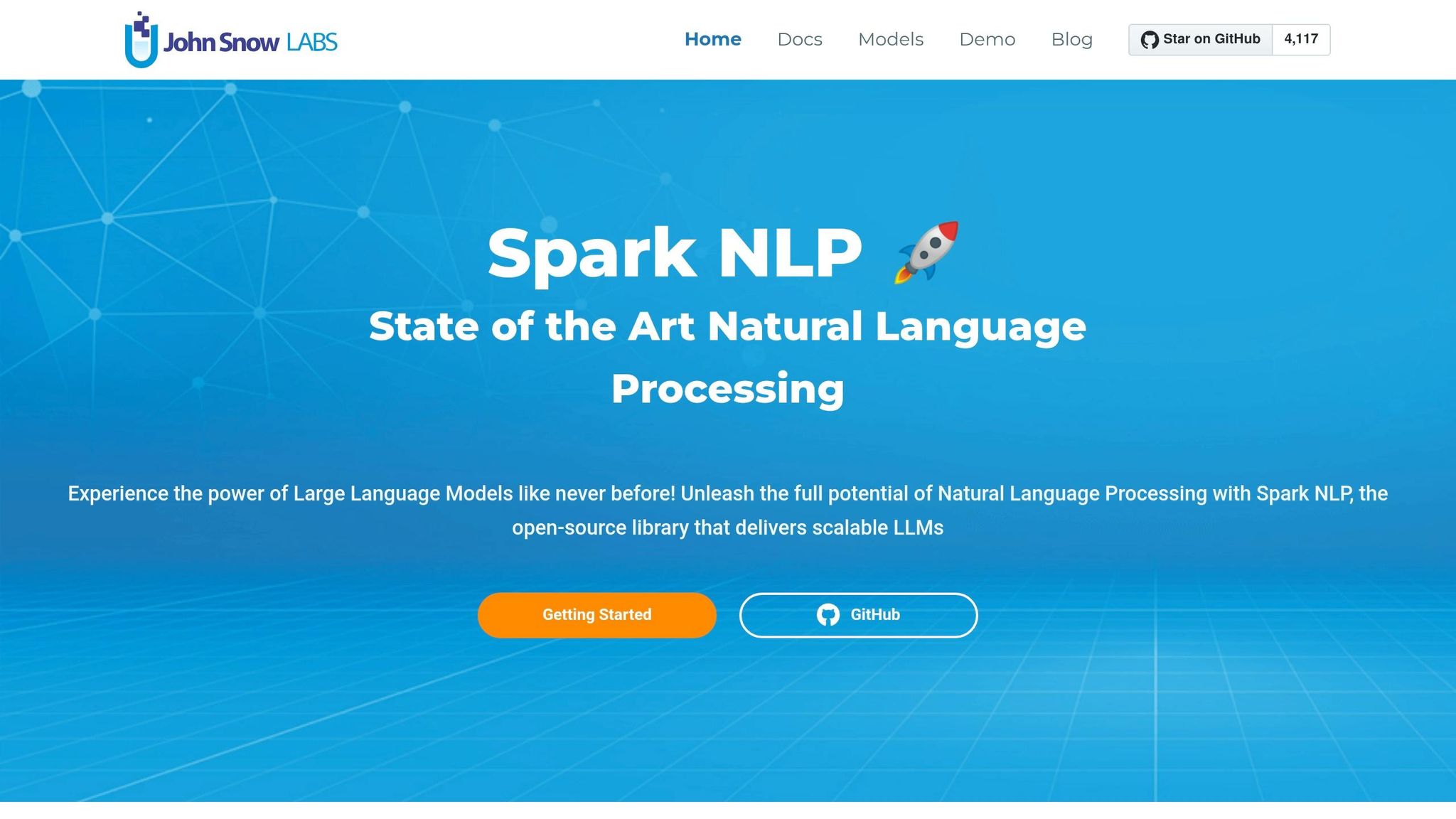
For larger-scale projects, Spark NLP is a better fit. Built on Apache Spark, it handles distributed processing across clusters and includes over 24,000 pre-trained models and 6,000 pipelines. According to a 2021 Gradient Flow survey, Spark NLP is the most widely used NLP library in enterprise environments. Teams can skip building from scratch by using pre-configured pipelines like explain_document_dl, which instantly extracts entities, parts of speech, and sentiment from quality reports.
Large Language Models (LLMs) like Claude, Gemini, and GPT-4 are also reshaping how reports are generated. These models can turn raw data into polished summaries, such as converting defect counts into executive-ready narratives. Claude even includes code sandboxes for running calculations in JavaScript or Python before generating text. Tools like n8n simplify connecting these models to autonomous AI workflows - integrating data sources (e.g., BigQuery, Google Sheets) with delivery platforms (e.g., Google Docs, Slack) without requiring heavy coding. For instance, Delivery Hero saves over 200 hours monthly by automating internal processes with n8n, while StepStone reduced a two-week data processing task to just two hours.
| Framework/Tool | Best For | Key Strength |
|---|---|---|
| spaCy | Large-scale information extraction | Fast, production-ready pipelines; supports over 75 languages |
| Spark NLP | Enterprise-grade distributed processing | Extensive pre-trained models; seamless Spark integration |
| n8n | Workflow automation | Links NLP models to 420+ apps; self-hostable |
| Claude/GPT-4/Gemini | Report narrative generation | Converts data into human-readable summaries |
While general-purpose tools offer versatility, domain-specific models are critical for handling specialized technical language with precision.
Domain-Specific NLP Models
For industries requiring technical accuracy, domain-specific models are indispensable. For example, BioBERT is tailored for medical terminology, capturing nuances that standard models like BERT might miss. Similarly, RadExtract, built on Gemini 2.5, transforms unstructured radiology notes into structured sections with precise references.
In 2025, researchers at the University of California, San Francisco fine-tuned Llama-3.1 8B on four clinical datasets, using fewer than 100 annotated reports per dataset. This model achieved 90% accuracy with a training cost under $3 on a single Nvidia A40 GPU. Such results demonstrate how fine-tuning even small datasets can yield high accuracy at minimal expense.
For teams needing rapid customization, Low-Rank Adaptation (LoRA) offers a cost-effective solution. By fine-tuning base models like Llama-3.1 8B with as few as 100 domain-specific reports, manufacturing teams can achieve human-level accuracy in just 1–3 hours on a single GPU. Training costs range from $0.80 to $2.40 per experiment, making this approach both efficient and budget-friendly.
"Small, open-source LLMs offer an accessible solution for the curation of local research databases; they obtain human-level accuracy while only leveraging desktop-grade hardware and ≤ 100 training reports." - Scientific Reports, Nature
Relying solely on zero-shot models can be risky. For example, DeepSeek-R1-Distill-Llama-8B achieves only 56.8% accuracy on clinical tasks without fine-tuning. In high-stakes fields, it’s worth investing the effort to train models on your specific terminology rather than assuming general models will perform well out of the box. Fine-tuned models not only improve accuracy but also ensure your reports meet the precision required for critical decision-making.
How to Automate Quality Reports: Step-by-Step Process
Automating quality reports involves three main steps: collecting and cleaning data, extracting insights, and generating verified reports. These steps leverage techniques like Named Entity Recognition (NER), text classification, and sentiment analysis, making it easier to integrate automation into your QA workflow.
Collecting and Preparing Data
Start by gathering raw text data from various sources such as technician notes, logs, or customer feedback. Tools like n8n can help pull data from platforms like CRMs, Google Sheets, and internal logging systems simultaneously. For example, if you're tracking quality across production batches, these tools ensure all relevant data is consolidated in one place.
Once collected, preprocessing the data is crucial. This involves cleaning up inconsistencies, standardizing terminology (using resources like RadLex for medical terms or UMLS for clinical contexts), and parsing the text to extract key details. A study by Johns Hopkins highlighted that rule-based NLP engines achieved up to 100% accuracy when extracting pathology data, while also being 24–39 times faster than manual processes. Cleaning the data at this stage is essential to ensure reliable results during analysis.
With the data prepped, the next step is to extract meaningful insights using NLP techniques.
Using NLP Techniques to Extract Information
NLP techniques play a central role in turning raw data into actionable insights. For example:
- Named Entity Recognition (NER): Identifies specific entities like pathogen names, diagnostic results, or root causes hidden within narrative text.
- Text Classification: Groups defect reports to identify recurring patterns or trends.
- Sentiment Analysis: Assesses worker safety reports or customer feedback to prioritize issues and uncover usability concerns.
For more complex datasets, combining rule-based methods with machine learning can improve accuracy. In pathology reporting, this hybrid approach has achieved micro-F1 scores exceeding 99% when converting narrative findings into structured templates. These techniques ensure that the extracted information is both accurate and useful.
Once insights are extracted, the focus shifts to creating structured, verified reports.
Creating and Checking Reports
Processed data can be transformed into clear, structured reports using templates or advanced tools like GPT-4 or Claude. These models are particularly effective at summarizing defect counts into polished narratives or generating reports in formats like PDF, HTML, or Google Docs. In financial reporting, similar automation has cut processing times by as much as 93%.
However, verifying the accuracy of these reports is critical. Use metrics like micro-F1, sensitivity, and specificity to check the reliability of AI-generated outputs. Additionally, cross-reference key figures with the original data, as large language models currently achieve about 85% accuracy on business-related numerical tasks. For high-stakes data, human oversight remains essential. In radiology, for instance, automated systems have demonstrated sensitivities ranging from 91% to 99% for detecting findings or recommendations.
Finally, automate report delivery to stakeholders via email, Slack, or integrations with tools like Quality Management Systems (QMS) or Electronic Health Records (EHR). This ensures timely and efficient communication of insights.
Adding NLP to QA and DevOps Workflows
Bringing NLP into your QA and DevOps workflows introduces an automation layer that links your existing tools - like Jira, GitHub, or Jenkins - with AI services through APIs and webhooks. A practical approach is to adopt a human-in-the-loop (HITL) model, where NLP handles reviews and drafts, while engineers provide final approval. This combination ensures accuracy and builds trust while delivering noticeable time savings. For instance, automating engineering reports can cut preparation time by 80%, reducing the weekly effort from 5.4 hours to just 65 minutes. Over a year, this translates to saving about 230 hours per manager, equating to over $27,600 in value.
Start small by rolling out opt-in implementations on a limited number of repositories or branches. This allows you to fine-tune NLP prompts and gather feedback before scaling up. Also, ensure sensitive information like tokens, passwords, and credentials are protected by implementing automated secret redaction before sharing code diffs or logs with external language models. Once integrated, this setup supports seamless deployment in CI/CD pipelines and enhances performance monitoring.
Using NLP in CI/CD Pipelines
NLP tools can integrate directly into CI/CD platforms - such as Jenkins, GitLab, and GitHub - using event-driven triggers. For example, configuring webhooks to respond to pull request events allows NLP analyses to run automatically without disrupting developers' workflows.
In March 2026, Sayan Nandi created a fully automated pull request (PR) review pipeline for Python microservices using Claude Code, Jenkins, and Bitbucket. The system relies on a dedicated file (CLAUDE.md) to enforce standards like type hints and security rules. It generates inline comments and summary reports with a verdict - either "PROCEED" or "REQUEST CHANGES" - based on thresholds such as test coverage of at least 80%. Nandi explained:
"Building an AI-powered code reviewer isn't about replacing human judgment - it's about automating the mechanical parts of code review so humans can focus on what they're best at: architecture, design, and mentoring".
Running NLP tools in containerized environments like Docker or Kubernetes ensures all dependencies are pre-installed for immediate use. By leveraging platform APIs, you can fetch code diffs, run NLP tools in headless mode, and extract structured outputs (e.g., JSON or Markdown) for inline PR comments. These automated reviews contribute directly to quality metrics, reinforcing the automation of quality reports. Regularly measuring the performance of these tools ensures they continue to deliver reliable results.
Measuring NLP Performance in QA
To evaluate NLP effectiveness, use metrics like precision, recall, F1-score, and BLEU scores. Flag outputs with low confidence for manual review, and validate them with schema tools such as ajv-cli. For example, in May 2025, profiq implemented an n8n-based automation system to triage GitHub issues. By using OpenAI to analyze issue titles and descriptions, the system automatically assigned labels for type, priority, and complexity, effectively replacing manual triage while maintaining quality.
Additionally, align NLP performance with standard DevOps DORA metrics, including deployment frequency, lead time for changes, change failure rate, and mean time to recovery. Teams that integrated NLP-assisted pipelines reported a 38% reduction in user story creation time and a 25% decrease in post-release defects by incorporating NLP-generated test scenarios early in the development process.
Best Practices and Tips for NLP Automation
Adapting NLP for Industry-Specific Needs
Generic NLP models often fall short when it comes to understanding industry-specific terms and meeting unique quality standards. To bridge this gap, customization techniques like domain-specific pre-training, fine-tuning, and contextual prompt engineering are key. For instance, Zurich Insurance leveraged an NLP and OCR system for claims management, slashing processing time from 58 minutes to just 5 - a staggering 90% reduction.
Retrieval-Augmented Generation (RAG) is another powerful approach, enabling models to work with proprietary or updated data. By incorporating proprietary datasets, models can minimize inaccuracies and align outputs with specific requirements. A great example is HSBC, which implemented NLP systems to analyze and classify over 100 million transactions daily for regulatory compliance. This initiative led to a 20% drop in false positives.
When tailoring NLP for a particular field, contextual prompt engineering can help define the audience and purpose. For example, the tone and detail required for a report aimed at a board of directors will differ from one intended for a technical team. Additionally, implementing safeguards to detect non-compliance and prevent data breaches is essential, especially in industries like finance and healthcare, where regulatory standards are strict.
Beyond customization, the use of robust and diverse datasets is crucial for improving model performance.
Using Varied Datasets to Improve Accuracy
Tailored models alone aren’t enough - diverse and high-quality training data is equally important for capturing edge cases and reducing bias. Without this, models risk producing skewed results or overlooking critical anomalies. A case in point is Johnson & Johnson, which enhanced interview match rates and cut recruitment time by 70% using their NLP system.
Before collecting data, it's essential to define clear criteria for attributes, formats, and quality standards. Prioritize accuracy, completeness, and consistency. Techniques like SMOTE or GANs can be employed to account for rare scenarios, and models should undergo continuous retraining as part of a dynamic quality assurance process.
Quality labeling is more important than sheer data volume. As noted by the deepset Team:
"Low-quality labels lead to a low-quality evaluation set, which damages your single best metric for measuring model performance".
For critical data, avoid relying on low-cost labeling services. Instead, invest in expert annotators who understand the nuances of your field. Additionally, use feedback from real-world prototypes to uncover gaps in your training data.
Conclusion and Key Takeaways
Natural Language Processing (NLP) is revolutionizing quality reporting by turning manual workflows into efficient, automated processes. Techniques like Named Entity Recognition (NER), sentiment analysis, and text classification extract meaningful insights, prioritize critical issues, and structure data seamlessly. With the right frameworks and a carefully planned implementation, businesses can slash processing times from hours to under 45 minutes, reducing effort by as much as 70%. This highlights just how impactful NLP can be for quality reporting.
Automated Extract, Transform, Load (ETL) processes further amplify these benefits, saving up to 200 hours each month and lowering the cost per report from $50–$100 to just cents through API integration. One standout example is a local health clinic that achieved a 90% reduction in reporting time while maintaining perfect accuracy across its records after adopting NLP automation.
What sets NLP apart isn't just speed or cost efficiency - it's the consistency it brings. Automated systems minimize human error and ensure every report follows a standardized template. When combined with human oversight, AI-driven analysis accelerates decision-making by 40% compared to manual methods alone. This shift allows teams to transition from acting as "human pipelines" to focusing on strategic, high-value tasks. Together, these advantages create a more efficient and strategic approach to quality assurance.
The roadmap is straightforward: start by automating one repetitive report type, use structured prompts and safeguards, and maintain human oversight for verification. As Stormy.ai aptly puts it:
"The future of reporting isn't a prettier chart; it's a workflow that tells you exactly why the chart looks the way it does and what to do next".
With 80% of analytics tools projected to be AI-powered by 2026, the real question isn't whether to adopt NLP for quality reporting - it’s how fast you can make it happen.
For a smoother implementation process, check out God of Prompt (https://godofprompt.ai). They provide over 30,000 AI prompts, guides, and tools designed for top models, helping you fast-track your quality automation efforts.
FAQs
What data should I start with for NLP quality reporting?
Start with reliable, relevant datasets like CRM systems, analytics dashboards, or databases packed with raw metrics. Incorporating structured data - such as sales figures or customer feedback - can significantly boost the accuracy of your analysis. Clean, well-organized data is key to producing meaningful insights. Tools like n8n can help automate data collection from platforms like Google Analytics or HubSpot, making workflows smoother and enhancing the depth of NLP-generated reports.
Do I need to fine-tune a model, or can I use zero-shot?
When deciding between fine-tuning a model and using it in a zero-shot setup, the choice often hinges on your specific needs. Tasks like text analysis, summarization, or classification typically perform well with zero-shot models, offering convenience and flexibility. However, for more specialized or intricate tasks, fine-tuning with data tailored to your domain can enhance precision. For example, in automating quality reports, zero-shot models might handle general requirements effectively, but fine-tuning could be beneficial when dealing with industry-specific jargon or compliance standards.
How do I verify AI-generated quality reports are accurate?
To make sure AI-generated reports are accurate, it's important to validate the outputs by comparing them with the original data and using evaluation tools. Approaches like observability, regression testing, and manual reviews can help spot potential errors. Another useful technique is context stacking prompting, which enhances accuracy and minimizes mistakes. By using these methods together, you can create reports that are both dependable and precise.
Related Blog Posts

Loved by Business Owners


Based on 1K reviews
Get smarter on AI every week.
Ready to transform your business?