
Automated GPT Testing Frameworks Compared




Testing GPT-based tools is tricky because AI outputs vary, even with the same prompts. To address this, specialized testing frameworks have emerged, focusing on features like semantic similarity, model-graded evaluations, and flexible assertions to manage AI's variability. This article compares five leading frameworks - Virtuoso QA GENerator, TestRigor, Testim, Mabl, and Testsigma - based on their capabilities in test generation, self-healing, platform support, integrations, and use cases.
Key Takeaways:
- Virtuoso QA GENerator: AI-native, excels in test generation and self-healing (95% accuracy). Great for enterprises transitioning to AI-driven QA.
- TestRigor: Focuses on plain-English test creation, reducing maintenance by 99.5%. Ideal for non-technical teams testing user interfaces.
- Testim: Strong CI/CD integration and smart locators. Cuts test creation time by 95%, suited for agile teams.
- Mabl: Low-code, affordable at $499/month. Best for startups needing simple, cloud-based testing.
- Testsigma: Supports 3,000+ devices and AI-driven test generation. Fits cross-functional teams managing large-scale testing.
Quick Comparison
| Framework | Self-Healing Accuracy | Platform Support | Integration Options | Best For | Pricing |
|---|---|---|---|---|---|
| Virtuoso | 95% | Web, mobile, APIs | 50+ integrations | Enterprises scaling AI-driven QA | Custom |
| TestRigor | 99.5% | Web, mobile, desktop | Limited | Non-technical teams, UI testing | Custom |
| Testim | High (unspecified) | Web, mobile | Extensive CI/CD tools | Agile teams with dynamic interfaces | $30,000+/year |
| Mabl | High (unspecified) | Web | Limited | Startups needing low-code solutions | $499+/month |
| Testsigma | High (unspecified) | Web, mobile, APIs, SAP | 30+ integrations | Large-scale regression testing, CI/CD | Custom |
Choosing the right tool depends on your team's skills, budget, and goals. Each framework offers unique strengths for automating GPT testing.

Automated GPT Testing Frameworks Comparison: Features, Pricing & Best Use Cases
1. Virtuoso QA GENerator
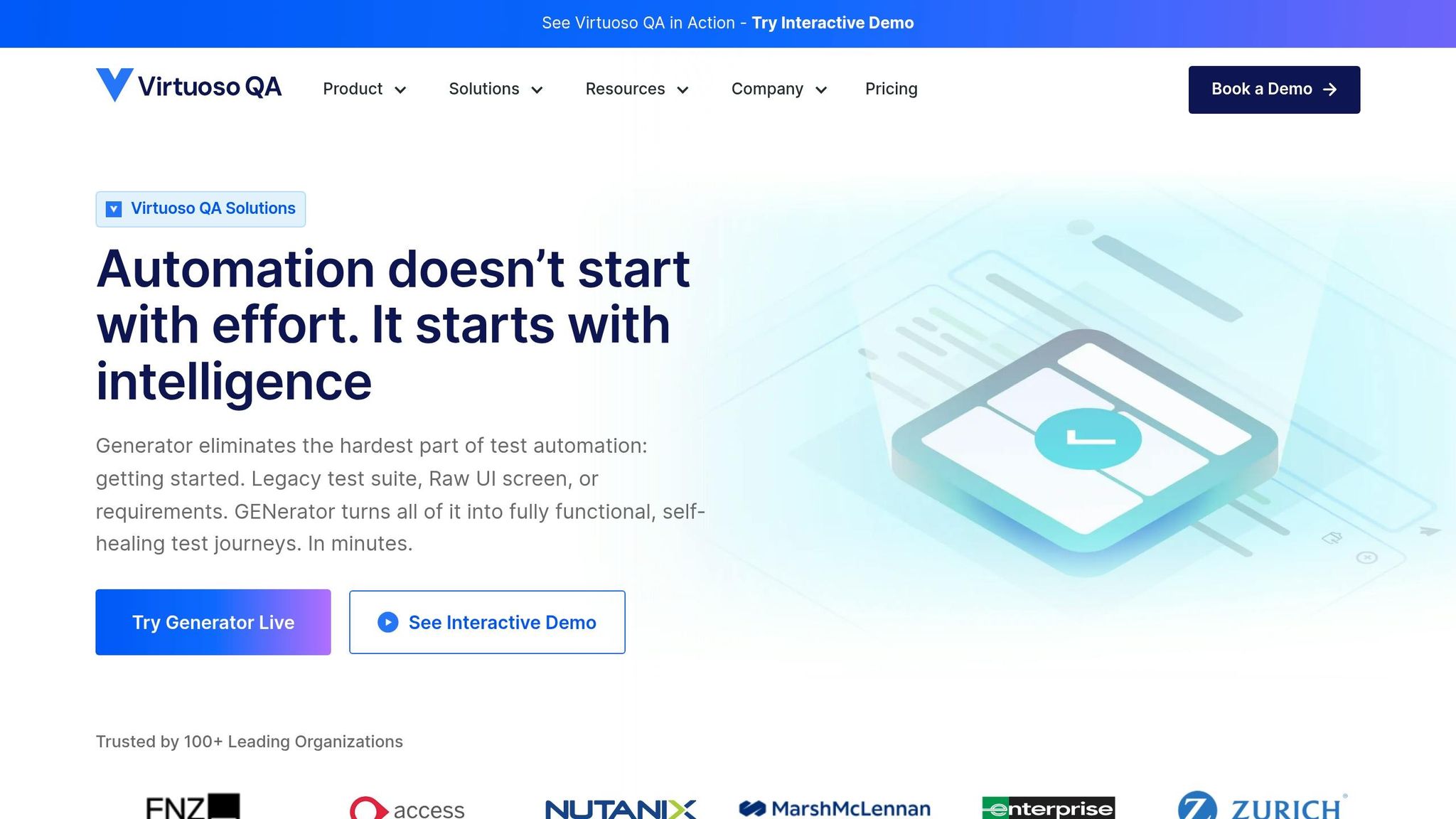
Virtuoso QA GENerator is an AI-native testing platform purpose-built with NLP and machine learning. Unlike older frameworks that retrofitted AI features, this platform is designed specifically to handle the challenges of modern GPT-based applications. Its GENerator tool can autonomously generate AI test cases from Jira, Figma, and UI wireframes, boasting an 84% first-run success rate - all without requiring manual scripting. Let’s break down its key features, including self-healing accuracy, platform support, integrations, and ideal use cases.
Self-Healing Accuracy
Virtuoso's self-healing capabilities stand out with 95% accuracy in automatically fixing locators. This has led to organizations reporting an 85-90% reduction in test maintenance efforts.
"Before using the platform, we performed a lot of time-consuming manual testing. Once we started running automated tests we felt a huge sense of relief knowing that Virtuoso was testing our core functionality."
- Gina Cross, QA and Product Lead at coaching.com
The platform also cuts defect triage time by 75% with its AI-powered root cause analysis, helping teams quickly determine whether issues stem from GPT logic or data-related problems.
Supported Platforms
Virtuoso provides automated testing for all modern browsers and devices, making it highly adaptable for web-based applications at any stage of development. Its NLP capabilities allow non-technical users to write tests in plain English, simplifying the QA process for diverse teams. Security is a priority, with features like SOC 2 Type II certification and SSO/SAML support. Additionally, the "Live Authoring" feature enables real-time test execution as tests are written, delivering 10x faster execution throughput.
Integration Capabilities
With over 50 integrations, Virtuoso seamlessly connects with tools like Jira, Jenkins, TestRail, GitHub, Azure DevOps, and BrowserStack. It automatically generates domain-specific test data - whether for healthcare systems like Epic or financial systems in banking. Tests can be scheduled, triggered through CI/CD pipelines, or run on demand.
"It's freed up lots of time to look at testing strategies as a whole rather than spending the majority of the time test executing."
- Kayleigh Sweet, Senior Test Analyst at Toolstation
Ideal Use Cases
Virtuoso is ideal for enterprises moving from manual testing to AI-driven QA to support large-scale continuous delivery. Test authoring is reported to be 9x faster than traditional frameworks, and users have seen QA costs drop by 30-50%. The platform holds a 4.5/5 user rating from 100+ reviews, with users frequently highlighting how it eliminates the complexity of tools like Selenium and Cypress.
sbb-itb-58f115e
2. TestRigor
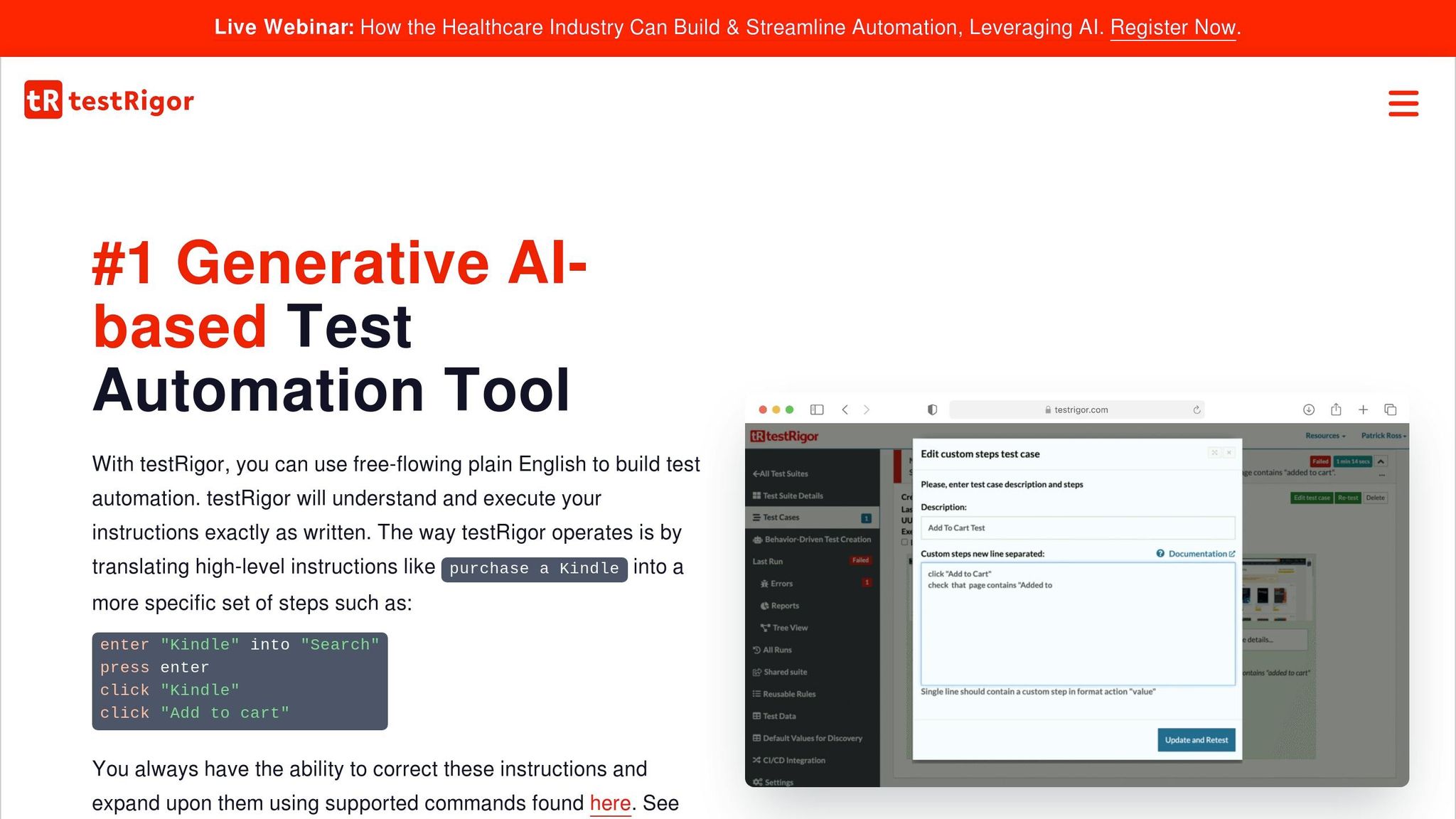
TestRigor offers a unique, user-focused approach to AI-driven testing by identifying UI elements from the perspective of the user rather than depending on traditional locators like XPath or CSS selectors. This method ensures tests remain stable even as the interface undergoes changes.
Self-Healing Accuracy
With its AI-powered self-healing capability, TestRigor minimizes the need for test maintenance by an impressive 99.5%. Instead of breaking when UI elements are updated, tests adapt automatically by recognizing elements based on their visual attributes. This feature not only enhances stability but also makes it easier for non-technical users to manage complex tests across multiple platforms.
Supported Platforms
TestRigor uses generative AI to transform plain English instructions into fully functional test sequences. For instance, a command like "purchase a Kindle" is translated into a complete test workflow. This functionality allows team members without a technical background to create and maintain even the most intricate tests with ease.
Ideal Use Cases
When it comes to evaluating GPT performance, TestRigor shines in AI product testing methods. It ensures that AI-generated UI outputs align with both functional and business requirements. This is especially valuable for teams needing to verify consistent display and dependable behavior in interfaces that adapt to dynamic content.
3. Testim
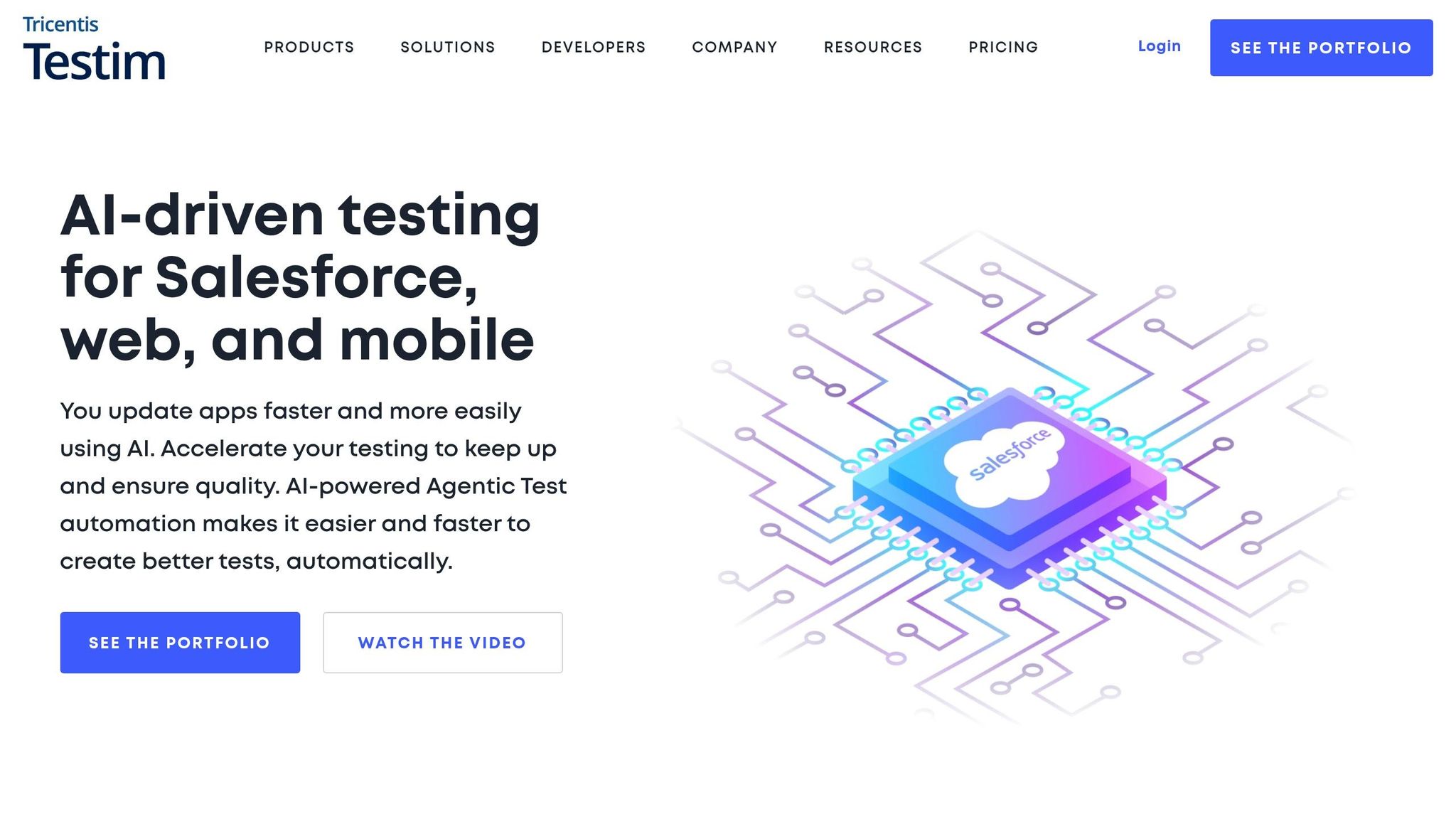
Testim, developed by Tricentis, stands out among automation frameworks by focusing on reducing manual test maintenance through AI. What sets it apart is its targeted CI/CD integration and API testing capabilities, making it especially useful for teams working with GPT-powered applications. These applications often have dynamic interfaces that adapt based on AI-generated content, and Testim addresses this challenge with its smart locators and self-healing selectors.
Self-Healing Accuracy
One of Testim's key strengths is its self-healing mechanism, which adjusts automatically to changes in the user interface. For instance, if a button's label changes or an element's position shifts, the platform's AI updates locators accordingly. This feature has been shown to reduce bugs by 30% over an 18-month period. Moreover, it slashes test creation time dramatically - from 1–2 days to just 20–30 minutes, representing over 95% in time savings.
Supported Platforms
Testim is designed to integrate seamlessly into modern development workflows as a CI/CD-native platform. It works with popular tools like Jenkins, CircleCI, GitHub Actions, Travis CI, TeamCity, and Codeship, enabling automated testing at every stage of development - whether during code check-ins or releases. The platform supports web testing on Chrome and Firefox and mobile testing for both native and hybrid applications. Additionally, it offers specialized support for Salesforce testing.
Integration Capabilities
The tool's integration capabilities are extensive. It connects with quality intelligence tools like SeaLights to map tests to code changes and identify areas lacking coverage. For GPT development workflows, Testim provides GUI-based API testing, allowing developers to run custom JavaScript code after API calls to validate responses. This feature is particularly useful for creating contract tests for external GPT services. Beyond that, Testim integrates with collaboration tools like Jira, Slack, and TestRail, as well as third-party testing grids like BrowserStack and Sauce Labs. It also supports visual validation tools such as Applitools. These integrations make it an excellent choice for agile teams aiming for rapid and comprehensive test coverage.
Ideal Use Cases
Testim is an excellent option for agile teams that need to establish test coverage quickly, especially when dedicated engineering resources are limited. Its classification as a "No-Code AI Test Builder" among other emerging AI tools makes it accessible to QA analysts and startup founders who may not have extensive coding expertise. The platform has earned a 4.9/5 rating for its low-code, AI-driven automation capabilities.
"Testim is more than just an automation tool - it is a learning-friendly platform for QA engineers starting their automation journey."
- QA Writer Nusrat Sarmin
However, it’s worth noting that the scripts generated by Testim can sometimes be challenging to debug if the AI logic diverges from the intended business requirements. Pricing for the platform typically starts at $30,000+ per year as of March 2026.
4. Mabl
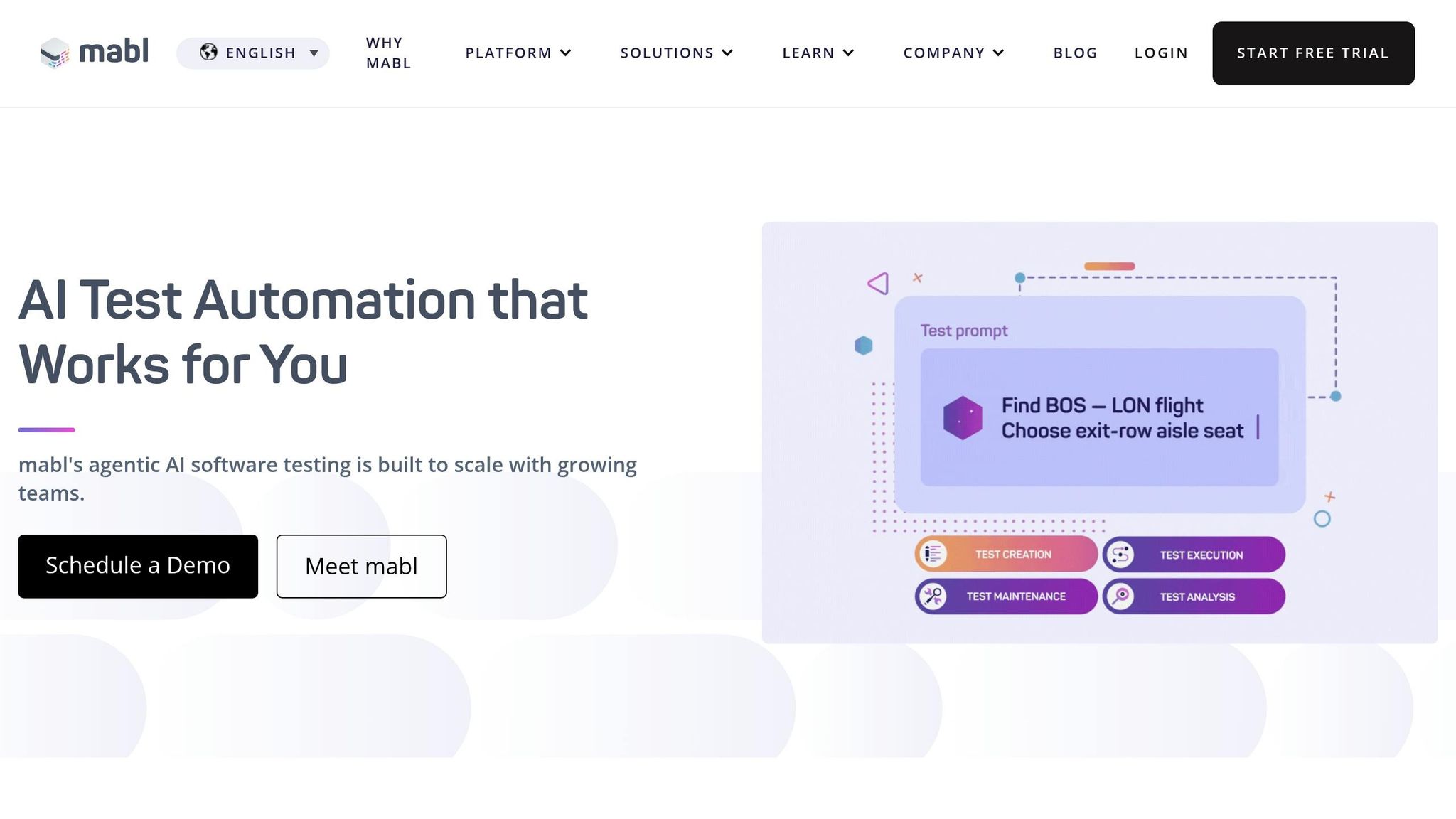
Mabl provides a low-code testing platform designed to simplify automation for teams without technical expertise. This cloud-based tool allows QA analysts to create tests by navigating through user workflows, making it an appealing option for startups and smaller teams aiming to scale their testing efforts quickly - without relying on specialized automation engineers.
Self-Healing Accuracy
One of Mabl's standout features is its AI-driven auto-healing capability. When UI elements change, the platform automatically updates locators, significantly reducing the maintenance typically required with traditional scripting tools.
Supported Platforms
Mabl handles test execution and infrastructure management automatically, removing the need for local testing setups or complex configurations. It functions as a browser-based, end-to-end testing environment and includes visual and performance testing features. However, there's a drawback: tests are stored in a proprietary format, which means they can’t be exported or run outside of Mabl’s cloud environment. This limitation could be a concern for teams requiring portable test scripts for more intricate or domain-specific testing requirements.
Integration Capabilities
Mabl unifies functional, visual, and performance testing in a single cloud-based platform. Its intent-based testing focuses on verifying specific outcomes - such as ensuring a user sees a particular message - making it particularly effective for testing dynamic interfaces, including those powered by AI. This centralized approach to testing multiple aspects of an application sets Mabl apart from many competitors.
Ideal Use Cases
Mabl is a great fit for low-code startups and smaller teams that need to scale quickly, especially those without dedicated DevOps or QA engineers. Its intuitive design ensures that non-technical QA members can get up to speed in just a day or two. Pricing begins at around $499 per month, making it accessible for growing teams. However, for highly complex workflows or custom UI patterns, users might find the platform's capabilities somewhat limited.
5. Testsigma
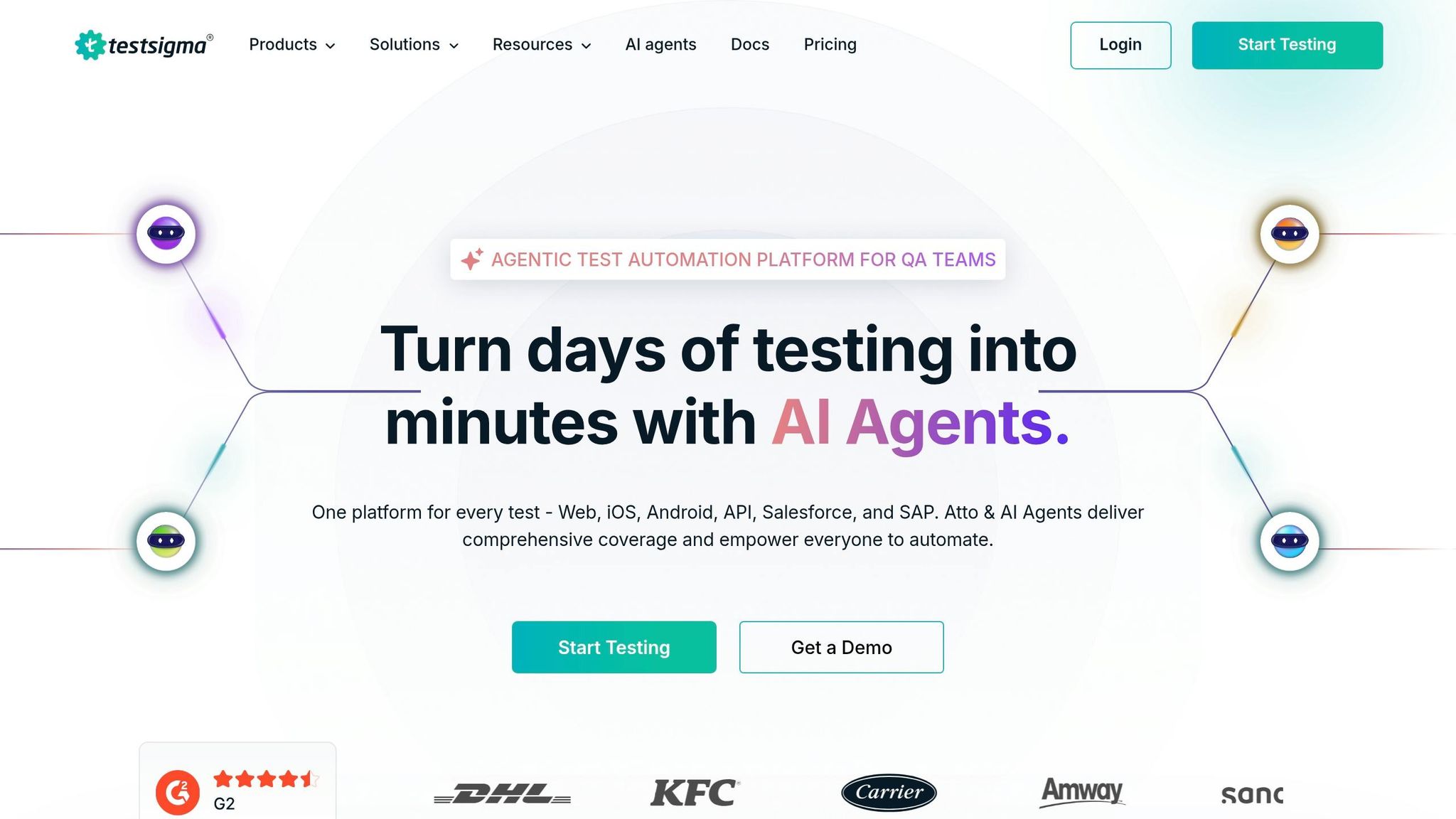
Testsigma is a testing platform designed with AI at its core, featuring an AI assistant named Atto that simplifies the entire testing lifecycle. By leveraging natural language processing, Testsigma allows users to write tests in plain English, which are then converted into automated actions. This makes it a user-friendly choice for QA teams, even those without extensive coding knowledge, while still delivering enterprise-grade testing across web, mobile, API, and desktop applications.
Self-Healing Mechanism
One standout feature of Testsigma is its self-healing capability. Instead of requiring manual updates when UI elements change, the platform automatically adjusts test scripts. This feature has proven to be a game-changer for teams like Nokia's, where QA Manager Deepak reported saving over $100,000 annually. His team was able to shift focus from tedious script maintenance to building trust and reliability in their testing efforts.
Broad Platform Support
Testsigma supports testing on over 3,000 real browsers and devices, covering Android/iOS (both real devices and simulators), API (REST/SOAP), desktop (Windows), and enterprise tools like SAP and Salesforce. This extensive platform coverage ensures thorough testing of dynamic outputs, such as those generated by GPT models. For example, teams can validate API-level GPT outputs and then assess the final user experience on web or mobile interfaces - all within a single workflow. Sathish Babu, a Senior Engineering Manager, shared that his team achieved a 400% boost in test automation speed for more than 2,500 tests using Testsigma's device lab.
Seamless Integrations
Testsigma integrates with over 30 popular tools, including CI/CD pipelines, test management platforms (like Xray, TestRail, qTest, and Zephyr), and collaboration tools such as Jira and Slack. These integrations allow teams to trigger tests directly within their existing workflows, enabling continuous testing at the speed of DevOps. Additionally, its AI-driven test case generation significantly reduces the time needed to create tests. Ekam Kaur Kalra, a Senior QA Analyst at 5x, reported a 95% reduction in test creation time, as Testsigma's AI generated precise tests within minutes. The platform even integrates with Figma, automating test updates during the design phase to address UI changes early in development. This AI-driven approach makes Testsigma particularly effective for testing GPT-based applications, where rapid updates and adaptability are essential.
Best Fit for Teams
Testsigma is ideal for cross-functional teams handling large-scale regression testing, continuous testing in CI/CD environments, and accessibility testing, including compliance with WCAG 2.2 standards. The platform offers a 21-day free trial, followed by Pro plans for growing teams and customizable Enterprise plans that include SOC2 compliance and dedicated 24/5 support. With an average rating of 4.5 out of 5 on major review platforms and over 25 million tests executed for more than 10,000 QA teams, Testsigma has established itself as a reliable choice for modern testing needs.
Strengths and Weaknesses
Taking a closer look at the frameworks discussed earlier highlights some key differences in their strengths and limitations when it comes to automated GPT testing. Factors like self-healing, platform coverage, integration options, and pricing play a big role in determining their overall efficiency.
Self-healing capabilities are handled differently by each framework, aiming to strike a balance between durability and ease of maintenance. For example, Testim uses machine learning-driven "locator intelligence" to automatically apply fallback strategies when primary locators break due to UI changes. Mabl features tools like Visual Assist and Auto TFA (Autonomous Root Cause Analysis) to adapt tests dynamically, cutting down on maintenance compared to traditional Selenium-based setups. Meanwhile, TestRigor simplifies this process by using plain-English prompts, allowing tests to adapt seamlessly across web, mobile, and desktop platforms.
Platform coverage also varies. Some frameworks expand their testing capabilities to include enterprise ERPs, desktop apps, and mobile devices, while others remain focused on web applications. Virtuoso QA and Testsigma, for instance, support enterprise systems like SAP and Salesforce, as well as APIs and mobile applications. On the other hand, Testim and Mabl are more web-centric, offering limited or optional support for mobile and API testing. TestRigor stands out by adding support for desktop applications and specialized testing scenarios, including email, SMS, and two-factor authentication.
Integration options also differ, with some platforms offering a broad range of native integrations while others provide fewer built-in connections.
Pricing is another area where frameworks diverge significantly. Monthly costs can range from about $450 to over $2,000, depending on the platform and subscription tier.
These differences in strengths and weaknesses provide a clear foundation for evaluating which framework might be the best fit for specific testing needs.
Conclusion
Our analysis of the five frameworks highlights their distinct strengths and trade-offs, each catering to different operational needs and priorities.
Selecting the right automated GPT testing framework hinges on your team's technical skills, budget, and specific goals. Each framework in this comparison shines in particular scenarios, so it's crucial to align your choice with your organization's unique requirements. You can also leverage a comprehensive AI prompt library to further refine your testing workflows.
Virtuoso QA GENerator stands out for its ability to generate tests quickly, boasting an 84% first-run success rate and 95% self-healing accuracy. This makes it a strong choice for enterprises moving from manual testing to large-scale AI-driven quality assurance. TestRigor simplifies test authoring with plain-English commands, reducing test maintenance by 99.5%. It's an excellent option for teams needing user-perspective UI testing across various platforms. Testim offers smart locators and seamless CI/CD integration, cutting test creation time by over 95% and reducing bugs by 30% over 18 months. Mabl provides an accessible, low-code solution starting at $499/month, combining functional, visual, and performance testing - ideal for startups and smaller teams. Testsigma supports over 3,000 browsers and devices while leveraging AI for test generation, enabling up to 400% faster test automation for cross-functional teams.
For small businesses and startups, low-code platforms like Mabl and Testsigma are particularly appealing, as they allow non-technical QA teams to scale efficiently. Enterprise teams looking for plain-English test authoring should explore TestRigor or Testsigma. For organizations dealing with complex user interfaces, Testim's machine learning-based stability and Virtuoso's AI-driven capabilities provide strong advantages.
"The companies winning with AI agents aren't the ones with the most sophisticated models. They're the ones who've figured out the governance and handoff patterns between human and machine."
- Dr. Elena Rodriguez, VP of Applied AI, Google DeepMind
Ultimately, the best framework depends on your technical expertise, deployment needs, and budget. Carefully weigh each framework's self-healing capabilities, platform compatibility, integration features, and pricing to find the one that best fits your testing requirements.
FAQs
How do I test GPT outputs that change run to run?
To evaluate GPT outputs that can differ across runs, it’s essential to account for the unpredictable nature of large language models (LLMs). You can use semantic similarity checks to compare the meaning of outputs rather than exact wording. Another approach is employing model-graded evaluations, where tools like GPT-4 act as a judge to assess the quality of responses. For structured outputs, rule-based validations such as JSON schema checks can ensure compliance with expected formats.
Regression testing also plays a key role. By using representative datasets and setting clear thresholds, you can detect whether updates or changes lead to unintended issues. These techniques help focus on maintaining the intended meaning and functionality of the outputs, rather than insisting on word-for-word consistency.
Which framework fits my team’s skills and budget?
Selecting the best GPT testing framework comes down to your team’s expertise and financial resources. God of Prompt is a solid choice, featuring over 30,000 prompts and tools designed to simplify tasks like marketing and development without requiring a large budget. For teams with technical know-how and limited funds, open-source options such as Promptfoo are a budget-friendly alternative. Meanwhile, commercial platforms like Adaline cater to those seeking production-ready solutions, offering advanced features like prompt management and testing capabilities.
What does “self-healing” actually fix in these tests?
"Self-healing" tests are designed to handle issues caused by changes in the UI or code that would typically break automated tests. These tests can automatically adjust or fix themselves to stay functional, minimizing the need for manual intervention and ongoing maintenance.
Related Blog Posts

Loved by Business Owners


Based on 1K reviews
Get smarter on AI every week.
Ready to transform your business?