
AI OCR and traditional OCR are both tools for converting text from images into digital formats, but they differ significantly in how they work and what they excel at. Here’s a quick breakdown:
- Traditional OCR relies on fixed templates and pattern matching. It’s great for clean, standardized documents like forms or printed text but struggles with complex layouts, handwriting, or poor-quality scans.
- AI OCR uses advanced technologies like deep learning and natural language processing (NLP). It can understand context, handle unstructured and messy documents, and even improve over time through feedback.
Key Points:
- Accuracy: Traditional OCR achieves 95–98% accuracy on clean text but drops to 40–60% on complex layouts. AI OCR maintains higher accuracy, even with challenging documents.
- Flexibility: AI OCR processes handwritten text, multiple languages, and irregular layouts, while traditional OCR requires manual updates for new formats.
- Speed & Scalability: AI OCR is faster and adapts to diverse document types without constant reconfiguration.
- Cost: AI OCR may have higher upfront costs but reduces labor and error correction expenses over time.
Quick Comparison
| Factor | Traditional OCR | AI OCR |
|---|---|---|
| Technology | Rule-based pattern matching | Deep learning, NLP, Vision-Language Models |
| Accuracy (Clean) | 95%–98% | 98%+ |
| Accuracy (Complex) | 40%–60% | 65%–75% |
| Handwriting Errors | 15%–20% | 5%–10% |
| Layout Handling | Fixed templates | Dynamic layout understanding |
| Learning Ability | Static, manual updates | Continuous improvement through feedback |
| Best Use Case | Standardized forms | Unstructured, varied documents |
AI OCR is ideal for businesses managing diverse and complex documents, offering better accuracy, adaptability, and long-term cost savings. Traditional OCR works well for basic, repetitive tasks with clean layouts.
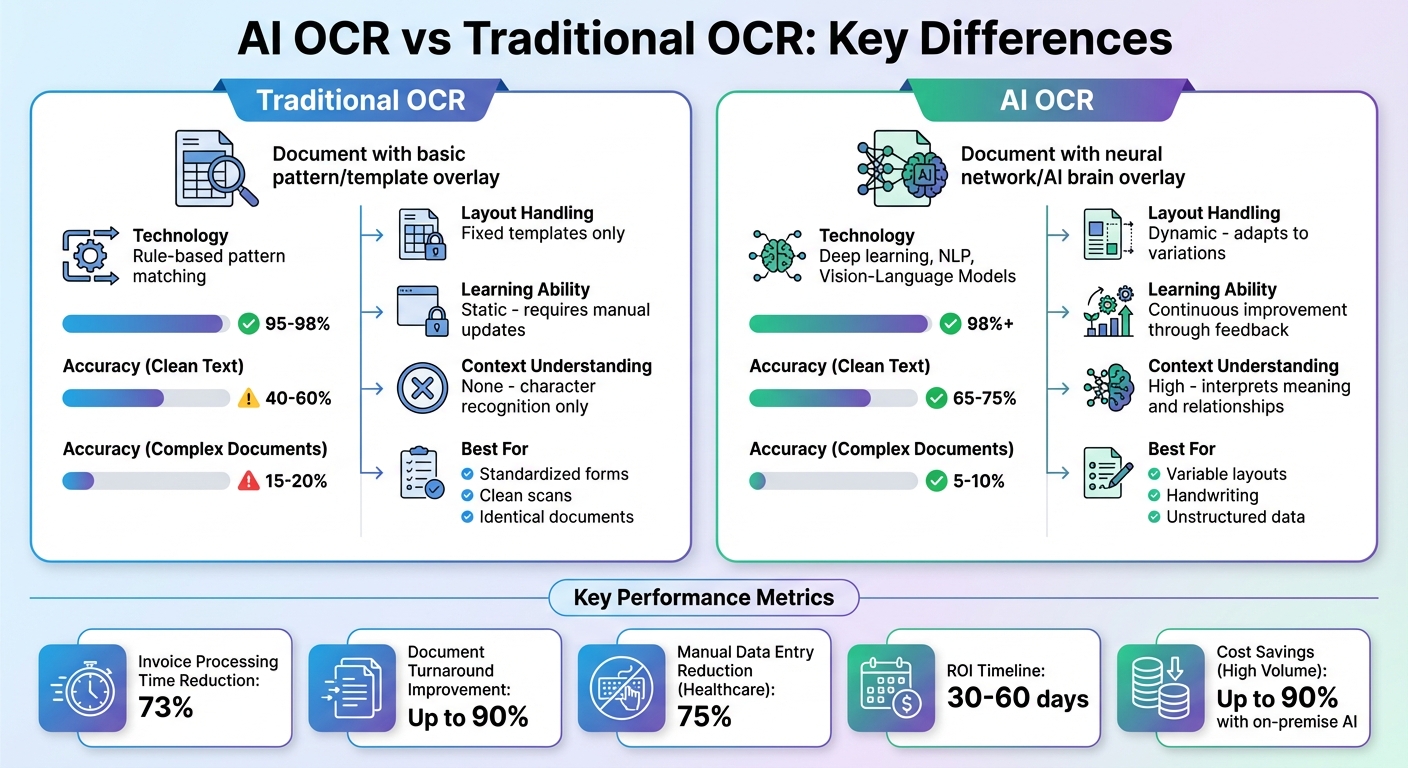
AI OCR vs Traditional OCR: Accuracy, Speed, and Cost Comparison
AI OCR vs. Traditional OCR
To find the right software for your workflow, you can browse our top AI tools directory for more options.
sbb-itb-58f115e
How the Technology Works
OCR technology comes in two main forms: traditional OCR, which uses pre-set patterns and strict rules, and AI-powered OCR, which leverages deep learning to interpret text in context. Understanding how these methods work helps clarify their differences in accuracy and reliability.
Traditional OCR: Rigid Rules and Template Matching
Traditional OCR works by matching characters to stored templates and extracting key features. Essentially, the system compares each scanned character to a database of fonts and patterns.
"Pattern recognition can only operate when the glyph that is stored has a similar scale and font to the glyph that is added." – Adobe Acrobat
For unfamiliar fonts, the system relies on fixed geometric rules. For instance, it identifies an uppercase "A" by recognizing two diagonal lines meeting at the top with a horizontal crossbar. However, this approach processes characters individually and assumes standard, clean layouts. Since it’s static by design, traditional OCR struggles with new data unless manually updated.
AI OCR: Contextual Understanding Through Deep Learning
AI OCR takes a completely different approach by using advanced deep learning models to analyze a wide range of fonts and handwriting styles. Instead of rigid templates, it employs neural networks like:
- Convolutional Neural Networks (CNNs): These specialize in interpreting image-based features, making them effective at recognizing text even in complex handwriting.
- Recurrent Neural Networks (RNNs) and LSTMs: These are designed to understand the sequential nature of text, allowing the system to read entire sentences or paragraphs.
- Transformers (e.g., LayoutLM, TrOCR): These focus on understanding the relationship between text and layout, making them ideal for processing unstructured documents.
AI OCR also integrates Natural Language Processing (NLP) to grasp context. For example, it can determine whether "Bill" refers to a person or an invoice based on nearby words. As ABBYY explains:
"AI OCR has become synonymous with intelligent document processing (IDP) – a foundational capability in modern automation workflows." – ABBYY
Another key feature is its ability to learn continuously through human-in-the-loop (HITL) verification. When humans correct errors, the system refines its models, enabling it to adapt to new document types. This adaptability allows modern AI OCR systems to recognize over 200 languages and 50 handwritten scripts. These advancements make AI OCR significantly more flexible and accurate compared to its traditional counterpart.
Accuracy and Reliability
This section highlights the shift from static document processing to more adaptable methods. When it comes to handling clean versus complex documents, traditional OCR and AI OCR show clear differences in performance.
Traditional OCR: Best for Simple, Clean Documents
Traditional OCR performs well with clean, typed documents in standard formats. For high-quality scans with simple layouts and common fonts, it can achieve accuracy rates of 95–98%. But things take a turn when conditions are less than ideal.
Challenges like blurry images, poor lighting, unusual fonts, or intricate layouts can severely impact traditional OCR’s performance. For instance, accuracy on complex forms and tables often drops to 40–60% in real-world scenarios. Handwritten text presents an even bigger hurdle, with error rates climbing to 15–20%. Dhavalkumar Patel explains this limitation in the International Journal of Science and Research:
"Traditional OCR applications, built on rule-based algorithms and predefined templates… often struggle with complex layouts, poor image quality, and handwritten text due to their reliance on rigid frameworks."
Traditional OCR processes each character individually without accounting for context. This means that even a small 2% character error rate can snowball during post-processing, leading to an overall 15–20% error rate in information extraction. AI OCR, on the other hand, tackles these challenges with more advanced tools.
AI OCR: Handles Tougher Documents with Greater Success
AI OCR takes accuracy to a new level by using context and advanced techniques. On complex formats, AI OCR achieves 67% accuracy, outperforming the 40–60% range typical of traditional OCR. For handwritten text, AI OCR reduces error rates to 5–10%, a noticeable improvement over the 15–20% seen with traditional methods.
AI OCR also excels at processing poor-quality images. It enhances image quality by adjusting contrast, removing noise, and sharpening edges before recognition begins. Natural Language Processing (NLP) adds another layer of sophistication, allowing AI OCR to interpret text meaning within its specific context. For example, advanced systems like Mistral OCR 3 achieve 96.6% accuracy on tables, far surpassing traditional tools like Amazon Textract, which average 84.8%.
Ryan Walker, Chief Technology Officer at Casetext, shared his experience with AI OCR:
"Google’s OCR accurately extracts text from files far better than every other system we’ve evaluated. Incorporating this technology into our products lets us deliver the highest-quality answers for the lawyers who rely on us."
AI OCR systems also improve over time through continuous learning. They assign confidence scores (ranging from 0 to 1) to each word, enabling businesses to automate business processes and set thresholds for accuracy. For instance, words with a confidence score below 0.80 can be flagged for human review. When humans correct these errors, the system learns from the feedback, enhancing its future performance. Traditional OCR, in contrast, remains fixed and does not evolve. For those looking to move beyond static systems, using workflow optimization prompts can help integrate these evolving AI tools into daily operations.
Processing Complex Documents
Business documents in the real world are rarely neat or standardized. Invoices come in countless formats, contracts are often split into multiple columns, and tables might stretch across several pages. These inconsistencies highlight the limitations of traditional OCR systems compared to AI-powered OCR. Let’s dive into how AI OCR bridges this gap.
Where Traditional OCR Falls Short
Traditional OCR systems rely heavily on rigid templates and predefined rules to process documents. This approach works well – until something changes. For example, if a supplier tweaks their invoice layout or a form arrives in an unfamiliar format, the system often fails. It processes documents through a strict pipeline, where even small errors can snowball into larger issues. And as previously mentioned, even a slight error rate can drastically reduce overall accuracy.
One of the biggest flaws of traditional OCR is its inability to recognize relationships between pieces of data. It might extract all the text from an invoice but can’t tell the difference between the total amount and the purchase order number unless someone manually configures it. Niels Tonsen, Co-founder and CEO of Turian, explains:
"Traditional OCR is fundamentally a pattern-recognition technology, not a reasoning one. It is not built to understand what it’s reading, it’s just really good at turning pictures of text into text files."
Additionally, traditional OCR struggles with documents in multiple languages, requiring separate configurations for each. It also falters when handling complex layouts, like tables that span multiple pages, often resulting in lost data. Maintaining these systems becomes a costly endeavor, as each new document variation demands manual updates and custom templates.
How AI OCR Handles Complexity
AI OCR takes a completely different approach. Instead of relying on fixed templates, it dynamically interprets both the text and the layout of a document in one go, using Vision-Language Models. This enables it to "read" documents more like a human, identifying key sections – such as termination clauses in contracts or line items in tables – without needing predefined rules.
Advanced techniques, like Image-Decoupled Table Parsing, allow AI OCR to accurately reconstruct tables spread across multiple pages or columns. It also detects and processes multiple languages and scripts within a single document, including non-Latin, right-to-left, and vertical text formats. Tools like ABBYY FineReader, for instance, now support text recognition in 198 languages, including rare ones like Burmese and Tibetan.
The impact of AI OCR is already evident. In 2024, a bank managed to boost its loan processing speed by 70% by leveraging AI OCR, cutting out manual queues entirely. Similarly, Mercado Libre’s fintech arm, Mercado Crédito, adopted Google’s OCR technology to streamline financial document processing. María Victoria Sasse, Product Fintech Supervisor, shared:
"Our integration with Google’s OCR capability has provided a user-friendly and secure tool that quickly enables the scrapping of financial documents, improving our credit risk analysis."
Organizations using AI OCR have reported a 73% reduction in the time it takes to process invoices and similar documents. AI OCR excels at handling unstructured data – like emails, contracts, and reports in mixed formats – by understanding the structure and relationships within the data. This eliminates the need for constant template updates, making it a game-changer for businesses dealing with diverse document types. To further optimize these workflows, you can build custom versions of ChatGPT tailored to your specific document processing needs.
Speed, Scalability, and Learning Ability
When dealing with thousands of documents every day, speed is critical – but so is the ability to handle growth without piling on extra manual work, even when using AI productivity tools. Traditional OCR and AI OCR tackle these challenges in very different ways. Let’s break down how each system’s speed, scalability, and learning capabilities impact daily operations.
Traditional OCR: Quick but Limited
Traditional OCR shines when it comes to one specific task: quickly converting clean, simple text into digital format. For basic documents with standard fonts and layouts, it performs well under ideal conditions, processing pages at impressive speeds.
But here’s the catch: errors in its multi-step process – OCR, text cleaning, NLP, and extraction – tend to snowball. This creates a need for manual reviews, which slows things down significantly.
Scalability is another weak point. Every time a new document layout appears, someone has to manually create a new template. As the variety of documents increases, so does the workload for staff who need to verify and correct errors. And unlike AI OCR, traditional OCR doesn’t learn from its mistakes – so it keeps repeating them unless someone manually updates its rules.
AI OCR: Fast, Smart, and Scalable
AI OCR takes a different approach, delivering not just speed but also adaptability. Instead of relying on a multi-step process, AI OCR uses Vision-Language Models to analyze text and layout in a single step. This streamlined process eliminates the compounding errors that bog down traditional systems, significantly boosting efficiency.
AI OCR also scales effortlessly. It can handle a wide range of document formats in one pass, making it ideal for businesses managing diverse document types. For example, major banks have slashed loan application processing times from 45 minutes to just 3 minutes – a 15x improvement – by adopting AI OCR. Healthcare organizations report cutting manual data entry time by as much as 75%, and companies across industries have reduced invoice processing times by 73%.
What truly sets AI OCR apart is its ability to learn and improve over time. Through "human-in-the-loop" (HITL) verification, every correction made by a person feeds back into the system, helping it get smarter. Traditional OCR doesn’t have this capability – it simply repeats the same errors. AI OCR, on the other hand, uses reinforcement learning and feedback loops to continually enhance its accuracy. Organizations using HITL have seen accuracy improvements of 15-20% as their systems adapt to real-world data.
This adaptability also drives cost savings. While API-based AI OCR systems might charge 10 to 50 cents per document, on-premise solutions cost about $2,000 per month, cutting total costs by up to 90% for high-volume users. Many organizations see a return on investment within just 30 to 60 days.
Business Applications and Use Cases
Choosing between traditional OCR and AI OCR boils down to the consistency and variability of documents. This decision directly impacts efficiency and cost management. Traditional OCR relies on fixed templates, while AI OCR uses contextual learning, making each suitable for distinct business needs. Many organizations are now building custom GPTs to further automate these document workflows.
Traditional OCR: Simple Document Conversion
Traditional OCR is ideal for handling large volumes of identical documents with consistent layouts. Think of tasks like digitizing printed books for archives, converting standardized forms like W-9s and 1099s, or processing employee records. These scenarios involve straightforward text extraction from clean, high-quality scans.
The strength of traditional OCR lies in its predictability. When documents have uniform layouts and clear text, it delivers quick and cost-efficient results. However, its accuracy falters with layout variations or poor scan quality, often leading to significant manual correction – sometimes requiring 20 to 40 hours of extra work per week.
AI OCR: Automated Business Processes
AI OCR thrives in environments where document layouts vary, handwriting is present, or contextual understanding is necessary. It’s built to handle unstructured data – like emails, contracts, and reports – where traditional OCR struggles.
In healthcare, for example, AI OCR extracts key details from handwritten physician notes and complex lab reports. This reduces manual data entry by 75% and improves claims accuracy by 40%. Legal firms have also benefited, with intelligent document processing cutting document review time by 60% and improving the identification of relevant documents during discovery by 85%.
A standout example is Casetext, a legal AI provider. They integrated Google Cloud’s OCR into their "CoCounsel" assistant to process massive volumes of complex legal documents. As CTO Ryan Walker noted:
"Missing even a single word can make the difference between winning or losing a case."
Financial institutions have also reaped rewards. Itochu Corporation, for instance, saved approximately 49,000 operational hours annually by June 2023 after combining AI OCR with RPA to manage purchase orders and invoices. Similarly, Mercado Crédito leveraged Google’s OCR to extract data from financial documents, enhancing credit risk analysis and expanding credit access across Latin America.
Side-by-Side Comparison
Building on earlier insights into technology, accuracy, and processing speed, this side-by-side breakdown highlights the key distinctions between traditional OCR systems and AI-driven OCR solutions.
When you compare these two approaches, the differences in performance and cost stand out clearly.
Accuracy makes all the difference. Traditional OCR systems often struggle with handwritten text, showing error rates between 15% and 20%. In contrast, AI-powered models significantly improve this, reducing error rates to a much lower range of 5%–10%.
Cost structures vary greatly. API-based OCR services typically charge between $0.10 and $0.50 per document. For businesses handling large volumes – think 50,000+ documents monthly – investing in on-premise AI infrastructure, which costs around $2,000 per month, can slash processing costs by up to 90% compared to API fees. While traditional OCR may seem cheaper upfront, hidden labor costs can add up quickly. Here’s a quick look at the critical differences:
| Factor | Traditional OCR | AI OCR |
|---|---|---|
| Core Technology | Rule-based pattern matching | Deep learning, NLP, Vision-Language Models |
| Accuracy (Clean Text) | 95%–98% | 98%+ |
| Accuracy (Complex Docs) | 40%–60% | 65%–75% |
| Handwriting Error Rate | 15%–20% | 5%–10% |
| Layout Handling | Template-based; fails with variations | Dynamic; preserves structure |
| Context Understanding | None; recognizes characters only | High; interprets meaning and relationships |
| Learning Capability | Fixed; manual updates needed | Continuous improvement via feedback |
| Setup Complexity | High (requires custom templates) | Lower (automated configuration) |
| Processing Speed | Quick but inflexible | 0.31–2.14 seconds per document |
| Best Use Case | Identical documents, clean scans | Variable layouts, handwriting, unstructured data |
AI OCR doesn’t just improve accuracy – it transforms efficiency. For example, it can reduce invoice processing time by 73%, optimize workflows with AI, slash document turnaround time by up to 90%, and deliver a return on investment of 30%–200% in the first year alone. The ability to adapt to complex layouts and unstructured data makes it a powerful choice for modern businesses.
Conclusion
The shift from traditional OCR to AI-powered OCR is reshaping how businesses handle document processing. Traditional OCR works well for standardized forms with consistent layouts and clean print quality, offering a fast and relatively inexpensive solution for such cases. It’s a practical choice when dealing with predictable, uniform templates.
On the other hand, businesses managing diverse documents – like invoices from various vendors, handwritten forms, or even smartphone-captured receipts – can benefit significantly from AI OCR. Its ability to interpret context, handle irregular layouts, and improve through feedback makes it a worthwhile investment, especially for workflows requiring frequent manual corrections. If your team spends over 5–10 hours a week fixing OCR errors, or if you process documents from more than five unique vendor layouts, AI OCR can drastically reduce inefficiencies.
The OCR industry is rapidly advancing, with projections showing growth from $10.62 billion in 2022 to $32.90 billion by 2030. To ease the transition, consider starting with a pilot project focused on a high-friction area like accounts payable. This lets you test the technology’s impact on your specific processes before scaling it across the organization.
Ultimately, the decision comes down to document complexity. Traditional OCR handles predictable layouts well, but AI OCR is the better choice for variable, messy, or context-sensitive documents. Matching your OCR solution to your needs can lead to faster, more accurate processing and significant time savings.
FAQs
How does AI-powered OCR get better over time compared to traditional OCR?
AI-driven OCR evolves and improves its accuracy over time thanks to machine learning and neural networks. Unlike older OCR systems that rely on rigid templates and fixed rules, AI OCR learns by analyzing vast datasets and real-world documents. This enables it to handle tricky layouts, various document formats, and even sloppy handwriting with growing precision.
As it undergoes ongoing training and receives feedback, AI OCR becomes increasingly dependable, cutting down on errors and reducing the need for manual fixes. This gradual improvement translates to greater efficiency for businesses, especially when dealing with unstructured or poor-quality documents.
How do the costs of AI-powered OCR compare to traditional OCR?
The cost comparison between AI-powered OCR and traditional OCR largely hinges on factors like accuracy, scalability, and automation. AI OCR often boasts accuracy rates between 95% and 99%, which means it can handle a variety of document types with minimal manual intervention. This adaptability reduces the need for constant setup and configuration, cutting down operational costs and delivering a better return on investment (ROI) for businesses managing large volumes of documents.
In contrast, traditional OCR might seem more affordable upfront. However, its limitations become apparent when dealing with complex layouts or handwritten text, often requiring significant manual effort to achieve acceptable results. This added labor can drive up operational expenses over time. While AI OCR may come with higher initial costs or subscription fees, its efficiency in processing documents quickly and accurately often leads to a lower total cost of ownership, especially for businesses tackling high-volume or intricate tasks.
What types of documents work best with AI OCR?
AI OCR shines when it comes to managing complex, unstructured documents like handwritten notes, forms with intricate layouts, tables, or files featuring multiple fonts or languages. While traditional OCR focuses mostly on printed text, AI OCR goes further – it can interpret handwriting, grasp contextual meaning, and identify structural elements like headers, footnotes, and tables.
Some examples of documents where AI OCR proves invaluable include legal contracts, invoices, receipts, medical records, handwritten forms, and materials with mixed content or challenging layouts. By extracting key details from these types of documents, AI OCR helps cut down on manual data entry and streamlines workflow automation, particularly for unstructured or semi-structured data.