
Top 7 AI Tools for Predictive Process Improvements




AI tools are transforming how businesses predict and improve processes, saving time and reducing costs. From IBM SPSS to Amazon SageMaker, each tool offers unique features tailored to different needs, whether it's advanced analytics, no-code interfaces, or scalable cloud solutions. Here's a quick overview of the top 7 tools:
- IBM SPSS: Focuses on statistical analysis with tools like SPSS Statistics and Modeler. Pricing starts at $105/month.
- RapidMiner: Offers a user-friendly drag-and-drop interface for machine learning. Enterprise pricing available.
- Alteryx: Simplifies data prep and modeling for non-coders. Starts at $250/user/month.
- DataRobot: Automates machine learning workflows for fast deployment. Enterprise pricing available.
- H2O.ai: Features automated feature engineering and open-source options. Enterprise pricing starts at $250,000/year.
- Microsoft Azure Machine Learning: Pay-as-you-go platform integrated with the Microsoft ecosystem.
- Amazon SageMaker: Fully managed service with flexible pricing and $200 in AWS credits for new users.
Quick Comparison
| Tool | Starting Price | Key Features | Best For |
|---|---|---|---|
| IBM SPSS | $105/month | Advanced statistical analysis | Data scientists |
| RapidMiner | Enterprise pricing | Intuitive drag-and-drop modeling | Teams needing simplicity |
| Alteryx | $250/user/month | Pre-built algorithms, non-coder friendly | Non-technical users |
| DataRobot | Enterprise pricing | Automated machine learning | Large enterprises |
| H2O.ai | $250,000/year | Open-source, automated ML | Mid-sized organizations |
| Azure Machine Learning | Pay-as-you-go | Cloud-native, Microsoft integration | Businesses using Azure ecosystem |
| Amazon SageMaker | Pay-as-you-go | Scalable cloud infrastructure | Growing businesses |
Each tool has strengths suited to specific use cases. Whether you're looking for statistical precision, user-friendly interfaces, or scalability, there's an option to fit your needs. Keep reading to explore detailed insights into these tools and their applications.

Comparison of Top 7 AI Tools for Predictive Process Improvements: Pricing, Features, and Best Use Cases
Harnessing Process Simulation & Predictive Analytics for Ultimate Efficiency
1. IBM SPSS
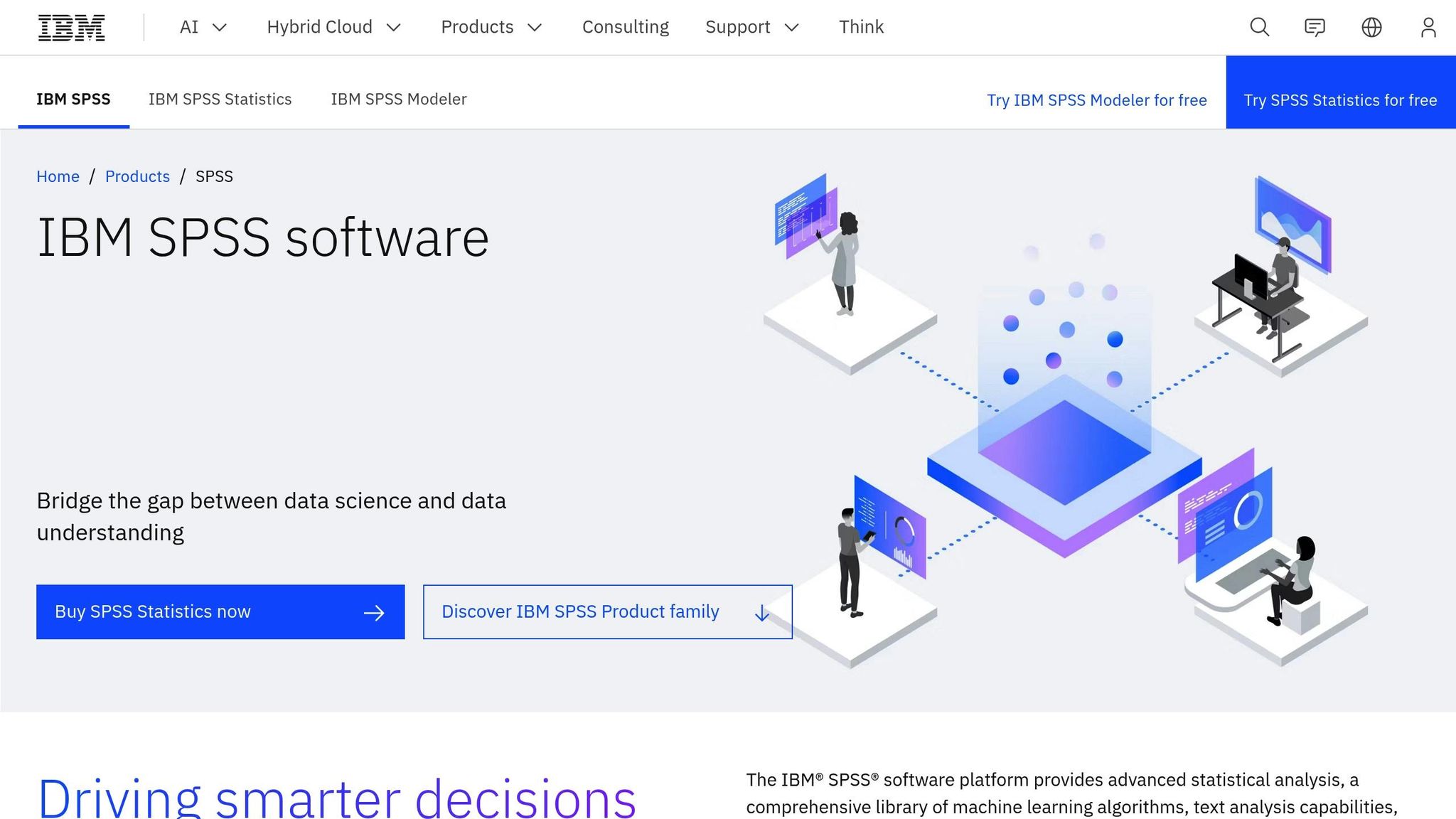
IBM SPSS is a powerful analytics platform that includes SPSS Statistics for detailed analysis and SPSS Modeler for visual data science. It supports a wide range of techniques, including regression, classification, forecasting (like ARIMA and exponential smoothing), decision trees, neural networks, and clustering methods.
Predictive Modeling Capabilities
One standout feature is the AI Output Assistant, powered by watsonx.ai, which translates complex statistical findings into plain language. This helps improve both model validation and understanding among stakeholders. Additionally, automated data preparation ensures that datasets are cleaned and optimized, enhancing the accuracy of predictive models.
"SPSS Statistics provides a comprehensive set of well-tested data management, statistical and graphical procedures in an easy-to-use package." - Jon K. Peck, IBM Champion
These capabilities make it easier to connect insights directly to business processes, offering a seamless experience from analysis to application with ChatGPT prompts for workflow optimization.
Integration Options with Business Systems
IBM SPSS integrates effortlessly with operational systems, allowing users to identify key factors influencing customer relationships - no coding skills required. The platform also supports extensions through Python, R, and open-source tools like Spark, TensorFlow, and Scikit-learn. Tools such as IBM Process Mining enable the platform to connect data from critical systems like ERP and CRM, providing a complete view of business processes. Furthermore, models can be deployed in any cloud environment, aligning with a ModelOps approach to streamline AI lifecycle management alongside existing DevOps workflows.
Scalability for Large Datasets
IBM SPSS handles enterprise-scale data efficiently by leveraging Apache Hadoop and Spark for distributed processing. However, its complexity might require more time and expertise for onboarding compared to simpler AI tools.
Pricing and Cost-Effectiveness
IBM SPSS offers flexible pricing to accommodate various organizational needs. Here's a breakdown:
- Base subscription: $105 per user/month
- Add-ons: $83.70 per user/month
- Perpetual licenses: Starting at $3,830 per user
- Annual subscriptions: $1,524 per user/year
The platform has received a 4.4/5 rating on Gartner Peer Insights (based on 27 reviews) and was recognized as a 2026 TrustRadius Buyer's Choice Award winner for Statistical Analysis.
2. RapidMiner
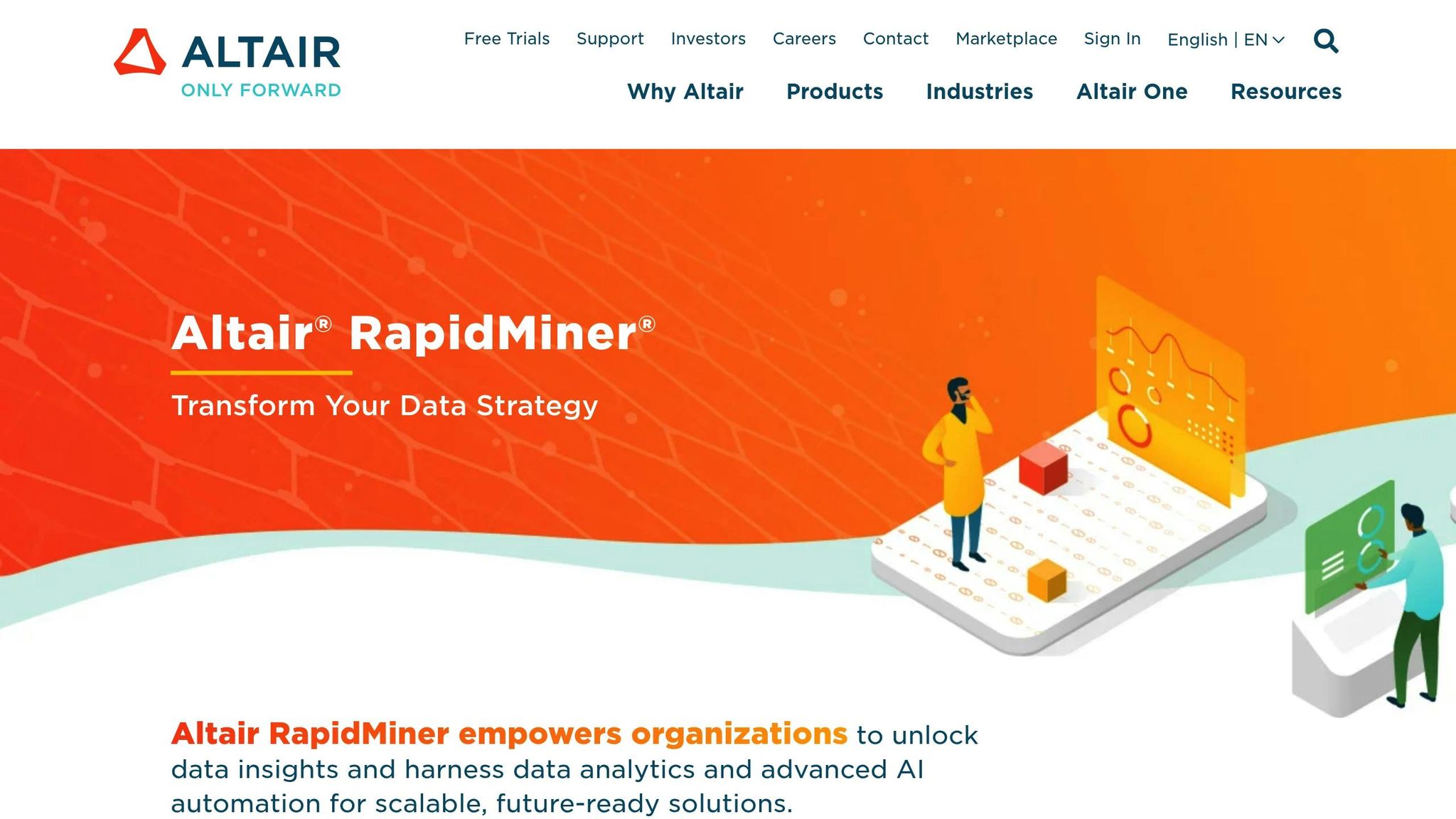
RapidMiner shines with its Auto Model feature, which simplifies the process of creating and comparing machine learning models. This functionality is designed for users who may not have extensive technical expertise, making it an accessible tool for a wide range of professionals. The platform's Design View uses an intuitive drag-and-drop interface, allowing users to visually build, test, and deploy predictive models.
Predictive Modeling Capabilities
RapidMiner strikes a balance between automation and manual control in predictive analytics. With Turbo Prep, users can clean and transform data using ChatGPT prompts for data analytics before diving into modeling. Meanwhile, AI agents handle repetitive tasks and monitor real-time processes, helping to streamline operations. One standout feature is the SAS language engine, which enables organizations to modernize and run their existing SAS code seamlessly. Additionally, the platform supports business process modeling, helping teams develop a shared understanding of workflows.
"Altair RapidMiner is a powerful data analytics and AI platform that connects siloed data, unlocks hidden insights, and accelerates innovation with advanced analytics and AI-driven automation."
– Altair RapidMiner
These tools integrate smoothly into broader business operations, improving overall system connectivity and efficiency.
Integration Options with Business Systems
Building on its robust modeling capabilities, RapidMiner offers seamless integration with existing workflows. It connects through REST and Python APIs and supports coding environments like JupyterLab, R, and Anaconda. The platform's Real-Time Scoring Agents allow external software to trigger instant predictions via HTTP, making it ideal for applications such as fraud detection or lead scoring. To ensure enterprise-level security, RapidMiner includes role-based access control through SAML v2.0, OAuth2, and LDAP. It also activates "dark data" by extracting insights from business reports and PDFs, enriching its predictive models.
Scalability for Large Datasets
RapidMiner is designed to handle enterprise-scale operations with ease. Its architecture supports massively parallel processing and incorporates a proprietary graph database to ensure high performance. The RapidMiner AI Hub further enhances scalability by enabling server-side execution, scheduling, and queuing for tasks on powerful hardware. This focus on scalability has earned the platform recognition as a Leader in the 2025 Gartner Magic Quadrant for Data Science and Machine Learning Platforms.
Pricing and Cost-Effectiveness
RapidMiner employs a flexible, units-based licensing model that simplifies adoption and encourages broad utilization. Users can access its range of solutions through Altair One, a cloud-based innovation platform. While specific pricing details may require direct consultation with the vendor, customers appreciate the platform's straightforward installation process and the extensive support resources available.
3. Alteryx
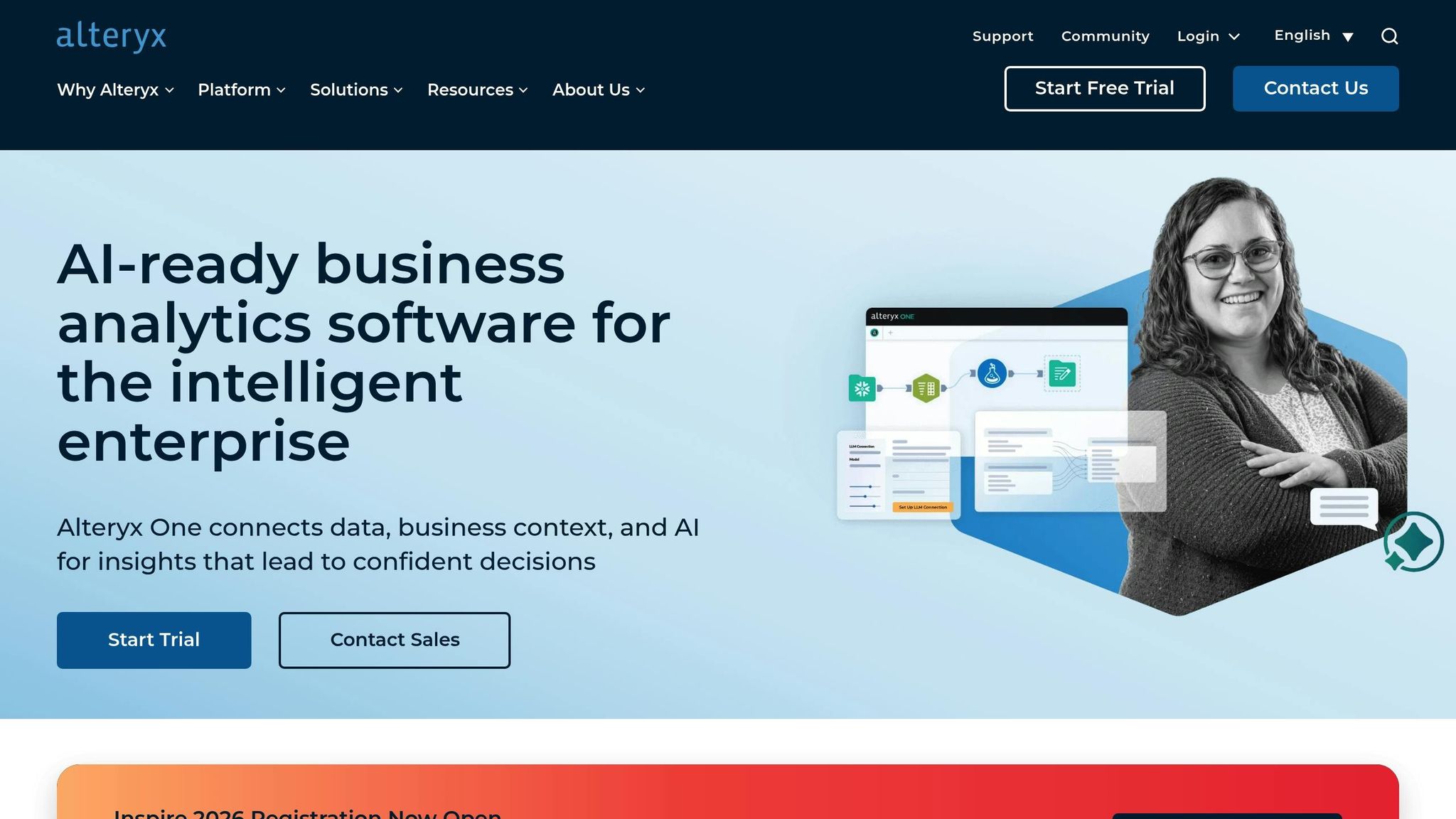
Alteryx offers a mix of Assisted Modeling and AutoML tools, making it accessible for both beginners and seasoned professionals. It supports a variety of advanced algorithms, such as XGBoost, Elastic Net, Random Forest, Neural Networks, and Support Vector Machines. The platform also handles unstructured data through tools like OCR, sentiment analysis, and named entity recognition (NER) [35, 38].
Predictive Modeling Capabilities
Alteryx simplifies the predictive modeling process, covering everything from data health checks to model deployment. A standout example is Bank of America, which leveraged Alteryx Designer Cloud to overhaul its regulatory testing process. The result? A staggering reduction in test development time - down from 1,700 hours to just 1 hour, a 99.94% improvement.
"A team member with no data science background built a model with Alteryx Machine Learning to classify product tax status." – Jacqui Van der Leij - Greyling, Global Head of Tax Technology, eBay
The Assisted Modeling feature walks users through steps like feature selection and choosing algorithms, while AutoML focuses on speed, enabling quick model creation for those with tight deadlines [34, 35]. Companies using these tools have reported saving up to 170 full-time equivalent (FTE) hours monthly by automating predictive analytics. These predictive tools integrate seamlessly with Alteryx's broader capabilities.
Integration Options with Business Systems
Alteryx One connects effortlessly with enterprise systems through more than 100 prebuilt connectors, including Snowflake, Databricks, AWS, Google Cloud, SAP, and Salesforce. Its in-database processing allows data to be analyzed where it resides, ensuring faster performance and enhanced security.
For example, Nielsen adopted Alteryx as its primary business intelligence solution, automating 2,000 manual processes and enabling self-service analytics across its teams. Additionally, Alteryx integrates with governance tools like Collibra and Atlan, supporting tasks like lineage tracking and compliance. Pre-built Playbooks are also available, offering guided workflows for common use cases such as customer churn analysis and demand forecasting.
Scalability for Large Datasets
Alteryx is designed to handle enterprise-scale analytics needs. Alteryx Server enables large-scale operations by efficiently scheduling and executing massive analytics tasks. A notable use case is McLaren Racing, which uses Alteryx Server to process 11.8 billion data points in real time, helping improve race performance and car design.
The Cloud Execution for Desktop feature adds flexibility, allowing users to build workflows locally and execute them in the cloud for additional computing power.
"What took my team almost a year to complete is now replicable and done in a matter of weeks." – Nikita Atkins, Data Science Global Leader, GHD
The platform also dramatically speeds up data preparation and blending, with users reporting up to a 100x improvement over manual methods and a 90% reduction in manual data prep time.
Pricing and Cost-Effectiveness
Alteryx offers flexible pricing options to accommodate different organizational needs. The Starter plan costs $250 per user per month, while the Professional and Enterprise editions are available with custom pricing. Many organizations have seen significant savings, with reports of cost reductions of up to 70% and an average annual savings of $2.2 million after adopting Alteryx.
A free trial is available for both Alteryx Designer and the Intelligence Suite, making it easier for businesses to explore the platform before committing [35, 36]. Alteryx's industry recognition is also worth noting - it has been named a Leader by Gartner, IDC, Forrester, and BARC, and was featured as a Leader in Snowflake’s 2026 Modern Marketing Data Stack report.
4. DataRobot
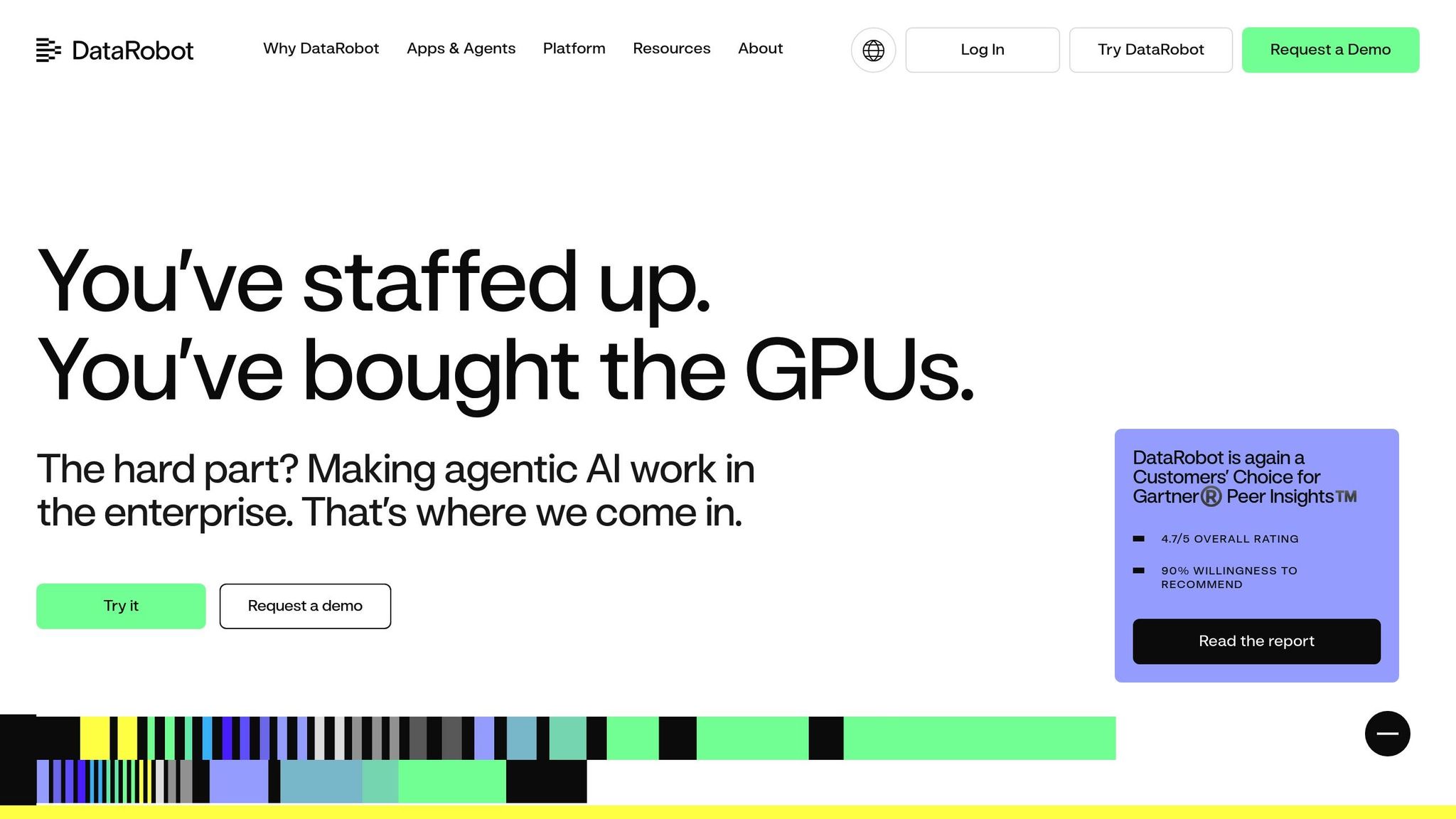
DataRobot simplifies the entire modeling workflow with its Automated Machine Learning (AutoML) approach. Supporting over 40 modeling techniques, it works seamlessly with various data types, such as text, images, geospatial coordinates, and time-aware data. Its Experimentation & Leaderboard feature tests hundreds of model variations simultaneously, ranking them by accuracy to identify the top-performing "champion" model.
Predictive Modeling Capabilities
DataRobot’s automated feature engineering takes the hassle out of identifying and ranking important features, helping to eliminate noise and irrelevant data. It shines in time series forecasting, delivering detailed predictions, "nowcasting" (filling in current unknown values), and cold-start forecasting for datasets with limited history. The platform also includes tools for unsupervised learning, making it useful for tasks like fraud detection, spotting manufacturing errors, or identifying security threats.
To make models more transparent, DataRobot provides visual tools like Feature Impact, Shapley values, and Individual Prediction Explanations. Freddie Mac leveraged these features to achieve significant efficiency improvements. Aravind Jagannathan, Chief Data Officer at Freddie Mac, highlighted: "AI/ML has been critical in terms of the efficiency we've achieved by allowing us to scale massively".
"What we find really valuable with DataRobot is the time to value. We can test new ideas and quickly determine the value before we scale across markets. DataRobot helps us deploy AI solutions to market in half the time we used to do it before." – Tom Thomas, Vice President of Data Strategy, Analytics & Business Intelligence, FordDirect
These capabilities make it easier than ever to integrate predictive models into existing workflows.
Integration Options with Business Systems
DataRobot integrates with business systems effortlessly, thanks to one-click connections and native support for platforms like Snowflake, Amazon S3, data warehouses, and data lakes. Certified for SAP, it also offers a powerful REST API and Python client. NetApp, for instance, used these integrations to unify data from Snowflake, SQL, and S3, speeding up their forecasting processes.
The platform allows models to be deployed with a single click via API endpoints, whether in serverless, dedicated, or external environments. Diego J. Bodas, Director of Advanced Analytics at MAPFRE ESPAÑA, shared: "For data scientists, it's only a push of a button to move models into production".
Beyond integration, DataRobot is designed to scale effortlessly for enterprise needs.
Scalability for Large Datasets
DataRobot supports enterprise-scale operations with flexible deployment options, including managed SaaS, virtual private cloud, and on-premise/hybrid setups. Its Console hub offers centralized governance, enabling organizations to monitor and manage hundreds of models while keeping an eye on service health and data drift. This ensures that insights remain reliable as data volumes and complexities grow.
The platform dynamically allocates computing resources to deploy models across edge, cloud, or on-premise infrastructures. Turo benefited from this flexibility, with Thibaut Joncquez, Director of Data Science, noting: "Nothing else out there is as integrated, easy-to-use, standardized, and all-in-one as DataRobot. DataRobot provided us with a structured framework to ensure everybody has the same standard".
Pricing and Cost-Effectiveness
DataRobot offers a "Try for free" option, making it accessible for initial exploration. However, its generative AI features are premium and require consultation for activation. The platform boasts a 4.7/5 rating on Gartner Peer Insights, with 90% of users recommending it. Organizations consistently report faster time-to-value, enabling them to test ideas quickly and deploy solutions in half the time compared to traditional methods.
sbb-itb-58f115e
5. H2O.ai
H2O.ai provides an advanced AutoML platform that simplifies feature engineering, model selection, and hyperparameter tuning. This allows users to create highly precise predictive models with minimal coding. The platform supports various data types, including tabular data, text, images, and audio, making it suitable for tasks like fraud detection and supply chain optimization.
Predictive Modeling Capabilities
The platform's Driverless AI speeds up feature engineering. For time-series forecasting, it tailors feature engineering to temporal data, enabling accurate predictions across product lines. The Explainable AI (XAI) toolkit ensures transparency with "White Box" models, Shapley reason codes, and bias detection - critical for industries with strict regulations.
"Every decision we make for our customers - and we make millions every day - we're making those decisions 100% better using H2O.ai" – Andrew McMullan, Former Chief Data & Analytics Officer, Commonwealth Bank of Australia.
The Commonwealth Bank of Australia leveraged H2O Enterprise AI to train 900 analysts, reducing fraud by 70%.
Integration Options with Business Systems
As predictive accuracy grows, the ability to integrate AI into existing workflows becomes crucial. H2O.ai supports this with APIs that connect to tools like Slack, Microsoft Teams, SharePoint, and Google Drive. Its Sparkling Water integration combines H2O's machine learning capabilities with Apache Spark's data processing, enabling smooth operation within existing infrastructures. For custom needs, H2O Wave allows developers to create AI-powered web applications using Python or R, bridging the gap between technical models and business users.
"Last year, we returned 2X ROI in free cash flow on every dollar we spent on generative AI. That's a one-year return" – Andy Markus, CDO, AT&T.
AT&T incorporated h2oGPTe to enhance call center operations. Similarly, the National Institutes of Health deployed h2oGPTe in a secure, air-gapped environment, enabling an AI assistant to provide 24/7 support for 8,000 federal employees by delivering fast, accurate policy and procurement answers. These integrations ensure that AI solutions are seamlessly embedded into day-to-day operations.
Scalability for Large Datasets
H2O.ai runs on Kubernetes clusters across AWS, Azure, GCP, and on-premise setups. With distributed processing and GPU acceleration, it can handle over 100 queries per minute on a single GPU deployment. These capabilities allow rapid iterations in predictive modeling. With a community of over 2 million data scientists, H2O.ai has demonstrated its ability to scale effectively.
The platform achieved 75% accuracy on the General AI Assistant (GAIA) test, outperforming other solutions at the time. It has also been recognized as a Leader in the Gartner Magic Quadrant for Data Science and Machine Learning Platforms and holds SOC2 Type 2 and HIPAA/HITECH compliance certifications.
Pricing and Cost-Effectiveness
H2O.ai offers a free open-source version (H2O-3) alongside its paid Enterprise version (h2oGPTe/H2O AI Cloud). Enterprise pricing starts at $250,000 per year per multi-GPU bundle on Azure Marketplace. The platform is compatible with commodity hardware and single 24GB GPUs, and deployment options include managed cloud, hybrid cloud, and on-premise installations.
6. Microsoft Azure Machine Learning
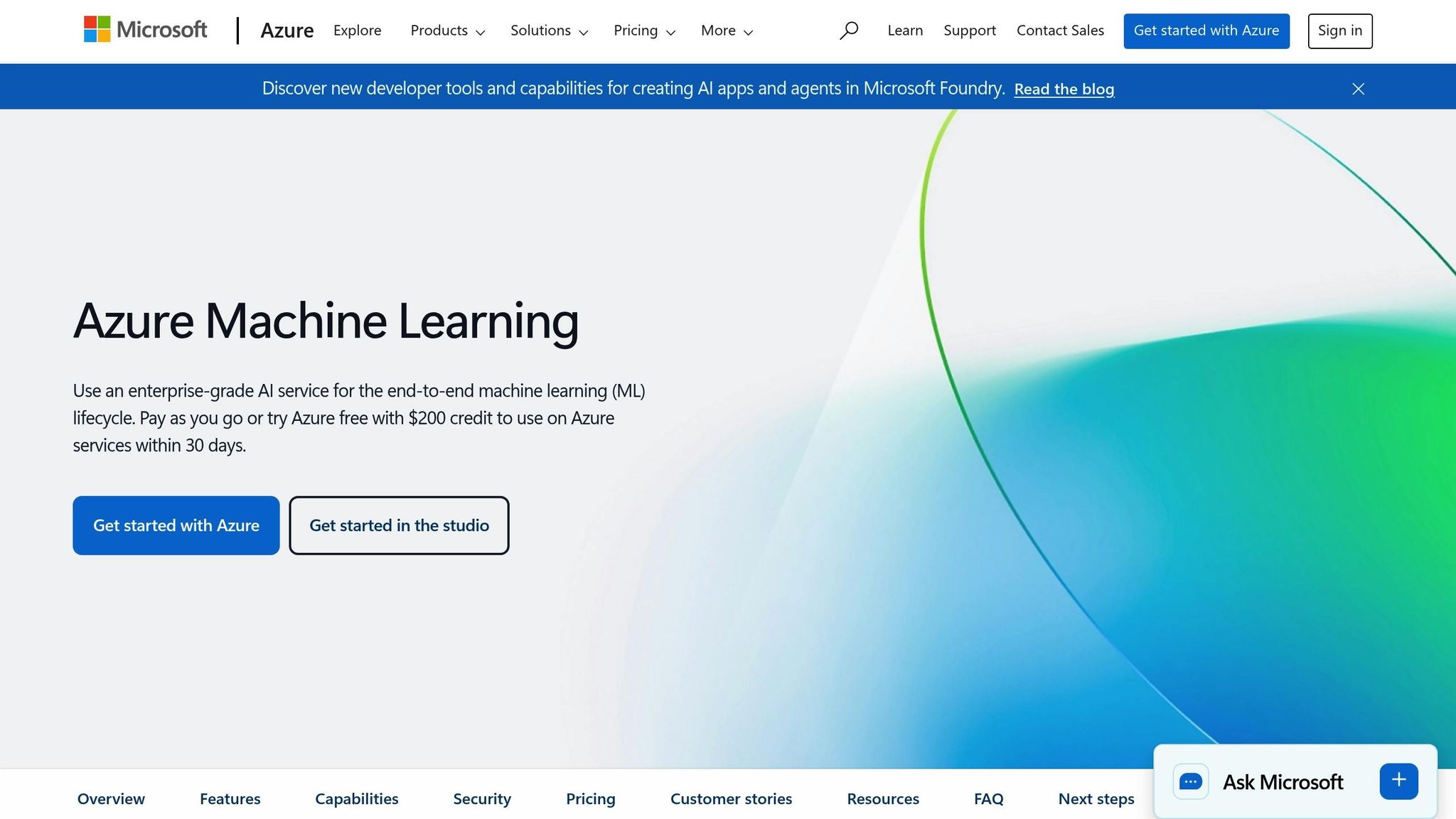
Microsoft Azure Machine Learning offers a comprehensive platform for managing the entire machine learning lifecycle, operating on a pay-as-you-go model. Users are charged solely for the compute resources they consume, making it a flexible option for various project needs. The platform also features Automated Machine Learning (AutoML), which simplifies model creation for tasks like classification, regression, and time-series forecasting through an intuitive no-code interface.
Predictive Modeling Capabilities
Azure Machine Learning stands out for its predictive modeling tools. Its AutoML feature streamlines the process by automating tasks like algorithm selection and feature engineering. The platform supports widely-used frameworks such as PyTorch, TensorFlow, scikit-learn, XGBoost, and LightGBM. Additionally, users gain access to over 11,000 foundation models, helping ensure model transparency and fairness.
Real-world use cases highlight its effectiveness. Carvana, for instance, developed an AI-driven conversation analysis engine using Azure, leading to a 45% reduction in customer calls per sale over two years and achieving complete visibility into customer interactions. Similarly, Marks & Spencer leverages the platform to process data for over 30 million customers, enabling large-scale personalized offers.
"Marks & Spencer has more than 30 million customers and large amounts of data that require systems that can scale to process it. Azure Machine Learning allows us to build machine learning solutions that can scale and give customers the right offers and better service overall." - Luis Arnedo Martinez, Machine Learning Platform Product Manager, Marks & Spencer
Integration Options with Business Systems
Azure Machine Learning integrates seamlessly with other tools and systems, enhancing its functionality. It works with Microsoft Fabric, Azure Synapse Analytics, Azure SQL Database, and Dynamics 365 Finance. Features like REST APIs, built-in Power BI integration, and prompt flow for generative AI simplify model deployment and real-time operations. Organizations like the Tampa Bay Buccaneers and Swift have successfully reduced data retrieval and training times by utilizing these integrations.
"Using Azure Machine Learning, we can train a model on multiple distributed datasets. Rather than bringing the data to a central point, we do the opposite. We send the model for training to the participants' local compute and datasets at the edge and fuse the training results in a foundation model." - Johan Bryssinck, AI/ML Product and Program Management Lead, Swift
Scalability for Large Datasets
Designed for large-scale projects, Azure Machine Learning employs advanced AI infrastructure, including InfiniBand and high-performance GPUs, to support multinode distributed training. It also features native Apache Spark interoperability and parallel model training for handling extensive datasets efficiently.
Several organizations have benefited from this scalability. KPMG International used Azure AI to support 95,000 auditors across 140 countries, ensuring compliance and governance in regulated industries. The ODP Corporation indexed over 10,000 documents using Azure AI, which led to a 20% boost in sales opportunities. Meanwhile, Assembly Software helped law firms save over 25 hours per case by cutting document drafting time from 40 hours to just minutes.
"It's been very valuable to us to work with Microsoft as we enhance and expand Pi because the reliability and scale of Azure AI infrastructure is among the best in the world." - Mustafa Suleyman, Cofounder and Chief Executive Officer, Inflection AI
Azure Machine Learning also ensures reliability with a 99.9% uptime Service Level Agreement and meets over 100 compliance certifications.
Pricing and Cost-Effectiveness
Azure Machine Learning offers a cost-efficient pricing structure. While the platform itself is free, users pay for CPU or GPU compute resources, along with any additional Azure services they use. It follows a pay-as-you-go model, includes a 30-day free trial, and provides tools for detailed cost analysis to help manage expenses.
7. Amazon SageMaker
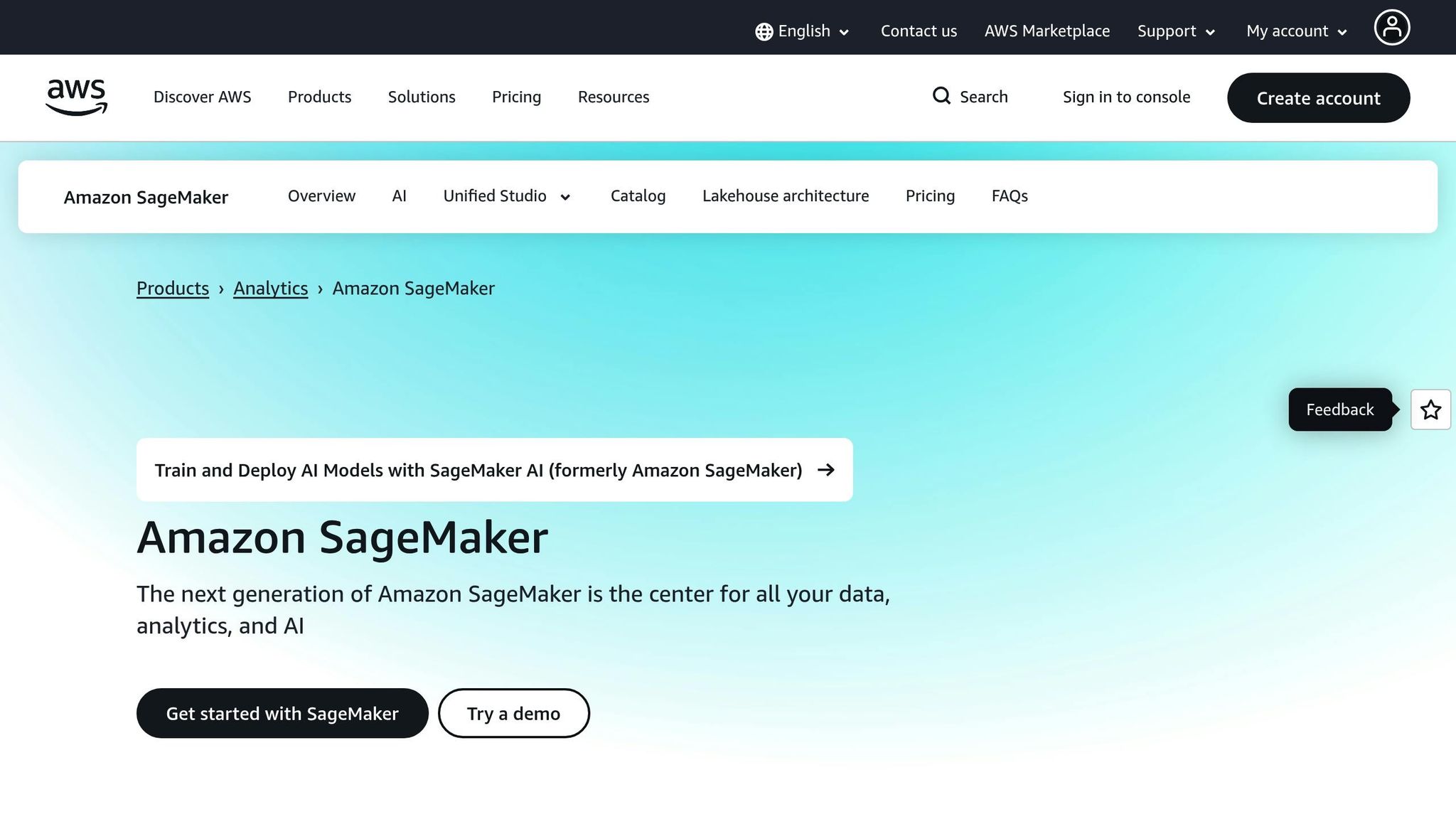
Amazon SageMaker stands out as a fully managed, pay-as-you-go platform designed to simplify predictive modeling, system integration, and scalability. With over 70 instance types, it offers flexible performance options and clear cost management. Plus, new AWS users get $200 in credits to explore its features.
Predictive Modeling Capabilities
SageMaker equips businesses with powerful tools to make predictions without needing coding expertise. For example, SageMaker Canvas allows analysts to predict outcomes like customer churn, inventory planning, and revenue optimization effortlessly. Meanwhile, SageMaker Autopilot automates the entire process of building, training, and fine-tuning machine learning models.
Another standout feature is SageMaker JumpStart, which offers access to over 1,000 pre-trained models from top AI providers. These models can be tailored with your own data for custom solutions.
The platform also includes SageMaker Pipelines, which automates end-to-end workflows and can handle tens of thousands of simultaneous processes. Companies like Janssen Pharmaceuticals have reported a 21% improvement in model accuracy using SageMaker. Additionally, its support for over 80 instance types ensures flexibility, while its optimization tools can cut deployment time from months to just hours.
Integration Options with Business Systems
SageMaker’s Unified Studio brings together key AWS data services into one cohesive environment. It supports zero-ETL integrations, enabling near real-time data syncing from operational databases and third-party apps like Salesforce and SAP. This functionality works seamlessly with a central lakehouse architecture and is compatible with Apache Iceberg, allowing direct data queries across Amazon S3 and Redshift without duplication.
To streamline the development-to-production process, SageMaker Projects offers templates for standardized environments, source control, and CI/CD pipelines. The platform also includes features like data lineage tracking and model monitoring to detect drift, helping maintain prediction accuracy over time.
Scalability for Large Datasets
For businesses handling large-scale data, SageMaker HyperPod manages clusters of thousands of AI accelerators, cutting model training time by up to 40% through automated cluster management. The platform supports various deployment options, including real-time, serverless, asynchronous, and batch inference, allowing users to choose what best fits their workload.
Its checkpointless training feature further reduces idle compute costs during hardware recovery. The serverless training and inference options make SageMaker an accessible choice for small businesses experimenting with predictive models and large enterprises running massive datasets.
Tool Comparison Table
Choosing the right tool for your business means diving into the details and aligning them with your specific needs. To make this process easier, here’s a breakdown of key factors to consider:
- Business size and technical expertise: What level of complexity can your team handle?
- Budget constraints and pricing models: Are you looking for a flat rate or pay-as-you-go?
- Predictive process improvement needs: How advanced are your analytics requirements?
- Integration and scalability: Does the tool fit seamlessly into your current tech stack, and can it grow with your business?
Let’s take a closer look at some tools and their standout features.
- IBM SPSS: With a 4.4/5 rating, this tool is perfect for teams focused on statistical control and in-depth analytics. It’s a strong choice for data scientists looking for traditional yet powerful analytics capabilities.
- Alteryx: Designed for non-coders, Alteryx features a drag-and-drop interface and pre-built algorithms, making it user-friendly. At $250 per user per month, it’s a great fit for project-based needs.
- RapidMiner: Known for its AutoML capabilities, RapidMiner offers a visual interface that simplifies machine learning workflows. It’s ideal for teams that prioritize intuitive design and enterprise-level solutions.
- H2O.ai: This platform shines with its automated feature engineering and model selection, catering to mid-sized organizations looking to streamline their machine learning processes.
- DataRobot: With a 4.7/5 rating and a 90% recommendation rate, DataRobot is a top choice for mid-to-large enterprises. Its unified AI platform speeds up deployment and supports multi-cloud environments.
- Microsoft Azure Machine Learning: Operating on a pay-as-you-go model, Azure ML is tailored for businesses that thrive in a cloud-native environment and benefit from integration with Microsoft’s ecosystem.
- Amazon SageMaker: Another pay-as-you-go option, SageMaker is built for scalable cloud deployments, offering flexibility and robust infrastructure for growing businesses.
Here’s a summary table to help you compare these tools at a glance:
| Tool | Starting Price (USD) | Best For | Key Strength | Gartner Rating |
|---|---|---|---|---|
| IBM SPSS | ~$499/month | Small teams, statistical control | Deep analytics for data scientists | 4.4/5 |
| RapidMiner | Enterprise pricing (custom quote) | Visual modeling, AutoML | Intuitive drag-and-drop interface with pre-built algorithms | N/A |
| Alteryx | ~$250/user/month | Non-coders, project-based needs | Visual IDE with numerous pre-built algorithms | 4.4/5 |
| DataRobot | Enterprise pricing (custom quote) | Mid-to-large enterprises | Unified AI platform that accelerates deployment | 4.7/5 |
| H2O.ai | Enterprise pricing (custom quote) | Automated ML workflows | Automated feature engineering and model selection | N/A |
| Azure Machine Learning | Pay-as-you-go | Cloud-native businesses | Integration within the Microsoft ecosystem | N/A |
| Amazon SageMaker | Pay-as-you-go | Scalable cloud deployments | Flexible, scalable cloud infrastructure | N/A |
This table and the insights above can serve as a guide to finding the tool that best aligns with your business goals and technical requirements for business.
Conclusion
Choosing the right AI tool comes down to what aligns best with your organization's needs. Each option brings something unique to the table: IBM SPSS excels in statistical precision, RapidMiner and Alteryx make AI more accessible with their intuitive interfaces, DataRobot speeds up processes with AutoML, H2O.ai offers the flexibility of open-source tools, and Microsoft Azure Machine Learning and Amazon SageMaker provide scalable, cloud-based solutions.
The real value of predictive AI lies in how it integrates into your day-to-day operations. As Domo puts it:
"AI only delivers when embedded in real business workflows. Models and insights must translate into automated actions, approvals, or notifications to drive meaningful impact".
This focus on integration is already transforming businesses worldwide, with 78% of companies globally using AI in at least one operational area by 2025.
To make the most of AI, start by identifying what matters most to your organization. If you're looking for quick and easy deployment, platforms like Alteryx or RapidMiner are great choices. For more complex, deeply embedded solutions, Microsoft Azure Machine Learning or Amazon SageMaker might be the way to go. And for industries with strict regulations, IBM SPSS offers the transparency and governance you need.
Take advantage of free trials or pay-as-you-go options to test how these tools can address challenges such as predicting equipment failures, improving demand forecasting, or reducing customer churn. Remember, the quality of your data is more critical than the sophistication of the tools you use. By aligning your strategy with the right tools, you can embed AI into your workflows and achieve measurable improvements that truly move the needle.
FAQs
How can I choose the right AI tool for improving my business processes?
To find the right AI tool for your business, start by pinpointing your goals. Do you need to automate tasks, refine predictive analytics, or simplify workflows? Defining what you want to achieve will make it easier to focus your search.
Once you have clear objectives, dive into the features of different tools. Look for functionalities like machine learning, natural language processing, and integration options to ensure the tool fits your operational needs. Don’t forget to factor in your budget - check if the tool offers flexible pricing that can scale as your business grows. Some tools cater to small startups, while others are built for larger companies with more complex demands.
Lastly, check out case studies and reviews to see how these tools perform in practice. Platforms like God of Prompt offer helpful insights, guides, and examples that can guide your decision-making process. By aligning your goals, necessary features, and scalability, you’ll be in a strong position to choose an AI tool that suits your business perfectly.
What’s the difference between pay-as-you-go and subscription pricing?
Pay-as-you-go pricing means you’re charged based on what you actually use. This approach works well for businesses with fluctuating demands, giving them the flexibility to scale costs up or down as needed. On the other hand, subscription pricing involves a set fee paid at regular intervals, which provides predictable expenses and often includes added perks or bundled features. Deciding between these models comes down to how your business operates and what fits your financial strategy best.
Can AI tools work with my existing systems like CRM or ERP?
AI tools today are built to work effortlessly with existing business systems like CRM and ERP platforms. Take Salesforce Einstein, for instance - it boosts CRM capabilities by delivering predictive insights that help businesses make smarter decisions. Similarly, other AI platforms specialize in automating workflows across industries like banking, healthcare, and retail. These integrations allow companies to optimize their processes and enhance efficiency without needing to completely replace their current systems.
Related Blog Posts

Loved by Business Owners


Based on 1K reviews
Get smarter on AI every week.
Ready to transform your business?