Managing document versions manually is slow, error-prone, and inefficient. AI-powered systems solve these issues by automating updates, reducing errors, and optimizing workflows. Here’s why businesses are moving to AI for document version control:
- Manual methods rely on spreadsheets, email chains, and inconsistent naming (e.g., "v1_final_final"), leading to delays, lost edits, and compliance risks.
- AI systems automate version tracking, flag errors, and enable real-time collaboration, saving time and reducing costs.
- Companies using AI report a 90% drop in template errors, faster drafting speeds (up to 10x), and fewer compliance issues. You can achieve similar results by using productivity mega-prompts to streamline your document creation process.
Key benefits of AI systems:
- Automatically update and track versions with timestamps.
- Highlight meaningful changes while skipping irrelevant edits.
- Integrate with tools like Microsoft Word, Slack, and cloud storage.
- Improve compliance by maintaining detailed audit trails.
Quick Comparison:
| Factor | Manual Method | AI-Powered System |
|---|---|---|
| Speed | Time-consuming, manual updates | Real-time, automated updates |
| Accuracy | High risk of errors | 90% fewer template errors |
| Scalability | Struggles with high volume | Easily handles large repositories |
| Cost Efficiency | Labor-intensive, higher costs | Saves time and reduces expenses |
Switching to AI simplifies document management, improves efficiency, and ensures compliance – making it a clear choice for modern businesses.
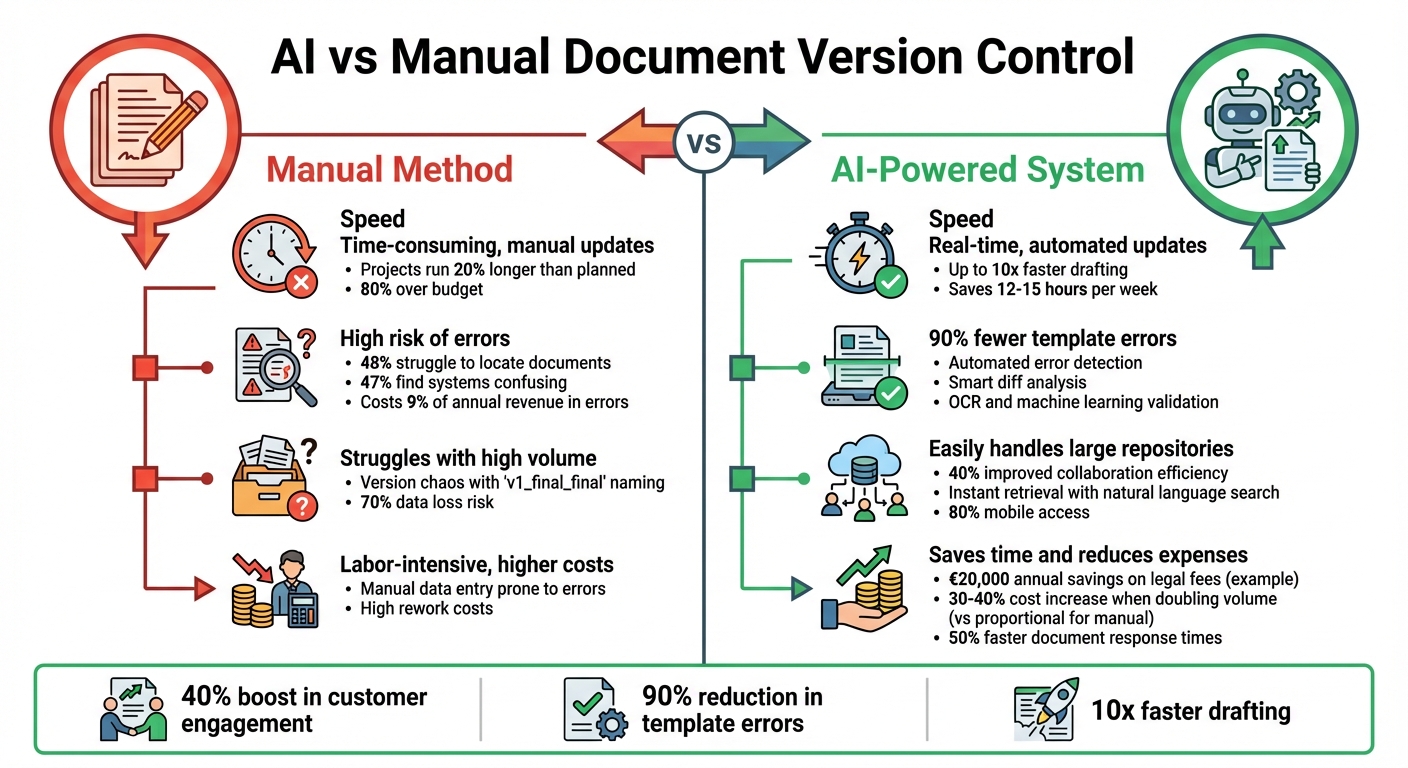
AI vs Manual Document Version Control: Speed, Accuracy, and Cost Comparison
Starting with AI in Microsoft 365 for Document Management (Machine Learning | Generative AI | Azure)

Manual Document Version Control: Problems and Drawbacks
Managing document versions manually becomes increasingly challenging as teams grow and the volume of documents multiplies. This approach not only wastes valuable time but also increases the risk of compliance failures. Below, we break down the key issues with manual version control.
Slow and Time-Intensive
Manual processes are notorious for causing delays, especially as teams expand. Employees often spend hours sifting through emails, folders, or spreadsheets just to find the latest draft of a document . It’s common for teams to use filenames with tags like "v1", "v2", "draft", or "final", which leads to "version chaos" when multiple versions circulate at the same time .
This inefficiency grows with the size of the organization. Without a centralized system, team members may inadvertently work on outdated documents, creating redundant tasks and duplicated efforts. Miscommunication between stakeholders further delays project timelines and client deliverables . Large projects relying on these outdated methods often suffer, running 80% over budget and taking 20% longer than planned.
Frequent Errors
Manual systems lack the safeguards needed to prevent common mistakes. Accidental overwriting is a frequent issue, particularly when multiple contributors edit a document simultaneously without a structured check-in/check-out process . Nearly half of professionals – 48% – report struggling to locate documents quickly, while 47% find their current systems confusing or inefficient.
The financial consequences of such errors are steep. Poor contract management, often caused by version confusion and uncontrolled edits, costs companies approximately 9% of their annual revenue. Additionally, manual data entry for tagging and classification is prone to human error, making it difficult to maintain the audit trails required for regulatory compliance .
Difficulty Scaling
As organizations grow, manual methods become increasingly impractical. Managing a larger repository of documents manually creates significant bottlenecks . Naming conventions like "Final" or "Final_v2" quickly lose their effectiveness when the number of versions grows.
Without automated tools to manage and purge outdated files, finding the authoritative version becomes a daunting task, while storage costs continue to climb. The risk of using outdated information or overwriting a colleague’s work increases exponentially with document volume . Transitioning to centralized systems, however, has been shown to reduce data loss by 70% and improve collaboration efficiency by 40%.
These challenges highlight the growing need for advanced solutions like AI-powered document version control to streamline processes and eliminate inefficiencies.
AI-Powered Document Version Control: Key Benefits
AI-driven systems tackle the challenges of manual version control by automating repetitive tasks, minimizing errors, and integrating seamlessly with tools teams already rely on. This turns document management into a smoother, more proactive process. These improvements unlock several benefits, starting with automatic updates and real-time tracking.
Automatic Updates and Live Tracking
AI keeps a close eye on changes, automatically generating new versions complete with timestamps – no manual effort required. Each edit triggers an update, eliminating the chaos of confusing filenames. This automation directly addresses the delays and errors that often plague manual systems.
For example, AnthroTek‘s adoption of Genie AI slashed drafting time by 90%, saving 12–15 hours per week while significantly reducing template errors.
Modern AI systems also feature smart diff analysis, which highlights meaningful edits and skips over minor formatting tweaks. This makes it easy for teams to track document evolution without sifting through irrelevant changes. Some platforms even incorporate blockchain technology, creating tamper-proof records where each version is cryptographically linked to the previous one, ensuring complete data integrity.
But the benefits don’t stop at efficiency. AI also dramatically improves accuracy.
Better Accuracy and Error Prevention
AI has a knack for catching inconsistencies and missing details that humans might overlook. Using OCR and machine learning, it can extract key fields like invoice numbers or dates, cutting down on manual errors. It also interprets document structures to maintain original numbering and layouts.
The results speak for themselves: AI solutions can reduce template errors by 90% and draft documents up to 10 times faster than traditional methods. These systems guide users through essential fields and terms, flagging incomplete sections to ensure compliance. By catching mistakes early, AI not only saves time but also strengthens audit trails and compliance efforts. Side-by-side comparisons clearly show what’s been added or removed, helping stakeholders avoid missing subtle changes in lengthy documents.
"AI in document version control is not just advantageous – it’s essential for modern records management." – Toshendra Sharma, Founder, RecordsKeeper.AI
The accuracy improvements are complemented by seamless integration with existing business tools.
Works with Existing Tools
AI-powered version control systems are designed to integrate effortlessly with widely used platforms like CRMs, ERPs, project management software, and cloud storage. This eliminates data silos and creates unified workflows. APIs link these systems with tools like Microsoft Word, Slack, CRMs, and eSignature platforms, ensuring a single, reliable source of truth.
A significant portion of enterprise data is unstructured, but AI makes it both searchable and trackable for versioning purposes. With natural language processing, users can perform context-aware searches, finding documents using everyday language. Companies using these tools have reported a 40% boost in customer engagement and have cut document response times by up to 50%.
These systems also support mobile access, which is used by 80% of employees. Combined with real-time anomaly detection, they keep workflows secure and functional, even on the go.
AI vs Manual: Side-by-Side Comparison
When comparing manual document control to AI-powered systems, the differences are striking. Manual methods depend heavily on human effort for updates, which often leads to inconsistent version naming and scattered communication channels. In contrast, AI-powered systems automatically track changes, create new versions with timestamps, and maintain audit trails.
Professionals using manual systems often face challenges like slow document retrieval and confusing filing systems. On the other hand, AI platforms offer instant access to documents through natural language search, which can interpret user intent and context.
Manual version control also brings significant risks, such as lost redlines, accidental overwrites, and fragmented audit trails scattered across emails and local folders. These inefficiencies in contract management can cost businesses up to 9% of their annual revenue. AI-powered tools mitigate these issues by reducing template errors by 90% and providing centralized, real-time audit trails. The table below highlights the key differences between the two approaches.
Comparison Table
| Factor | Manual Method | AI-Powered System |
|---|---|---|
| Speed | Time-consuming; relies on manual search and processing | Real-time updates; drafting up to 10x faster |
| Accuracy | High risk of lost redlines and accidental overwrites | 90% reduction in template errors |
| Scalability | Difficult to handle large volumes; 48% struggle to locate files | Easily manages high volumes with instant retrieval |
| Cost-Efficiency | Labor-intensive; higher rework costs due to manual updates | Saves 12–15 hours per week and reduces overall costs |
AI-powered systems consistently outperform manual methods across all these factors. Francesco Sodini, CFO at AnthroTek, shared his experience:
"Now that I’m using Genie for drafting documents, I’m saving 12-15 hours of my time a week and I’m saving €20,000 a year on legal fees".
These time and cost savings are nearly impossible to achieve with manual methods, where every update requires human intervention. The efficiency, accuracy, and scalability of AI-driven solutions make them an increasingly popular choice for organizations looking to improve their document management processes.
sbb-itb-58f115e
How Businesses Use AI Document Version Control
AI-powered document version control is reshaping workflows across various industries, offering speed and precision that manual systems simply can’t match. By automating what was once a tedious process, businesses are saving time and reducing errors.
Construction Projects
In construction, where documents like blueprints and specifications are constantly updated, staying on top of the latest version is critical. AI systems integrate seamlessly with tools like AutoCAD, ensuring that teams always have access to the most current CAD drawings. Forget the chaos of manually renaming files or accidentally working from an outdated plan – AI takes care of it. These systems can even flag major updates in complex documents, such as revised blueprints or specifications. For project managers, this means less time hunting down files and more time focusing on keeping the project on track.
Marketing and Content Creation
Marketing teams deal with a flood of content across multiple campaigns, and managing it all manually can be overwhelming. AI steps in to simplify the process by automating tasks like tagging and organizing digital assets. With semantic search capabilities, team members can find what they need by describing it, rather than relying on exact file names. The efficiency gains are striking – AI systems can classify and organize a file in just 2.4 seconds, compared to minutes with manual methods. This speed not only accelerates campaign rollouts but also minimizes the risk of errors, keeping everything running smoothly.
When AI Makes More Sense Than Manual Methods
AI-powered systems bring efficiency and precision to document management, but their value becomes even clearer under certain conditions. For businesses juggling large volumes of documents or dealing with strict regulatory requirements, AI can be a game-changer. Knowing when to make the switch can save time, cut costs, and eliminate administrative headaches.
Large Document Volumes
If your business regularly handles hundreds or even thousands of documents – especially those requiring frequent updates – manual tracking quickly becomes overwhelming. AI systems, on the other hand, scale far more efficiently. For instance, doubling your document volume with AI increases costs by just 30–40% – a stark contrast to manual systems, which often demand proportional increases in staffing. For companies managing vast libraries of contracts, invoices, or forms, AI simplifies the process and ensures accuracy across diverse document types.
Compliance Requirements
Industries like healthcare, finance, and legal services operate under strict rules for documentation. AI excels here by automatically generating detailed audit trails, a critical feature for meeting compliance standards.
"AI in document version control is not just advantageous – it’s essential for modern records management." – Toshendra Sharma, Founder, RecordsKeeper.AI
Manual methods often rely on outdated naming conventions like "v1_final_final", which can lead to accidental overwrites or the use of incorrect versions. In contrast, advanced AI platforms can even integrate blockchain technology to enhance document security and integrity. For businesses adhering to standards such as ISO, HIPAA, GDPR, or SOX, AI tools enforce access controls and ensure consistent formatting automatically. For organizations with limited staff or resources, these features are especially valuable.
Limited Resources
For small businesses or lean teams, AI offers efficiency gains that are hard to ignore. By automating tasks like version tracking and duplicate removal, AI reduces the need for additional staff. It also streamlines document retrieval, cutting down on time spent searching for files. This allows teams to concentrate on their primary goals, while the lower infrastructure costs of AI make it an appealing alternative to hiring more personnel.
Conclusion
From the analysis above, it’s clear that AI-driven systems outshine manual document version control in almost every way. The decision boils down to three key factors: speed, accuracy, and scalability. Manual methods depend heavily on human input for updates, searches, and compliance checks. This approach is not only slow but also prone to errors and struggles to keep up as demands grow. In contrast, AI automates these processes, scaling effortlessly without requiring additional resources. You can even build custom versions of ChatGPT tailored to your specific document workflows.
The drawbacks of manual systems are significant. Nearly half of professionals (48%) report issues retrieving files, and errors in document management can cost businesses up to 9% of their annual revenue. AI addresses these challenges by automating version tracking, predicting and correcting naming inconsistencies, and using semantic search to find exactly what’s needed. For organizations managing large volumes of documents or navigating strict compliance requirements, AI offers tools like automated audit trails, real-time policy enforcement, and proactive conflict resolution – capabilities that manual systems simply can’t match.
If your team is losing hours searching for the correct file version, resolving conflicting edits, or worrying about compliance risks, it’s time to make the switch. AI-powered tools deliver efficiency, reduce errors, and scale effortlessly, allowing businesses to focus on their core priorities. By adopting AI for document control, you can streamline operations, minimize risks, and meet compliance requirements with ease.
FAQs
How does AI make document version control more accurate?
AI improves document version control by automating tasks such as tracking changes, updating files, and managing revisions. This minimizes human error and ensures the latest version of a document is always available. With the ability to recognize patterns and automate version classification, AI systems can achieve accuracy rates as high as 99%.
Beyond accuracy, AI enforces consistent formatting and versioning standards. This streamlines collaboration, helping teams avoid errors often seen in manual workflows. As a result, everyone can confidently work with the most reliable and up-to-date version of a document.
What are the main advantages of using AI for document version control?
Integrating AI into document version control systems brings enhanced efficiency and precision to the table. Instead of relying on manual processes, AI takes over tasks like version tracking, document comparison, and classification. This not only cuts down on tedious manual work but also significantly reduces the chances of human error. The result? Faster access to files, smoother document management, and systems that can scale effortlessly as organizational demands grow.
Another major advantage is AI’s ability to spot even the smallest differences between document versions. This ensures accuracy, supports compliance efforts, and minimizes mistakes. Plus, by automating repetitive tasks, AI frees up teams to focus on more strategic work, boosting productivity and creating more streamlined workflows.
When is the right time for a business to switch to AI for document version control?
When manual methods for document version control start causing inefficiencies, frequent errors, or scalability issues, it might be time to consider AI solutions. AI-powered systems are great at automating repetitive tasks, minimizing mistakes, and ensuring that everyone is always working with the most up-to-date version of a document. This makes them particularly useful for managing complex workflows like contract management, version history tracking, and compliance requirements.
For organizations that handle large volumes of documents daily – think contracts, invoices, or detailed reports – or face challenges in tracking changes and avoiding overwrites, AI can be a game-changer. By automating processes like data extraction and interpreting content, AI simplifies workflows, saves time, and helps eliminate operational slowdowns.
If your current approach is slowing down collaboration, compromising accuracy, or reducing efficiency, it’s worth exploring how AI-powered document management tools can transform the way your team works.