
Top 7 AI Tools for Pricing Optimization




Pricing optimization can significantly boost profits, with even a 1% price improvement increasing operating profit by 8% to 11%. AI tools are transforming how businesses approach pricing, offering real-time data analysis, demand forecasting, and automated adjustments. Here's a quick look at seven leading AI pricing tools:
- Pricefx: Cloud-based platform with real-time pricing insights and customizable models. Annual cost: $50,000–$200,000+.
- PROS Pricing: Focuses on dynamic pricing for B2B and airlines, leveraging advanced AI models. Annual cost: $100,000–$300,000+.
- BlackCurve: Ideal for e-commerce, offering dynamic pricing and competitor analysis. Custom pricing available.
- Omnia Retail: Retail-focused tool with natural language query capabilities. SMB plans start at $430/month.
- Prisync: Budget-friendly for small e-commerce, tracking competitor prices. Plans range from $99–$399/month.
- Competera: Enterprise-level AI for demand-based pricing and revenue modeling. Custom quotes provided.
- Zilliant: Tailored for B2B, integrates deeply with ERP/CRM systems for precise pricing logic. Custom quotes available.
These tools cater to businesses of all sizes, from small e-commerce stores to large enterprises, enabling smarter, data-driven pricing strategies.
Quick Comparison
| Tool | Pricing Structure | Best For | Key Feature |
|---|---|---|---|
| Pricefx | $50,000–$200,000+/year | Large enterprises | Real-time pricing insights |
| PROS | $100,000–$300,000+/year | B2B and airlines | Advanced AI for dynamic pricing |
| BlackCurve | Custom enterprise quotes | E-commerce | Dynamic pricing and competitor tracking |
| Omnia | $430+/month | Retail | Natural language queries |
| Prisync | $99–$399/month | Small e-commerce | Competitor price tracking |
| Competera | Custom enterprise quotes | Enterprise retailers | Demand-based pricing |
| Zilliant | Custom enterprise quotes | B2B manufacturers/distributors | ERP/CRM integration |
These tools can help businesses maximize profits, reduce manual effort, and stay competitive in dynamic markets.

AI Pricing Tools Comparison: Features, Pricing & Best Use Cases
Best AI Retail Optimization Tools & AI Dynamic Pricing
sbb-itb-58f115e
1. Pricefx
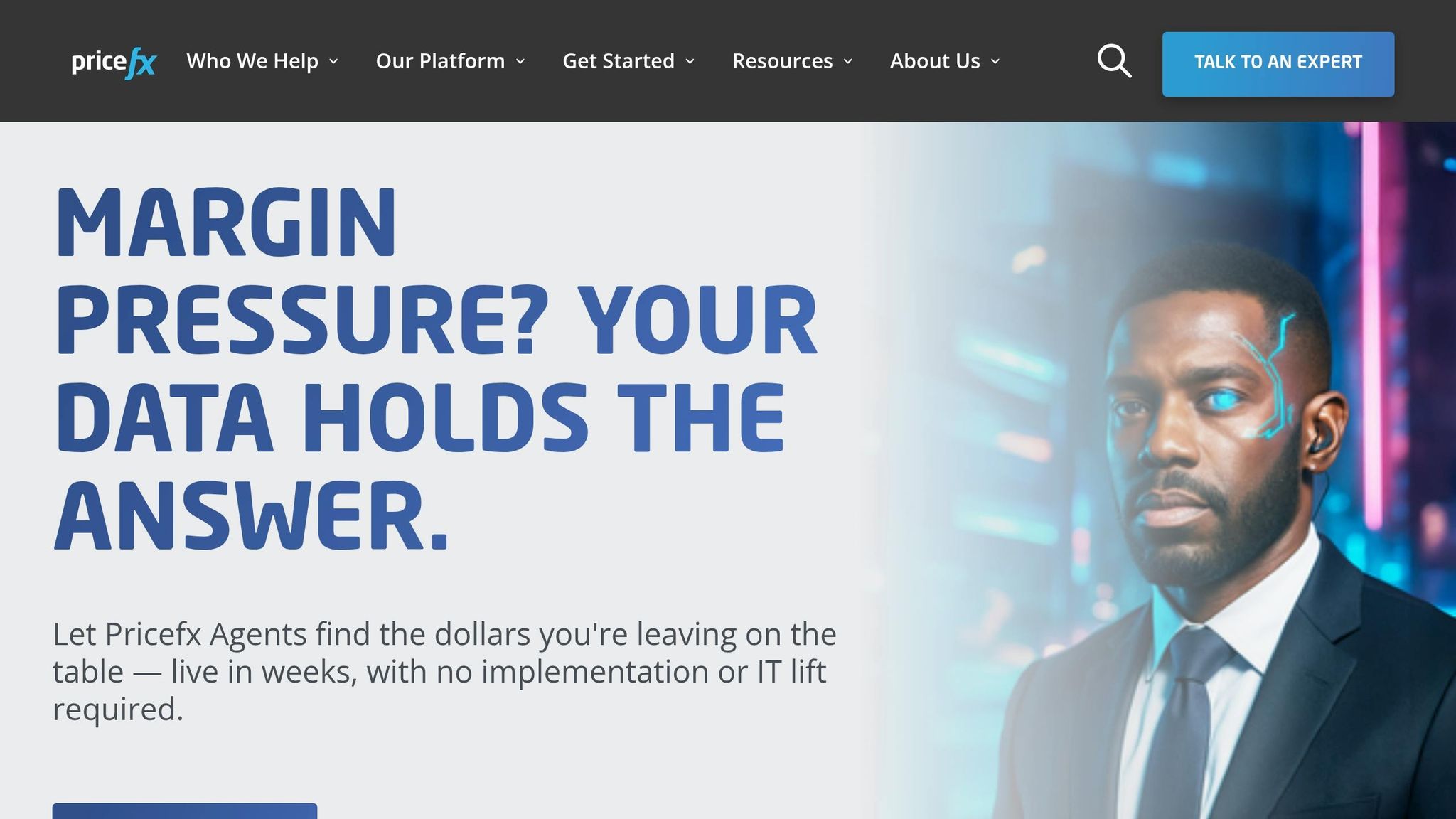
Pricefx stands out among AI-driven pricing tools with its focus on transparency and real-time adaptability. It operates as a cloud-based enterprise platform for pricing intelligence. At the heart of Pricefx is PricingAI, an advanced optimization engine, paired with Copilot, an AI assistant designed to help pricing teams translate insights into actionable strategies. Unlike opaque "black-box" systems, Pricefx offers a "white-box" approach, enabling users to view and customize pricing models to suit their needs.
AI-Powered Pricing Optimization Capabilities
Pricefx leverages continuous AI agents to monitor data, identify margin leaks, and uncover growth opportunities. During the quoting process, it provides guidance to optimize deal value. Its CPQ (Configure, Price, Quote) module includes AI-driven product recommendations, enhancing cross-selling and up-selling efforts. For example, a global manufacturer using Pricefx reported a 17% improvement in margins, while the average customer experiences a 8.4% margin increase and a 15x ROI within the first year.
Integration with ERP, CRM, or E-Commerce Platforms
The platform's modular, cloud-native architecture, managed through its Platform Manager, streamlines data integration and governance across enterprise systems. Pre-built connectors and "Accelerators" allow for quick deployment, avoiding lengthy IT processes.
- Elektro-Materials, a Swiss electrical distributor, transitioned from manual spreadsheets to Pricefx’s automated system, cutting price update times from three days to just one.
- Ascend Performance Materials achieved full pricing transparency across its global operations within seven months.
These integrations enable businesses to quickly adapt to market dynamics, a key requirement in modern pricing strategies. For online retailers, using AI prompts for e-commerce can further refine these strategies.
Real-Time Market Data and Competitor Analysis
The Price Setting module centralizes the development, simulation, and deployment of market pricing strategies, ensuring businesses can adjust quickly to evolving conditions.
"We like to work with Pricefx because it gives us the possibility to react quickly and flexibly to the market changes" – Andreas Schwarz, Head of Marketing at ProfiParts
Additionally, companies like FlintGroup have cut their quote creation and approval times in half, resulting in a higher deal win rate after implementing Pricefx's quoting solutions.
Pricing Models
Pricefx's enterprise pricing model ranges from $50,000 to over $200,000 annually. Over a five-year period, the platform typically costs less than 2% of the profit it generates for customers. On average, customers report profit gains of €520 million during that timeframe.
User feedback reflects a 4.4/5 rating on G2 (111 reviews) and 4.1/5 on Capterra (10 reviews). While many praise its comprehensive pricing management and flexible configuration, some users highlight the complexity of implementation and the platform's high entry cost.
2. PROS Pricing
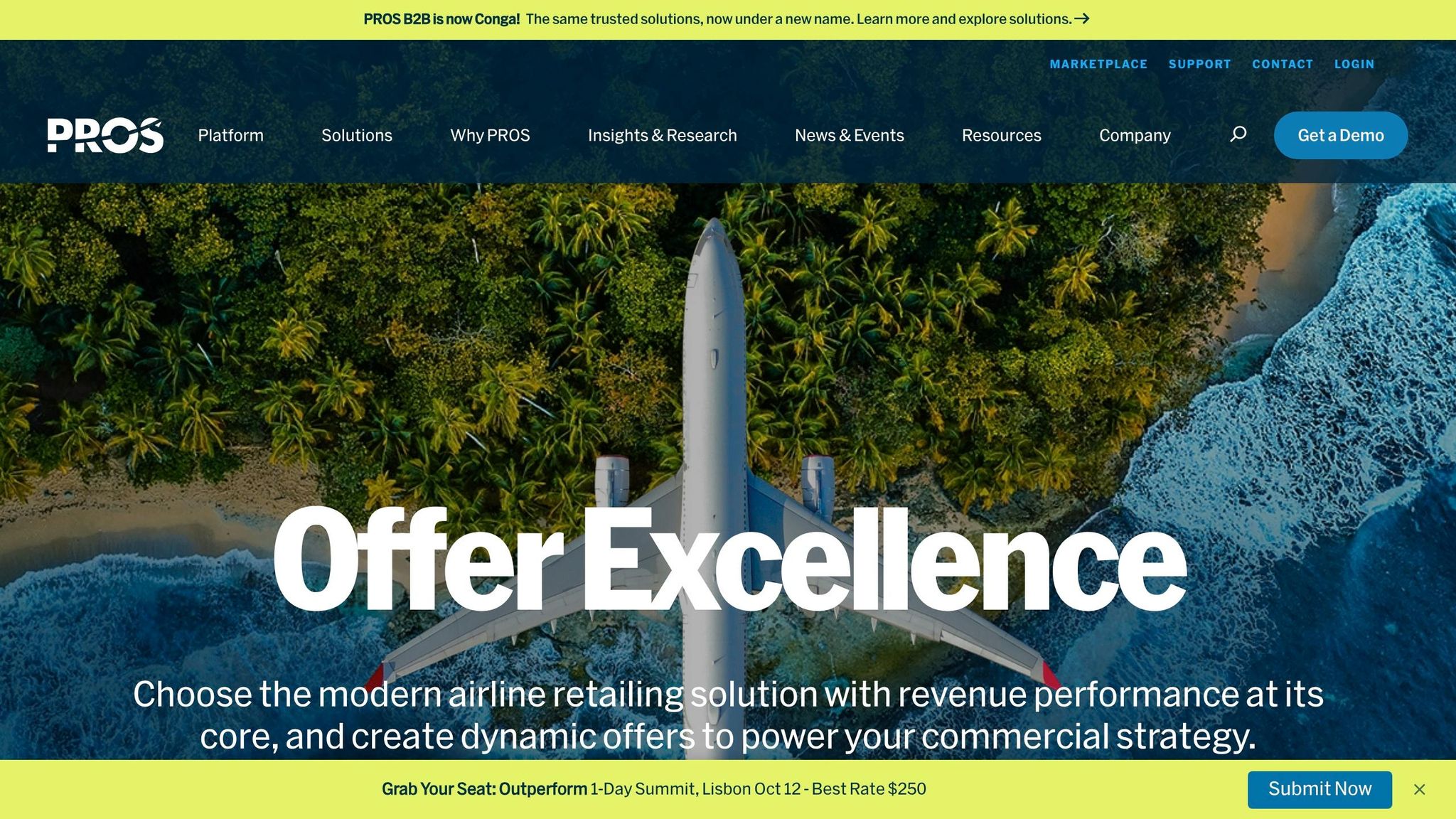
PROS Pricing brings over four decades of expertise, supporting 130 airlines and more than 60 industries. The platform uses advanced technologies like neural networks, deep reinforcement learning, and Bayesian network models to solve intricate pricing challenges with speed and precision. Unlike traditional rule-based systems that demand frequent manual updates, PROS automates pricing decisions across millions of customer segments in real time.
AI-Powered Pricing Optimization Capabilities
PROS uses AI to analyze historical data alongside real-time market signals, generating pricing recommendations. Its Dynamic Ancillary Pricing (DAP) feature automates pricing for add-ons across more than 15 customer segments, while the Deal Guidance tool provides predictive insights into customers' willingness to pay, improving B2B negotiation outcomes.
Between September 2023 and March 2024, airBaltic implemented the Dynamic Ancillary Pricing feature, achieving a 6% increase in revenue per passenger while significantly reducing manual workload.
"By leveraging PROS, we are able to offer tailored pricing options that meet the needs of our travelers, enhancing overall experience and driving customer-centric commercial offers." – Stefan Kreuzpaintner, Senior Vice President, Commercial Customer Offer, Lufthansa
Integration with ERP, CRM, or E-Commerce Platforms
Beyond its AI capabilities, PROS integrates seamlessly with major enterprise platforms like Salesforce, SAP, Microsoft Dynamics, Oracle, NetSuite, and HubSpot. Its Configure, Price, Quote (CPQ) software simplifies complex sales processes, ensuring pricing strategies are accurately reflected in quotes and digital commerce transactions. For B2B companies, the integration feeds historical sales data - such as volume, pricing, and customer segmentation - into the AI system, enabling precise elasticity modeling.
"Now, we have a better understanding of the story behind the price which empowers our sales organization, so they can confidently explain and defend every pricing recommendation to customers." – Stephane Bratu, VP of Pricing, DigiKey
These integrations make it easier to implement PROS's AI-powered tools, further strengthening its role in dynamic pricing strategies.
Real-Time Market Data and Competitor Analysis
PROS leverages real-time analytics to identify actionable trends and customer demand patterns instantly. Its Explainable AI feature provides users with transparent workflows, showing exactly how pricing decisions are made - an essential factor for gaining stakeholder trust. According to research, 66% of B2B buyers prefer working with companies that use algorithm-driven pricing. This ability to adapt to market changes in real time is crucial for staying competitive in today’s fast-moving environment.
On average, PROS delivers a 100–300 basis point margin improvement for enterprise clients.
Pricing Models
PROS follows a custom enterprise pricing structure, with annual costs typically ranging from $100,000 to $300,000+. Pricing details are available upon request. The platform enjoys strong user ratings, scoring 4.4/5 on G2 (111 reviews) and 4.1/5 on Capterra (10 reviews). While users praise its B2B capabilities and proven success in enterprise environments, some note that implementation can be complex, with long timelines and significant data integration requirements.
3. BlackCurve
BlackCurve is designed for e-commerce businesses and professional retailers with large product catalogs, offering tools like competitor analysis automation and dynamic pricing technology. These features help adjust inventory prices in real time. By scanning the web and Google Shopping daily, BlackCurve identifies competitors selling identical or similar products, eliminating the need for time-consuming manual matching. This provides a solid foundation for making data-driven pricing decisions.
AI-Powered Pricing Optimization Capabilities
BlackCurve’s AI engine evaluates multiple factors - competitor pricing, historical sales trends, stock levels, and marketing campaign outcomes - to deliver pricing recommendations. This approach helps businesses avoid losing sales or leaking revenue. With its dynamic pricing tools, companies can improve profit margins while staying competitive across their product range.
The platform supports various pricing strategies, enabling businesses to focus on market share growth (by maintaining lower prices) or profit maximization (through performance-based pricing). To ensure brand integrity and profitability, users can set safeguards like minimum margins or price floors while allowing the AI to handle pricing adjustments.
Integration with ERP, CRM, or E-Commerce Platforms
BlackCurve’s analytics extend into seamless integrations with popular sales platforms. It offers native support for Shopify, Magento/Adobe Commerce, and BigCommerce. For businesses using other systems, BlackCurve provides a general API for custom ERP and CRM integrations. It also allows automated data syncing via Google Drive, Google Spreadsheets, or manual CSV uploads. Additionally, the platform connects with Google Shopping, Google Content API, and Google Ads API, enabling businesses to monitor their market position across search channels. Enterprise users with custom ERPs can use the API to incorporate historical sales and inventory data, enriching pricing recommendations beyond basic competitor analysis.
Pricing Models
BlackCurve operates on a subscription basis, but pricing details are not publicly available and require direct inquiries for a tailored quote. The platform has received high user ratings, with an average of 4.9/5 across the web from 16 reviews, 4.8/5 on G2 (13 reviews), and 5/5 on Capterra (3 reviews). Users appreciate its ability to simplify complex pricing tasks and offer actionable insights, though some note that its effectiveness depends on the quality of initial competitor matching and data feeds.
4. Omnia Retail
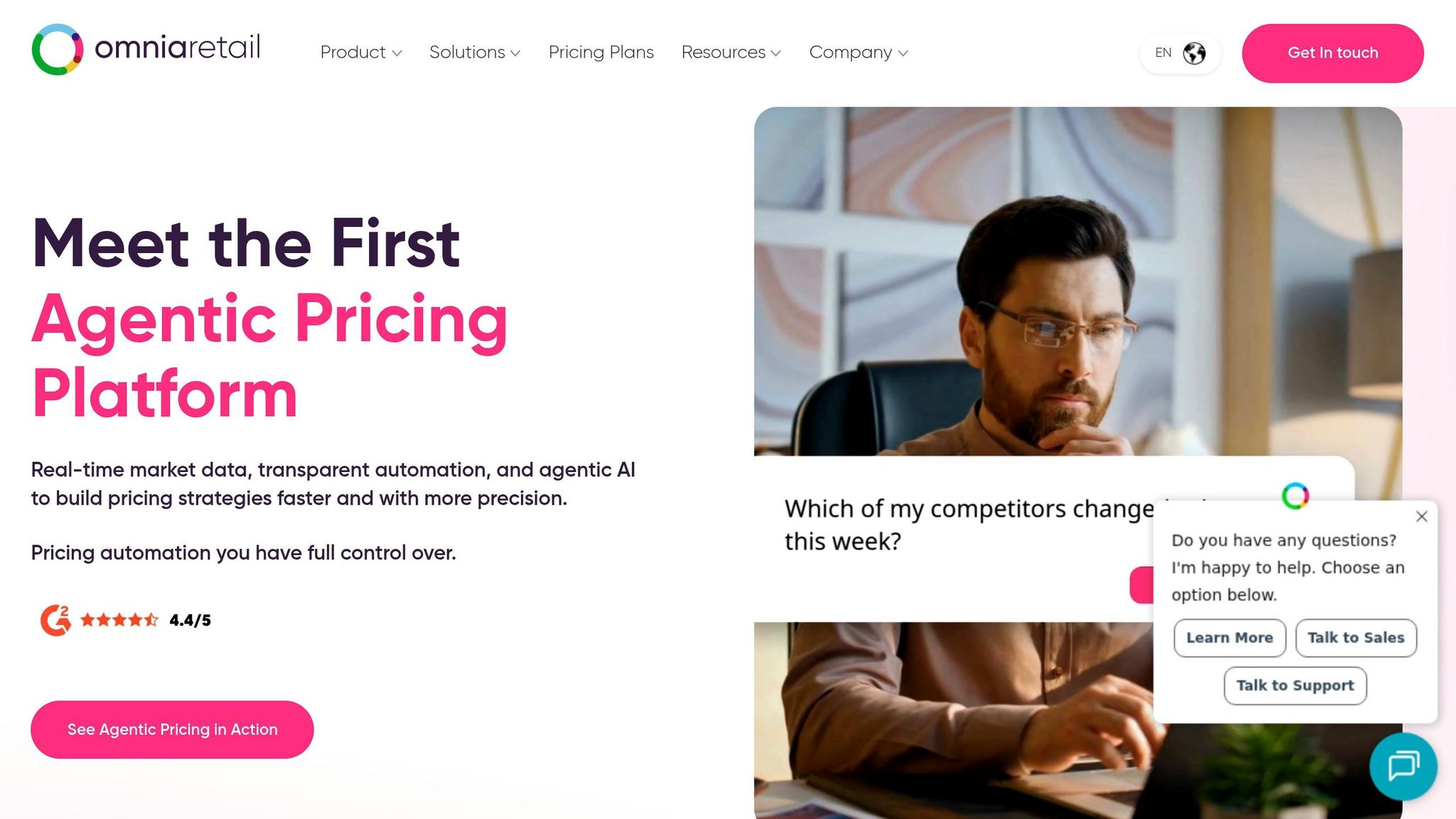
Omnia Retail makes pricing optimization more intuitive with its Omnia Agent, an AI tool that turns pricing data into actionable insights. Instead of navigating through traditional dashboards, pricing teams can simply ask natural language questions like, "Which categories have room for margin increases?" using AI prompts for business The system responds with detailed, context-driven analysis, pulling real-time competitor data from sources like Amazon, eBay, Google Shopping, and direct website scraping. Since its launch in 2012, Omnia has established itself as a key player in the retail pricing space and was named a Category Leader in G2's Winter 2026 Grid for Retail Pricing Software. Below, we explore how Omnia's tools provide clear, real-time pricing insights.
AI-Powered Pricing Optimization Capabilities
Omnia uses advanced AI to simplify and enhance pricing decisions. Its Pricing Strategy Tree™ offers a visual interface that allows users to build detailed pricing rules using no-code automations. This feature eliminates the mystery of "black box" algorithms by clearly explaining why specific prices are set. The AI continuously analyzes competitor prices, demand trends, and inventory levels, making dynamic price adjustments within minutes. According to Omnia, businesses using the platform can boost profit margins by up to 25% while cutting pricing errors by 90%, thanks to its automated market analysis.
Integration with ERP, CRM, and E-Commerce Platforms
Omnia seamlessly integrates with popular e-commerce platforms like Shopify, Magento, WooCommerce, and BigCommerce, as well as business tools such as Salesforce, Zapier, and QuickBooks. By combining internal data from ERP and CRM systems with external market intelligence, the platform enables businesses to execute highly customized pricing strategies.
"By specifying the competitors to track, they offer a great feed and platform that give the right insights to sharpen up your own pricing position" – Martijn, Business Analyst
Users have also reported saving over 15 hours per week on manual pricing tasks, freeing up time for more strategic work.
Pricing Models
Omnia operates on a subscription model, with SMB plans starting at €399/month (around $430/month), designed for single-shop setups with up to five users. For larger enterprises, custom pricing is available based on factors like product assortment size, market coverage, and specific strategic needs. These plans include unlimited users and access to a dedicated customer success team. The platform has earned a 4.4/5 rating from 99 reviews on G2, with users highlighting its "professional, fast, and personal" support and its straightforward setup process that requires minimal ongoing maintenance.
5. Prisync
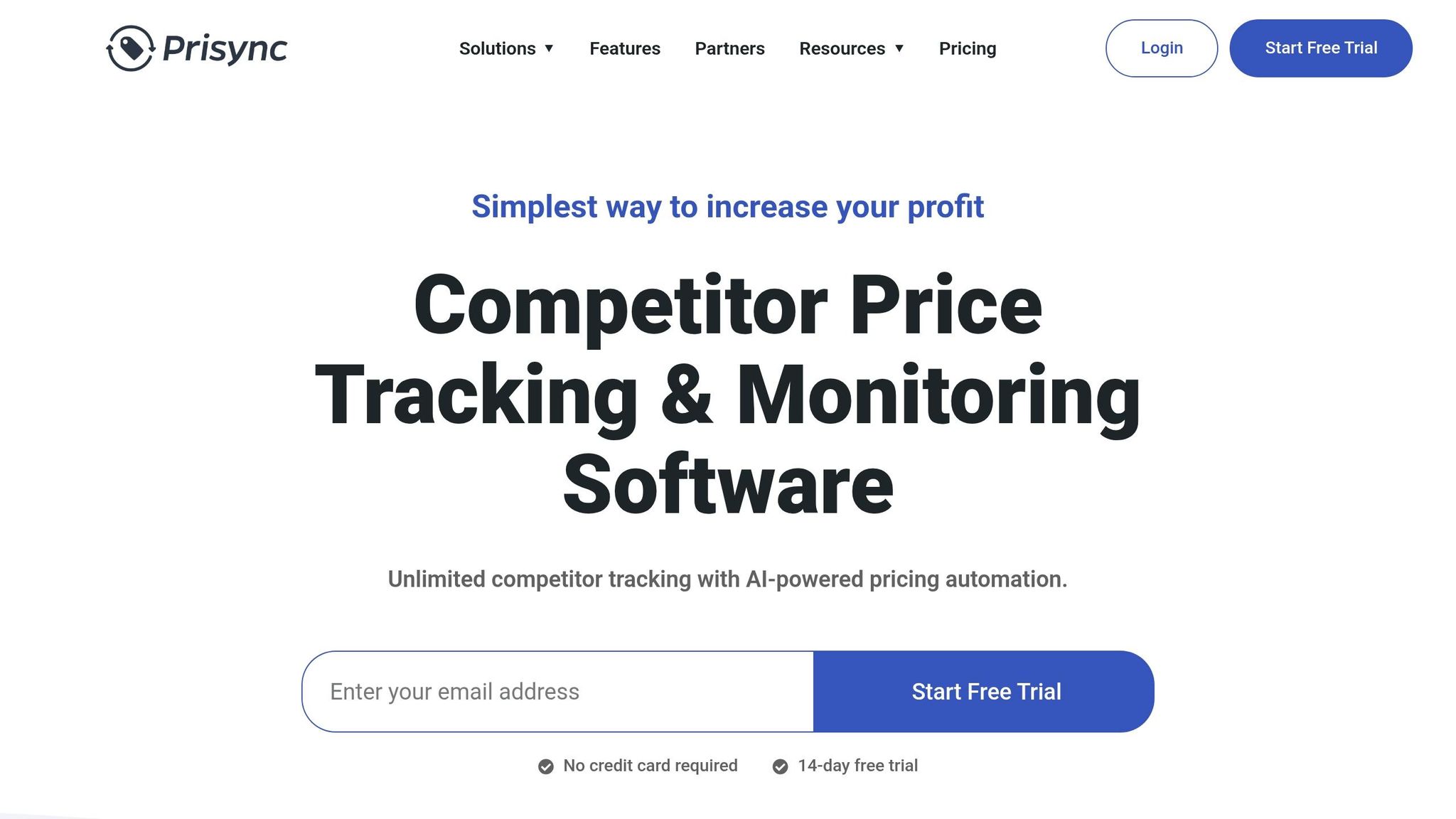
Prisync takes the hassle out of competitive price tracking by automating the process. Instead of manually checking competitor websites and managing spreadsheets - a method still used by 83% of companies - Prisync uses AI to monitor unlimited competitors and adjust prices continuously. Trusted by over 700 brands globally, the platform is highly rated on Capterra and G2. With 90% of online shoppers comparing deals before purchasing and 60% prioritizing price as the deciding factor, Prisync ensures businesses can stay competitive without missing a beat. It builds on earlier dynamic pricing systems, focusing specifically on competitive tracking.
AI-Powered Pricing Optimization Capabilities
Prisync's Dynamic Pricing Engine automatically updates prices in response to competitor movements, stock levels, and custom rules you set. The AI also identifies new competitors in the market. Through features like Smart Price Rules, businesses can fine-tune their pricing strategies. Companies using Prisync have reported sales and profit margin increases ranging from 3% to 20%. Additionally, the platform includes MAP Monitoring, which helps suppliers enforce Minimum Advertised Price policies across their distribution channels.
Real-Time Market Data and Competitor Analysis
Prisync provides real-time market data that enables businesses to analyze competitors quickly. Competitor prices are updated three times daily for URL-based tracking and once daily for channel-based monitoring. Instant email alerts notify users of major market changes. This rapid pace is vital, especially when retail giants like Amazon adjust prices as often as every 10 minutes during peak periods. Prisync not only tracks prices but also monitors stock availability across platforms like Amazon, eBay, and competitor websites, consolidating all this information into a single, easy-to-use dashboard.
"Easy to use and saves tons of time checking prices of products manually. They have a great customer support and help you out in no time if needed." – Riverbird
Integration with ERP, CRM, and E-Commerce Platforms
Prisync integrates effortlessly with existing systems, offering one-click product imports from major e-commerce platforms. For advanced needs, the platform provides API access (available for an additional 20% fee) to enable automated workflows by feeding pricing data directly into ERP and CRM systems. Teams without technical expertise can use CSV exports for manual data transfers, and the tool is accessible via any web browser, eliminating the need for IT support by building autonomous AI workflows with zero coding.
Pricing Models
Prisync offers a tiered subscription model tailored to different monitoring needs:
- URL-Based Monitoring: Starts at $99/month for up to 100 products (Professional), $199/month for up to 1,000 products with dynamic pricing (Premium), and $399/month for up to 5,000 products with MAP monitoring (Platinum).
- Channel-Based Monitoring: Pricing begins at $199/month and scales to $399/month and $599/month for broader marketplace tracking.
- Hybrid Model: Combines both approaches, starting at $299/month.
Every plan includes a 14-day free trial with full features, and no credit card is required to get started.
6. Competera
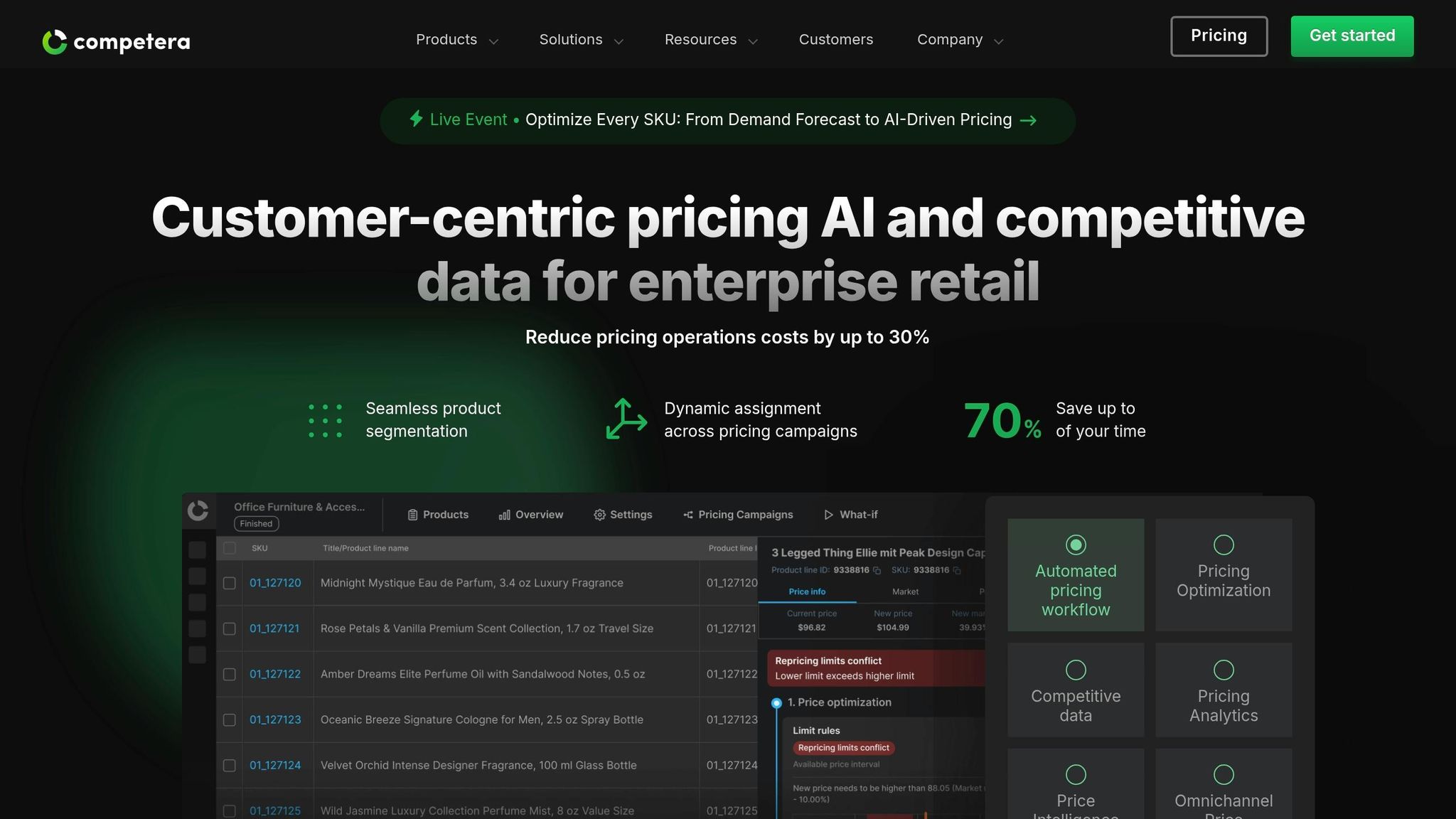
Competera stands out as a leading AI tool for pricing optimization, powered by a second-generation AI engine trained on a staggering 10 billion transactions. It operates with 930 deep learning models, analyzing over 20 factors, including demand elasticity, product lifecycle, and competitor actions. This sophisticated analysis has enabled retailers to see results like an 8% increase in revenue and a 6% improvement in profit margins using AI-driven strategies. Competera’s reputation is reflected in its stellar ratings: 5.0/5 on Capterra, 4.9/5 on G2, and 4.9/5 on Crozdesk. It has also earned a spot on the Inc. 5000 Fastest-Growing Companies list in 2025.
AI-Powered Pricing Optimization Capabilities
Competera's "What-If" simulation tool is a game-changer, allowing businesses to predict the impact of pricing strategies on revenue and profits with up to 95% accuracy before implementation. Its dynamic segmentation feature adjusts product roles - like Key Value Items or Long Tail products - automatically as customer behavior shifts throughout a product's lifecycle. Companies such as WiggleCRC Group and Flaconi, a German online beauty retailer, have cut their repricing and pricing process times by half, managing hundreds of thousands of SKUs across multiple markets.
"We believe Competera is the best in the industry. Their platform provides a set of tools, including market-based pricing and AI-driven demand-based pricing, that offers solutions to an immediate need, as well as our long-term plans." - David Elder, Group Head of International and Pricing, WiggleCRC Group
Real-Time Market Data and Competitor Analysis
Competera excels in delivering real-time competitive market data through API, backed by a 99% service level agreement, and updates insights as frequently as every two hours. Its product matching technology achieves a 98% accuracy rate, offering a comprehensive view of the market. This capability has helped businesses slash repricing efforts - from 60 hours per week to just 4 hours. The platform also generates over 162 million optimal price recommendations annually, enabling quick and precise responses to market shifts. All this data integrates seamlessly into enterprise systems, supporting fast and informed pricing decisions. These workflows can be further optimized using business prompt collections designed for finance and operations.
Integration with ERP, CRM, and E-Commerce Platforms
Competera’s integration capabilities combine both internal and external data to create unified pricing strategies. By pulling internal data from ERP systems - like stock levels, transactions, and costs - and feeding AI-driven price recommendations back into these systems, it acts as a centralized hub for pricing information. Its human-in-the-loop design ensures pricing teams maintain control while AI handles complex data analysis and recommendations. Integration timelines are efficient, with Competitive Data and Pricing Automation taking about 14 days, and full price optimization requiring up to 60 days. The platform also ensures consistent pricing across all sales channels.
Pricing Models
Competera operates on a custom quote model, offering transparent billing based on the data points delivered. Businesses can also opt for Proof of Concept projects to test the platform’s capabilities before committing to a full contract.
7. Zilliant
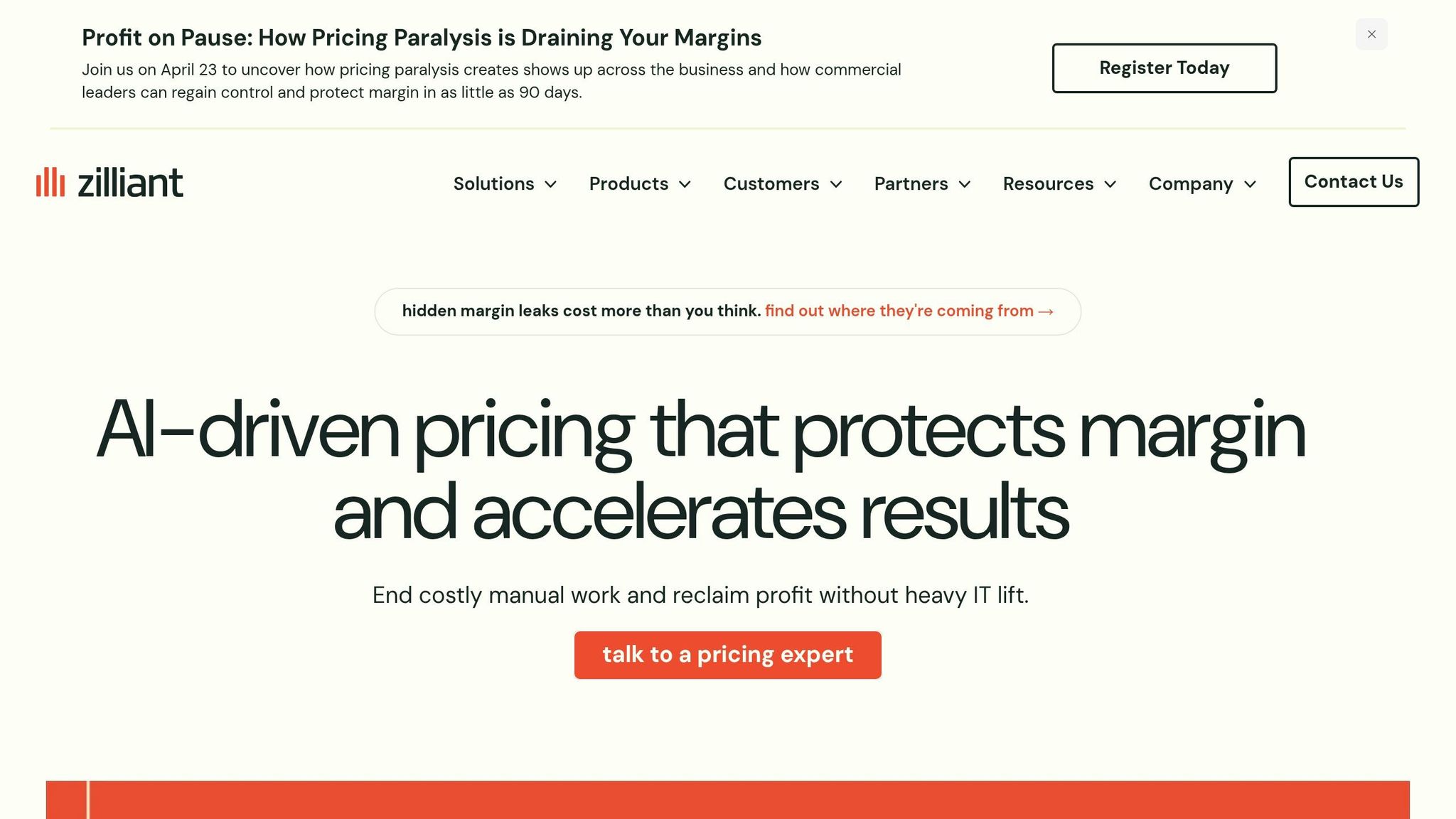
Wrapping up the list, Zilliant distinguishes itself with its focus on prescriptive pricing and its ability to respond to market changes in real time. Instead of just predicting trends, the platform provides precise pricing recommendations that align with a company’s goals. Using AI-driven models, Zilliant uncovers subtle data patterns and anticipates market changes that often escape manual analysis. Will Moore, Global Pricing Manager, summed it up well: "You can't do it in Excel - you need technology. Zilliant's solutions revealed insights beyond human capability". Businesses using Zilliant have reported 135–150 basis point margin improvements and up to 5% revenue growth. For enterprise clients, this translates into protecting over $1 million in margin within the first year.
AI-Powered Pricing Optimization Capabilities
Zilliant offers a range of tools to refine pricing strategies. Its scenario modeling feature allows businesses to test pricing strategies and forecast their impact on revenue, volume, and margins before making changes. The Win Probability tool helps sales teams by estimating the chances of closing deals at different price points, highlighting key value drivers. To build trust, its Explainable AI function provides clear, detailed reasoning behind each recommendation. The platform also employs Gen AI Pricing Analytics, which accelerates insights and minimizes errors, leading to a 40% reduction in manual work and a 73% drop in price approval times.
Integration with ERP, CRM, and E-Commerce Platforms
Zilliant centralizes pricing data into a single, managed source, eliminating the need for scattered spreadsheets. It integrates seamlessly with ERP, CRM, and CPQ systems, enabling businesses to publish real-time pricing updates with a single click. This allows companies to adapt quickly to market shifts. For e-commerce, the platform ensures accurate pricing across channels. David Werner, SVP Sales and Marketing, highlighted this benefit:
"Zilliant gives us an AI tool that allows our sellers to effectively price customers through e-commerce without worrying about the wrong price coming through".
The system also includes role-based access, audit tracking, and draft/publish workflows to ensure pricing consistency and compliance across all sales channels.
Real-Time Market Data and Competitor Analysis
Zilliant continuously monitors cost changes, customer behavior, and competitor activity. It sends real-time alerts for potential risks like margin erosion or deal threats, as well as opportunities for price adjustments. This proactive approach helps businesses move away from reactive pricing and seize new opportunities as they arise.
Pricing Models
Zilliant’s pricing is flexible and tailored to each client, with quotes provided upon request. Businesses can also access a free demo to explore the platform’s features before making a commitment. Designed to accommodate organizations of all sizes, Zilliant supports everyone from small businesses transitioning from spreadsheets to large enterprises managing thousands of SKUs across multiple regions. To further enhance these strategies, many leaders use business AI prompts to refine their competitive edge.
Feature and Pricing Comparison
When evaluating AI pricing tools, a side-by-side look at their features and pricing models can help pinpoint the right fit for your business. The choice often depends on factors like company size, industry focus, and the complexity of your pricing needs.
Enterprise-level platforms such as Pricefx and PROS come with hefty price tags - ranging from $50,000 to over $300,000 annually. However, they offer advanced tools that can significantly enhance profit margins through margin optimization. These solutions are best suited for large B2B companies managing extensive product catalogs (thousands of SKUs) across multiple regions. They also provide comprehensive lifecycle support, including integration with CPQ systems and ERP platforms.
Mid-market e-commerce retailers might find platforms like BlackCurve and Omnia Retail more aligned with their needs. These tools typically cost between $1,000 and $5,000 per month and are tailored for businesses looking to improve profit margins through AI-driven insights. Larger omnichannel retailers, on the other hand, might benefit from Competera, which uses contextual AI to analyze customer purchasing behaviors and optimize pricing strategies.
For smaller e-commerce businesses, Prisync offers a budget-friendly option, starting at $99 per month for up to 100 products and scaling to $399 per month for 5,000 SKUs. This pricing structure is ideal for Shopify or Magento stores that focus on monitoring competitor pricing and ensuring MAP compliance, rather than diving into more complex demand forecasting.
The financial impact of these tools can be substantial. Studies show that a mere 1% improvement in the average selling price can boost operating profits by 8% to 11%. For example, a company with $100 million in revenue and 10% margins could see a 20% to 50% increase in profits with a 2% to 5% margin improvement. This makes the investment in advanced platforms like Zilliant worthwhile for B2B manufacturers and wholesalers managing complex, negotiated deals. Zilliant specializes in delivering custom pricing solutions tied to ERP and CRM systems for precise, segment-specific pricing logic.
The table below outlines the pricing models, ideal use cases, and standout features of each tool:
| Tool | Pricing Structure | Best-Fit Use Case | Key Differentiator |
|---|---|---|---|
| Pricefx | $50,000–$200,000+/year | Large B2B/B2C enterprises | Full lifecycle pricing with Gen-AI chat |
| PROS Pricing | $100,000–$300,000+/year | Complex B2B negotiations | Neural-net pricing and deal guidance |
| BlackCurve | Custom enterprise quotes | Mid to large e-commerce | AI-powered profit maximization |
| Omnia Retail | Custom enterprise quotes | Mid-market/enterprise retail | Conversational AI (Omnia Agent) |
| Prisync | $99–$399/month | SMB e-commerce stores | Affordable competitor tracking |
| Competera | Custom enterprise quotes | Enterprise omnichannel retailers | Contextual AI for demand modeling |
| Zilliant | Custom enterprise quotes | B2B manufacturers/distributors | ERP/CRM-tied segment-level logic |
Conclusion
These seven AI tools take pricing from a guessing game to a precise, real-time strategy for boosting profits. Whether you're running a small e-commerce shop keeping tabs on competitor prices or managing intricate negotiations in a large B2B enterprise, there's a solution designed to fit your needs.
The financial impact speaks for itself: A mere 1% increase in average selling price can lead to an 8–11% jump in operating profit. For a $100M company with 10% margins, improving prices by just 2–5% could translate into a 20–50% profit increase.
The pricing landscape is shifting - from simply reacting to competitors to proactively focusing on shoppers. Modern AI tools can predict what customers are willing to pay, model demand scenarios, and offer actionable insights. This turns pricing into a dynamic, automated process.
To get started, analyze your historical pricing data and establish realistic boundaries. Then, test AI-driven pricing on roughly 20% of transactions before rolling it out more broadly.
With the right AI pricing tool, you can transform how your business captures value - cutting decision-making time by up to 80% while staying aligned with your growth goals.
FAQs
What data do I need to start AI pricing optimization?
To kick off AI pricing optimization, start by collecting essential data like competitor pricing, market benchmarks, and insights at the category level. These elements allow you to effectively compare and position your prices.
Beyond that, gather information on demand patterns, customer behavior trends, and real-time market signals. Adding data like sales history, inventory levels, and external factors - such as weather or economic conditions - can fine-tune your pricing models. This helps AI tools make dynamic adjustments, ensuring prices align with market shifts and revenue goals.
How do I choose the right AI pricing tool for my business size?
Choosing an AI pricing tool hinges on your business's size, specific needs, and the complexity of your pricing strategies. If you're part of a larger enterprise with more intricate pricing requirements, platforms like Pricefx or Intelligence Node might be worth exploring. For businesses needing real-time pricing updates, tools such as Competera, Omnia Retail, and Zilliant offer flexible solutions. Take time to assess your product range, pricing objectives, and overall business complexity to determine which tool aligns best with your goals.
How can I test AI pricing safely before a full rollout?
To experiment with AI pricing securely, try controlled strategies like pilot programs or A/B testing. Begin by focusing on a small selection of products or targeting a specific customer group. This allows you to assess how the AI influences factors like sales, revenue, and customer reactions. Taking this step-by-step approach helps you spot potential problems and fine-tune the AI settings before rolling it out more broadly, reducing risks to your overall pricing plan.
Related Blog Posts

Loved by Business Owners


Based on 1K reviews
Get smarter on AI every week.
Ready to transform your business?