
Best AI Prompts for Education and Training Companies



AI prompts are changing how education and training companies create, deliver, and manage content. These prompts act as instructions for AI tools like ChatGPT to generate specific outputs tailored to learning needs. Companies using AI report saving up to 20 hours weekly by automating tasks such as lesson planning, personalized training, and administrative work. The global AI in education market is projected to grow from $3.99 billion in 2023 to $21.13 billion by 2028, highlighting its increasing impact.
Key takeaways:
- Curriculum Development: Use AI to create learning objectives, break topics into modules, and design tiered activities for different skill levels.
- Personalized Learning: Adjust content for different learning styles, create adaptive study plans, and tailor materials for specific job roles.
- Employee Training: Build scenario-based simulations, customize content for experience levels, and track progress with detailed feedback.
- Administrative Efficiency: Simplify scheduling, reporting, and document management to save time and improve workflows.
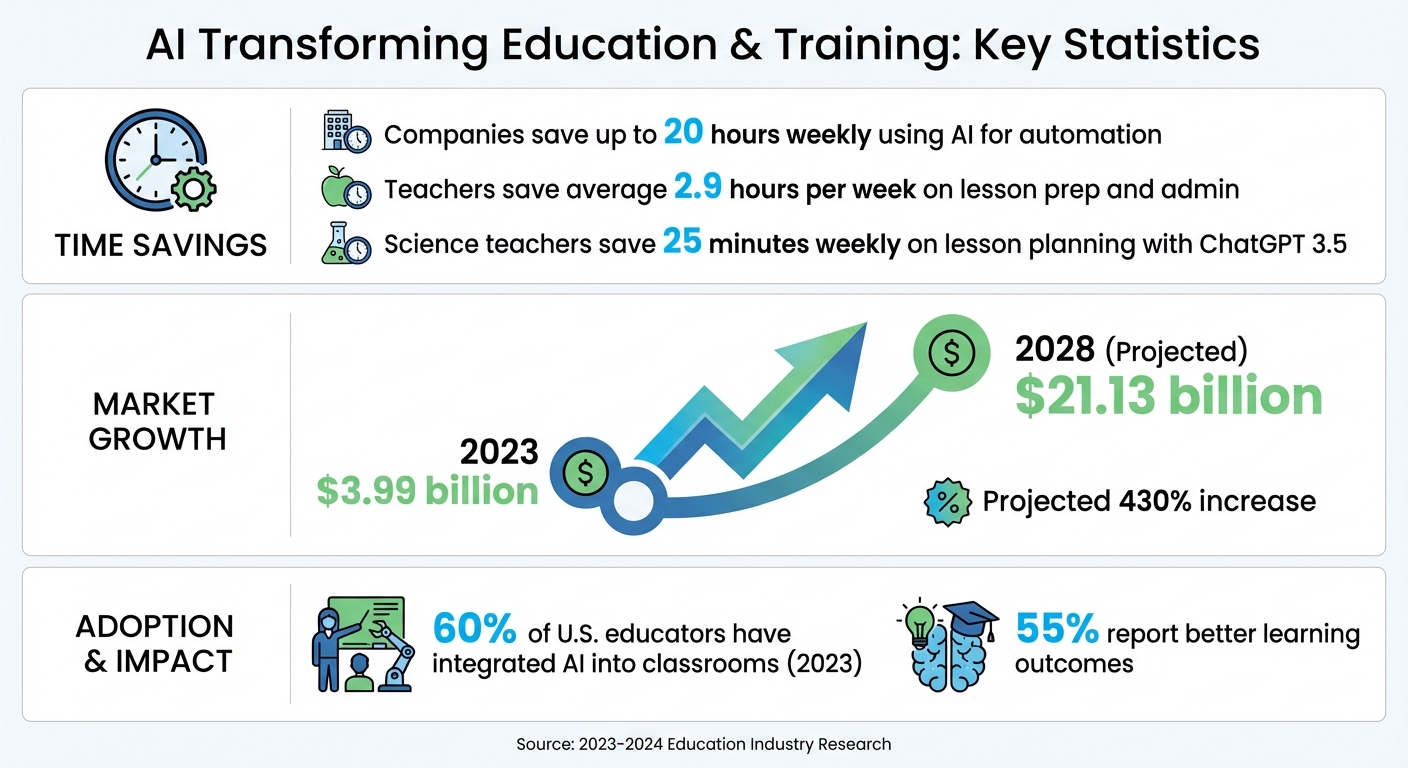
AI in Education: Market Growth and Time-Saving Statistics 2023-2028
1. Curriculum Development
Generate Learning Objectives Using Bloom's Taxonomy
AI can help turn vague learning goals into precise, actionable objectives using tools like Bloom's Taxonomy. For example, instead of saying, "students will understand marketing", you can prompt AI to create something more specific, such as: "Students will analyze three case studies and evaluate which marketing strategy produced the highest ROI." This not only clarifies expectations but also sets measurable targets for learners. To achieve this, you can prompt the AI to act as an instructional design expert, referencing frameworks like Bloom's Taxonomy or the ADDIE model.
Once objectives are clear, the next step is to organize them into structured modules.
Break Down Complex Topics Into Weekly Modules
The "Recipe Pattern" is a practical way to break down broad course objectives into smaller, step-by-step modules. For instance, if you're creating a 12-week corporate compliance training program, you could prompt the AI with: "I want to teach employees about data privacy regulations. Provide a weekly sequence of learning objectives that progresses from beginner to advanced concepts." This method ensures that content is delivered in a logical, digestible order.
This approach also works great for microlearning - short, focused lessons under five minutes that tackle a single concept. With structured modules in place, the next focus is on tailoring activities for different learning levels.
Create Tiered Activities for Different Skill Levels
AI can streamline the creation of tiered assignments to cater to learners at varying skill levels - beginner, intermediate, and advanced. For example, you might prompt: "Develop three versions of this product knowledge quiz - one for new hires, one for mid-level employees, and one for team leaders." This saves time on manual customization while ensuring every learner gets content suited to their abilities.
Additionally, you can use the "Persona Pattern" to refine your materials. For example, prompt the AI to "act as a first-year university student" and review your syllabus draft to flag any confusing sections. This ensures clarity and accessibility before rolling out the curriculum.
sbb-itb-58f115e
2. Personalized Learning
Tailor Training Materials to Different Learning Styles
People learn in different ways - some are visual learners, others prefer audio, and some thrive with hands-on activities. Catering to these diverse learning styles is at the heart of personalized education. AI can help by reworking content to suit individual preferences. For example, you could ask: "Rewrite this technical policy for a visual learner: simplify the language, use bullet points, and suggest a flowchart layout." This kind of adjustment not only saves time but also ensures that learners receive information in a way that clicks with them. You can also use education mega-prompts to speed up this content adaptation process. By doing so, training becomes more engaging and effective.
Create Study Plans That Evolve With Progress
Standardized online learning plans often fall short because they don’t account for individual learning speeds. AI can step in to design flexible study plans that adapt as learners progress. A useful prompt might be: "Develop a personalized study plan for [Subject] using [Performance Data] and [Syllabus]. Adjust it based on the learner's progress." If someone struggles with a particular topic, the AI could provide extra explanations or targeted exercises before moving on. This dynamic approach ensures learners stay on track without feeling overwhelmed or left behind.
Adjust Content for Specific Job Roles
Different roles within a company demand training that’s relevant and practical for their day-to-day tasks. A sales professional, for instance, doesn’t need the same training as a software developer. AI can make this distinction by tailoring content to fit the needs of specific roles. You might prompt: "Modify this [Topic] module for [Specific Role], including examples and language suited to their responsibilities." This targeted customization ensures that training feels relevant and immediately applicable, moving away from generic, one-size-fits-all methods.
3. Employee Training
Build Scenario-Based Simulations for Real-World Practice
The best training mirrors the challenges employees face on the job. AI can help create branching scenarios where every decision leads to a distinct outcome. For instance, you could prompt: "Develop a branching scenario for customer service training where an employee handles a frustrated client. Include three decision points with realistic consequences for each choice." This method is particularly effective for teaching soft skills like conflict resolution or leadership. You can also explore ChatGPT prompts for professional development to further refine these skills. By incorporating engaging dialogue and realistic conflicts into the scenarios, employees get hands-on practice that builds confidence before they face similar situations in the workplace.
Once you've created realistic scenarios, it's important to adapt the training to different skill levels.
Design Multi-Level Content for Different Experience Tiers
Not all employees start at the same level of expertise. New hires typically need the basics, while seasoned staff benefit from more advanced material. AI can customize training content to match these varying needs. For example, a useful prompt might be: "Create two versions of a product feature explanation: one simplified for new hires and another with detailed insights for experienced employees. Highlight common mistakes each group should avoid." By tailoring the content this way, you ensure that everyone receives relevant information without wasting time on material that doesn’t match their skill level. In December 2024, the founder of God of Prompt used a Mega-Prompt Generator to revamp an SEO training program, leading to a 35% productivity increase in just two months.
After customizing the material, the next step is to track how well it’s working.
Track Progress and Generate Personalized Feedback
AI can simplify progress tracking by compiling data into clear, actionable reports. You might use a prompt like: "Create a training progress tracking system that includes employee names, courses, completion levels, and scores. Generate a weekly summary report highlighting employees who need additional support." Beyond tracking, AI can also provide detailed feedback that goes deeper than a simple pass/fail result, helping employees understand their strengths and areas for improvement. This combination of monitoring and personalized feedback keeps training relevant and engaging, ensuring continuous improvement and better outcomes for both employees and the organization.
3 AI Prompts That Create Ready To Publish Courses in under 29 minutes
4. Administrative Efficiency
AI isn't just about personalizing learning - it’s also a game-changer for simplifying administrative tasks, freeing up valuable time for more strategic work.
Streamlining Scheduling, Reporting, and Document Management
Administrative duties like scheduling, reporting, and managing documents often eat into time that could be better spent elsewhere. AI tools can handle these routine tasks with ease, allowing educators and administrators to focus on what really matters.
For instance, consider using a prompt like this:
"Create a first-week orientation schedule for new staff members. Include columns for date, activity, key contact person, meeting type, and priority level. Format as a table."
With this, you can quickly generate a structured onboarding plan without the usual hassle.
AI also simplifies document management by summarizing lengthy email threads and identifying key action points. For example:
"Summarize this email thread and list all action items with their deadlines. Highlight any items that require immediate attention."
This eliminates the need to sift through endless emails, saving hours of work.
When it comes to reporting, AI can handle tasks like generating ChatGPT prompts for Excel and formulas to calculate metrics or clean up data, such as standardizing region names or totaling enrollments.
To make your AI prompts even more effective, you can use the PTCF Framework. This approach structures your request around four key elements:
- Persona: Define the role, like "Act as an HR Manager."
- Task: Specify the job, such as "Draft a report."
- Context: Provide background, like "Based on these survey results."
- Format: Clarify the output, such as "A three-point bulleted list".
If you’re working in tools like Google Workspace, you can even reference specific documents directly using "@" tags (e.g., "@[2024 Budget]") to ensure the AI pulls in accurate internal data.
Start with a general request and refine it with additional instructions, like "Organize this into a table" or "Use a professional tone." You can also set negative constraints, such as "Exclude personal opinions" or "Avoid student-identifiable information". These strategies not only make operations more efficient but also help organizations focus on boosting productivity where it counts.
Conclusion
AI prompts are transforming the landscape of education and training by streamlining tasks, enhancing engagement, and improving learning outcomes. For example, teachers using AI save an average of 2.9 hours per week on lesson preparation and administrative work, while science teachers leveraging ChatGPT 3.5 shave off about 25 minutes weekly on lesson planning tasks. A 2023 survey revealed that 60% of U.S. educators have integrated AI into their classrooms, with 55% reporting better learning outcomes. The industry is growing rapidly, as previously mentioned.
The strategies outlined earlier provide actionable ways to incorporate AI into your daily workflows. However, as Jeremy Roschelle, Executive Director at Digital Promise, wisely points out:
"My overall worry in this space is that AI is moving fast with a lot of hype and heat, and it still takes a long time to measure if it is working. We can't let the hype outpace the evidence".
This serves as a reminder to focus on meaningful outcomes like improved student performance, higher teacher retention, and effective knowledge transfer, rather than being swept up in superficial metrics. Thoughtful integration of AI prompts represents a shift toward more efficient and impactful education and training.
To get started, try experimenting with prompts that address your most immediate challenges - whether that’s generating lesson plans, creating personalized quizzes, or organizing schedules. Use pre- and post-assessments to measure progress and track how prompts evolve over time. Gathering feedback from learners about how they refine their prompts can also offer valuable insights.
The true potential of AI emerges when you tailor prompts to your specific needs. Upload internal documents, define your target audience (such as recent graduates, mid-level managers, or technical specialists), and experiment with role-playing personas like “Act as an in-house company trainer” to generate more relevant and effective outputs. Remember, AI is an assistant, not a replacement for human expertise. Always have subject matter experts review content for accuracy and appropriateness before implementation.
Whether your goal is to save time, increase engagement, or scale personalized learning, the strategies in this article provide a strong starting point. From curriculum design to employee training, customized prompts can help unlock new possibilities for your organization. While AI enhances efficiency, human oversight is essential to ensure quality and relevance. The education and training sectors are evolving quickly, and those who thoughtfully adopt AI today will be well-prepared to lead in the future.
FAQs
How do AI prompts improve personalized learning in education?
AI prompts turn general-purpose AI tools into customized learning companions by shaping responses to fit each learner’s unique needs. By incorporating specifics like age, skill level, interests, and available time, prompts can deliver explanations and examples that match the learner’s knowledge and preferences. For instance, a prompt such as: "Explain fractions to a middle school student using sports statistics in under 200 words" ensures the explanation feels both relevant and engaging.
Thoughtfully designed prompts also enable step-by-step learning by simplifying complex concepts, generating practice exercises, and adapting content based on progress. When paired with learner data - like quiz scores or identified skill gaps - AI prompts can provide tailored feedback, recommend what to study next, and even create custom assessments. This method not only keeps learners engaged but also accelerates their progress. Meanwhile, educators can dedicate more time to mentorship and guidance, as the AI takes care of routine personalization.
What are the main advantages of using AI for developing educational content?
AI has transformed curriculum development by making it faster and easier to create lesson plans, learning objectives, activities, and assessments - all in just minutes. This gives educators more time to focus on improving their teaching strategies instead of getting bogged down with repetitive tasks. Plus, AI can generate content tailored to different skill levels, whether for beginners or advanced learners, making personalized learning much more accessible.
Beyond speed, AI brings consistency to course design by sticking to a unified framework for tone, language, and standards. It also takes care of administrative tasks like tagging resources, building rubrics, and formatting materials for learning platforms. By handling these time-consuming chores, AI allows educators to dedicate more energy to engaging with their students.
Another major advantage is AI’s ability to support continuous improvement. By analyzing how learners interact with the material, it identifies what’s working and what isn’t. This feedback loop helps educators refine content quickly, resulting in cost-efficient development, better learning experiences, and the flexibility to meet changing educational demands.
How can AI make administrative tasks easier for education and training companies?
AI takes the hassle out of administrative tasks by automating repetitive processes and delivering fast, data-backed solutions. Need an email drafted? Done. A meeting agenda created? Handled. Scheduling events or generating standardized documents like policies or training materials? AI can whip those up in seconds. This automation not only cuts down on manual labor but also reduces errors and frees up valuable time for your team.
In education, AI assistants are like a teacher's secret weapon. They can quickly pull together lesson plans, design grading rubrics, or even draft templates for parent communication. On top of that, they can answer common student questions through chat interfaces, saving educators countless hours. By taking care of these routine tasks, AI lets teachers and administrators focus on the bigger picture - like strategic planning and offering personalized support - boosting both efficiency and productivity across the board.
Related Blog Posts

Loved by Business Owners


Based on 1K reviews
Get smarter on AI every week.
Ready to transform your business?