
AI Agents in Social Science Simulations




AI agents, powered by LLM tools (LLMs), are reshaping how researchers study human behavior in social science. By simulating human attitudes and decisions, these agents offer a cost-effective, scalable alternative to traditional experiments, which are often expensive and face ethical challenges. For example, a Universal Basic Income (UBI) study in Kenya cost over $30 million and spanned 12 years, whereas AI agents can simulate similar scenarios at a fraction of the cost and time.
Key points:
- AI Agents: These use LLMs combined with personal data (like interviews and surveys) to mimic human behavior.
- Accuracy: Agents trained on two-hour interview transcripts replicated survey responses with 85% accuracy, close to how humans replicate their own answers.
- Applications: Tools like AgentSociety simulate over 10,000 agents to study complex issues like polarization, policy impacts, and social trends.
- Reduced Bias: Using interview data instead of demographics alone cuts stereotyping, improving fairness in simulations.
- Validation: Simulations are rigorously tested against benchmarks like the General Social Survey and behavioral experiments.
AI agents are transforming research by enabling large-scale studies of human behavior, offering a safe and efficient way to explore complex social scenarios.
Researcher Clones Human Personality INTO AI Agents With Stunning Accuracy
Building AI Agents from Real-World Data
Creating AI agents that can closely mimic human behavior starts with gathering high-quality, diverse data. One effective method involves using stratified sampling to ensure the participant pool reflects a broad range of demographics, such as age, gender, race, region, education, and political ideology. After selecting participants, researchers conduct in-depth, two-hour voice-to-voice interviews. These semi-structured interviews, modeled on methods like the American Voices Project, collect rich personal stories and perspectives on social issues, resulting in transcripts averaging 6,491 words per participant.
Collecting and Preparing Data
AI interviewers play a crucial role in these interviews by asking adaptive follow-up questions that delve into unique personal insights often overlooked by standard surveys. Once the interviews are recorded, the audio is transcribed into text. These transcripts are then used to inform language models, instructing them to use ChatGPT to its full potential by "imitating the person" based on the provided qualitative data.
A 2024 study from Stanford University, led by Joon Sung Park and Michael S. Bernstein, demonstrated that agents built from these transcripts could replicate participants' responses on the General Social Survey with 85% of the accuracy individuals achieved when replicating their own answers two weeks later. Even when 80% of the transcript data was removed - leaving only about 24 minutes of interview content - these agents still performed better than those relying solely on demographic data. This comprehensive data collection process lays the groundwork for embedding nuanced behavioral traits into AI agents.
Embedding Behavioral Traits into AI Agents
Once the data is collected, the next step is programming agents with realistic behavioral tendencies. This involves integrating personality assessments, like the Big Five Inventory (BFI-44), and leveraging insights from behavioral experiments such as the Dictator Game or Prisoner's Dilemma. In the Stanford study involving 1,052 participants, agents trained with interview data achieved a normalized correlation of 0.80 in predicting Big Five personality traits.
To further refine behavior, researchers use theory-based workflows. For example, scientists from Tsinghua University and Hong Kong University of Science and Technology developed agents with three key modules: motivation, planning, and learning. These modules helped streamline behavior modeling, and when tested against real-world data from Beijing’s mobility patterns, the agents showed up to 75% less deviation compared to traditional generative models. Removing any one of the modules increased behavioral errors by 1.5–3.2×.
Another critical tool is a digital "scratchpad", which updates each agent's stable profile (such as name, age, and education) alongside their dynamic status (like economic conditions or social relationships). This ensures the agents maintain consistency throughout multi-stage simulations. These strategies contribute to the high simulation accuracy metrics, enabling agents to exhibit reliable behavior across various scenarios.
Using Prompt Engineering for Agent Behaviors
With robust data and behavioral frameworks in place, advanced prompt engineering takes agent responses to the next level. Techniques like Chain-of-Thought (CoT) prompting enable agents to incorporate their profiles, current states, and past experiences when responding to new situations.
A particularly innovative method involves simulating an "inner parliament", where sub-agents representing different psychological factors - such as anxiety, confidence, and motivation - debate internally to form a cohesive response. This approach mirrors the way humans process internal conflicts. In a 2025 study by Tsinghua University, researchers used prompts based on the Gravity Model to simulate social interactions around gun control. When agents interacted with like-minded individuals, 52% became more polarized. However, exposure to diverse viewpoints led 89% of agents to adopt more moderate positions.
The results speak volumes. Agents trained on interview data outperformed those relying solely on demographic information by 14–15 normalized accuracy points on the General Social Survey. Additionally, they reduced the Demographic Parity Difference in political ideology from 12.35% to 7.85%, effectively cutting stereotyping by nearly half. This demonstrates the power of combining rich qualitative data with advanced engineering techniques to create more accurate and nuanced AI agents.
Tools and Frameworks for AI-Based Simulations

Comparison of AI Agent Simulation Platforms for Social Science Research
Scaling AI agents for simulations requires specialized frameworks designed to handle the complexities of social science research. Several platforms cater to different simulation needs, each tailored to specific research goals and methodologies.
AgentSociety Simulator
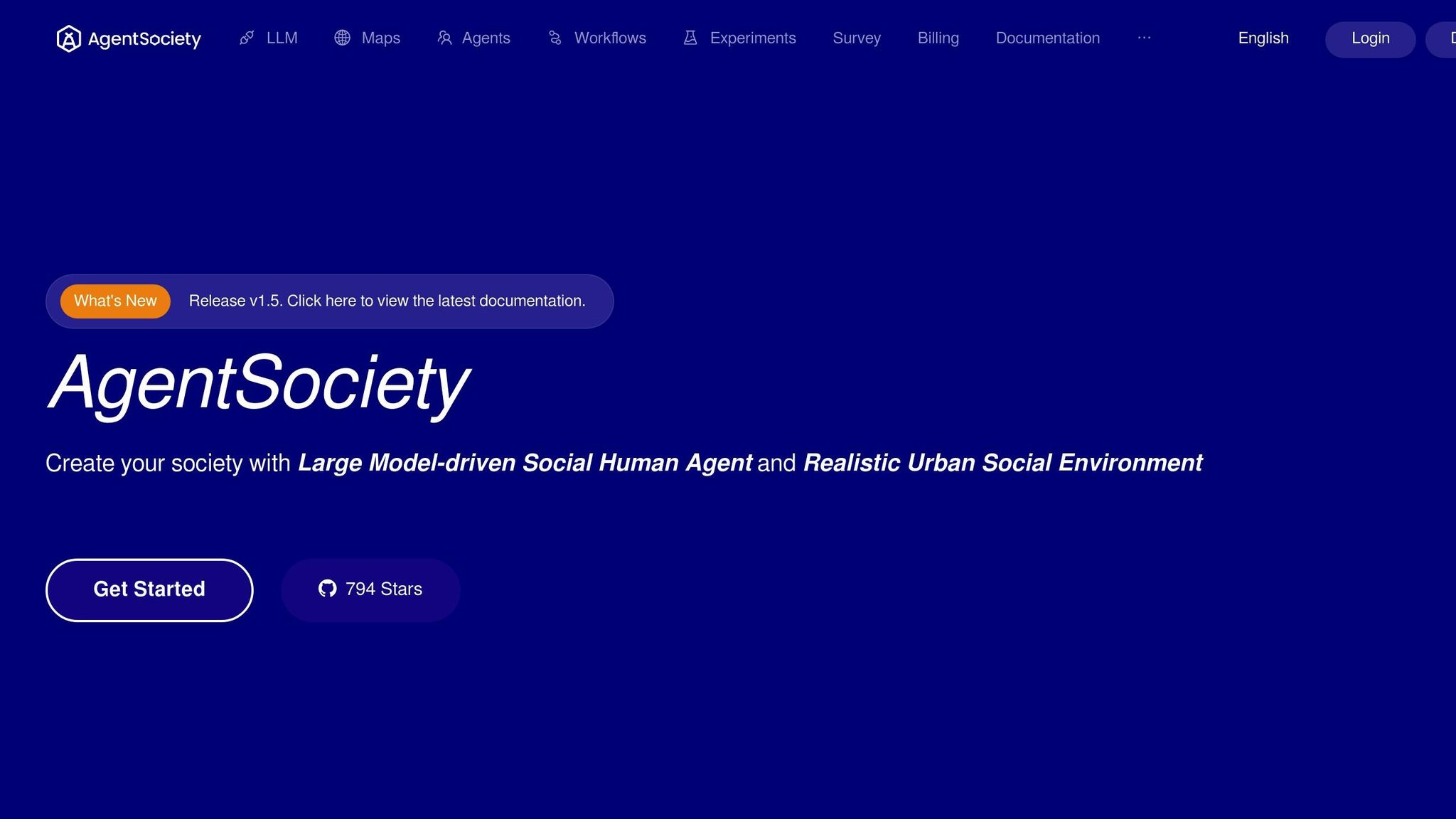
AgentSociety is a powerful engine for large-scale social simulations, particularly suited for urban environments and societal dynamics. Built on an asynchronous architecture using the Ray framework and Redis, it can simulate more than 10,000 agents at once. In one example, 10,000 agents generated an impressive 5 million interactions.
This platform integrates sociological concepts like Maslow's Hierarchy of Needs to create agents with human-like emotions and motivations. It also replicates real-world urban settings, including transportation networks and infrastructure, making it a go-to tool for studying complex societal behaviors.
"AgentSociety... helps drive the transformation of social science research paradigms, promoting the development of sociology from behavior simulation to mental modeling." - AgentSociety Documentation
The platform comes with a Social Science Research Toolkit, which includes features like automated interviews, surveys, and message interception. Researchers have leveraged AgentSociety to model real-world scenarios, such as behavioral responses during Hurricane Dorian's impact on Columbia, South Carolina. This makes it especially useful for examining how populations react to major events like natural disasters, Universal Basic Income trials, or the spread of polarizing messages.
While AgentSociety excels in large-scale modeling, its effectiveness also depends on detailed persona and memory modules, which are explored in the next section.
Persona and Memory Modules in Simulations
For simulations to feel authentic, detailed persona modeling and memory systems are crucial. While AgentSociety focuses on scale, TinyTroupe, developed by Microsoft, prioritizes persona-based simulations for more focused behavioral studies. This tool emphasizes "imagination enhancement", making it ideal for market research and brainstorming. Researchers can define specific persona attributes to simulate targeted behaviors.
"TinyTroupe enables concise formulation and simulation of practical behavioral problems." - Paulo Salem et al., Microsoft Corporation
Memory modules play a significant role in maintaining consistency in agent behavior. For example, AgentSociety uses "Reason Blocks" for decision-making and "Action Blocks" for executing tasks, ensuring agents process information systematically.
The Stanford HAI Generative Agent Architecture takes persona modeling a step further. By combining large language models with qualitative interview data, this system achieves a high level of individual fidelity. In a study led by Joon Sung Park and Michael S. Bernstein (2024–2025), researchers simulated 1,052 real individuals by embedding two-hour interview transcripts into LLM prompts. These agents successfully predicted personality traits and outcomes in behavioral economic games like the prisoner's dilemma, achieving 85% accuracy in replicating responses to the General Social Survey.
| Feature | AgentSociety | TinyTroupe | Stanford HAI Architecture |
|---|---|---|---|
| Primary Focus | Large-scale urban/societal dynamics | Persona-focused behavioral studies | High-fidelity individual modeling |
| Scale | 10,000+ agents | Individual or small groups | 1,000+ real individuals |
| Key Mechanism | Ray/Redis distributed engine | Stimuli (THOUGHT) & Actions (TALK) | Embedded interview transcripts |
| Research Tools | Surveys, interviews, interventions | Experimentation tools | Social science benchmarks |
Using God of Prompt for Simulation Workflows
Advanced prompt engineering plays a critical role in refining agent behaviors, and God of Prompt simplifies this process. This platform enhances simulation workflows by offering tools for precise behavioral tuning. At its core, it manages the "LLM Layer" in simulation frameworks, handling model invocation, execution, and monitoring.
God of Prompt provides access to over 30,000 categorized AI prompts tailored for platforms like ChatGPT, Claude, and Gemini AI. These prompts can be adjusted to define agent behaviors, moving them from generic and overly polite responses to more nuanced, human-like patterns.
For researchers designing agent personas, detailed prompts are essential to create realistic variability. God of Prompt organizes its offerings into bundles, such as the Complete AI Bundle ($150.00) and the ChatGPT Bundle ($97.00). These bundles provide a wealth of resources to fine-tune agent behaviors and make simulations more lifelike.
sbb-itb-58f115e
Setting Up and Running Social Science Simulations
Configuring AI Agents for Simulations
Creating reliable simulations starts with setting up agents that closely mirror real-world behaviors and beliefs. One effective method, introduced by Stanford University researchers in 2024–2025, involves using detailed interview transcripts. By incorporating two-hour interview sessions into the language model's prompt, these simulations emulate how specific individuals might respond to surveys or make decisions.
For larger simulations, platforms like AgentSociety streamline the process with modular components. These modules handle various aspects of agent behavior, such as mobility for movement patterns, economy for financial decisions, cognition for reasoning, and social interactions for communication. Each agent's setup file, typically formatted in YAML or JSON, defines their starting conditions, range of actions, and how they interact with their surroundings. Agents also document their experiences as natural language narratives, which influence their future choices.
With this level of precision in configuration, simulations can scale effortlessly to include vast populations.
Executing Large-Scale Simulations
Once agents are configured, the simulation framework comes into play. AgentSociety uses a four-layer architecture - Model Layer, Agent Layer, Message Layer, and Environment Layer - to ensure stability and scalability. This setup allows for the simultaneous simulation of over 10,000 agents.
In February 2025, researchers Jinghua Piao and Yuwei Yan used AgentSociety to simulate 10,000 AI-driven agents, generating 5 million interactions. The simulation explored critical social issues like polarization, the spread of inflammatory content, and the impact of universal basic income (UBI) policies.
To manage complexity, multi-head workflows are employed. Agents operate in a "normal" mode for routine activities but shift to an "event-driven" mode when unexpected events - like policy changes or natural disasters - occur. Automated error correction systems are essential for maintaining the simulation's stability over time.
Benchmarking Simulations Against Real-World Data
To ensure simulations are both accurate and meaningful, results are validated against real-world data. At the individual level, this involves comparing AI agent responses to those of the people they represent using a metric called "Normalized Accuracy." For example, in the Stanford study, generative agents matched participants' responses to the General Social Survey with 85% accuracy - comparable to how participants replicated their own answers two weeks later.
For population-level validation, tools like the General Social Survey (GSS), the Big Five Personality Inventory (BFI-44), and behavioral economic games (e.g., the Dictator Game or Prisoner's Dilemma) are used to test whether groups of agents replicate known treatment effects. Spatial simulations are benchmarked using high-resolution data on movement patterns, evaluated through metrics like "Radius of Gyration" and "Daily Visited Locations".
This rigorous validation process ensures that the simulations accurately reflect complex social behaviors, achieving the goal of replicating human dynamics with precision.
Validation and Evaluation of AI Agent Simulations
Testing Agent Fidelity Against Benchmarks
To evaluate how well AI agents replicate human behavior, researchers use established AI tools for research and social science. For instance, the General Social Survey (GSS) assesses attitudes and beliefs, while the Big Five Inventory (BFI-44) examines personality traits. Behavioral economic games, such as the Dictator Game, Trust Game, and Prisoner's Dilemma, are also employed to measure decision-making in scenarios that involve real stakes.
But here's the tricky part: defining what "accurate" replication means. After all, even humans can struggle to replicate their own responses consistently. In November 2024, a team from Stanford University, led by Joon Sung Park, tackled this challenge by introducing the concept of a "human ceiling." They asked real participants to retake surveys two weeks apart to measure how consistent people were with themselves. Generative agents, built from two-hour interviews, were then tested against the GSS. These agents matched participants' original responses with 85% of the accuracy that humans achieved when replicating their own answers.
In November 2025, MIT Media Lab introduced the HugAgent benchmark, which goes a step further by testing not just current beliefs but how those beliefs evolve when presented with new information. Human participants achieved 84.84% accuracy in inferring belief states and 88.92% directional accuracy in updating beliefs. These benchmarks help researchers evaluate both the accuracy of AI outputs and the reasoning process behind them.
Evaluating Behavioral and Textual Alignment
Numbers alone don’t tell the whole story. To ensure AI agents behave in a human-like way, researchers also assess their internal reasoning and consistency. For example, MIT researchers used a "think-aloud" approach, where 54 participants shared their reasoning processes through a chatbot called "TraceYourThinking." These narratives became a benchmark for comparing how closely agents' reasoning aligns with human thought patterns.
Human annotators play a crucial role in this process. They evaluate agents on behavioral plausibility (does the agent’s behavior make sense?) and internal consistency (does the agent contradict itself over time?) using Likert scales. This qualitative approach helps identify issues that automated metrics might miss - like agents providing correct answers for illogical reasons.
Interestingly, agents built from full interview transcripts outperform those relying solely on demographic data. A Stanford study in 2024 found that interview-based agents achieved a normalized accuracy of 0.85 on the GSS, compared to just 0.71 for agents prompted only with demographic information. Using a comprehensive AI prompt library can further refine these agent personas. Beyond accuracy, these agents also reduced the Demographic Parity Difference - a measure of performance gaps across groups - from 12.35% to 7.85% for political ideology. This demonstrates that interview-based agents are better at avoiding stereotypes and treating individuals as unique.
Ethical Considerations in AI Simulations
Ethics are at the forefront when dealing with AI simulations. Privacy and consent are non-negotiable. Participants have the option to withdraw, and their data is protected under non-commercial use agreements, similar to those used for genome banks. While aggregated data is openly available, access to individual-level responses is restricted and monitored through usage audits.
"Because these generative agents hold sensitive data and can mimic individual behavior, policymakers and researchers must work together to ensure that appropriate monitoring and consent mechanisms are used to help mitigate risks while also harnessing potential benefits." - Stanford HAI
Another concern is reputational risk. If an agent generates harmful or offensive outputs, it could damage the reputation of the person it represents. Additionally, researchers must be cautious about over-reliance on simulations before the technology is fully validated. For instance, MIT’s research revealed that even advanced models like GPT-4o struggle to adapt from population-level trends to individual reasoning styles, often defaulting to generalized consensus rather than reflecting unique perspectives.
To ensure fairness, validation processes should include subgroup analyses across categories like race, gender, and political ideology. In networked simulations, researchers also monitor for "social contagion", where policy-induced inequities might spread through the agent population, potentially undermining cooperative behavior over time. These measures are critical for ensuring that AI simulations advance research without causing unintended harm.
Conclusion
Key Takeaways
AI agents are reshaping social science research by offering a scalable alternative to expensive and time-intensive field studies. Unlike traditional agent-based models that relied on rigid, oversimplified rules, LLM-driven agents bring a more nuanced, context-aware approach that better reflects the complexities of human behavior. In fact, simulations powered by these agents have demonstrated accuracy levels comparable to human test–retest performance.
By incorporating theory-driven designs, researchers have managed to significantly minimize behavioral inconsistencies compared to older models. Platforms like AgentSociety are capable of simulating over 10,000 agents and 5 million interactions, enabling rapid testing of policies such as universal basic income at a fraction of the cost and time. These simulations also provide a safe way to study ethically sensitive scenarios - like prison environments or extreme social conflicts - without putting real people at risk.
Another breakthrough is the move away from relying solely on demographic stereotypes. Researchers are now grounding agents in context-rich data, which has proven to outperform demographic-only models while reducing biases tied to race and ideology. For example, interview-based agents have shown improved accuracy and fairness. Benchmarks like the Big Five Personality Inventory and behavioral economic games confirm that these simulations align closely with genuine human behavior patterns. For those developing simulation workflows, tools like God of Prompt simplify the process of designing realistic agent behaviors through advanced prompt engineering.
These advancements not only validate the effectiveness of current methods but also pave the way for more sophisticated and comprehensive simulations.
Future of AI in Social Science
Building on these validated approaches, social science is entering a new era - shifting from exploratory studies to long-term simulations that can model societal changes spanning decades in just weeks. As Richard Feynman famously said, "What I cannot create, I do not understand". This sentiment highlights how AI agents are enabling researchers to build, test, and refine theories on a scale never before possible.
Looking ahead, the integration of latent features into agent architectures and the development of multi-domain agents capable of navigating interconnected social, economic, and political systems are promising areas of exploration.
"LLM social simulations can now be cautiously used for exploratory social research, such as pilot studies, in which surfacing interesting possibilities can be more important than avoiding false positives".
While these technologies are not yet ready for high-stakes decision-making, their rapid evolution - combined with rigorous validation, ethical safeguards, and theory-driven designs - positions AI agents as essential tools for better understanding and improving the social world.
FAQs
How do AI agents improve the accuracy of social science simulations compared to traditional methods?
AI agents are transforming social science simulations by replicating human behavior and responses with impressive accuracy. Research indicates that these agents, built on large language models and real-world inputs like interview transcripts, can mirror survey responses with up to 85% accuracy. Interestingly, this level of accuracy aligns with how consistently individuals repeat their own answers over time.
What sets AI agents apart from traditional methods is their ability to go beyond surface-level demographic data. They delve into deeper individual characteristics, such as personality traits and decision-making patterns. This approach minimizes biases and enables more refined predictions. By generating realistic, context-sensitive responses, researchers can test social theories and explore "what if" scenarios on a scale and level of detail that was previously unattainable.
What ethical issues should be considered when using AI agents to simulate human behavior?
When employing AI agents to replicate human behavior in social science research, it's crucial to tackle several ethical challenges head-on. One major issue is privacy. Researchers must ensure that any personal data used to train these AI systems is safeguarded and that individuals have provided informed consent for its use. Without stringent protections, there's a risk that sensitive information could be mishandled or misrepresented.
Another pressing concern is bias. AI models can unintentionally reinforce societal biases or deliver less accurate outcomes for specific demographic groups. Such issues can skew research findings or lead to unfair results, particularly when these simulations influence policies or critical decisions.
To maintain ethical standards, researchers should adopt transparent methodologies, continuously monitor for bias, and establish clear ethical protocols. These measures should prioritize privacy, fairness, and accountability at every step.
How does prompt engineering improve the behavior of AI agents in social science simulations?
Prompt engineering plays a key role in shaping how AI agents behave in social science simulations. By carefully designing prompts, researchers can guide these models to deliver responses that are more precise, realistic, and tailored to the context of the scenario. This helps AI systems better reflect human-like thought processes, such as reasoning, planning, and adjusting their actions to fit various social situations.
Through this method, researchers can incorporate empirical data and theoretical insights directly into simulations. This not only helps AI agents replicate complex human behaviors more effectively but also enhances the quality of virtual experiments. By refining prompts and using datasets from social sciences, AI responses can closely mirror real-world human patterns, boosting both the accuracy and reliability of these simulations.
Related Blog Posts

Loved by Business Owners


Based on 1K reviews
Get smarter on AI every week.
Ready to transform your business?